Self-growth
 Apps & Digital Tools
 Business & Career
 Success
 Growth Tools
 Psychology
 Communication
 Relationships

Have you ever purchased a book only to never finish reading it?
Or has it been sitting on your shelf, building guilt as the reading list of new titles grows? Book summary apps like Blinkist offer a solution: They summarize books into reads that take around 15 minutes, so you can finally finish books without spending your entire weekend doing so.
That said, is Blinkist worth it for 2026? With subscription costs rising — and your time is more valuable than ever — you want to know you're getting something out of it, rather than just buzzwords.
Quick verdict: Is Blinkist worth it?
Choose Blinkist if you want the largest possible library to browse, you prefer 15-minute audio summaries, and you're fine with a read-it-and-move-on format.
Consider Headway if you want spaced repetition and quizzes built to make ideas stick, daily streaks that keep a learning habit going, and recommendations personalized to your goals.
In this Blinkist review 2026, we'll dissect everything: What it offers, how much it costs, its biggest strengths, and weaknesses. Are you a busy professional, trying to squeeze knowledge into your commute? Or someone who's committed to genuine personal growth? You'll know exactly what you're getting before you subscribe.
📘 And if you want to experience self-growth immediately, download Headway. Our microlearning app has proven itself to millions of users over the years as an innovative approach to learning, combining expert book insights with tools that are designed to make knowledge stick.

Is Blinkist worth it? Features, library, how the app works, and the user experience
In 2012, Blinkist, a book summary service, started in Berlin with the simple mission of delivering popular nonfiction books to people who don't have time to read entire books. The company's founders understood that busy professionals and lifelong learners wanted the essence of popular books without spending the 8–10 hours it takes to read them.
Over the past decade, Blinkist, a mobile app for Android and iPhone (iOS) users, has evolved into one of the most recognized names in the field of book summaries, boasting a library of over 9,000 titles across more than 27 categories.
Is Blinkist good? Blinkist's core features: summaries, audio, offline access, and notes:
Here are some of the app's main features:
15-minute summaries: Each book is condensed into key insights, called "blinks," that you can read or listen to (via an audiobook-like feature) in about 15 minutes.
Audio versions and text formats: Switch between reading summaries and listening based on your preference or situation.
Offline access: Download Blinkist summaries to consume without an internet connection.
Curated collections: Browse themed collections like "Communication Skills," "Productivity Hacks," or "Mental Health."
Highlighting and note-taking: Save important passages and create personal notes (Premium feature).
Blinkist spaces: Share book recommendations with friends or reading groups.
Blinkist vs Headway app: A quick comparison table
| Feature | Headway | Blinkist |
|---|---|---|
Catalog size | 2,500+ hand-curated summaries | ~9,000+ titles (varying depth) |
Pricing | From $19.99 / 4 weeks | ~$79.99/yr Premium; ~$139.99/yr Pro |
Offline access | Yes | |
Audio | Yes | |
Quizzes | Yes | No |
Streaks / habit tools | Yes — daily streaks, spaced repetition | No |
All app features described in this article are accurate as of August 2026. Prices may vary depending on your region, current promotions, and seasonal offers.
Inside the Blinkist app: Interface and usability
The app's user interface is simple and intuitive, similar to Audible and getAbstract. You can search for titles, browse categories, or see what's trending. The reading experience is straightforward; the book's summaries are presented in digestible chapters that take approximately 2–3 minutes to read.

Blinkist does well at providing a high-level understanding of a book's primary arguments. Still, the same brevity that makes it easy to read a book also becomes its downside — nuance, examples, and depth are typically sacrificed for more convenient and faster reading options.
Then the question becomes: Is a surface-level understanding enough to meet your learning goals, or do you need to incorporate tools that assist you with going deeper and applying what you learn?

Blinkist pricing in-depth analysis: Is it worth the cost?
Let's talk money. Blinkist operates on a subscription model with two main tiers, and understanding what you're paying for is essential before committing.
Current pricing: Blinkist premium subscription (2026):
According to Blinkist's official pricing, here's what you'll pay:
Pro (12 months): ~$174.99/yr regularly, currently offered at $139.99 for the first year as an intro offer, then renewing at $174.99 per year automatically.
Premium (12 months): ~$99.99/yr regularly, currently ~$79.99 for the first year with the promotional discount applied.
Free plan: A free version of Blinkist gives you one free summary per day.
Both paid tiers include 9,000+ book and podcast summaries, read-or-listen access in about 15 minutes, offline use, and personalized daily recommendations. Pro adds Blinkist AI, which summarizes videos, podcasts, docs, and articles.
Blinkist's prices vary by region, current promotions, and seasonal offers — check Blinkist's official pricing page for the latest figures.
Blinkist subscription cost value: Which option saves you more? (annual vs. monthly)
The annual subscription results in an approximate monthly price of $11.66 in the first year, increasing to $14.58 per month upon renewal. While the monthly subscription offers more flexibility, it will be more expensive if you opt for a full-year commitment, costing around ~$79.99-$139.99 per year.
Blinkist offers a 7-day free trial with the annual plan, allowing you to test the platform for a week and see if it suits your needs, with no risk.
Is the Blinkist cost justified?
Now we come into a bit of a minefield. To put this into monetary terms, the annual fee of $140–$175 is your investment in convenience and expediency. Even if you read one summary per week, you're paying around $2.70–$3.40 for a book summary.
By comparison, the price of full books typically ranges from $15 to $30 each. So the math is clearly in favor of Blinkist, but only if you're looking for something a bit deeper than the synopsis. Of course, this puts us back into a questioning mode.
The question is not whether Blinkist saves money compared to buying new books; rather, whether the value of Blinkist's surface-level insights justifies the yearly subscription cost, given the availability of slightly more valuable Blinkist alternatives that are comparable or less expensive.
Additionally, these alternatives provide interactive features, retention tools, and personalized learning experiences.
Apps with progress tracking, daily quizzes, and spaced repetition help you retain and apply knowledge, not just consume it.
Blinkist pros and cons: Strengths, weaknesses, and who it suits
Every app has strengths and weaknesses. Here's a candid assessment of Blinkist's advantages and drawbacks, helping you determine if this app is a good fit for your learning style.
Blinkist pros: Large library, audio quality, and offline access
Huge library selection: More than 9,000 book summaries and audiobooks across 27 categories means you will have coverage on basically every popular nonfiction subject — productivity, psychology, business, self-help, health, you name it!
Great for busy schedules: The 15-minute structure actually works. You can complete a summary during your commute, during lunch, or while you're handling household chores.
High-quality audio format: The narrators are professional, and the pacing feels natural. There's some light music in the background that stays engaging without becoming distracting.
Offline access included: Download summaries locally and learn without using cellular data or searching for Wi-Fi. This feature is excellent for flights, road trips, or subways.
Share for free: The 2-for-1 subscription service allows you to share Blinkist at no additional cost with a family member or friend, effectively splitting the price in half.


Blinkist cons: Passive format, no retention tools, inconsistent quality
Surface-level content: This aspect is the biggest issue. These fifteen-minute summaries almost always oversimplify key ideas, removing nuance and examples.
Limited interactive retention: Blinkist is a purely passive consumption experience. There are no quizzes, no flashcards, and no spaced repetition systems to help you remember whatever you consumed.
No personalized learning paths: While there are curated collections, there's no technology helping you discover content based on what you are trying to achieve.
Expensive for what you're getting: At $140–$175 per year, you pay premium rates for summaries that come with no retention tools or personalization.
Inconsistent summary quality: Some summaries are fantastic and capture the essence of the book. Others feel rushed and miss essential context.
According to a meta-analysis of 317 experiments published by Cepeda et al. (2006), spaced repetition consistently outperforms passive review by 10–30% across all study types — a gap that purely passive apps like Blinkist cannot close.
Blinkist works if you want quick overviews and don't care about retaining much beyond the basics. However, if you're genuinely trying to grow, learn deeply, and apply knowledge to your life, the lack of interactive tools and personalization feels like a significant gap.
Head-to-head: Blinkist vs. Headway – Which app delivers more value?
Blinkist and Headway are both solid apps, so let's take a closer look, as they are pretty different. But how does each app work? And how can you know which one may work better for you?
1) Blinkist vs. Headway: Library size and content quality compared
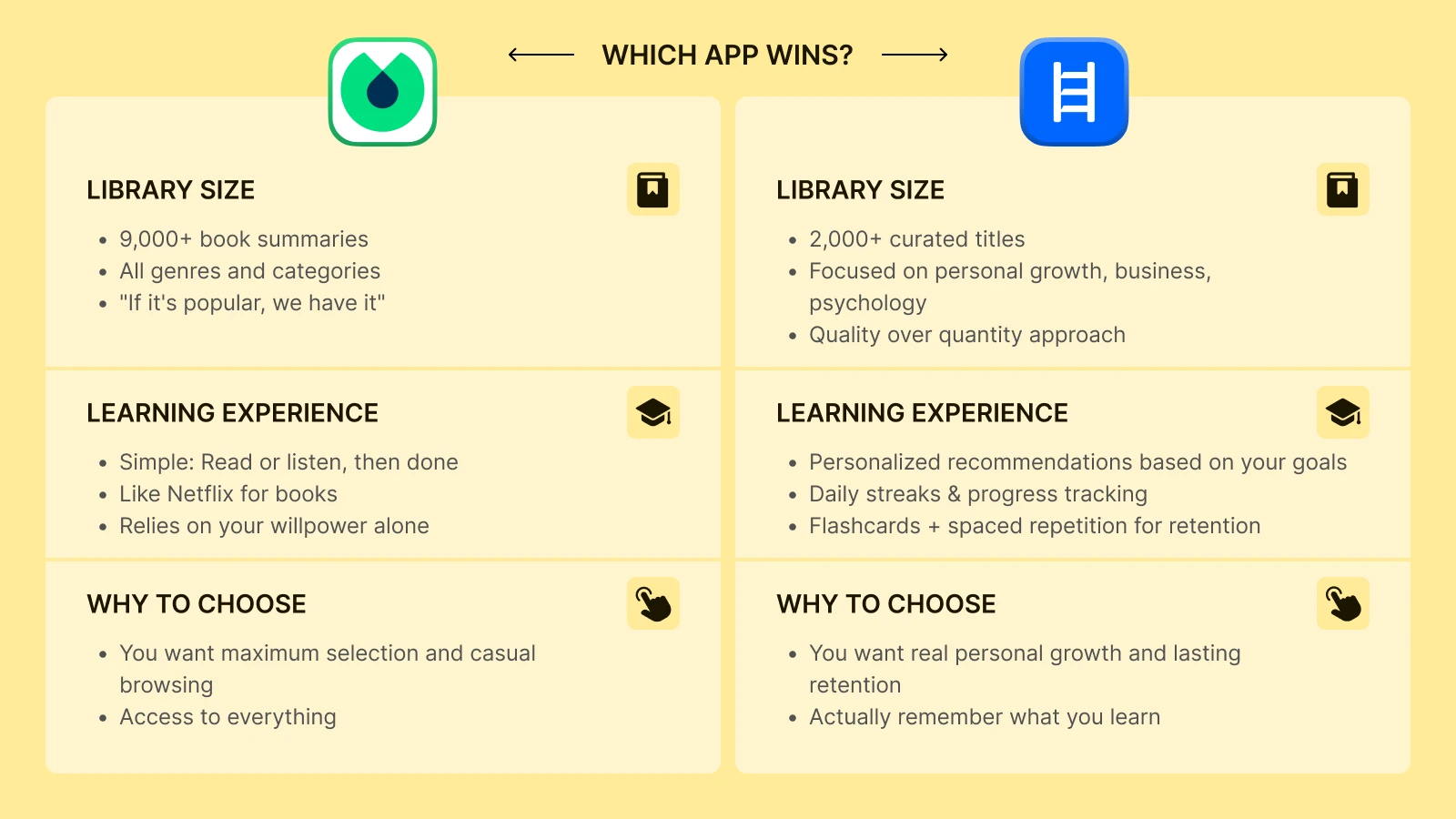
When it comes to library size, the Blinkist library stands out particularly well here, boasting over 9,000 summaries, but not every title can be listened to. Headway is much tighter, with more than 2,000 titles available, each having both text and audio formats. On paper, both sound good!
Here is the main difference: Blinkist tries to cover it all, and if you want a summary, they likely have it. Headway appears to be more particular about each title and has chosen not to produce summaries across dozens of categories.
This approach stood out in the greater purpose of the app, particularly in the quality of each summary title. Blinkist covers a wide range of topics, while Headway focuses on the quality of takeaways that can have a lasting impact. You may want to use Blinkist if you wish to access most of the popular books being "talked about" lately.
Or, you might wish to have a more "constructive" version of the summary if the text aligns with your personal learning style.
📘If that's the case, Headway will likely support your learning better by providing meaningful engagement with the content that "sticks" in your brain in a much more effective way.
2) Blinkist vs. Headway: How each app supports active learning
Blinkist is reasonably straightforward — open the app, select a book, read or listen, and done! It feels like scrolling through Netflix, except with book summaries! You do not have to worry about the nonsense that goes along with finding a good movie (or book) because it is really that simple.
The only problem? There is nothing to engage you aside from your willpower.
Headway is constructed differently: Headway's technology assesses your interests and the goals you are trying to achieve, and then provides book suggestions that actually move you toward a goal you've identified.
In the Headway app, you can also track your daily progress and create little streaks of learning that are addictively interesting!
Finally, our flashcards and spaced repetition features are also so cool and helpful. You know when you finish a book and then two days later can't consciously remember a single thing? Learning with Headway is not just about the quantity of books you read, but about the quality in terms of retaining what you read.

3) Blinkist vs. Headway: Daily usability and habit-building experience
Both applications are easy to use, and there are no complaints about that. Blinkist keeps everything sleek and simple, which is nice. Headway adds a little bit of fun by showing you reading streaks and providing motivation to keep you moving along! Some people prefer Blinkist's "just give me the content" approach. Others find that Headway's extra motivation makes them more likely to continue using the app rather than abandon it after two weeks.
So, which one is for you?
Blinkist gives you access to many more books, but it doesn't really help you do anything with them. Headway is more affordable, provides clear and concise information, and ultimately helps the information stick in your brain.
If you simply want to browse summaries when you are bored, Blinkist will work. However, if you truly want to improve as a person and recall what you've learned a week from now, Headway is a better option.
Blinkist reviews and testimonials: What do real users say about it?
What authentic users' experiences reveal is more than any marketing copy could ever convey. Here's the customer feedback from Blinkist users, ensuring you hear from real people without any bias about what works and what doesn't.
Positive Blinkist reviews: What satisfied users highlight
It's clear that many users genuinely appreciate what Blinkist offers, particularly in terms of fitting education into their busy schedules, as finding time to learn and grow can be challenging.
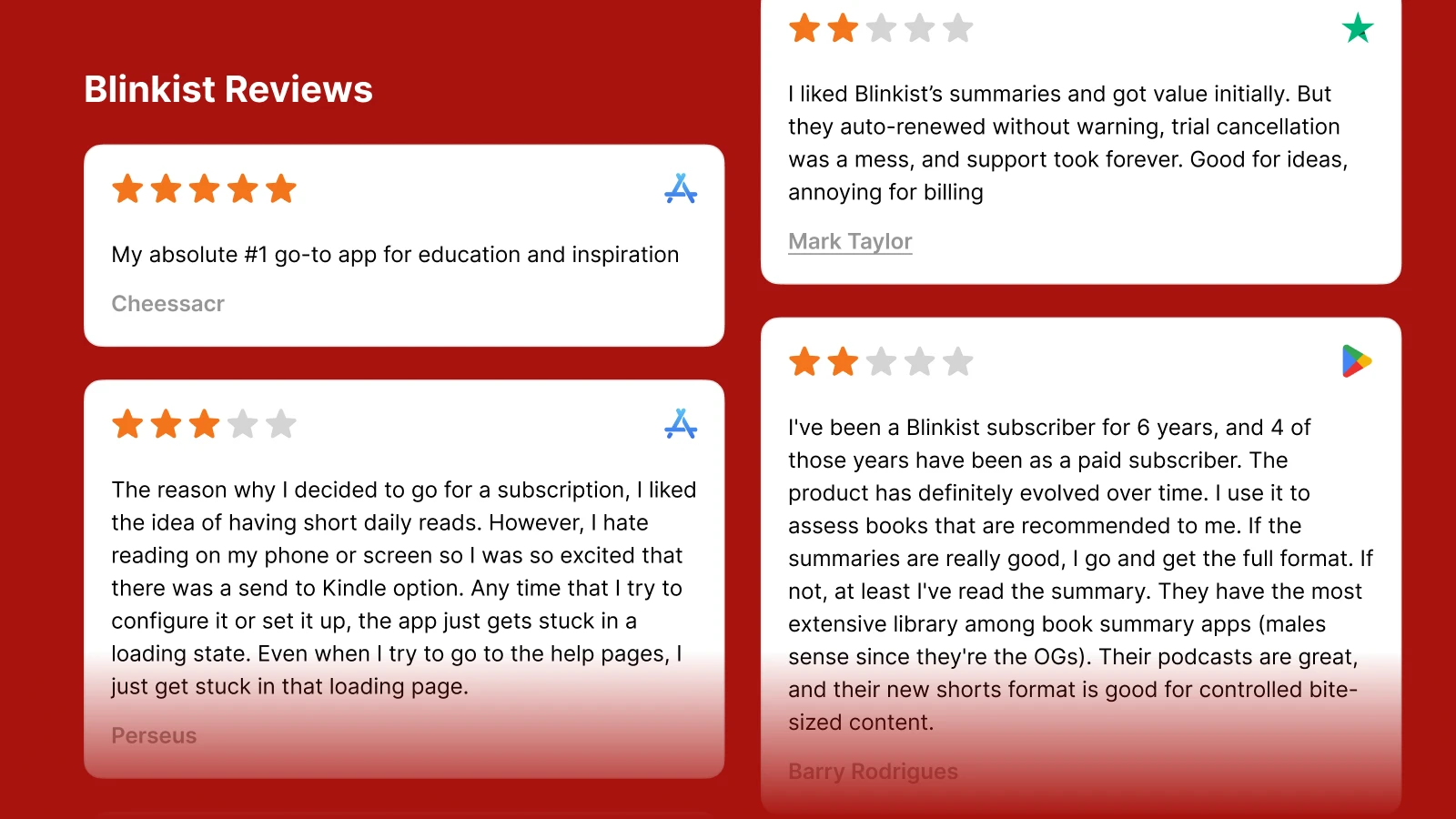
"My absolute #1 go-to app for education and inspiration" — Cheessacr, 5/5 stars
For commuters or travelers who may not be able to fit full-length books into their busy schedules or on the go, Blinkist is a good option. All the things that users like about Blinkist are: high-quality audio narration, an extensive library of topics, and the ability to quickly consume learning through short pieces or episodes.
Furthermore, they really appreciate the offline download feature on the app, which is ideal for frequent travelers who want to learn on a plane or in areas with limited internet access.
Mixed Blinkist reviews: Users who like the concept but hit friction
Some people's experiences don't go nearly as smoothly as they envision. Others like the idea but run into issues in practice.
"Fantastic concept, but the app needs work." — WhitneyBrookut, 4/5 stars
"Blinkist doesn't support Apple family sharing." — JWR from CT, 4/5 stars
The most common issues include technical bugs, the lack of family sharing capabilities that other apps offer, and the feeling that you're paying a premium for an app that doesn't provide typical, premium app conveniences. Others pointed out that there is an option to share 2 for 1, but it isn't as easy as having a family plan.
Negative Blinkist reviews: Common complaints about quality and retention
The harshest criticism centers on summary quality and the passive learning experience. When users compare Blinkist to alternatives with interactive features, the gaps become obvious.
"The people they have summarizing the books have a problem with keeping their own opinion out of the summary...I've changed my review to 1 star due to this." — Small Hobbit, 1/5 stars
Users who are frustrated with Blinkist often cite three main issues: Summaries that feel too brief or biased, a lack of tools to help retain information, and the realization that they're not actually learning — just consuming content they'll forget within days.
These are selected reviews, not the full rating. Current scores are available on Trustpilot/Google Play/App Store.
📘 Several reviewers mentioned switching to Headway specifically for our flashcards, spaced repetition, and personalized recommendations features, which make learning feel more purposeful.
Review verdict: Blinkist works for casual browsing, less so for deep learning
Blinkist works well if your expectations are realistic — the app offers quick overviews for casual browsing. However, users who seek deeper engagement, improved retention tools, and greater value for their subscription dollars consistently report better experiences with alternatives that prioritize active learning over passive consumption.
So, should you get Blinkist? Our bottom‑line verdict
So, should you try Blinkist? Is it worth it in 2026? The honest answer is that it really depends on what you want.
"Your knowledge is a lagging measure of your learning habits. You get what you repeat." — James Clear, 'Atomic Habits'
At the end of the day, Blinkist delivers on its core promise of quick, professionally narrated summaries of the best books (nonfiction). If you want to be a learner who casually browses bestselling ideas while commuting — without a commitment to retaining or applying the information — Blinkist is a solid option.
One of the major benefits of Blinkist is its vast library of over 9,000 books and the ability to access them offline.
But here lies the major drawback of the app: At $140–$175 a year, you are paying a premium price, yet you may lack in-depth learning opportunities, personalization, or tools to help you remember what you've read.
The book summaries reduce complex ideas. But they are not interactive, and you must figure out what to read next by yourself. So what's the point?
For serious learners who want to apply new knowledge to personal growth, there are more effective apps, such as Headway.
Headway provides personalization based on your goals, tracks your daily, consistent habit-building progress, and features learning retention tools like flashcards with spaced repetition, all at a lower price.
Using Headway is not just about consuming more content; it is about making the knowledge stick, for real personal growth.
Headway has more than 55 million downloads and over 172,000 five-star reviews. It's been named App of the Day and made TIME's top 5 EdTech apps. People stick with it because the 2,500+ summaries run about 15 minutes each, so a whole book fits into a coffee break.
The bottom line is that Blinkist is worth it if you enjoy lightly browsing through books and don't really care about remembering what you've learned.
However, suppose you invest in true personal development and want tools based on how your brain actually learns. In that case, you will get significantly more value out of Headway for a lower price.
Want to experience personalized learning that actually sticks?
📘 Download Headway now and discover how tools tailored to your learning style can actually drive growth.
This comparison reflects publicly available information as of August, 2026.
FAQs: Is Blinkist worth it?
Is Blinkist worth the hype?
Blinkist is undoubtedly convenient, but some people consider it overrated. While the large library is impressive and well-produced, its non-interactive nature prevents depth and personalization, placing a premium price tag on passive consumption. Apps with retention tools and personalization that provide individualized learning, like Headway or Shortform, will likely outperform Blinkist, offering competitive pricing.
Is Blinkist better than reading the whole book?
Yes and no. Blinkist provides high-level takeaways, but a complete reading of an actual book will offer depth, context, examples, and the author's whole argument. Blinkist can be useful for getting a quick summary, but you won't really remember everything you've just read, because it doesn't have special tools for that.
Can you really learn from Blinkist?
Yes, but with limitations. Blinkist helps you understand the key ideas quickly, but the 15-minute format oversimplifies complex ideas and doesn't lend itself to deep understanding. You grasp the content at a surface level, but you won't remember the main points, as Blinkist doesn't offer any special tools for that.
Is cost of Blinkist worth it?
Wondering how much Blinkist costs? As of August 2026, Blinkist's annual plans run from ~$79.99–$99.99/year for Premium up to ~$174.99/year for Pro, often shown with a first-year promotional discount at checkout. That's a steep price for summaries with no quizzes or spaced repetition to lock in what you read. Prices vary by region and promotion — confirm the current figure on Blinkist's official page.
What is Blinkist at its core?
It's a book summary app that condenses nonfiction into 15-minute reads. But here's the problem: passive consumption without interactive features means you'll forget most of what you've read within days.
There are more affordable and effective alternatives available. Headway, for example, costs less than Blinkist while adding crucial learning features like interactivity, flashcards, spaced repetition, progress tracking, and personalized recommendations. If you're serious about learning and retaining knowledge — not just skimming summaries — explore other tools that deliver more value for the same money.
Is Blinkist written by AI?
No, the summaries were written by human editors or experts, not by ChatGPT or any other AI tool. Each one was created by an editor and narrated by a voice actor. However, there are allegations about this on the web, as well as concerns that some users have mentioned — inconsistent quality and editor bias leaking into the summaries, which distorts the original author's intention.
How much is Blinkist in 2026, and what pricing options are available?
If you're wondering how much Blinkist costs, the pricing has two annual tiers as of August 2026. Premium runs ~$99.99/year (recently ~$79.99 with a promo applied), and Pro is ~$174.99/year, adding Blinkist AI for summarizing videos, podcasts, and documents. Prices shift with region and seasonal offers, and a free plan gives one summary per day. Check Blinkist's official page before subscribing.
Is Blinkist worth it for students?
For students on a budget, Blinkist's 7-day trial and free daily summary let you sample it before paying. The 15-minute format works for quick topic overviews, but it's built for passive reading, not exam recall — there are no quizzes or spaced repetition to lock information in. If retention matters more than breadth, an app with active-recall tools like Headway may fit study goals better.
Is Blinkist cheaper than Headway?
It depends on the plan. Blinkist runs on monthly and annual subscriptions, while Headway uses shorter billing cycles, so a direct like-for-like comparison isn't straightforward. Prices also shift with region, promotions, and seasonal offers. The most reliable way to compare is to open each app's checkout and look at the first price you're shown for the plan you want.
Is there a Blinkist lifetime deal?
As of August 2026, Blinkist doesn't advertise an official lifetime plan on its own pricing page — its standard options are a monthly Premium plan plus annual Premium and Pro plans. Third-party "lifetime" offers sometimes surface on deal sites, but those aren't run by Blinkist, and terms can change without notice. Confirm current plans on Blinkist's official page before buying.