Self-growth
 Apps & Digital Tools
 Business & Career
 Success
 Growth Tools
 Psychology
 Communication
 Relationships

In 1885, Hermann Ebbinghaus ran memory experiments and found that we forget roughly 50% of new information within an hour, and up to 90% within a week without reinforcement. These findings set the foundation for microlearning statistics.
One hundred and forty years later, corporate training budgets are still largely built around one-day workshops and multi-hour courses that violate every principle Ebbinghaus' data uncovered. That gap is exactly what microlearning was designed to close.
Microlearning is a training approach that delivers content in short bursts, targeting a single learning objective at a time. Formally theorized by Theo Hug at Innsbruck in 2005 and refined by practitioners like Ray Jimenez in corporate L&D, it has since grown into a market worth approximately $3.41 billion, expanding at CAGRs between 13% and 22%.
This article compiles the most relevant microlearning statistics drawn from peer-reviewed studies, bibliometric analyses, and market research, covering knowledge retention science, effectiveness data, mobile learning adoption, corporate training ROI, AI-powered personalization, and the limitations the data still cannot answer.
Quick summary: What microlearning statistics cover
Here are the most important numbers before the full breakdown.
Microlearning completion rates average 80%, vs. ~20% for long-form courses
The microlearning market is worth $3.41B in 2025, growing at a 13-22% CAGR
Spaced microlearning improves recall by up to 1.6x compared to massed study
Gamified microlearning lifts learner engagement from ~15% to ~90% in some studies
Microlearning reduces corporate training time by 45-80% with no comprehension loss
Read on for more research-backed insights.
Methodology
This article draws on peer-reviewed studies, systematic reviews, and market research reports published between 2013 and 2025. In total, 30+ primary sources were analyzed, including controlled experiments, quasi-experimental studies, meta-analyses, and scoping reviews.
Key peer-reviewed sources include a 10-study meta-analysis (n = 743), a large-scale physician study (n = 26,258), a Duolingo spaced repetition study (5.2 million user-word pairs), and a scoping review covering 17 microlearning studies in health education. Market sizing data references reports from Emergen Research, MRFR, Technavio, Grand View Research, and Mordor Intelligence.
Where research firms used different definitions of the microlearning market, figures are reported with methodological context.
What microlearning is and where the term came from
Microlearning is a learning strategy that delivers single-objective content in focused sessions, typically 3 to 15 minutes long, designed to fit within existing workflows. Theo Hug formalized the term at his 2005 Innsbruck conference on microlearning, which he presented as an emerging educational discipline.
Early prototype research from the same year demonstrated voluntary learner acceptance rates of 75% and an average of 15 completed micro-units per day, establishing that short mobile content could sustain participation without institutional pressure.
In the United States, Ray Jimenez became the most prominent practitioner voice on microlearning in corporate learning and development, arguing that most training content could be restructured into shorter segments without a loss of outcomes. His work brought the concept into mainstream HR conversations before academic validation caught up.
Explore microlearning in your language
Learning works best in the language you think in. Here's where to find this topic covered in yours:
¿Qué es el microaprendizaje? — Español
O que é microaprendizagem? — Português
Qu'est-ce que le microapprentissage? — Français
Was ist Mikrolernen? — Deutsch
Cos'è il microlearning? — Italiano
無料のマイクロラーニングアプリ — 日本語
Not all short content is microlearning: Formats, definitions, and distinctions
Microlearning is often confused with adjacent concepts. Here's why.
| Concept | What it is | Examples |
|---|---|---|
Microlearning | Short, focused content (3–15 min) targeting a single learning objective, designed to fit within existing workflows | The content formats include video-based microlearning, infographics, spaced repetition flashcards, scenario-based quizzes, audio summaries, interactive shorts, and bite-sized lessons in text format. |
E-learning | Any digitally delivered instruction, regardless of length or format | Broader parent category: microlearning is a subset of e-learning, not a synonym |
Mobile learning (mlearning) | Content accessed on smartphones or tablets | A delivery channel. Microlearning is often delivered via mlearning, but the two are not interchangeable |
Just-in-time learning | Content delivered at the precise moment of need, within the workflow | A purpose-driven subset of microlearning; all just-in-time learning is microlearning-compatible, but not all microlearning is just-in-time |
Micro-courses | A packaged series of related microlearning modules with a shared learning goal | A structured application of microlearning; the course is the container, the modules are the microlearning |
The formats microlearning takes vary widely: video, infographics, spaced repetition flashcards, short quizzes, audio summaries, and interactive shorts all qualify. What unifies them is not length but specificity.
Each unit targets exactly one learning objective. That design constraint turns out to have deep roots in how memory works, which is where the research begins.
The neuroscience behind why microlearning works
Before the numbers, here's a quick detour into the brain because the data makes a lot more sense once you understand what's happening when someone learns.
Working memory can hold roughly 3–5 pieces of information at once. Push more than that through at once, and the brain stops learning; it starts triaging. Chunking content into smaller units keeps the load manageable, which is why shorter formats reliably beat longer ones on retention tests.
Timing matters as much as volume. Spaced repetition works by scheduling review sessions at the exact point memory starts to slip, catching the forgetting curve before it drops. Cramming puts a lot in at once; spacing keeps it there.
Completion also hits the brain differently than people expect. Finishing a short lesson triggers a dopamine response that reinforces the habit of coming back. This is all about the brain flagging an action as worth repeating. Long-form formats lose people before that loop ever closes.
And combining text with audio activates more memory pathways than either format alone, which matters when you're trying to move something from short-term exposure to information that sticks.
Headway's science page covers all four mechanisms in detail. The statistics that follow show what they produce at scale.
The forgetting curve problem: Why traditional training fails
Every one-day workshop has the same built-in design flaw. Ebbinghaus measured it in 1885, and the data have not changed since.
Hermann Ebbinghaus and the science of forgetting
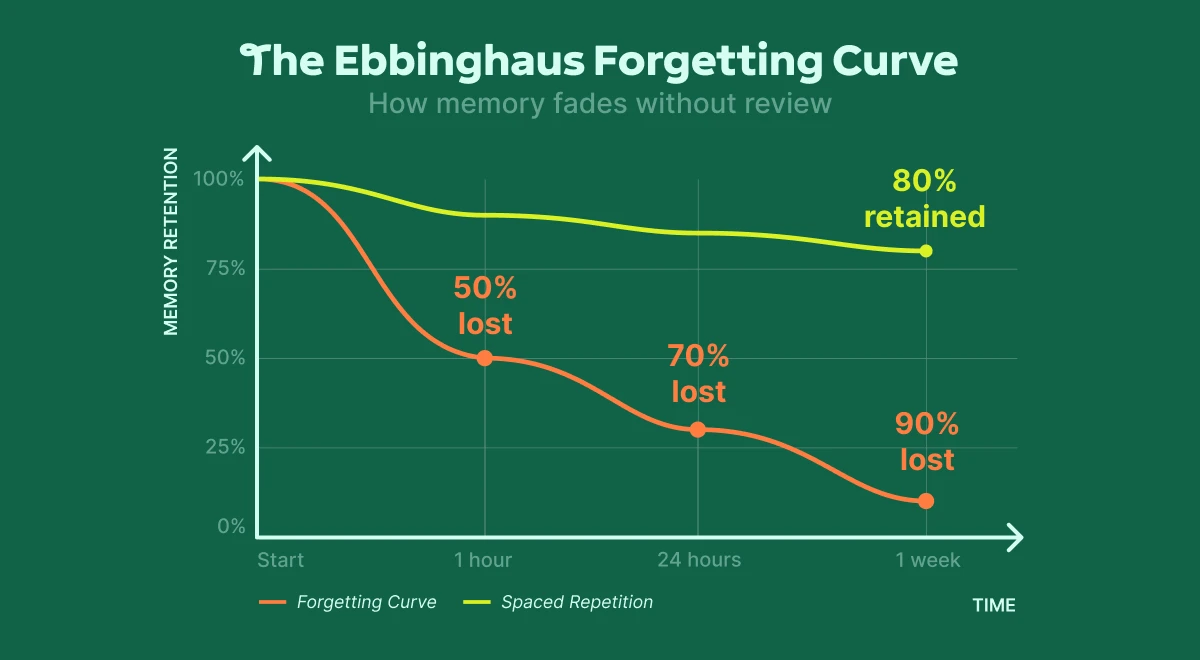
Hermann Ebbinghaus published his self-experiments on memory in 1885 and produced one of the most replicated findings in psychology:
"Memory retention drops steeply after initial learning. Roughly 50% of new information is lost within one hour, and by 24 hours, that figure reaches approximately 70%."
Without any reinforcement, learners retain as little as 10% of new content within a week of exposure. The forgetting curve is not a rough heuristic. It is a measurement of how biological memory consolidation works.
Ebbinghaus also identified the remedy: repetition at spaced intervals, rather than intensive cramming, is what moves information into long-term memory.
The connection to corporate training failure is direct. When organizations invest in a one-time learning event and expect employees to retain and apply content months later, the Ebbinghaus data predicts they will not.
A 2017 study on chunk size and comprehension found that students in a macro-chunk learning format re-read sections three times more often than those in a micro-chunk format. Information overload was forcing repeated retrieval attempts without producing proportional comprehension.
More content delivered at once means more to forget, and more time wasted trying to recover what was never properly consolidated.
Working memory limits and why chunk size matters
The brain is not a hard drive. It has a bandwidth limit, and most training ignores it entirely.
Cognitive load theory holds that working memory has a strictly limited processing capacity. Miller's Law, commonly cited as 7 plus or minus 2 items, captures the constraint: the human mind can actively hold and process only a small number of discrete pieces of information at once.
When a training module introduces twelve concepts across forty-five slides, most learners are not learning. They are managing cognitive overflow.
Microlearning's design logic maps directly onto this constraint. By keeping each module to one learning objective and four to five supporting points, the format respects working memory architecture rather than fighting it.
The Dresden University study found that the group receiving content in micro-chunks performed 22.2% better on assessments and used 28% less time on task compared to the control group.
A more recent quasi-experimental study on microlearning in English for Specific Purposes, published in Open Distance Education, found that the short-format program significantly reduced cognitive load and improved vocabulary outcomes. The efficiency gain changes how successfully learners process what they encounter.
Instructional design is the discipline that formalizes these principles into repeatable practice. Hermann Ebbinghaus provided the core problem, and instructional designers have spent four decades building the frameworks that microlearning now operationalizes at scale.
Microlearning market growth 2026 statistics: How big is the industry?
The numbers from market research firms do not agree on the exact figure, but they agree on the direction: this market is growing fast across every segment.
Multiple research firms converge on a 2026 microlearning market size of approximately $3.0 to 3.5 billion. Emergen Research puts the figure at $3.41 billion with a projected CAGR of 13.4%, reaching $9.32 billion by 2035.
At the high end, MRFR estimated the 2025 market at $6.19 billion with a 22.31% CAGR, projecting $46.4 billion by 2035. That wider figure reflects the inclusion of adjacent LMS and eLearning infrastructure rather than standalone microlearning platforms alone.
The variation between estimates reflects methodology differences. Some firms count standalone microlearning platforms; others include microlearning as a feature layer within the broader LMS ecosystem.
Technavio's 2024-2029 forecast projects $3.15 billion in incremental growth at 15% CAGR, with government gamification initiatives specifically named as a structural driver.
For context, the broader learning management systems market was valued at $28.6 billion in 2025 and is projected to reach $123.8 billion by 2033 at 20.2% CAGR (Grand View Research).
How the microlearning market breaks down by segment
According to the Microlearning Market Size & Share Analysis, microlearning sits within this ecosystem as a delivery format rather than a competing product category.
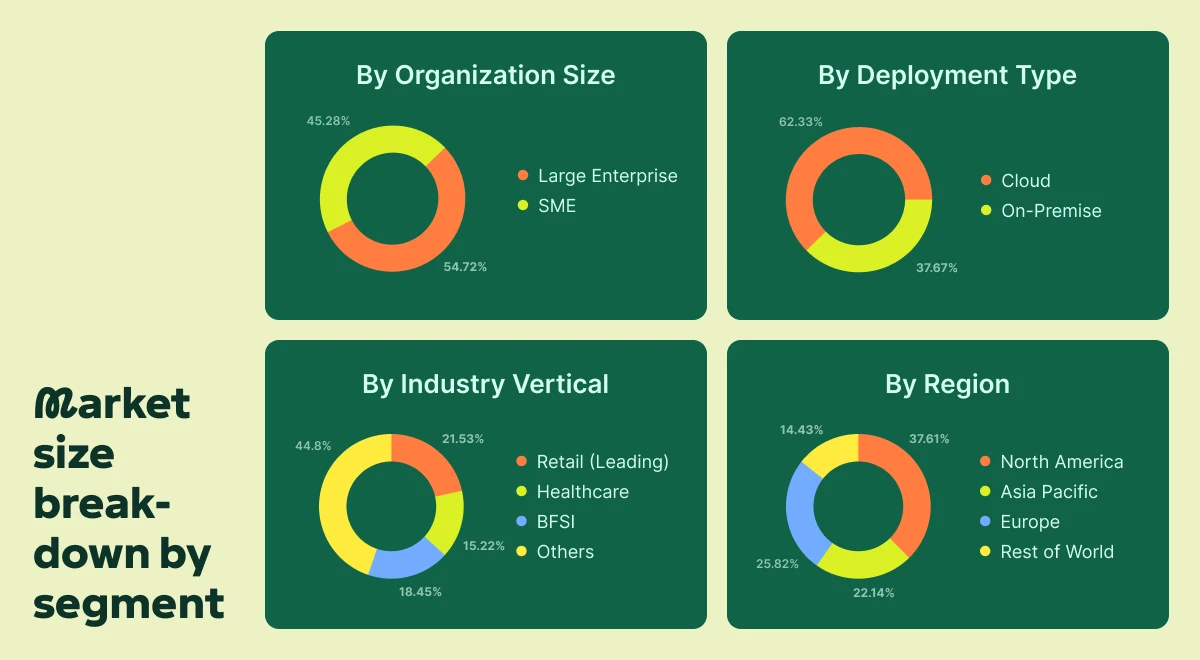
By organization size: Large enterprises commanded 54.72% of market share in 2026, reflecting their capacity to invest in dedicated microlearning infrastructure. SMEs are growing at 14.59% CAGR, driven by affordable cloud-based platforms.
By deployment: Cloud platforms captured 62.33% of microlearning deployments in 2025, projected to grow at 15.19% CAGR. Mobile-first design is now a baseline expectation rather than a differentiating feature.
By industry: Retail holds the largest end-user share at 21.53%. Healthcare and life sciences are the fastest-growing sectors at 15.22% CAGR, driven by continuing medical education requirements and compliance training mandates.
By region: North America leads at 37.61% of global market share in 2025. Europe is the second-largest region, with the European market valued at around $810 million in 2024 and projected to grow at a 22.3% CAGR through 2035.
Asia Pacific is the fastest-growing region. India's National Skill Development Corporation recorded over 13 million enrollments by February 2025. South Korea's AID 30+ initiative allocated KRW 110 billion to mobile microlearning programs. Japan's corporate upskilling mandates are accelerating adoption across manufacturing and technology sectors.
Microlearning retention statistics: What the research shows
Here is what controlled research found when it measured memory over time.
Spaced repetition and long-term memory formation
Spaced repetition re-presents content at increasing intervals timed to intercept the forgetting curve just before recall degrades. The result is that each retrieval attempt reinforces the memory trace more efficiently than repeated massed study. The intervals can also be optimized by an algorithm, which is where AI enters the picture later in this article.
The evidence base is substantial.
Research published in Frontiers in Human Neuroscience found that one hour of spaced learning produced test scores statistically equivalent to four months of conventional teaching, with a p-value below 0.00001. That is the finding that compresses the entire case for spaced microlearning into a single measurement.
The largest study to date on spaced repetition in professional education analyzed 26,258 physicians. Published in Academic Medicine, the research found the spaced repetition group scored 58.03% on knowledge assessments compared to 43.20% for the no-repetition group, a Cohen's d of 0.62.
STEM education researchers examining exam outcomes found that students using a spaced repetition app scored 70% on finals versus 61% for non-users, with an effect size of 0.47 and a p-value below 0.000056.
Separately, a vocabulary retention study from Cambridge found spaced learners recalled words 1.6 times more effectively than massed learners one week after the initial session. That is a finding particularly relevant for workplace training, where content needs to survive not just a post-test but a return to the job.
At scale, a large-scale Duolingo study spanning 5.2 million user-word pairs found that an AI-optimized spaced repetition schedule produced measurably lower forgetting rates and required less review effort than human-designed intervals.
Stanford cognitive psychology researchers found that learner preferences for massed learning decayed after a delay period, while preferences for spaced learning increased.
The retention advantages of microlearning become more apparent to learners themselves over time.
Microlearning retention statistics vs. traditional learning
Across peer-reviewed studies, microlearning consistently produces 17-22% better performance outcomes and up to 1.6x better long-term recall compared to traditional massed instruction.
| Metric | Traditional / massed learning | Microlearning / spaced learning |
|---|---|---|
Average completion rate | ~20% | ~80% |
Knowledge retention (1 week) | Baseline | 1.6x better (Nakata & Suzuki, 2018) |
Exam performance vs. control | Baseline | +18% (Aljebreen et al., 2018) |
Passing rate | ~64% | ~82% (Aljebreen et al., 2018) |
Training time | Standard | 45-80% reduction (no comprehension loss) |
Cognitive re-reading frequency | 3x higher | Baseline |
Physician knowledge retention | 43.20% | 58.03% (Price et al., 2024) |
Student interest level | ~30% | ~70% (Zhou & Deng, 2018) |
Learner satisfaction | Varies | 94% satisfaction rate (market research, 2024) |
Course positive feedback | Baseline | +18% after micro-conversion (Shatte & Teague, 2020) |
A controlled study published in the International Journal of Educational Research and Engineering reported that a microlearning group outperformed a traditional group by 18 percentage points, with an 82% passing rate versus 64% in the control and zero failures in the microlearning cohort, compared to failure rates of 23-36% in traditional lessons, depending on the subject.
Flipped classroom researchers in China measured student interest directly: in a microlearning model, interest rose from 30% to 70% over the study period, while the failure rate dropped from 25% to 12.1%. A conversion study tracking course reception found that replacing long-form video content with 1-2 minute micro-modules produced an 18% increase in positive course feedback.
Both a 2017 chunk-size study and the Dresden study independently found that short content formats increase retention by approximately 20% compared to traditional formats, while reducing the need for re-reading by a factor of three.
Memory researchers at Stanford observed that learner preferences for massed formats decayed post-delay, while spaced preferences held. The advantages of microlearning appear to become more visible to learners over time, not less.
Microlearning effectiveness statistics: Completion rates, training time, and ROI
Microlearning consistently hits around 80% average completion rates in industry research, while traditional long-form courses tend to land somewhere around 20%.
That gap makes a lot more sense when you think about the real experience. There's a difference between a 6-minute module someone can knock out between tasks and a 3-hour course they open with good intentions, lose the thread halfway through, and quietly abandon.
Training time is the other big win. Employees on mobile microlearning platforms typically spend 45–80% less time in training than they would in traditional formats, without any measured drop in comprehension. When you multiply that across a whole workforce, it adds up fast: fewer facilitator hours, less time pulling people off the floor, and new hires getting up to speed noticeably quicker.
A pharmacy education study examined learner preference and outcomes in parallel: 72% of participants preferred microlearning over a 30-minute traditional format (p = 0.007), while knowledge gains were statistically equal across both conditions. Microlearning delivers equivalent outcomes in less time, which is not a marginal efficiency but a structural one.
The headline number from meta-analysis comes from a meta-analysis pooling 10 controlled studies (n = 743): microlearning was superior to traditional lectures with a standardized mean difference of 1.43 (95% CI: 1.27 to 1.59).
In medical education, a BMC Medical Education study found that 95.7% of medical students considered microlearning combined with simulation beneficial to their training, with significant post-test score improvements and self-efficacy gains.
Medical education researchers studying case-based learning found that the micro-learning group outscored the control on all five knowledge dimensions and the retention test (p < 0.05 across all measures).
Instructional validity has also been measured directly. Curriculum designers applying the ADDIE model found expert validity at 87.1%, student practicality at 87.5%, and N-Gain scores above 76%, categorized as effective by standard thresholds. A Sri Lankan performance study found that the microlearning group scored significantly higher on assessments, with microlearning usage also correlating with more positive learner reactions.
Learner satisfaction data is consistently positive: industry surveys report a 94% satisfaction rate with microlearning platforms. A Latin American flipped classroom study found 83.9% of psychology students responded positively on satisfaction surveys after microlearning was introduced.
A biochemistry study tracking exam correlations also found microlearning activity scores positively correlated with performance, with the strongest effect concentrated among students who had been struggling. Overall, microlearning is approximately 17% more efficient than traditional course formats, measured by performance per unit of learning time.
Mobile learning and employee engagement statistics
The phone in every employee's pocket changed what training can look like. The adoption data shows organizations figured that out.
Mobile learning (mlearning) adoption data
The structural driver of microlearning's market growth is smartphone penetration. Cloud-based deployment captured 62.33% of the microlearning platform share in 2025, and 74% of companies in North America now integrate mobile learning into training strategies. Mobile-first design is a baseline expectation, not a differentiating feature.
The behavioral data is equally telling: 52% of people use mobile learning in bed after waking up, and 46% use it before sleep. These patterns normalize microlearning as a daily habit rather than a scheduled work event, which is the behavioral profile that bite-sized lessons are built for.
Video content dominates the format mix: 85% of organizations use video in their microlearning strategies. The MIT study shows that images can be identified in as little as 13 milliseconds, which meaningfully demonstrates rapid visual processing without an invented ratio.
The conversion study tracking course feedback confirmed this directionally, finding that replacing long videos with 1-2 minute micro-modules produced measurably better reception.
The integration of microlearning into existing LMS infrastructure is progressing in parallel. A multi-country study on LTI/LIS integration documented the successful embedding of microlearning modules into existing LMS platforms, with positive faculty reception across multiple institutions. Short-format content is being absorbed into standard academic and corporate platform stacks rather than requiring entirely separate systems.
Learner engagement statistics: What the data shows
Microlearning increases employee engagement by approximately 50% compared to other online learning formats. 58% of employees are more likely to use learning tools when content is broken into shorter segments. These figures partially explain the completion rate gap between micro and long-form content.
Gamification researchers studying Gen Z and millennial learners found engagement rose from approximately 15%, the industry average for non-gamified L&D, to approximately 90%. Completion rates for gamified 10-minute microlearning reached roughly 83%, compared to 20-30% in traditional formats.
The mechanisms, including leaderboards, points, progress tracking, and spaced repetition card systems, are not decorative. They create behavioral feedback loops that sustain consistent learning across time.
EdApp, now operating as SafetyCulture Training, is the platform most frequently cited in microlearning practitioner literature as a practical example of this approach. It built gamification with leaderboards, spaced repetition, and mobile-first design natively into its architecture. 45% of companies using microlearning reported improved learner engagement.
Millennials and Gen Z present a structural tailwind for m-learning adoption. These cohorts have grown up consuming content in short formats across YouTube, social media, and app ecosystems.
The expectation of short, well-produced content in learning environments is not a preference to accommodate. It is the default against which longer formats are now measured by learners themselves.
Employee productivity gains from microlearning are real but difficult to isolate in dollar terms. The training time reduction of 45 to 80% translates directly to less time off the floor and more productive working hours.
However, experts who reviewed 17 microlearning studies in health education found that zero studies measured Kirkpatrick Level 4 outcomes, which track organizational results or financial ROI.
The learner satisfaction data is strong. The direct link between microlearning and measurable business performance, in areas like turnover costs, time-to-productivity, and L&D budget efficiency, still needs to be built through longitudinal organizational research.
Corporate training statistics: Compliance, upskilling, and the skills gap
Corporate training is the largest single application of microlearning. Retail, healthcare, BFSI, and IT/telecom are the primary end-user sectors mentioned across market reports, each for a different reason rooted in their specific training requirements.
Compliance training is one of the fastest-growing use cases. In BFSI, regulatory requirements around anti-money-laundering and cybersecurity demand frequent knowledge refreshes. In healthcare, CME credits require ongoing professional education. Both are high-stakes, repetitive, and time-constrained, which maps precisely onto spaced repetition microlearning.
The format allows compliance training to be delivered in 3 to 5-minute daily sessions rather than annual all-day events, reducing both instructional cost and retention loss.
The global skills gap is a structural driver of microlearning adoption. Organizations need faster upskilling tools as technology cycles accelerate and job requirements shift faster than traditional training programs can keep pace with. Microlearning's modularity allows employees to target a specific skill deficit without enrolling in a full course.
The Dresden study framed this in knowledge management terms: competency-based training that addresses precise gaps rather than broad topic areas, which changes how training time is allocated and measured.
Just-in-time learning is the application pattern that best captures why microlearning fits modern work rhythms. A salesperson pulling up a 3-minute product refresher before a client call, a nurse reviewing a procedure checklist before an ICU procedure, a retail associate checking a company policy mid-shift: all are just-in-time use cases.
These are scenarios that a traditional LMS course architecture cannot easily serve. The content has to be available in seconds, not behind a login screen and a course menu.
Employee development is increasingly framed around microlearning because it lowers the perceived cost of learning for individuals. When employees feel they are growing, engagement improves, and microlearning makes development feel achievable rather than an additional burden on an already full workday. The link to employee productivity runs through this behavioral pathway, not just through raw time savings.
Researchers studying retail microlearning adoption in Norway identified three barriers practitioners rarely discuss: prioritization challenges (workers consistently deprioritize learning when workload spikes), competition from other platforms, and content relevance (learners disengage when modules do not connect to their specific role). These are operational barriers, not pedagogical ones.
Research published in 2025 on organizational microlearning patterns documents a shift in how organizations deploy microlearning: away from standalone training events and toward performance support and workflow-embedded formats.
Content is appearing in the flow of work rather than outside it. This shift is being accelerated by AI integration and represents the direction of corporate investment in employee development over the next five years.
Microlearning trends and smart learning systems statistics
Smart microlearning AI trends 2025-2026 statistics show a clear direction: the combination of adaptive algorithms, spaced repetition science, and mobile delivery is producing platforms that personalize learning at the individual level, in real time, with less learner effort for equivalent retention outcomes.
Adaptive microlearning (AML) uses AI to adjust content difficulty, pacing, and sequencing based on individual learners' performance in real time. A study in Scientific Reports following 111 in-service personnel compared AML against conventional microlearning and found the adaptive group showed significantly lower unnecessary cognitive load (ANCOVA analysis).
A companion study in the International Journal of Managing Information Technology found the AML group achieved a mean learning achievement score of 17.59 compared to the conventional microlearning group, with significantly higher learning adaptability scores.
AI optimization is also producing measurable gains over human-designed spaced repetition schedules. The 5.2-million-pair Duolingo study demonstrated this at scale. More recently, deep reinforcement learning approaches to spaced repetition scheduling have achieved a mean absolute error of 0.0274, 11% below the second-best competing method. Machine-optimized spacing intervals are becoming measurably more precise with each iteration of research.
The content creation side is also changing. AI is reducing the time to build new micro-courses from storyboard through deployment. Industry analysts estimate production timelines are compressing from 18 months to approximately 6 months across the sector. Automated assessment generation, AI video production tools, and template-driven instructional design are the specific mechanisms being adopted.
One caveat worth flagging: algorithmic fairness in adaptive learning systems is an emerging concern. Research in this area has noted that personalization algorithms can reproduce existing learning inequities if training data is not representative across demographic groups. As AML platforms scale, this is a design problem that research is only beginning to address.
Early smart microlearning research surveying learner attitudes found that 90% of respondents welcomed smart microlearning systems and 82% described the approach as holistic and user-friendly, which is early empirical support for the direction the field is now moving at a much larger scale.
Microlearning tools: Platforms, apps, and how to get started
Research consistently shows microlearning works, but only when the delivery mechanism fits naturally into how people consume content. The right platform depends on whether the use case is corporate compliance, individual upskilling, or LMS-integrated delivery.
1. SafetyCulture Training
SafetyCulture Training (formerly EdApp)/ is one of the most-cited platforms in microlearning practitioner literature. It was built with gamification in mind, including leaderboards, spaced repetition, and mobile-first design as native features rather than add-ons. It is free for small teams, which has driven wide adoption in retail, hospitality, and manufacturing.
The gamification engagement research reflects the same design philosophy EdApp has commercialized at scale.
2. Axonify
Axonify targets enterprise clients with AI-driven daily 3-5 minute training sessions built around behavior change and memory science. It appears in market reports as a category leader in the enterprise microlearning segment, with particular strength in retail and frontline worker training, where just-in-time learning modules are a daily operational tool.
3. Headway
Headway is the most downloaded book summary app and daily growth app globally, used by over 55 million people. The platform distills bestselling books into a focused session that targets one key learning area and, in practice, functions as a micro-course on topics including productivity, psychology, leadership, and career development.
4. Docebo
Docebo is a mainstream learning management system that has added microlearning-compatible delivery features. It is practical for organizations that already have LMS infrastructure and want to layer short-form content within an existing workflow. Multi-country research on LMS integration confirmed that microlearning adoption does not require replacing existing systems.
5. LinkedIn Learning and Coursera
LinkedIn Learning and Coursera are broader eLearning platforms with growing microlearning module libraries. LinkedIn Learning's August 2025 AI recommendation feature is a live example of personalized micro-content delivery at scale. Coursera's September 2025 employer partnership program shows the corporate training market moving directly toward this format.
6. Duolingo
Duolingo is the most academically studied consumer microlearning app. The 5.2-million-pair spaced-repetition study and the half-life regression study both used Duolingo's platform as the research environment, making its spaced-repetition and gamification design the most empirically validated of any consumer app in this category.
Choosing between these tools depends on the use case: corporate compliance and frontline training point toward Axonify or EdApp; LMS-integrated delivery works best through Docebo or TalentLMS; Headway or Duolingo best serve individual upskilling; broader eLearning with microlearning modules is available through LinkedIn Learning or Coursera.
What the data says and what it still does not
The evidence for microlearning is strong in specific areas and noticeably thin in others. Cherry-picking positive results produces a distorted picture, and the limitations of current research are themselves actionable information for teams deciding how to allocate training resources.
Where the evidence is strong: Spaced repetition's effect on long-term memory is one of the most replicated findings in learning science, running from Ebbinghaus's 1885 experiments through the 2024 physician study. Completion rate superiority over long-form is consistent across multiple independent industry data sources.
A scoping review of 17 microlearning studies in health education found 94% assessed learner reactions positively, and 82% showed measurable knowledge or skill gains.
Where the evidence is weaker: The same scoping review found that of 17 studies, zero measured Kirkpatrick Level 4 outcomes: organizational results, performance changes, or financial ROI. The gap between "learners scored higher on a post-test" and "the organization performed measurably better" remains almost entirely unmeasured in the peer-reviewed literature.
The definition problem: A systematic review in Medical Education flagged that "spaced learning" is inconsistently defined across studies. Specific interval counts, session durations, and retention measurement windows vary widely, making direct cross-study comparison unreliable.
When a meta-analysis draws on studies with different definitions of the same intervention, the pooled effect size is meaningful but should be interpreted with that variability in mind.
Context dependency: Research and practitioner accounts agree that microlearning is less suited to complex procedural skills, judgment-based decision-making, or soft skills requiring sustained feedback loops. Early research on learner attitudes explicitly noted that the format is not useful for acquiring complex skills, behaviors, or processes, a limitation that rarely surfaces in promotional literature about the format.
Statistical heterogeneity: The 10-study meta-analysis found high heterogeneity (I squared = 66%) across included studies, meaning results varied substantially. The pooled SMD of 1.43 reflects a general direction, not a uniform business outcome.
Results ranged considerably depending on subject matter, learner population, and module design. The study found no detected publication bias, which is a meaningful quality signal, but the heterogeneity is worth noting when applying these figures to specific training contexts.
The numbers that matter: Microlearning statistics by the numbers
Here are the key data points, grouped by theme for fast scanning and verification.
MARKET SIZE
Global microlearning market: ~$3.41B in 2025 (Emergen Research); projected $9.32B by 2035 at 13.4% CAGR
Alternative estimate (MRFR): $6.19B in 2025, projected $46.4B by 2035 at 22.31% CAGR
LMS market (broader context): $28.6B in 2025, projected $123.8B by 2033 (Grand View Research)
Asia Pacific is the fastest-growing region; North America holds 37.61% global share in 2025
Large enterprises: 54.72% of microlearning market share; cloud deployment: 62.33% (Mordor Intelligence)
India NSDC enrollments: 13M+ by Feb 2025; South Korea AID 30+ initiative: KRW 110B allocated
RETENTION AND LEARNING SCIENCE
Ebbinghaus forgetting curve: ~50% forgotten within 1 hour; ~70% within 24 hours; ~90% within a week without reinforcement
Spaced repetition vs. massed study: 1.6x better recall after one week (Nakata & Suzuki, 2018)
One hour of spaced learning is equivalent to four months of conventional teaching (Kelley & Whatson, 2013)
26,258 physicians: spaced group scored 58.03% vs. 43.20% no-repetition (Cohen d = 0.62) (Price et al., 2024)
Short content formats increase retention by ~20% vs. traditional (Giurgiu, 2017; Emerson & Berge, 2018)
The micro-chunk group performed 22.2% better and spent 28% less time on the assessment (Emerson & Berge, 2018)
EFFECTIVENESS
Average microlearning completion rate: ~80% vs. ~20% for long-form (multiple industry sources)
Microlearning group: 18% better exam performance; 82% passing rate vs. 64% traditional (Aljebreen et al., 2018)
Meta-analysis SMD = 1.43 for microlearning vs. traditional lectures, a large effect size (Prasittichok & Smithsarakarn, 2024)
72% of learners prefer microlearning over a 30-minute format; knowledge gains are equal (Roskowski et al., 2023)
Microlearning is approximately 17% more efficient than traditional formats overall
95.7% of medical students found microlearning combined with simulation beneficial (Liew et al., 2023)
ADDIE-based microlearning: 87.1% expert validity, 87.5% student practicality, 76%+ N-Gain (Safaruddin et al., 2023)
ENGAGEMENT AND COMPLETION
Gamified microlearning: engagement up from ~15% to ~90% (Savithri et al., 2024)
Gamified completion rates: ~83% for 10-minute microlearning vs. 20-30% in traditional L&D
45% of companies report improved learner engagement after adopting microlearning platforms
94% learner satisfaction rate with microlearning platforms (industry survey data)
58% of employees are more engaged when content is in shorter segments
Duolingo spaced repetition upgrade: +12% daily user engagement (Settles & Meeder, 2016)
MOBILE LEARNING AND TRAINING TIME
Training time reduced 45-80% with mobile microlearning; no measured comprehension loss
85% of organizations use video content in microlearning strategies
74% of North American companies integrate mobile learning into training programs
Cloud platforms: 62.33% of 2025 microlearning deployments (Mordor Intelligence)
52% of learners access mobile learning content immediately after waking
What these microlearning statistics mean for how we learn: Now and next
Microlearning statistics point toward one conclusion: learning is more effective when it is spaced, focused, and fits into the rhythm of daily life.
Three forces are converging to make microlearning a structural shift rather than a passing preference:
Cognitive science has established, with high precision, how memory forms and what disrupts it.
Mobile technology has made short content available at any moment, not as a feature but as an ambient condition of the way people spend their time.
AI is personalizing spaced repetition and content sequencing at the individual level, producing learning schedules that no human instructor could manually construct for each learner at scale.
The remaining gap is organizational measurement. The link between learning events and measurable business performance remains largely absent from the peer-reviewed microlearning literature.
The next frontier in microlearning statistics is connecting test score gains to turnover costs, time-to-productivity, and L&D budget efficiency in real organizations over real time periods.
Additionally, AI-optimized adaptive microlearning, integrated directly into daily workflows, is erasing the conceptual boundary between training time and working time.
The question will not be whether to use microlearning. It will be whether the instructional design behind it is strong enough to earn attention in a workday already full of competing demands.
The science is settled. The execution is where the work is.
FAQs about microlearning statistics
What are the most important microlearning statistics for corporate training in 2025-2026?
The figures that appear most often: an 80% average completion rate versus 20% for long-form courses, a 45-80% reduction in training time with no comprehension loss, 94% learner satisfaction, and 45% of companies reporting improved engagement after adoption. For compliance training, physician research shows spaced repetition lifts knowledge scores by nearly 15 percentage points.
How does microlearning compare to traditional training in terms of retention rates?
Consistently better, across multiple study types. A meta-analysis of 10 studies found microlearning outperforms traditional lectures with a standardized mean difference of 1.43, a large effect size. Spaced learners recall vocabulary 1.6 times more effectively after one week. Passing rates in microlearning groups average 82%, compared with 64% in traditional formats.
What is the current size of the microlearning market, and how fast is it growing?
Microlearning market growth 2025 statistics range from $3.41 billion to $6.19 billion, depending on the research firm and scope, with projections of 13-22% CAGR. The broader LMS market sits at $28.6 billion. Asia Pacific is the fastest-growing region. North America holds 37.61% of the global share.
Does microlearning improve employee engagement and completion rates?
Yes, across multiple data sources. Completion rates average around 80%, compared with 20% for long-form courses. Gamified microlearning lifts engagement from approximately 15% to 90%. 58% of employees engage more with shorter content. 45% of companies that adopted microlearning platforms reported measurably improved employee engagement.
What does research say about spaced repetition and long-term memory in microlearning?
Spaced repetition is the most consistently supported mechanism in microlearning research. One study found that one hour of spaced learning produced results equivalent to four months of conventional teaching. Physician research showed spaced groups scoring nearly 15 percentage points higher. Recall improves by a factor of 1.6 after one week compared to the massed study.
How long should a microlearning module be for maximum effectiveness?
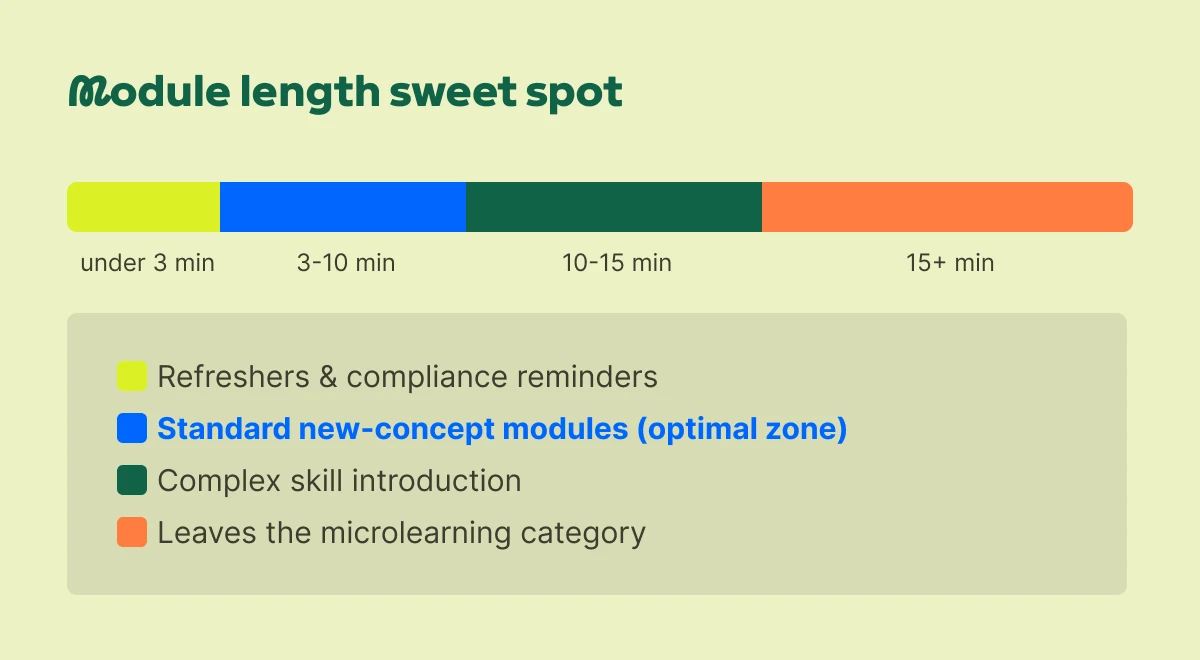
Research and practitioner consensus land on 3-10 minutes for standard modules. Under 3 minutes works for refreshers and compliance reminders. Up to 15 minutes suits the introduction of the new concept. Beyond that, cognitive load advantages disappear. The 1-objective rule is more reliable than time alone: one module, one learning outcome.
Which industries benefit most from microlearning, and why?
Retail leads with 21.53% of the global microlearning market share. Healthcare and life sciences are the fastest-growing sectors at 15.22% CAGR. BFSI uses it for compliance training refreshers. IT/telecom for upskilling on 5G and cloud. All share the same training profile: time-sensitive, high-stakes content that frontline workers need without extended time off the floor.
How is AI changing microlearning platforms and personalized learning paths?
Smart microlearning AI trends 2025 statistics center on adaptive microlearning systems that adjust content difficulty and pacing in real time. Studies show these systems produce lower cognitive load and higher achievement than conventional microlearning. AI-optimized spaced repetition scheduling outperforms human-designed intervals.