Self-growth
 Apps & Digital Tools
 Business & Career
 Success
 Growth Tools
 Psychology
 Communication
 Relationships
If a goldfish could read this article, it would probably remember it for weeks. And you? …well, that’s less certain.
Those memes about a goldfish having a “three-second memory” are far from reality. Instead, they can remember things for months — even years.
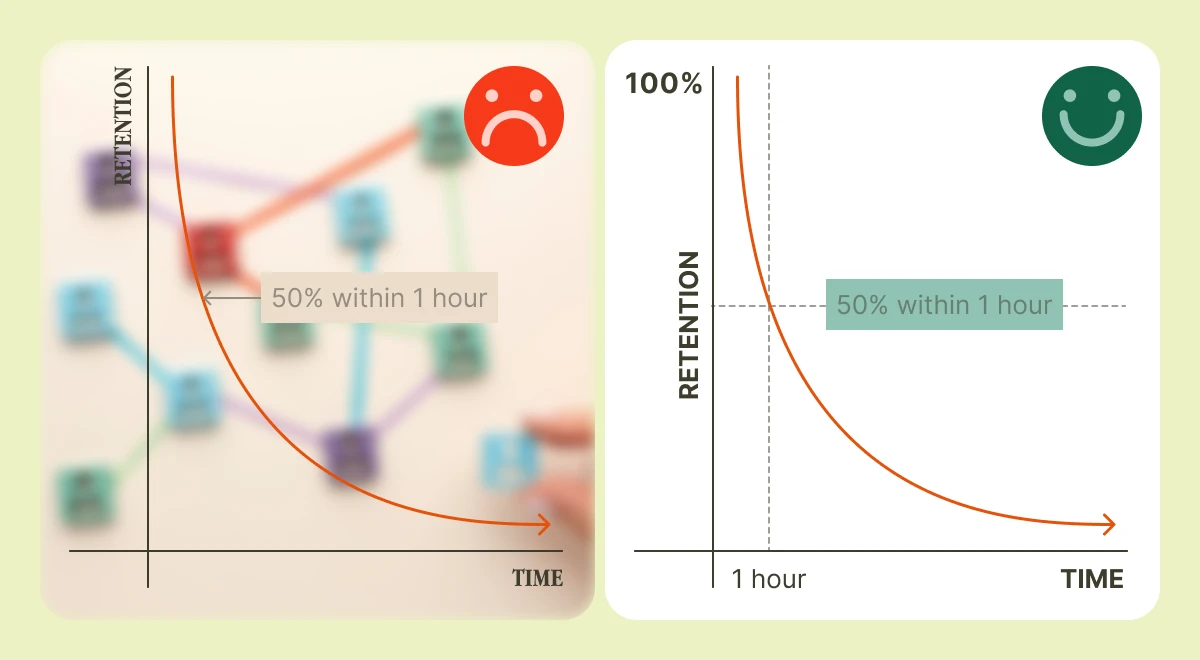
Human memory could definitely use an upgrade. We forget up to 70% of new information within the first 24 hours if we don’t revisit it. It’s not about willpower, laziness, or being “less gifted” than a tiny aquarium fish (though the comparison stings a little).
The truth is that we live in an age of constant information overload, and the human brain has its limits. Is there any way to fix it?
When your brain says “enough!”
Picture this: you have twenty browser tabs open at once — work documents, music, news, YouTube, and social media. Your computer starts to slow down — pages load slowly, videos freeze, the cursor lags, and finally the whole system crashes. Sound familiar?
Your brain works the same way. When you try to process too much new information at once, your mental “operating system” overloads.
Staying focused becomes a challenge, mistakes start popping up (sometimes quite annoying ones), and new information simply doesn’t stick. It’s not a pleasant feeling — but once you understand how it works, you can actually take control.
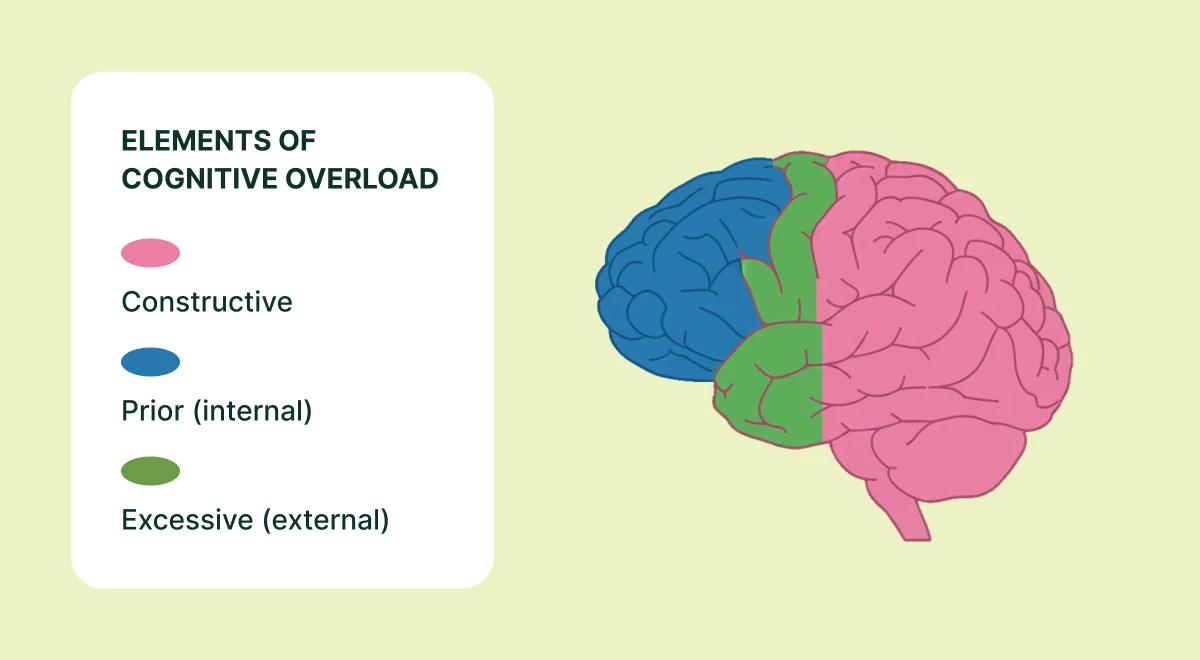
Let’s start with the basics. Cognitive load refers to the amount of mental effort your brain needs to process information. In neuroscience, it’s usually divided into three types:
Intrinsic load — the built-in difficulty of the task
What’s easier to learn: an entire language or just the handful of phrases you’ll actually use most often? Obviously, the second one. That’s exactly why phrasebooks exist — especially when you travel to a country where you don’t speak the language.
Or consider another example: you want to understand how stress affects the brain so you can better comprehend your own reactions.
Focusing specifically on that topic will give you clear answers. Trying to study the full structure of the brain and every single neuro-mechanism involved in stress responses? Probably not the best idea. Unless, of course, you’re Sheldon Cooper.
Extraneous load — everything that gets in the way
This includes unnecessary elements, such as confusing structure, illogical transitions, unexplained terminology, and visual noise — like excessive colors, random fonts, and slide designs that look straight out of the early 2000s.
This is the kind of load you can avoid. Sometimes you start reading or watching something, and the further you go, the more you feel like Frodo tangled in Shelob’s web — completely stuck and increasingly unsure how you got there (millennials, this one’s for you).
Germane load — the helpful effort that builds new connections
This is the type of mental effort that actually works in your favor. Germane load kicks in when you connect new information to something you already know.
Imagine you’re a UI/UX designer: you understand color psychology, user flow, and how to guide someone toward clicking the “right” button at the “right” moment.
So when you learn more about how the human brain perceives colors and visual patterns, that knowledge naturally plugs into your existing mental framework. It deepens your understanding of user experience rather than competing with it.
But now imagine trying to dive into the algebraic number system, even though it’s been years since you last did maths in high school. Let’s just say the learning curve would not be gentle.
These three types of cognitive load fit together like pieces of a puzzle — and when they’re balanced, learning becomes clear, memorable, and free from unnecessary overload. And let’s be honest: every one of us has experienced that “my brain is melting” moment at least once.
But here’s the thing — it doesn’t have to be that way. When you understand how these layers work, you get more value from the information with less effort. And most importantly, your brain is satisfied. That’s basically the best motivation to keep learning. Isn’t it?
Turning chaos into something your brain really likes
So the brain really doesn’t like overload (and who does?). But there is a way to outsmart it. And that way is chunking — breaking information into small, meaningful pieces.
It’s like taking a huge pile of stuff and organizing it onto shelves: suddenly there’s space, order, a system, and a clear sense of where to start.
Take phone numbers, for example. Remembering ten digits in a row is tough, but breaking them into chunks — like 067-123-45-67 — makes it manageable.
The same thing happens when a musician learns a new song: they practice it fragment by fragment. Chunking works like an internal organizer. Your brain groups bits of information and turns them into familiar patterns.
That’s why we can remember a phone number, a childhood song, or a school poem even through the years.
Size matters: why long study sessions fail
“The exam is tomorrow. So today, like a responsible adult, I am going to study the entire semester’s material.” Sounds familiar? Let me guess — it probably didn’t end too well.
Chunking helps the brain handle large amounts of information by breaking it into smaller pieces. However, if you try to learn the whole textbook in a single day, the system inevitably crashes.
After about an hour of nonstop studying, even the most motivated brain starts to stall.
Research shows that our average ability to maintain focused attention is about 15 to 30 minutes. After that, cognitive resources drain: new information sticks less effectively, mistakes multiply, and our interest fades fast. Instead of feeling progress, we feel tired — just trying to “make it to the end.”
Microlearning: small steps to big results
Struggling to absorb information all at once and finding yourself returning to it in small bursts? That’s not procrastination — your brain is just cleverly hacking the system.
Nobody enjoys exhaustion or overwhelm, and your brain is no exception.
In fact, the Oxford Dictionary’s 2024 Word of the Year was “brain rot” — that foggy, overloaded feeling we get when our mind is stuffed with too much information, especially low-quality content. The constant avalanche of updates, notifications, news, posts, and “must-know” content — so fast you can’t even sneeze without missing something — is exhausting.
Add to that the classic FOMO, the fear of missing out and falling behind in this rapidly advancing information stream, and no wonder our cognitive system starts to overheat.
So the brain tries to cope — and microlearning becomes a brilliant way to optimize its internal resources. Indeed, those resources need to be saved and managed just as your financial ones!
The power of microlearning lies in its short, focused bursts of information. These small units don’t overwhelm your working memory — they let you absorb knowledge gradually and return to it whenever you need a quick refresh.
Research shows that this kind of format reduces unnecessary extraneous load while increasing germane load — the helpful effort that strengthens long-term neural connections.
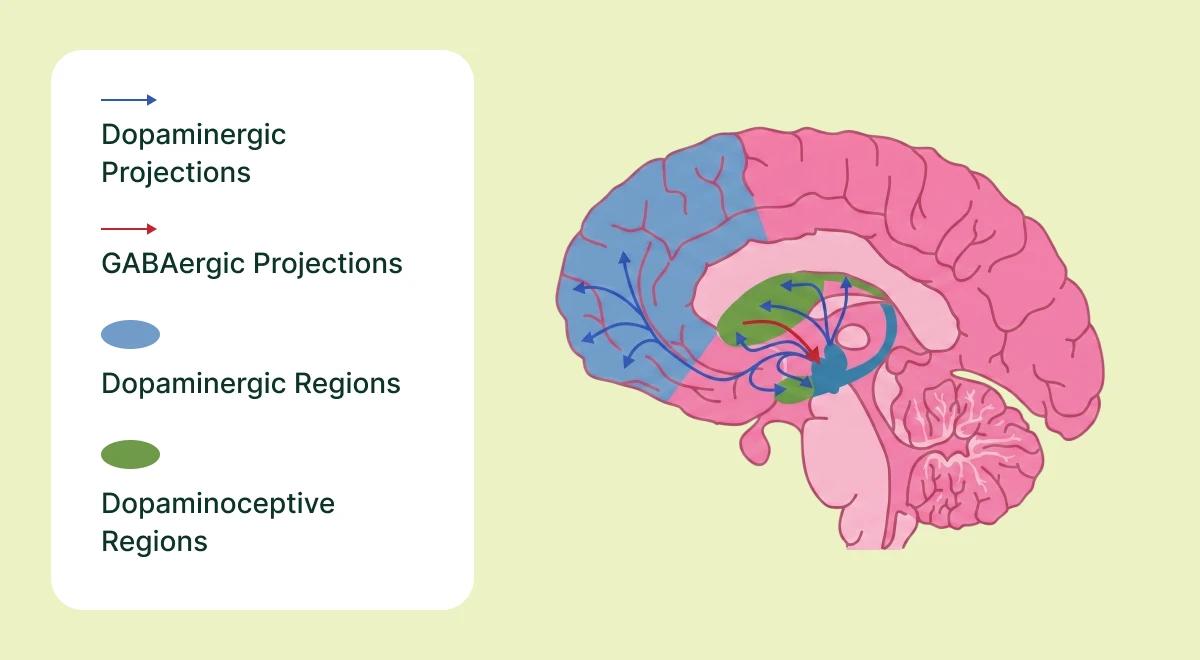
Microlearning also taps into the brain’s dopamine-based reward system. Every tiny completed task or short video gives your brain a little treat — a micro-reward that lights up its pleasure centers and motivates you to keep going.
That’s why apps like Duolingo, Quizlet, Anki flashcards, or Headway’s 15-minute book summaries feel so engaging: they use chunking, spaced repetition, and instant feedback to keep your brain curious, energized, and wanting more.
Simple tricks your brain will thank you for
Learn in short sessions — but do it consistently. A few 10-minute sessions a day are far more effective than long study marathons. And yes, learning should feel energizing and enjoyable, not draining.
Review what you’ve learned regularly. The spaced repetition method helps move information into long-term memory. Sticky notes on the fridge with new vocabulary? That actually works.
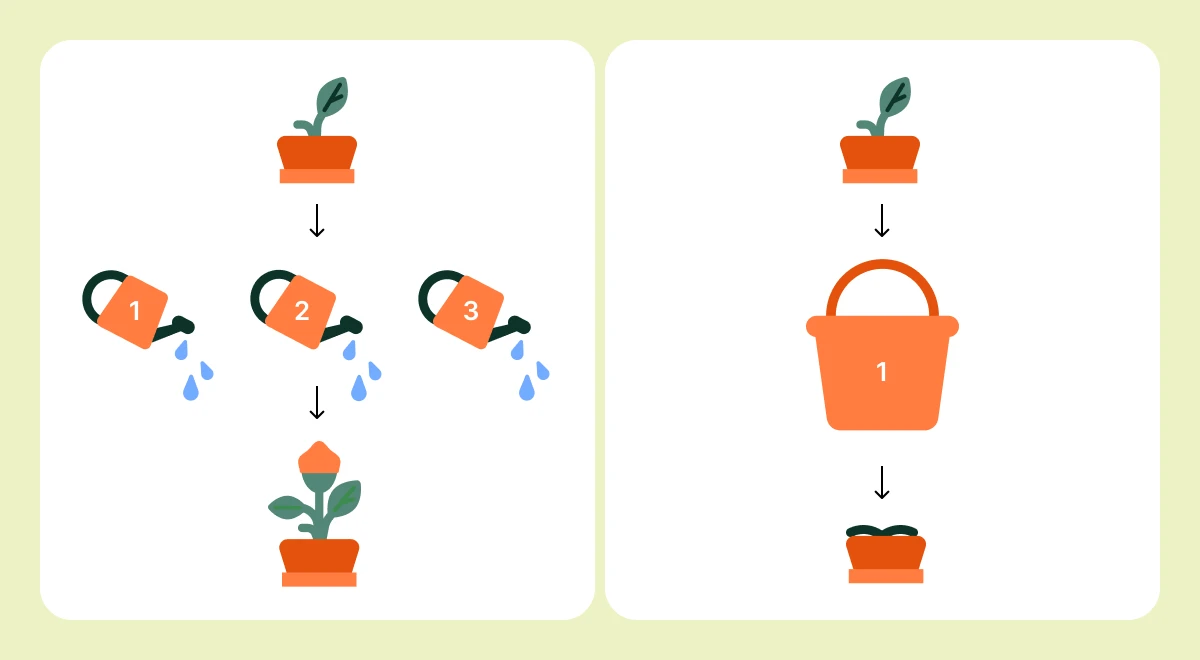
Got plants at home? Think of spaced repetition, like watering them on a schedule — not dumping a whole bucket of water at once. When you build a steady foundation, new information settles into your mental framework rather than evaporating on the spot.
You can also make your reviews more effective by adding small variations each time — rephrase the idea, use a different example, or test yourself in a slightly new way.
Mix your learning formats. Use different apps, short videos, flashcards, and quick quizzes — our brain loves variety. There’s also something called information interference, when similar topics overlap and blur together. Whenever possible, switch between themes and formats (text, audio, video) — it helps your brain consolidate information more effectively.
Take short breaks. Taking a 5-minute rest after 25 minutes of studying can restore your focus and energy. But this break isn’t about grabbing your phone and scrolling through memes (even though we all do it — zero judgment here, 100% solidarity). Still, it’s better to stand up, walk a little, drink some water, stretch, or simply look out the window. Your brain needs a change of context, not just a switch from one stream of information to another. A simple timer can help — it keeps you on track and makes sure your attention peaks exactly when you need it most.
End your learning session with a small win. We all enjoy that feeling of winning — even when the only person we’re competing with is ourselves. Interactive check-ins or quick self-tests that show your progress feel like a mini-achievement to the brain. These tiny victories boost interest and strengthen memory.
Teach someone else — even if it’s your cat. When you explain something out loud (even to your fluffy pet), your brain stores the information more firmly. This is known as the “explaining effect”, and it works even when you’re just talking through the material to yourself. Remember memorizing school poems out loud? Same principle.
Build learning into your routine. Driving somewhere? Listen to a short book summary you’ve been meaning to get to. Having your morning coffee? Learn five new Spanish words. These tiny triggers connect learning to everyday activities, and soon your brain starts treating it as a natural part of the day — not something you have to prepare for.
The brain is not a multi-armed Shiva — multitasking simply isn’t its superpower. So choose your learning goals, write them down, and move step by step, task by task.
Create your own “distracting things map”. A plant on your desk, messenger notifications, the ticking wall clock — anything that pulls your attention away. Identify those triggers and try to avoid them whenever possible.
Mindfulness techniques can also be beneficial — sometimes you just need to “come back to the moment” and ground yourself. Mindfulness encompasses a wide range of tools, including daily meditations, mindful eating, or even simple breathing exercises that take no more than two minutes. Mindfulness is great for boosting focus and managing fatigue. And yes — it helps far beyond learning, too.
At the end, better learning isn’t about pushing yourself harder — it’s about understanding how your brain actually works. Start small: choose one technique or app from this article and give it a try today.
You will notice the difference sooner than you expect. With the right approach, you might even remember this article longer than a goldfish would.
About the Headway app
With over 50 million users in 170+ countries, the Headway app is the world's most downloaded book summary app. It offers 15-minute audio and text summaries of nonfiction bestsellers, as well as daily microlearning sessions and gamified challenges. The app is designed to help people achieve their self-development goals. Headway received the Editor's Choice award from the US App Store and constantly hits the App Store home screen as App of the Day.