Self-growth
 Apps & Digital Tools
 Business & Career
 Success
 Growth Tools
 Psychology
 Communication
 Relationships
Imagine going on a museum tour… blindfolded. The guide passionately describes the painting in front of you — what’s on it, who painted it, when, and why it’s so famous.
You listen carefully and try to picture it in your mind, but fully experiencing its beauty and value is almost impossible. Some things are simply hard to understand by listening alone. We need to see, to feel, sometimes even to touch — that’s when the brain can finally put the whole picture together.
Our brain loves variety — both in how we experience the world and in how we learn. When information reaches the brain through more than one channel — sight, sound, reading, interaction — it activates more areas of the brain and sticks much better.
Learning the way your brain already works
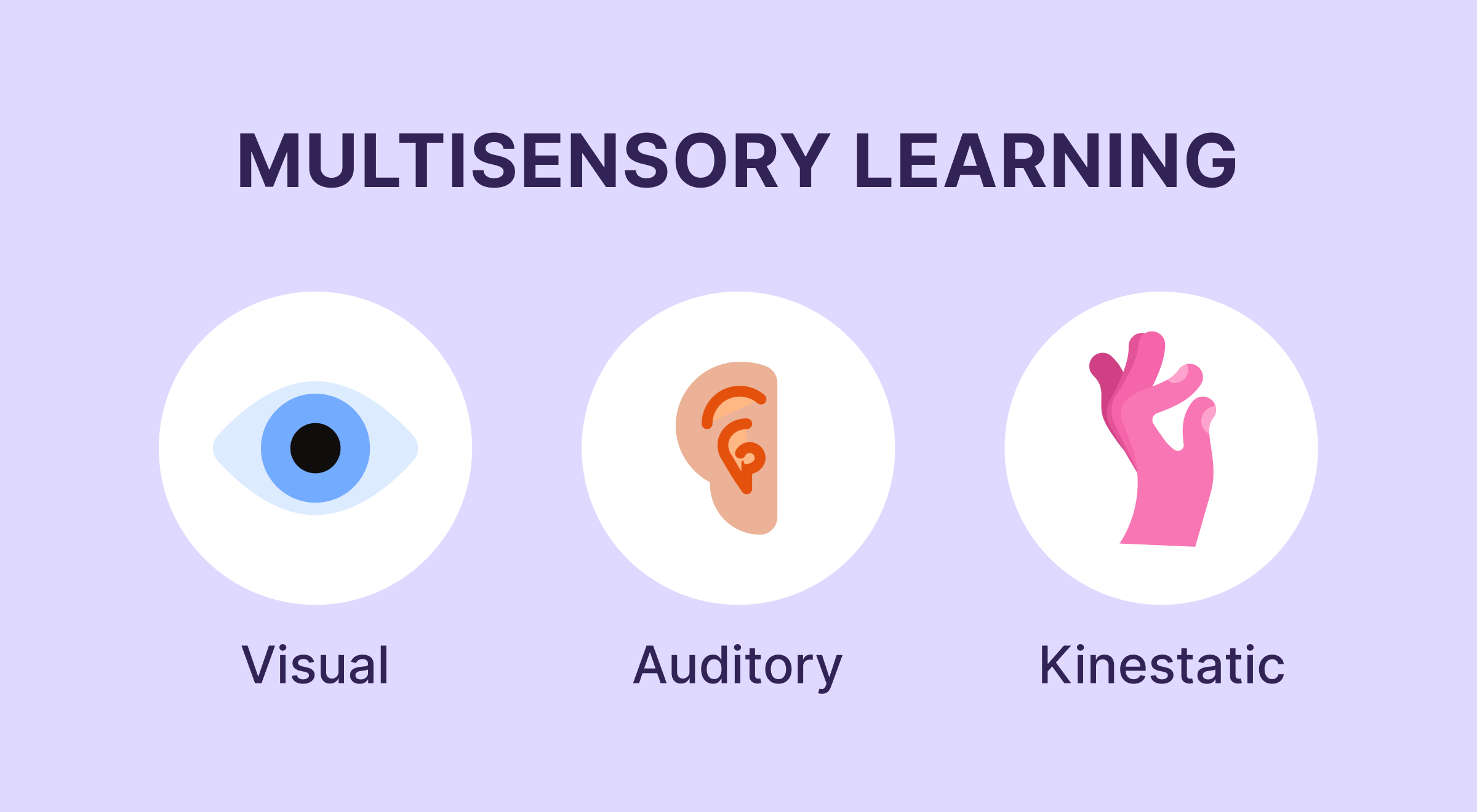
This principle is at the core of multimodal learning. It’s an approach where information is absorbed through several channels at the same time:
Visual — when we read or watch,
Auditory — when we listen to audio or a teacher’s explanation,
Kinesthetic — when we do something, move, click, or interact.
This is how the brain works every day — it rarely relies on just one mode of perception.
Think about how you learned to drive. First, you read the traffic rules and listened to lectures, took computer-based tests, and only then practiced driving with an instructor. You engaged multiple sensory channels — and as a result, you now feel confident behind the wheel.
Multimodal learning simply taps into the way our brain naturally operates: it gathers information from different sources and weaves it into one coherent picture.
When learning sounds like an orchestra
Imagine your brain as an orchestra. When information comes in through just one channel — let's say, you’re only reading a text — only one instrument is playing. You can recognize the melody, but it sounds flat and one-dimensional.
Add two or three more instruments, and suddenly the sound becomes deeper, fuller, richer. Learning works the same way: the more “instruments” you engage, the stronger the connections your brain builds.
That’s why different ways of taking in information activate different mechanisms in the brain — and complement each other so well.
Reading is all about meaning and logic. When we read, the brain builds sequences and links concepts together. You can pause, go back, reread. That’s why instructions, lists, and explanations of terms work especially well in written form. Holiday grocery lists, for example, can save your salad from disaster — and save you an extra trip to the store, too.
Visual materials are all about quick understanding. Humans are highly visual creatures — we process images faster and more effectively than text.
This has been confirmed by numerous studies and even has a name: the picture superiority effect. Diagrams, illustrations, and charts help us see structure, spot patterns, and compare elements at a glance.
Try assembling new furniture using audio instructions alone — it quickly becomes clear why IKEA manuals rely so heavily on pictures.
Audio, in turn, activates different areas of the brain. We don’t just register meaning, but also rhythm, intonation, and emotion. A human voice helps hold attention, improves focus, and sometimes makes key ideas stand out more clearly. It’s no coincidence that many people find complex topics easier to grasp through podcasts or explanations delivered in “living,” spoken language.
Inter(action) — when we click, engage with content, answer questions, or apply knowledge in practice — brings motor memory into play. Think back to learning how to drive: it’s hard to imagine mastering it by memorizing traffic rules and reading the car manual alone, right?
Why this actually works: what science says
All these formats don’t just complement one another — they create multiple entry points into memory. When we read, listen, and do something at the same time, the brain receives a clear signal: this information matters, it’s worth keeping.
Plain text on its own fades quickly. The very same content, supported by a diagram, an example, or a short task, stays with us far longer.
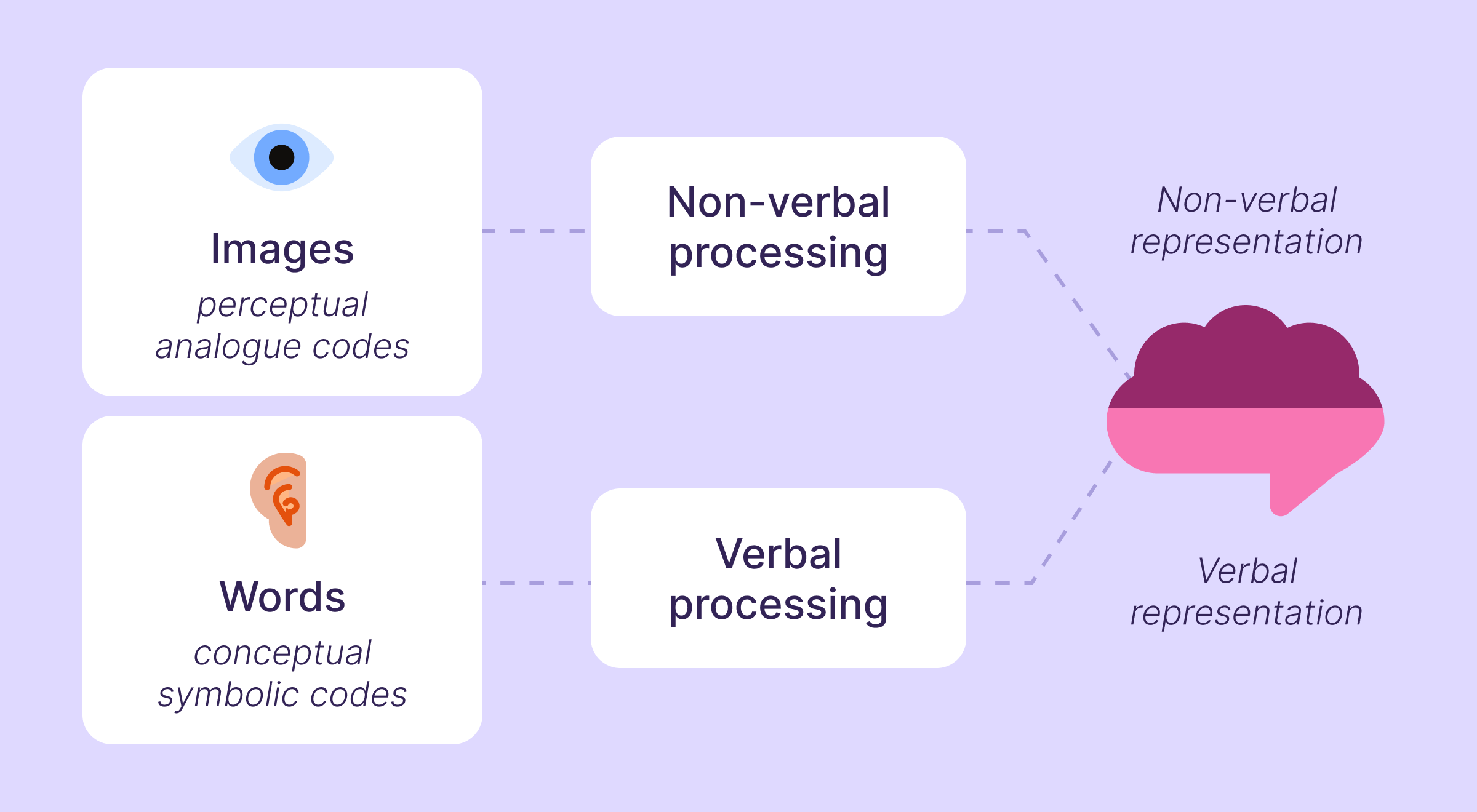
In cognitive psychology, this effect is explained by dual coding theory, proposed by psychologist Allan Paivio back in the 1970s. The idea is simple: the brain stores information in two “codes” — verbal and visual. When we receive text alone, only one channel is active.
But when words are paired with images, we create two pathways to the same information. These pathways can work independently or together, making recall easier and more reliable. And yes — memes aren’t just funny.
They often capture a complex idea in a few words plus an image, which makes them surprisingly memorable. In fact, students who learned biology through memes performed significantly better on tests than those who studied without them.
Recent research also shows that learning becomes even more effective when audio and interaction are added to text and visuals. This combination helps us understand material more deeply and remember it longer. The key is balance: formats should support one another, not overload the brain.
Why microlearning and multimodality click?
And this is where microlearning steps onto the stage. Short formats are a perfect match for multimodality: brief videos, concise texts, podcasts, or quick interactive quizzes can be easily combined without overwhelming the brain.
Imagine a modern Spanish lesson. First, the teacher explains the topic while you listen carefully to new words and grammar rules. Next, you read those same words and structures in a short text and hear them again in a listening exercise.
Then comes a short video showing the phrases used in real-life situations. Finally, you complete a few test questions and a role-play exercise. The formats change, but they all serve the same goal — to make the topic stick.
The same principle is widely used in learning apps. In language-learning apps, for example, a new word or rule is rarely presented as text alone. You see how it’s written, hear the pronunciation, repeat it out loud, use it in a sentence, or choose the correct option in a quiz. Each of these formats helps turn theory into a practical skill.
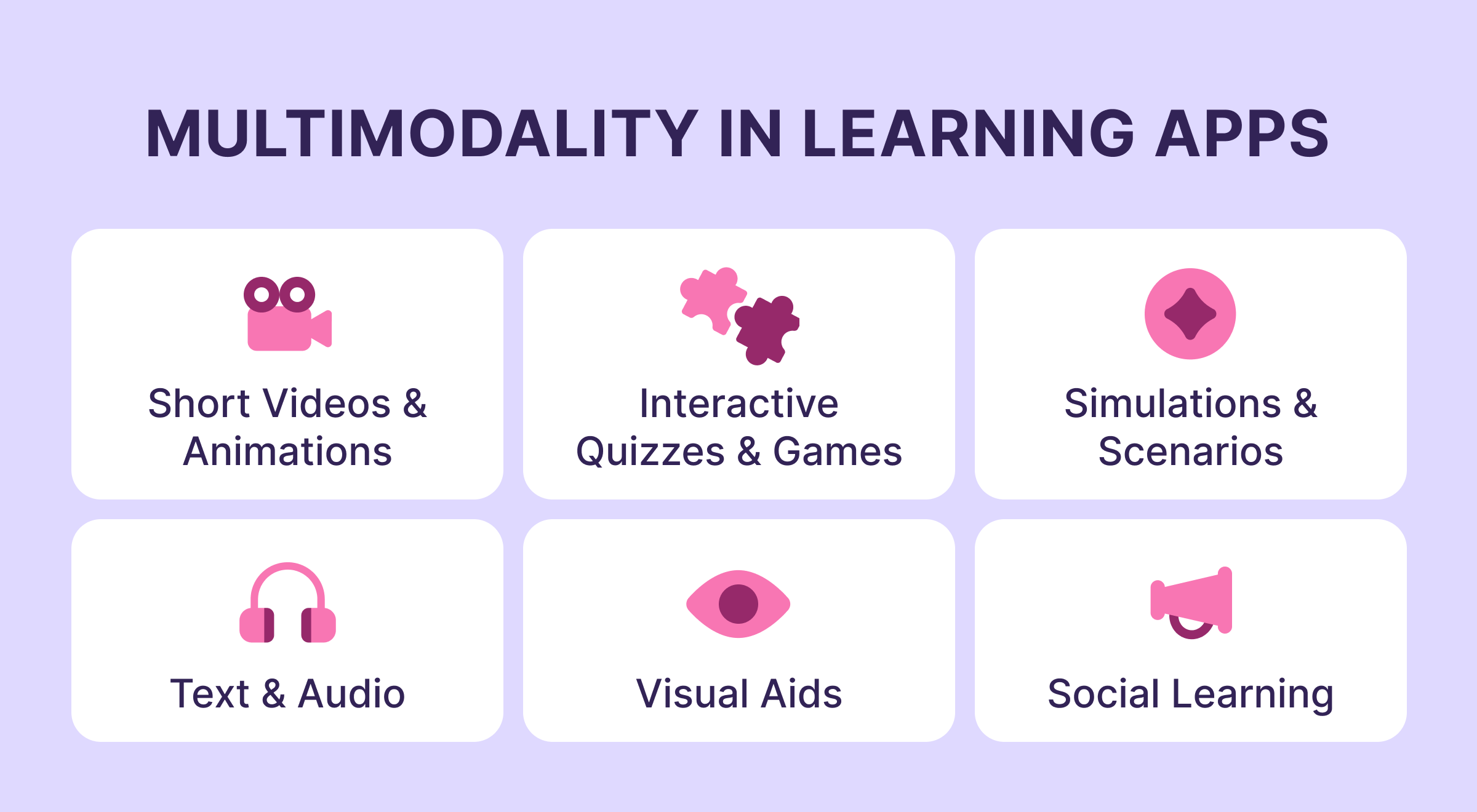
The Headway app also uses the principle of multimodality. You read a concise summary with the book’s key ideas, see highlights and prompts, listen to the audio version, and later return to those ideas at spaced intervals. This way, insights don’t disappear after the first read — they gradually stick and become much easier to apply in real life.
That’s exactly why microlearning and multimodality work so well together. When information is delivered in small portions through different formats, the brain doesn’t get tired — and it stores knowledge in multiple ways.
Effective learning is a lot like a well-balanced diet. If you eat nothing but lasagna, sooner or later you’ll start to hate it (unless, of course, you’re Garfield). But when your “learning diet” includes a mix of text, audio, video, and hands-on practice, the process becomes not only more effective, but far more enjoyable.
So don’t hold back. Start small: add just one more format to the way you already learn. Love reading nonfiction? Pair it with audio. Enjoy motivational podcasts? Write down the key insights and try to apply them right away.
Because when you don’t just consume information but actually act on it, learning turns into experience — and experience is what truly stays with us.