Self-growth
 Apps & Digital Tools
 Business & Career
 Success
 Growth Tools
 Psychology
 Communication
 Relationships
Four times five is twenty — easy, right? But can you remember what you wore to that party last Friday just as quickly? Not so simple, huh?
It’s not that your memory was better back in school when you were memorizing the multiplication table (though there’s a bit of truth to that). It’s just that the brain isn’t Hermione Granger’s bottomless bag where you can toss in everything and pull out whatever you need later.
It has limits — and it works more like a dynamic sorting system constantly deciding: “This matters. This doesn’t. This is taking up too much space — delete. This might be useful — keep.”
Inside your brain: your memory, explained fast
Everything we take in during the day — news, messages, conversations, sounds, images, even whatever was on that billboard you passed by — first lands in short-term memory. It works fast, but its capacity is limited. In fact, we can hold only about 3–5 pieces of information in working memory at a time.
This means any extra detail literally “pushes out” the previous one. So if that billboard wasn’t important to you, your brain will drop it within a few hours or even minutes. To move something into long-term memory, the brain needs certain cues: emotions tied to the information, repetition, real-world application, or links to things we already know.
That’s why you still remember the multiplication table — you practiced it hundreds of times in school and beyond. But try recalling what Taylor Swift posted on her Stories yesterday, or where exactly you left off in last week’s report… suddenly not so easy.
The world record for memorizing digits of π after the decimal point belongs to Rajveer Meena, who in 2015 recited 70,000 digits in a row in 9 hours and 27 minutes! That’s not magic, but the result of systematic memory training and a deep understanding of how the brain responds to new information. So the real question is: how do we help the brain store the things that actually matter?
Break the cramming cycle: a smarter way to remember
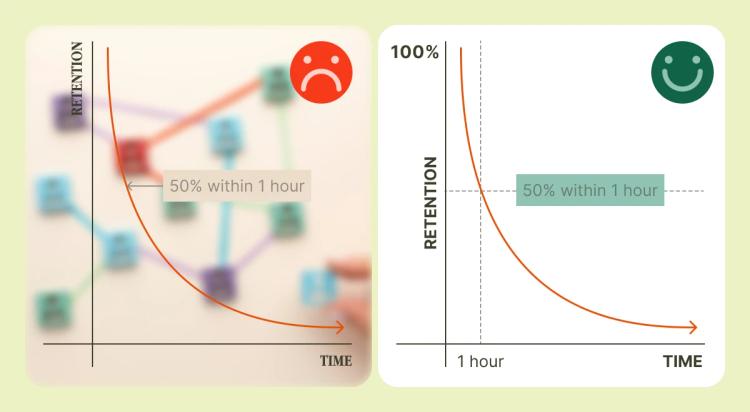
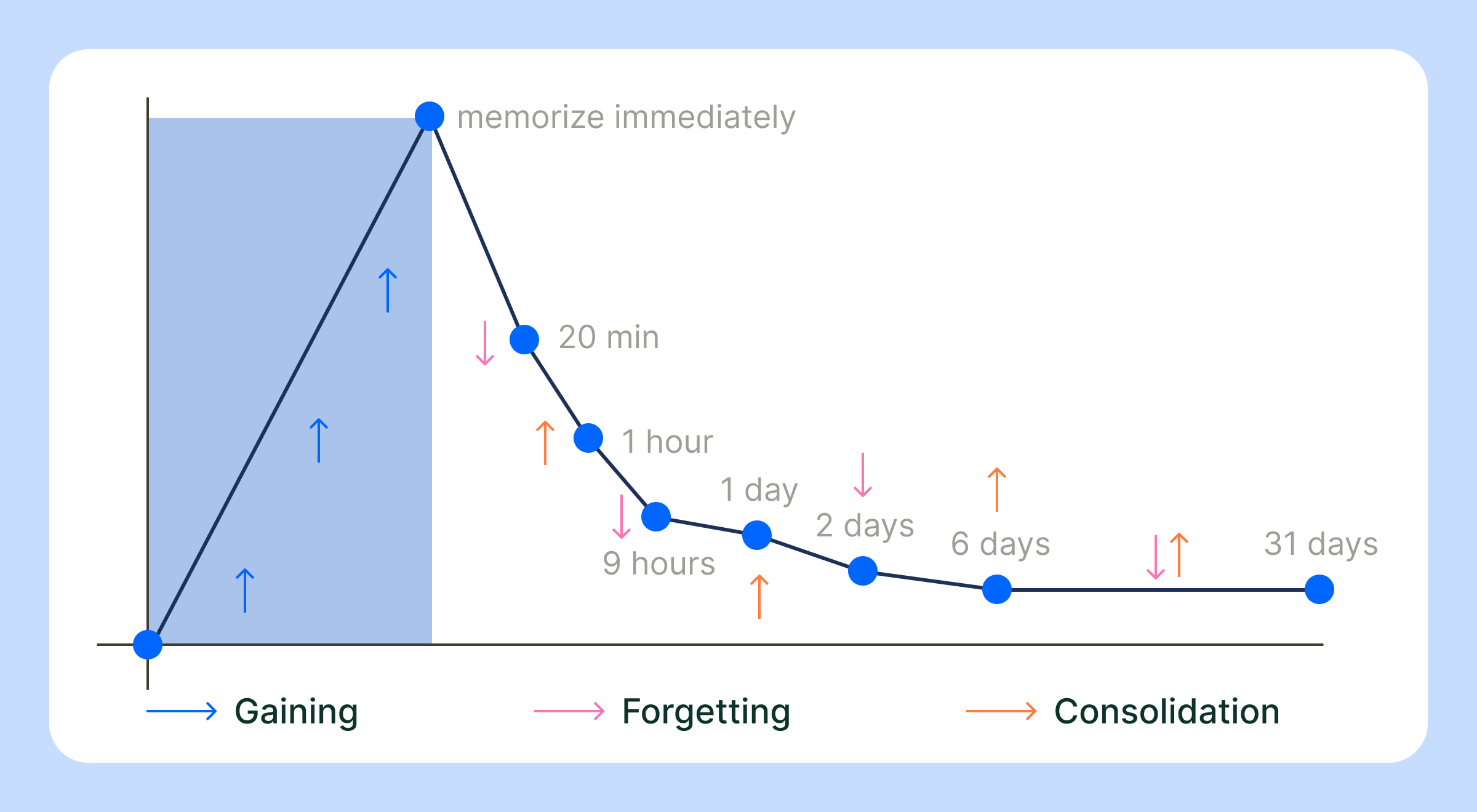
If the brain doesn’t see information as important — often because we don’t revisit it — it simply clears it out to “free space” for new impressions, tasks, and experiences. This phenomenon was described by German psychologist and philosopher Hermann Ebbinghaus back in the late 19th century.
He found out: right after learning, we remember almost everything, but within just a few hours, a significant portion fades. And after a few days, only fragments remain — unless we return to it from time to time. Ebbinghaus visualized this pattern in what we now call the forgetting curve.
The good news is that you can manage this process. Surprisingly, it's a lot like your eating habits. Think about how you feel when you skip breakfast and lunch, then reward yourself with a giant dinner. At first — pure bliss. But soon after?
That heavy, sleepy, and zero-energy-for-anything feeling. Now compare that with how you'd feel if you had a few balanced snacks throughout the day — probably more energized, focused, and way less tired. Your brain works the same way. When you try to cram everything at once, you overload it. You remember the big picture, but all the details slip away.
But when you “feed” the brain smaller bits more often — gradually leveling up the complexity — it actually takes in and stores much more. Just think back to school: some formulas, dates, or poems have stayed with us for years!
This is exactly the principle behind spaced repetition — reviewing information at increasingly longer intervals: after a day, then a few days, a week, a month. Research shows that knowledge sticks best when we repeat it just before it slips from memory.
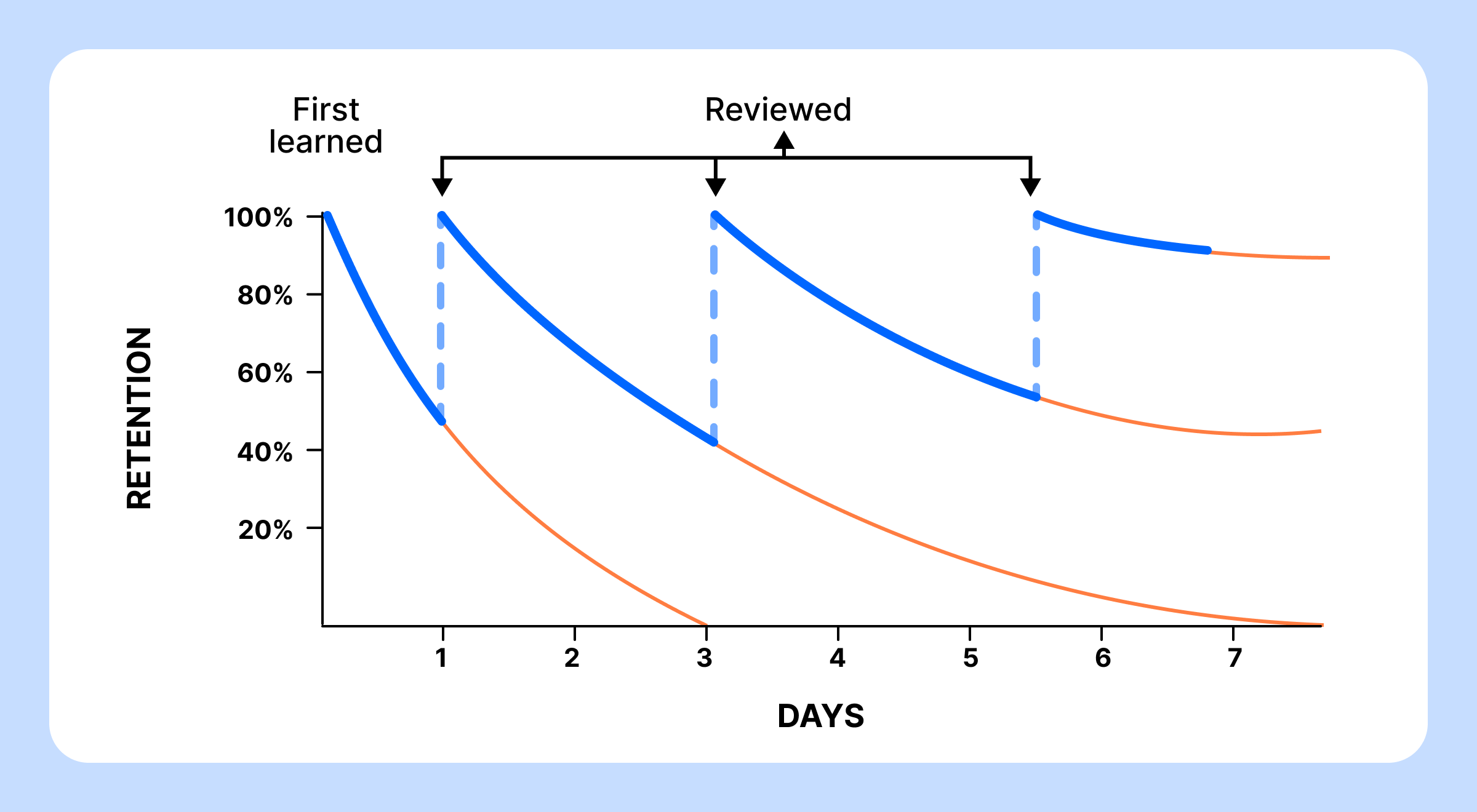
This approach helps move information from short-term to long-term memory, strengthening those neural connections as it goes. You end up studying less, but learning more — just the way we like it.
Does cramming the night before an exam actually work? Yes… and no. It might help you recall something briefly, right before a test. But it’s like trying to fill a glass with a fire hose — most of the water just splashes out. The information never has time to move into long-term memory.
If you want your knowledge to stick for the long run, the smarter choice is spaced repetition — a deliberate, structured way of learning that works with your brain, not against it.
The perfect match: how spacing trick boosts microlearning
Spaced repetition isn’t just a handy tool for self-study — it’s a proven, science-backed system that many learning apps already use behind the scenes: Duolingo, Nibble, Anki, Mochi, Headway, and many more.
Imagine your usual language-learning app. You tag the words you know well, the ones you mix up, and the ones you still can’t remember.
The app keeps track of all that — and that’s where the magic of spaced repetition begins. Words you’ve mastered start showing up less. The ones that keep slipping away from memory pop up more often.
This way, you don’t waste time revisiting what’s already solid — instead, you focus on the areas that actually need work. Over time, as you review words at different intervals, they slowly shift from short-term to long-term memory.
Headway uses a similar logic — but instead of vocabulary, you revisit key ideas and insights from books. The app nudges you right when the brain is about to forget something important — precisely the moment when repetition hits the hardest. It helps you reinforce ideas more deeply and start applying them in real life.
So if you want to learn more and remember longer — start small
Revisit one key insight tomorrow. Then again in a few days. Then next week. You’ll be surprised by how long it sticks.
And if building your own system feels overwhelming, let the tech handle it. Use apps that remind you of the right things at the right moment. Memory can be trained — and you can absolutely teach it to work for you, not against you.
Who knows? With this method, you might even break a world memory record… or at the very least, finally learn Spanish.