Self-growth
 Business & Career
 Success
 Communication
 Healing
 Relationships
 Psychology
 Happiness
A childhood friendship that's renewed through video games becomes the emotional and creative heartbeat of 'Tomorrow, and Tomorrow, and Tomorrow,' Gabrielle Zevin's literary triumph. The novel was Amazon's #1 book of the Year in 2022. It's a story about making art and surviving grief, highlighting the regeneration of human connections.
In this 'Tomorrow, and Tomorrow, and Tomorrow' summary, you'll find a complete overview, plus some spoilers, a character guide, a thematic analysis, and recommendations for similar reads. If you're a fan of this must-read, this article also contains thematically similar reads that are available in the Headway app. Keep on reading!
Quick answer: Key plot twists that change everything in 'Tomorrow, and Tomorrow, and Tomorrow' (spoilers alert!)
Sadie's betrayal (regarding school credit) ends their childhood friendship.
Ichigo becomes a surprise hit, launching their careers.
Dov's toxic mentorship affects Sadie's creative confidence.
Marx's death shatters their studio and emotional stability.
Sam's creation of Mapleworld is a step toward empathy and healing.
Their final collaboration signals reconciliation and emotional maturity.
What is 'Tomorrow, and Tomorrow, and Tomorrow'?
Gabrielle Zevin's 'Tomorrow, and Tomorrow, and Tomorrow' was published in July 2022 by Knopf, an imprint of Penguin Random House. The novel has quickly become a genre-defying work. Its storyline spans three decades and follows Sam Masur and Sadie Green, two childhood friends and gamers turned developers.
Their partnership becomes both a safe space and a source of hardship, challenging their creativity and identity.
The novel became a New York Times bestseller. It earned praise for its emotional depth and structure, as well as for combining literary fiction with gaming culture. It has also won the Goodreads Choice Award for Best Fiction in 2022.
If you enjoy novels that speak about finding refuge in the creative process and the exploration of disability and ambition, Zevin's novel will surely become a favorite.
Quick synopsis (non-spoiler!)
Sam Masur and Sadie Green first meet as children in a hospital. Sam is recovering from a car accident that left him with a disabled leg and took his mother's life, while Sadie's older sister is undergoing leukemia treatment. They bond over the video games of the time, Super Mario Bros. and Oregon Trail.
A misunderstanding drives them apart, only to reconnect years later in Boston. Sam is a Harvard student, and Sadie is at MIT. They reignite their friendship, and a creative partnership is formed, resulting in a video game called Ichigo.
Their creation becomes a breakout hit, and with Marx Watanabe's help, their charismatic producer and friend, they launch a studio. But as their careers evolve, the stakes become higher and more challenging. Rival ambitions and personal trauma begin to affect their bond. This tension illustrates how creativity can both unite and divide.
Love short and informative reviews?
Dive into 2k+ book summaries and discover something new every day.
Continue'Tomorrow, and Tomorrow, and Tomorrow' full plot summary and spoilers
1) Origins and first game
Sam and Sadie's childhood friendship begins in a hospital game room. They bond over Nintendo and video games. The language of play becomes a relief from the pain. However, when Sam discovers that Sadie was earning a school credit for visiting him, he feels betrayed. They drift apart.
Years later, they accidentally meet at a subway station in Boston. They reconnect, and their shared passion for video and computer games reignites. This passion results in the creation of Ichigo, a quest inspired by Japanese folklore. Marx Watanabe, Sam's roommate and a former theater major, joins as producer. The game becomes a massive success, launching their careers.
2) Unfair games and creative challenges
With fame comes pressure. As the newly created studio, Unfair Games, expands rapidly, Sadie struggles with creative burnout. She puts in a lot of effort to escape the shadow of her former mentor and romantic interest, Dov. Sam, meanwhile, deals with chronic pain as memories from his past surface.
Their second game, Both Sides, is an RPG that explores parallel realities and the creation of an ideal life. This ambitious project reveals the division growing between the two best friends. Sadie feels increasingly sidelined as Sam's control expands.
3) Success, conflict, and betrayal
Marx becomes the emotional glue of the trio, even if his romantic involvement with Sadie is not well-received at first. Tragedy strikes when he is killed by someone who actually wanted to eliminate Sam. His death has a terrible impact on the two, and their partnership collapses.
Their paths separate, with Sam retreating into solitude and dealing with chronic pain after his amputation. As a response, he creates Mapleworld, an online refuge governed by empathy. Sadie continues to design and make her own game engine.
3) Loss, reconciliation, and what comes after
Sam and Sadie tentatively reconnect, years later. They begin working on a new game together, one that reflects their shared history and emotional evolution. The final chapters are a quiet introspection, as they finally come to terms with what they've built and what they've lost.
The novel ends with a sense of rebirth, showing that their friendship has survived, though scarred. The act of creation becomes a way to honor the past and imagine new tomorrows.


'Tomorrow, and Tomorrow, and Tomorrow' characters breakdown
Sam Masur
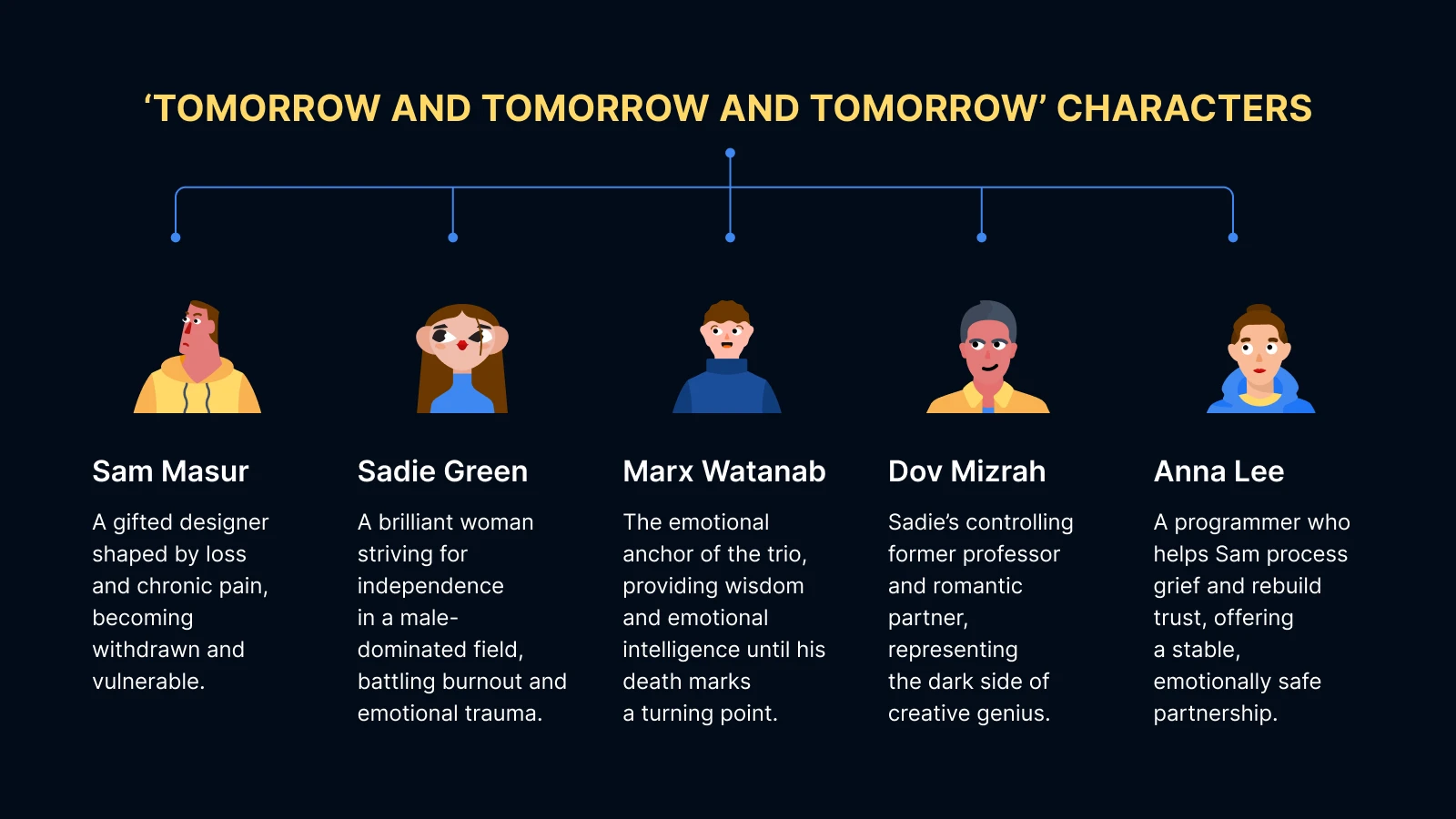
Also known as Samson Mazer, he is one of the main characters, a gifted designer. Losing his mother at an early age and having to live with chronic pain from his injured leg shaped his personality. As a result of these experiences, his vulnerability increases, and he becomes withdrawn.
Sam's connection with Sadie Green sits at the heart of the story. Their friendship doesn't fit the usual mold of love, but is equally powerful and messy. Sam also shares a brotherly connection with Marx Watanabe, who brings some much-needed calm and warmth into Sam's chaotic life.
Sadie Green
Sadi, the other protagonist, is equally brilliant and determined to find her professional independence. She's determined to make her own name and become successful in a male-dominated field, not just follow in her mentor's footsteps. Dov Mizrah's influence extends over her personal life as well, affecting her sense of self-worth. Sadie's development is marked by her struggle with creative burnout and emotional trauma.
She and Sam form a perfect creative pair, but their friendship is often affected by miscommunication and their own ambitions. Her relationship with Marx starts as platonic and matures into something stronger. His death deeply affects Sadie, changing the way she approaches work and relationships.
Marx Watanabe
Marx is the glue that holds the trio together, serving as an emotional anchor. Once their first game shows a promising future, he assumes the role of producer. He brings emotional intelligence and wisdom to their new gaming company, Unfair Games. His death is a turning point in the novel, symbolizing the fragility of life and the cost of ambition.
Other 'Tomorrow, and Tomorrow, and Tomorrow' characters
Dov Mizrah, Sadie's former professor and romantic partner, represents the darker side of creative genius. Dov uses his charisma to control and undermine Sadie. This abuse leaves her creatively stifled and personally wounded.
Anna Lee, a programmer and collaborator on Mapleworld, helps Sam process grief and rebuild trust. Her quiet presence becomes a partnership marked by mutual respect and emotional safety. Their relationship stands in contrast to the unstable relationship with Sadie.
'Tomorrow, and Tomorrow, and Tomorrow' themes and analysis
Friendship & collaboration
Friendship is the novel's central element and its defining force. Sam and Sadie's bond is built on mutual respect. It's born out of a shared passion for the game world. Their relationship challenges the reader to analyze intimacy not as a sexual connection, but as a deeper emotion. Zevin portrays collaboration as both a safe space and a battlefield — a place where trust and ego collide at every step.
Creativity, game design & authorship
Game design is viewed as a philosophy in the novel. It becomes a way of interpreting life, with each game being a reflection of their emotional state and evolving relationship. Ichigo is born from their early synergy, while Both Sides is a more fractured approach, its virtual worlds showing their growing distance.
Mapleworld represents their healing process and acts as a response to their grief and isolation. The novel also challenges the concept of ownership in the creative process — who receives credit and who holds power.
Headway parallel: 'Steal Like an Artist' by Austin Kleon offers insights into the creative process, authorship, and the beauty of borrowing and remixing ideas.
Identity, disability, and trauma
Sam's disability is shown as a way through which he experiences life, not only physically, but also emotionally and creatively. Meanwhile, Sadie carries emotional damage from her relationship with Dov and the pressures of being a technical woman in the world of video games.
Zevin combines their identities with their art. The novel shows how trauma can influence creativity. The book also explores cultural identity through Sam's Korean-Jewish heritage and Sadie's Jewish background.
Headway parallel: 'The Body Keeps the Score' by Bessel van der Kolk explores how trauma lives in the body and shapes identity.
Ambition, success, and failure
Through the story, questions regarding the price of accomplishment and what it actually means start to arise. When Sadie and Sam achieve fame, the tension between art and commerce sets in. Both become consumed by these elements.
Headway parallel: 'Grit' by Angela Duckworth examines perseverance, ambition, and the emotional toll of striving.
Love, loss, grief, and rebirth
The highest emotional point is Marx's death, which changes Sam and Sadie's relationship and the way they create art. The novel illustrates the instability of the healing process. Both our main characters navigate it in their own unique ways.
The final chapters are more introspective. Both begin to rebuild. The title, drawn from Shakespeare's 'Macbeth,' suggests that each new day brings the possibility of new beginnings.
'Tomorrow, and Tomorrow, and Tomorrow' ending explained
Spoiler warning! This section of the book review contains plot details from the final chapters.
The ending of Gabrielle Zevin's novel is introspective and symbolic. After their years facing creative triumphs and personal losses, Sam and Sadie find themselves once more at a crossroads. We don't have a dramatic reunion, but a return to what first connected them — the act of making something together.
In the closing chapters, Sam reaches out to Sadie with a new game idea. He starts from a simple premise. The game would reflect their shared history, encompassing both the joys and the wounds. Sadie agrees to collaborate, and her decision marks a silent reconciliation.
They don't resolve every past hurt, nor do they fall into a romantic relationship. Instead, they choose to create again, side by side. They acknowledge that their friendship is worth preserving.
The game they begin to build is an act of persistence, proving that relationships require effort and patience. We don't know if Sam and Sadie will remain close, or if their new game will succeed. But the idea suggested is that creation is a form of connection, maybe as powerful as love.

If you liked 'Tomorrow, and Tomorrow, and Tomorrow,' check out
Fiction recommendations:
'The Animators' by Kayla Rae Whitaker: An emotional story of two women animators and their volatile friendship.
'Normal People' by Sally Rooney: A story about an emotionally complex friendship that challenges romantic rules.
'The Interestings' by Meg Wolitzer: It follows a group of friends over decades, dealing with ambition and love.
Nonfiction recommendations:
'Option B' by Sheryl Sandberg & Adam Grant: A story that discusses grief and rebuilding after loss.
'Big Magic' by Elizabeth Gilbert: It encourages self-expression and unleashing your creative power.
'Ways of Seeing' by John Berger: Another title about discovering your inner artist and harnessing creative energy from the world around.
Book club / Discussion questions
'Tomorrow, and Tomorrow, and Tomorrow' is not just a novel about a group of video game creators. Gabrielle Zevin invites us into the lives of Sam and Sadie, two brilliant minds whose connection defies standard labels.
The story is ideal for book clubs, as it ignites meaningful conversation through its themes. We've selected a list of questions to help you get the discussion started:
Does the relationship between Sam and Sadie redefine what romantic love means?
What does the novel suggest about the nature of creative collaboration?
How do video games shape the characters' identities?
How do emotional and physical disabilities impact Sam's character development?
What role does failure play in the characters' growth?
Can art ever truly separate itself from the artist?
Create your own tomorrow with Headway!
'Tomorrow, and Tomorrow, and Tomorrow' serves as a reminder that creativity, friendship, and resilience are created through ongoing effort and reinvention. Sam and Sadie's journey through collaboration, loss, and reconciliation illustrates the healing power of making things. This process connects us to what is best about life.
If this unique story dazzled you, why not keep that feeling going? Headway offers a library of over 2,000 summaries and ideas on everything from creativity and resilience to friendship and individual growth. Each summary is presented in 15-minute bite-sized chunks.
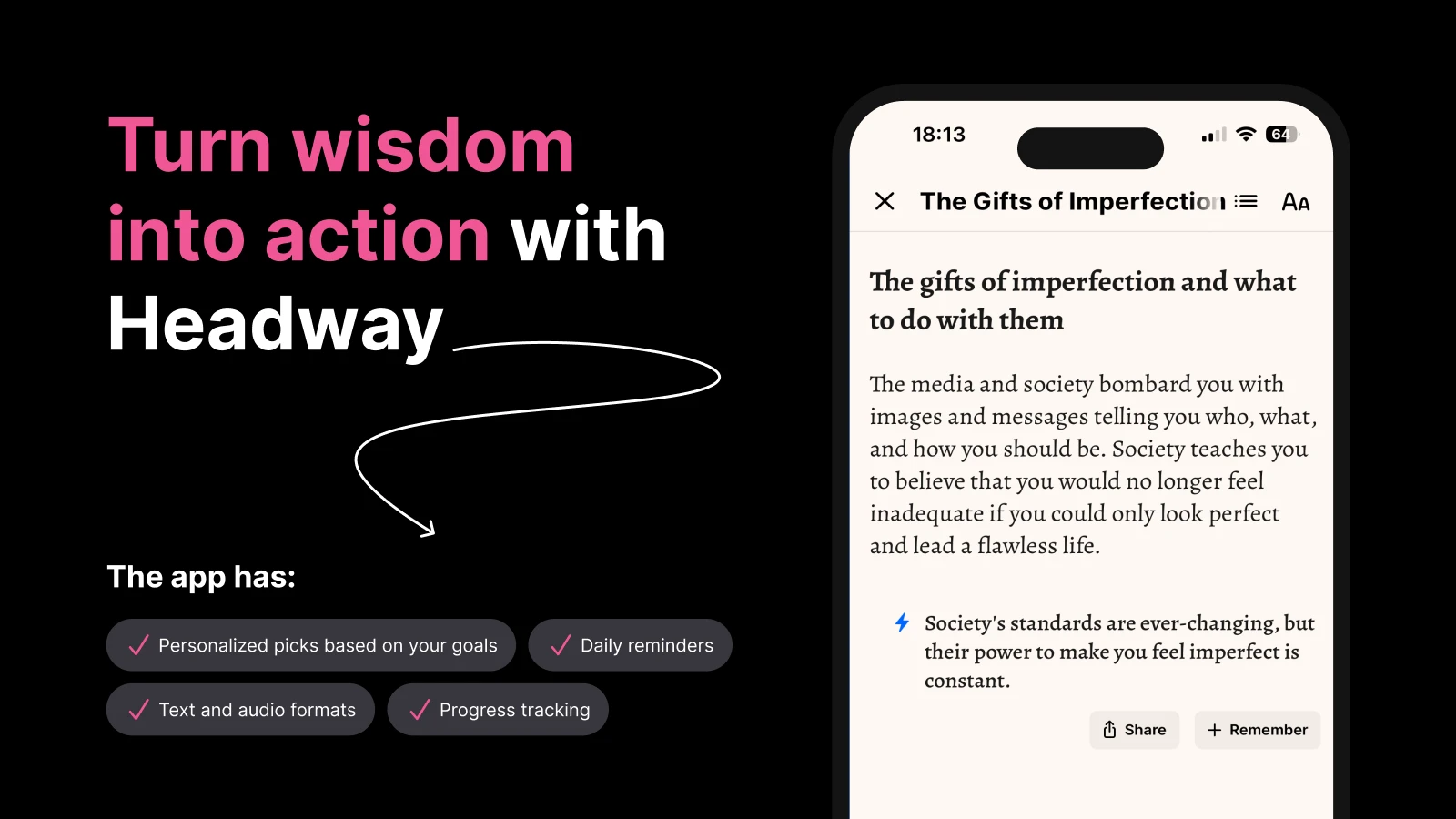
You will receive personalized recommendations tailored to your interests. You'll get daily commitment trackers to help you establish a strong reading routine. And you'll even receive flashcards to aid in reviewing and retaining key ideas.
Download Headway today to help establish learning as part of your everyday life!
FAQs about 'Tomorrow, and Tomorrow, and Tomorrow'
Why does Sadie hate Sam so much?
Sadie doesn't actually have a strong dislike for Sam. Instead, their history reveals a complicated relationship marked by tension stemming from betrayal and misunderstanding. When Sam was a child, he felt betrayed when he found out from his mother that Sadie would receive school credit for visiting him in the hospital.
What is the famous quote 'Tomorrow, and Tomorrow, and Tomorrow'?
The line comes from Shakespeare's 'Macbeth,' which Macbeth spoke after his wife's death. Zevin flips this sense of despair expressed by Shakespeare into one of hope. This transformation happens when Sam and Sadie are able to reconcile and begin to create again after the event of Marx's death.
What is the ending of 'Tomorrow, and Tomorrow, and Tomorrow'?
The ending is quiet and hopeful. After years pass following Marx's death, and years apart, Sam decides to reach out to Sadie to enlist her help with yet another game based on some of the history they shared growing up. They aren't a couple, nor is every problem solved. Rather, they decide to create together again and recognize that friendship is valuable and meaningful.
Will there be a 'Tomorrow, and Tomorrow, and Tomorrow' movie?
As of 2025, no officially confirmed movie has been announced. Given that it won both a Goodreads Choice Award and was a bestseller, people have likely had conversations regarding the sale of the movie rights. Since the story is already visual, with its connections to gaming, its 30-year time span, and the implications of feminism, it's a worthy story for the big screen.