Self-growth
 Apps & Digital Tools
 Business & Career
 Success
 Growth Tools
 Psychology
 Communication
 Relationships

Your phone is going to give you something today: Either another hour lost to doomscrolling, or 15 minutes that leave you a little smarter than you were yesterday. The right knowledge apps make that swap easier than it should be.
They turn the gaps in your day — the commute, the waiting room, the moment between meetings — into something that compounds over a year instead of evaporating into nothing. Call it productive screen time — same phone, same minutes, different outcome.
The list below is eight apps that earn the title for real reasons, not because they ranked well on someone else's listicle. Each one gets a clear note on what it's best for, what format it uses, and what it costs.
One of the most-used knowledge apps in the world right now is Headway, with over 55 million downloads, and it condenses bestselling non-fiction books into 15-minute reads.
📘 If that sounds useful — try the Headway app today!

All app features described in this article are accurate as of August 2026. Prices may vary depending on your region, current promotions, and seasonal offers.
The best knowledge apps, at a glance (TL;DR)
The best knowledge apps for adults right now include Headway, Nibble, Brilliant, Khan Academy, Duolingo, TED, Curiosity Stream, and DailyArt.
For big-idea non-fiction, Headway is the strongest pick — book summaries in 15-minute reads or audio, with deep dives across psychology, business, and habits.
For bite-sized general knowledge across art, history, philosophy, and science, Nibble is one of the best general knowledge apps available right now.
For STEM and critical thinking, Brilliant offers good interactive lessons.
The right knowledge app for you depends on what you want to learn, how long your sessions tend to be, and whether you prefer reading, watching, or interactive practice.
The 8 best knowledge apps in 2026 to try
Not sure which one to try? Here's the list of the 8 best options.
1. Headway app — Bestselling non-fiction, condensed into 15-minute reads and audio
Headway has become one of the best knowledge apps in the world for a reason — it solves the problem most adults actually have. You want to read more non-fiction. You know roughly which books would help. You just never find the time.
Each title is condensed into a 15-minute read with the option to listen as audio, and the library spans psychology, business, productivity, philosophy, history, relationships, and self-improvement. The author list includes James Clear, Brené Brown, Cal Newport, Daniel Kahneman, Adam Grant, Yuval Noah Harari, Mark Manson, and many more.
Over 55 million people use it. It functions equally well as a self-improvement app and an app for motivation when you need a push. (Weighing Headway vs. Blinkist? Similar idea — but Headway leans more interactive and habit-focused.)
Best for: Adults who want the ideas from the world's best non-fiction without the time commitment.
Pricing: Free trial; Premium annual subscription — $69.99, which is ≈ $5.83/month.
App Store rating: 4.6/5 stars (116K ratings).
2. Nibble — Bite-sized lessons on art, philosophy, science, history, and general knowledge
Nibble is a microlearning app built for adults who want a steady drip of general knowledge across the topics most education leaves out — art history, philosophy, geography, and science. Bite-sized lessons run 5 to 15 minutes, structured as short reading sessions with quizzes built in for retention.
Over 4 million people have downloaded it, and the ratings and reviews consistently put it in the Top 15 Free Education apps on the App Store in the US, Canada, and Australia. If you've been looking for an app to replace social media with something that leaves you a little smarter, this is one of the cleaner options.
Best for: Curious adults who want to broaden their general knowledge across art, science, philosophy, and history.
Pricing: Free tier; Premium annual subscription — $49.99, which is ≈ $4.16/month.
App Store rating: 4.3/5 stars (43K ratings).
3. Brilliant — Interactive lessons on math, science, computer science, and logic
Brilliant teaches by problem-solving rather than lecturing. Each lesson is a hands-on puzzle in math, physics, programming, probability, or logic, designed to teach concepts through doing. Sessions run 5 to 15 minutes, and the format is built around active recall, which means retention is significantly better than passive video learning.
Some users call it a brain training app, though it goes well beyond what Impulse or other brain training tools do.
Best for: People who want to genuinely understand STEM concepts, not just hear them explained.
Pricing: Free tier with limited daily lessons; Premium around $24.99/month or $149.88/year.
4. Khan Academy — Free, in-depth courses on almost any academic subject
Khan Academy is the long-running standard among educational apps for free academic learning. Math, science, economics, history, computer science — almost any K through college subject is covered with video lessons, structured learning paths, practice problems, and progress tracking.
Sessions are flexible: anywhere from 10 minutes to an hour, depending on what you're working through. For math-heavy needs in particular, it pairs well with tools like Photomath, which is excellent for working through problems step by step.
Best for: Filling in academic gaps, brushing up on math, or learning a subject systematically.
Pricing: Free.
5. Duolingo — The most-used language-learning app in the world
Duolingo is the gamified standard for casual language learning. The streak mechanic, short daily lessons, and habit-forming design have made it one of the most-used apps of the past decade.
It won't make you fluent on its own, but it's effective at building vocabulary, basic grammar, and a real daily habit. People often pair Duolingo with Quizlet decks for vocabulary drills, which is a solid combo for early-stage learners.
Best for: Building or maintaining a language habit. Beginners and intermediate learners specifically.
Pricing: Free with ads; Super Duolingo is around $6.99–$12.99/month.
6. TED — The talks and ideas library that introduced the world to short-form learning
TED's app gives you direct access to thousands of talks across every topic worth thinking about — science, design, psychology, global issues, business, and the arts. Talks run 5 to 20 minutes and are curated by topic, mood, and length.
The format works better as a discovery tool than as a structured learning path. If you want online courses with real depth, TED isn't it — but as a way to graze across ideas, it's hard to beat.
Best for: Casual learning, getting exposed to new ideas, listening during commutes or walks.
Pricing: Free.
📘 TED talks are great for ideas you bump into. Headway's audio mode is for the books you've actually been meaning to read.
7. Curiosity Stream — Documentary streaming for ideas, science, history, and nature
Curiosity Stream is the Netflix of documentaries with thousands of high-quality non-fiction films and series across science, technology, history, society, and the natural world. The format suits people who learn best through long-form video.
Sessions tend to run 20 to 60 minutes, so it fits better for evening or weekend learning than commute-style use.
Best for: People who prefer documentaries and video over reading.
Pricing: Around $4.99/month or $39.99/year.
8. DailyArt — One painting a day, with the story behind it
DailyArt is a quiet daily ritual rather than a full learning app. Each day, the app delivers one work of art with a short description of the artist, the period, and the context around the painting.
Over time, it builds a surprisingly deep familiarity with art history without ever asking more than two minutes of your attention. Some iPad app versions handle the visuals especially well.
Best for: Building art-history knowledge slowly, with almost no daily commitment.
Pricing: Free with optional Pro upgrade for around $4.99/month.


What makes a knowledge app worth using
A knowledge app earns the title by doing three things well: it teaches you something genuinely worth knowing, it fits into a real adult schedule rather than a college student's, and it uses a format that actually helps you remember what you learned afterward.
Four criteria separate the strong knowledge apps from the forgettable ones:
Short, finishable sessions. Five to twenty minutes. Long enough to teach something. Short enough to fit into the gaps in your day.
Retention is built into the format. Quizzes, spaced repetition, summaries, audio replays, practice exercises — anything that fights the Ebbinghaus forgetting curve. Without retention features, you're just consuming content. With them, you're building memory.
Depth on a topic worth your time. A trivia app is fun. The best general knowledge quiz apps are even more fun. But a real knowledge app should leave you with something that compounds. The difference between a fact you remember at parties and a concept that actually changes how you think.
Low friction to open. The apps you actually use are the ones that don't require setup, planning, or a free hand. The best learning app in the world is useless if you never open it. That matters double for ADHD brains: the lower the friction, the more likely the habit survives.
📘 Want to actually finish a book this month? Pick one Headway summary tonight.
How to pick the right knowledge app for your needs
Match the app to what you actually want to learn.
If you want big-idea non-fiction: Headway is the clearest fit. Book summaries in 15 minutes, covering the topics most adults care about — habits, focus, psychology, work, relationships.
If you want broad general knowledge: Nibble. Art, philosophy, science, history — all in short, retention-friendly lessons. Among the best general knowledge apps for adults right now.
If you want STEM and critical thinking: Brilliant. The interactive lessons make the concepts stick in a way passive video learning never does.
If you want serious skill development: Masterclass and Udemy are stronger picks than anything on this list — they're built for longer learning tools and structured deep work on specific skills. Simply Piano sits in a similar category for music specifically.
If you want to learn a language: Duolingo, paired with iTalki or a tutor when you've outgrown the basics. The language-learning app market is crowded, but Duolingo is still the easiest place to start.
If you want academic depth: Khan Academy.
If you want passive learning during walks or commutes: TED or Headway in audio mode.
You don't need more than two or three of these at a time. Knowledge base apps work best when you commit to one or two for at least a month before adding more. And if you take notes, pairing any of them with Notion or Obsidian turns passive reading into a real personal knowledge base.

Try Headway, the knowledge app built for real adult schedules!
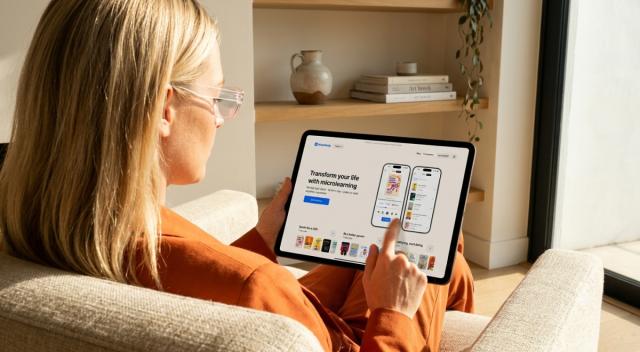
Most knowledge apps are good at one thing. Headway is built around a real problem most adults face: wanting to read more non-fiction, knowing roughly which books would help, and never finding the time to actually do it.
The library condenses bestselling non-fiction — Cal Newport, James Clear, Brené Brown, Daniel Kahneman, Adam Grant, Mark Manson, and hundreds of others — into focused 15-minute reads or audio.
Fifteen minutes a day adds up to roughly two books a week. Over a year, that's a hundred of the most influential books on focus, growth, leadership, and life. The essential app for swapping doomscrolling for something that compounds.
📘 Want one knowledge app that earns its space on the home screen? Headway is the one.
FAQs about knowledge apps
Which is the best knowledge app?
There isn't really one. If you mostly want nonfiction book ideas, Headway is what most people end up using. Nibble's better if you want shorter lessons across art, philosophy, and history. Brilliant is the one if you actually like math and logic puzzles. The best one is whichever you'd open tomorrow without thinking about it.
Is there a free knowledge app?
Yeah, Khan Academy is fully free and covers most academic subjects you'd want to relearn or fill in. TED's app is free too. Duolingo has a free version with ads that works fine for casual language stuff. DailyArt is free. Most of the others give you a trial and then charge. Khan Academy is probably the most useful of the free ones.
What app is best for studying?
If you mean memorizing material for exams, Anki is the standard. Quizlet's easier to set up if you're cramming. Khan Academy works for the actual subject content. Headway is a different thing — it covers the habits side, books on focus and memory, and so on. You'd use them for different reasons, not as alternatives.
Which AI is best for knowledge?
NotebookLM is worth checking out because you can upload your own notes and ask questions about them specifically. ChatGPT and Claude are fine for general explanations or working through ideas. The one thing to know is that all of them make stuff up sometimes, even when they sound certain. So check anything important against a real source.
What 3 apps should I try right now?
Headway for nonfiction. Nibble for the kind of stuff you wish you'd paid more attention to in school — art, philosophy, history. And then either Forest or Brilliant, depending on what you need more of. If your phone is eating your day, Forest. If you want to actually think harder about something, Brilliant.