Self-growth
 Business & Career
 Success
 Communication
 Healing
 Relationships
 Psychology
 Happiness

Ever finish a chapter and realize you have no idea what you just read? Your eyes moved across every word, you turned the pages, but nothing stuck. Five minutes later, it's gone — like you never read it at all.
This happens constantly. And no, you're not a bad reader — you just never learned the actual techniques for reading comprehension. Schools make you read and answer questions, but nobody teaches you how to make stuff stick in your head in the first place.
There are some straightforward things you can do that make a huge difference. Once you know them, information stops disappearing the second you close the book.
Trying to read more but forgetting everything? Headway uses spaced repetition and flashcards to help with reading comprehension. The stuff you learn actually stays in your brain instead of vanishing.
📘 Download Headway and and learn how to improve reading comprehension!
Quick answer: What is reading comprehension?
Reading comprehension isn't just reading aloud or recognizing words on a page — it's getting what they actually mean. You've probably finished a few pages, thought "okay, that was fine," and then couldn't tell anyone what you just read. That's because you weren't really comprehending it.
Reading comprehension skills help you process and remember information instead of letting it evaporate.
Decoding – Your brain turns letters into words and sounds
Understanding – You figure out what those words and sentences mean
Connecting – You piece it all together
Reading comprehension strategies that work:
Ask yourself questions while you read.
Pull in prior knowledge about the topic for extra context.
Guess what's coming next.
Summarize sections in your own words to check if you actually got it.
When your improve reading comprehension and it becomes solid, books stay with you. You remember what you read instead of forgetting it five minutes later.
Why are reading comprehension skills important?
Reading comprehension skills are vital in many areas of life. They go beyond simply looking at words on a page to understanding, integrating, and critically analyzing information. Effective reading comprehension skills enable deeper learning, improved communication, and informed decision-making.
Let's put this into some real-life contexts:
Academic success
Reading comprehension is vital for learners, so it's a great skill to have if you're studying, whether in high school or beyond. As you enter higher education, you're expected to absorb and understand information from written materials.
Textbooks, research papers, essays, and instructional materials require strong reading comprehension to grasp and apply complex ideas. Otherwise, it's all lost, and you just sit there, totally confused. Not fun.
Those who excel in these skills often find it easier to manage their course loads, perform well in exams, and contribute to classroom discussions. In essence, reading comprehension skills help students meet their potential.
Your professional advantage
We can also discuss work, where reading comprehension skills are equally crucial. Whether reading reports, drafting emails, or preparing presentations, the ability to understand and communicate information accurately is crucial.
In many jobs, advanced reading skills are needed to interpret data, follow complex instructions, or stay informed about key points in industry trends. This gives the background knowledge to move forward and suggest new ideas.
Critical thinking and problem-solving
Reading comprehension is closely linked to critical thinking. If you're talented at comprehending written material, you can focus on key arguments, recognize assumptions, and understand the validity of information.
This skill set is vital for problem-solving, as it enables you to make well-informed decisions based on a careful understanding of information.
Personal growth and lifelong learning
Of course, reading broadens horizons beyond measure. Through books, you can explore cultures, experiences, and new perspectives. This enhances social understanding and cultural sensitivity, skills that are crucial in our modern world.
Additionally, whether it's learning a new skill through a how-to guide, staying current with news and developments, or reading books and articles, reading is a lifelong tool for personal growth.
Finally, reading for pleasure has been linked to improved mental health and well-being. From all of that, you can see just how important reading comprehension is in many areas of life.
📘 Try Headway to build reading comprehension skills that stick.
How reading comprehension connects to other reading skills
Reading comprehension works hand-in-hand with reading as an overall skill, connected with other aspects such as phonics, vocabulary, fluency, and text analysis.
Let's take a closer look at how these elements link together and summarize the main points:
Phonics and decoding: Phonics is the foundation that allows you to decipher unfamiliar words by correlating sounds with letters or groups. Decoding is using this knowledge to read words accurately. Reading comprehension takes this further by making sense of the decoded words.
Vocabulary: A strong vocabulary is vital for comprehension. Knowing the meaning of words and being able to understand them within different contexts enhances your ability to grasp the overall meaning of texts. By understanding what new words mean, you widen your vocabulary over time.
Fluency: Fluency is the ability to read text smoothly, with speed and expression. This skill is directly linked to comprehension because stumbling through text can affect your understanding of it and means you may miss the key points.
Text analysis and interpretation: This involves deeper engagement with a text, such as identifying themes, analyzing main characters, and understanding plot structures. Comprehension is key here because it allows you not only to take in the surface meaning of the text but also to analyze and critique it, deepening your understanding and engagement.
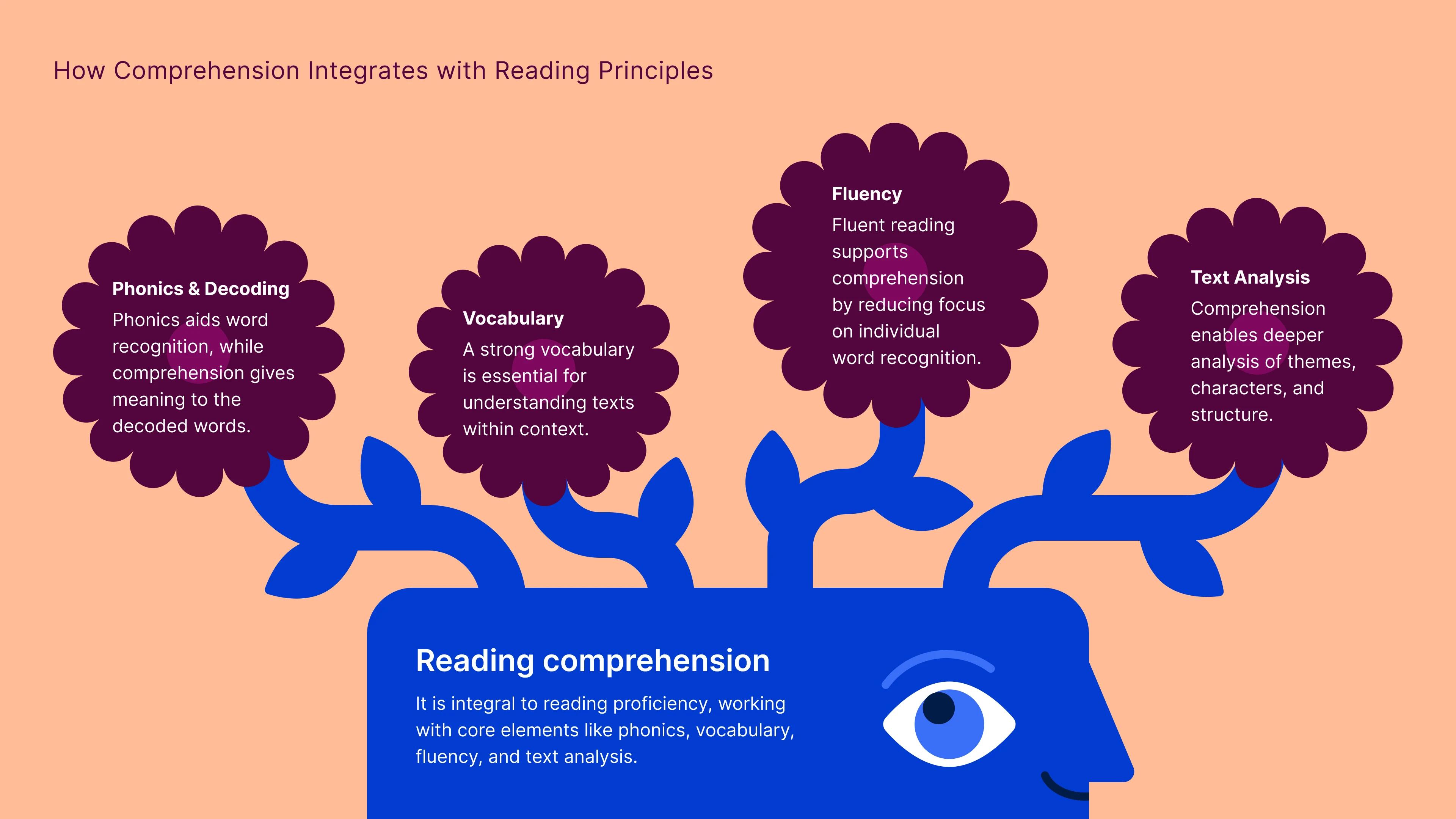
You could argue that reading comprehension is the glue that binds all the elements of reading together. That's why boosting your reading comprehension skills is so important.
A warning about the media…
Unfortunately, the media also plays a part in this. When you read something online or in a newspaper, it's written in a way that skews your understanding. It's biased and doesn't provide a balanced view. In 'How to Read a Book,' Mortimer Adler tells us:
"Television, radio, and all the sources of amusement and information that surround us in our daily lives are also artificial props. They can give us the impression that our minds are active, because we are required to react to stimuli from the outside. But the power of those external stimuli to keep us going is limited. They are like drugs. We grow used to them, and we continuously need more and more of them."
Reading comprehension skills allow you to dig a little deeper and move away from biases. In the end, you will understand your own definition of reading material, not what someone else tells you.
Seven strategies to improve your reading comprehension skills (1-7)
You know the what and why, but now you need to know the how. Let’s take a look at seven key strategies to help you boost your reading comprehension skills with ease.
1) Active reading
Active reading involves engaging with the text through questioning, predicting, and summarizing the main points. As you read a chapter in a book, pause after a few paragraphs to ask yourself questions like, "What do I think will happen next?" or "What is the main point of this section?" Use context clues and write down these questions. Your answers can also help solidify the material in your memory and help you identify the key take aways.
Of course, not all books are the same, and some are a lot easier to understand than others. But that doesn't mean you should stick to the same genres out of fear of not understanding or because you think it's too simple.
In 'How to Read the Classics,' Rostyslav Semkiv tells us:
"Books span a wide range of difficulty while being equally high-quality writing. You should not limit your reading diet to exclusively complex texts because they are not the only ones containing the truth."
2) Pre-reading
This strategy involves quickly previewing the text to get a sense of its structure and content before diving in deeply. Much of this depends on your reading speed, but it’s entirely possible to improve that, too.
In his book, 'Speed Reading,' Kam Knight advises:
"Read the front and back covers. Review the table of contents to get a feel for the organization, and notice if the book is divided into sections or parts. Read chapter headings to get a sense of the topics that will be covered."
So, before reading, scan the headings, subheadings, introduction, conclusion, and any summaries or abstracts. This provides a framework for understanding and helps establish expectations for what you're about to learn.
Speed reading can be quite tiring on the eyes, but there are several things you can do to help alleviate the strain. Kam Knight advises drawing figures of eight with your eyes, moving your eyes from side to side, then up and down, and blinking slowly for a few minutes.
3) Visual aids
Using visual aids, like graphic organizers, can help reinforce understanding and retention. For example, create mind maps or diagrams that help visualize relationships between different concepts in the text.




For a historical text, draw a timeline of events as you read, which can help you better understand and remember the chronological order and significance of events. For a novel, you could create a family tree to help you understand the connections between characters.
4) Annotating and highlighting
A good option is to try notetaking — marking important parts of the text with a colored highlighter and making notes as you read in the margins or a notebook. Note down your thoughts, comprehension questions, or real-life applications of the material. This will make reviewing key concepts much easier.
Additionally, why not try flashcards to help you remember key points from the book later? In the Headway app, you can use the flashcards feature and progress tracking to improve your comprehension skills.
📘 Get Headway to practice reading comprehension with real books.
5) Rereading difficult sections
Sometimes, you will read a section or a chapter and not grasp it the first time. In that case, revisit and reread sections that are complex or difficult to understand. If you're reading a challenging textbook and come across a particularly complex section, read it through once to get a rough idea, then go back and read it again more slowly, breaking down each part to fully grasp the concepts.
In his book, 'Limitless,' Jim Kwik advises:
"Before each reading, take a few minutes to talk about or write what you remember from the previous reading."
By doing this, you're reminding yourself of your previous learnings and building on them brick by brick. You may also find that you answer questions as you go, drawing on knowledge from your previous reading session.
6) Discussing with others
One of the most effective strategies is talking about what you've read with others. This discussion can deepen your understanding and provide new perspectives. You could join a book club or study group where you can share insights and discuss interpretations of texts.
Alternatively, try explaining what you've read to a friend or family member; teaching others is a great way to reinforce your own understanding. You can also do this to improve your vocabulary. Using new words in conversation helps enhance your understanding of what those words mean in practice.
7) Applying the content
This simply means using what you've read in practical, real-world contexts. So, if you're reading a book on financial literacy, actively apply concepts like budgeting or investing strategies to your personal finances. This not only helps improve your financial health but also cements financial concepts in a practical manner.
Regular practice of these strategies can significantly enhance your reading comprehension skills. This not only makes reading more enjoyable but also turns it into a powerful tool for lifelong learning.
Start practicing better reading comprehension with Headway!
Reading comprehension gets way easier once you know the techniques — ask questions, connect ideas, use context clues, and practice regularly. The tricky part is finding stuff worth reading and staying consistent when you're doing it on your own.
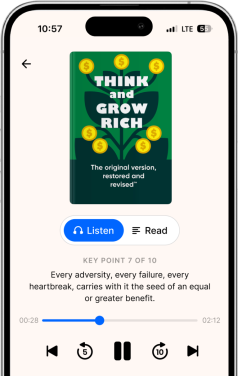
Headway works as a reading program that gives you 15-minute summaries of non-fiction bestsellers. You can read them or listen to them like audiobooks, whatever suits your day.
Commit today: think about how many books a year you want to read, or participate in the 'How to read 50 books a year' challenge and improve your reading comprehension. Who knows, maybe one day you'll even start writing your own book!
Pick topics you're curious about, use the reading comprehension strategies from this guide, and see how much more you remember. No sitting there for hours — just regular practice that fits your life.
📘 Download Headway and put your reading comprehension skills to actual use!
FAQs about how to improve reading comprehension
What is the best way to improve your reading comprehension?
Ask yourself questions while you're reading, then recap each section in your own words when you're done. Connect what you're reading to stuff you already know — it helps your brain file it properly. Turn off your phone and any other distractions. Your brain can't process anything if you're half paying attention. Actually engage with what you're reading instead of zoning out. Doing this consistently changes everything.
Why is my comprehension so poor?
Probably because you're distracted, rushing through it, or thinking about other stuff while your eyes scan the words. It's possible that you're exhausted, or the material isn't engaging enough. Not knowing enough words can also hinder comprehension — you can't understand sentences if you don't know what half the words mean. There could be plenty of reasons.
How to remember 80% of what you read?
Write stuff down as you go, mark important parts, and explain each section to yourself right after. If you can teach it to someone else, it'll stick even better. Go back over your notes the next day — that's when your brain really locks it in. Spaced repetition apps and flashcards are effective for this purpose. By the way, the Headway app offers this feature, so you won't miss anything.
What are the big 5 reading strategies?
Phonemic awareness (recognizing sounds), phonics (matching letters to sounds), fluency (reading without stumbling), vocabulary (actually knowing words), and comprehension (getting what it means). Teachers drill these because they're the foundation. Get decent at all five, and reading stops being a struggle. They feed into each other — can't really comprehend stuff if you're still sounding out every other word.
How can I improve my reading speed and comprehension?
Read more — your brain speeds up with practice like anything else. Use your finger to guide your eyes and stop yourself from rereading the same line three times. Learn more words so you're not constantly stopping. Check headings and summaries first so your brain knows what's coming. Try not to say words in your head if you can help it. Just remember, going faster usually means understanding less, so there's a tradeoff.
What are the most effective strategies for reading to improve vocabulary?
To maximize your progress, try focusing on context clues rather than stopping for every unknown word. While many people search for how to improve reading comprehension skills, they often overlook that a rich vocabulary naturally reduces the mental energy required for difficult passages. By actively engaging with varied genres, you bridge the gap between simple word recognition and deep, meaningful understanding.
What daily habits help with improving reading comprehension over time?
Consistency is the secret to mastering complex material. If you are looking for how to improve comprehension skills, try summarizing each chapter in your own words before moving to the next. This forces your brain to synthesize information rather than just scanning the pages. Over time, these small reflections make the process of absorbing new ideas feel completely intuitive.