Self-growth
 Apps & Digital Tools
 Business & Career
 Success
 Growth Tools
 Psychology
 Communication
 Relationships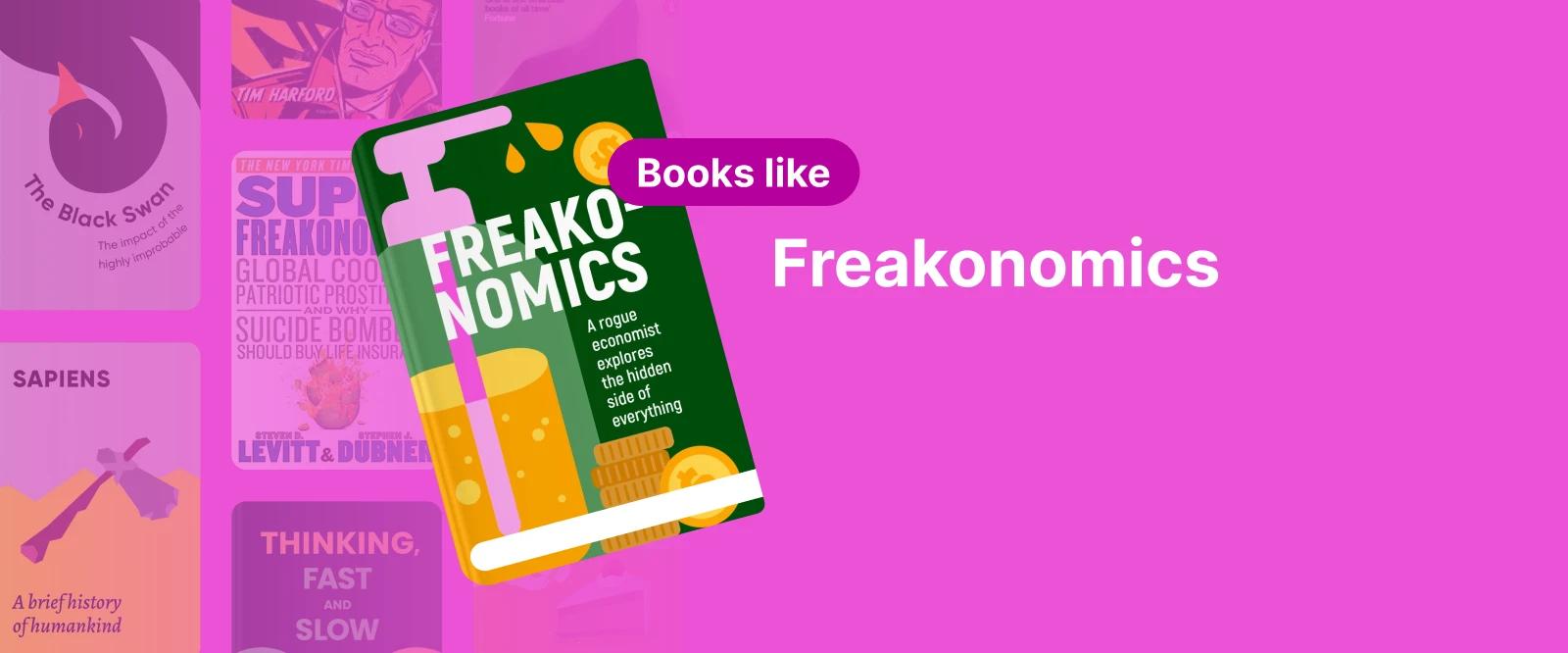

Ever taken time to ask yourself what really motivates people's decisions? Why do we make the decisions we do, and what's determining those decisions when we're not aware?
Similar books to 'Freakonomics' dive below the surface to explore hidden influences in our behavior, decisions, and even success, just like this must-read by Steven D. Levitt and Stephen J. Dubner.
In 'Freakonomics,' the authors demonstrate exactly how economic forces impact everything from crime to parenting — forces we don't normally discuss or aren't aware of. Furthermore, this isn't strictly economics, as it also covers the ways in which decisions are made, often unbeknownst to people.
Seeking more reads on economics, psychology, or simply human behavior? Then you'll love Headway — a daily growth app that breaks down complex stories into bite-sized summaries. Our app, with a library of over 2000 nonfiction titles, is an ideal companion for self-growth, especially if you're the 'always-busy' kind of person.
Download Headway and find out why we act the way we do in just 15 minutes a day!
Quick list: Topic four books like 'Freakonomics'
'The Black Swan' by Nassim Nicholas Taleb — Discusses the implications of rare, unpredictable events, commonly known as black swans, in your life and around the world.
'The Undercover Economist' by Tim Harford — Provides insight into the economic considerations behind everyday life, and how they're determined by choices or other outside forces.
'Thinking, Fast and Slow' by Daniel Kahneman — Looks at how we think (fast, instinctual thinking vs slow, analytical thought) and how it affects decision-making.
'Think Like a Freak' by Stephen J. Dubner and Steven Levitt — A manual that encourages you to take thinking outside the box toward a positive conclusion.
★★★★★ 172K+ reviews
Empower yourself with the best insights and ideas!
Get the #1 most downloaded daily growth app.
Try nowBonus from Headway: Enjoy this free bill tracker printable and make smarter economic and financial decisions!
12 books like 'Freakonomics' to satisfy your inner curiosity in 2026
If 'Freakonomics: A Rogue Economist Explores the Hidden Side of Everything' piqued your interest in the unseen forces shaping our lives, then enjoy these 12 business books. They provide new ideas about success, economics, and human behavior, and embrace research that challenges traditional thinking.
📘 Curious but overwhelmed by 12 books? Get Headway for all the hidden insights in under 5 hours!
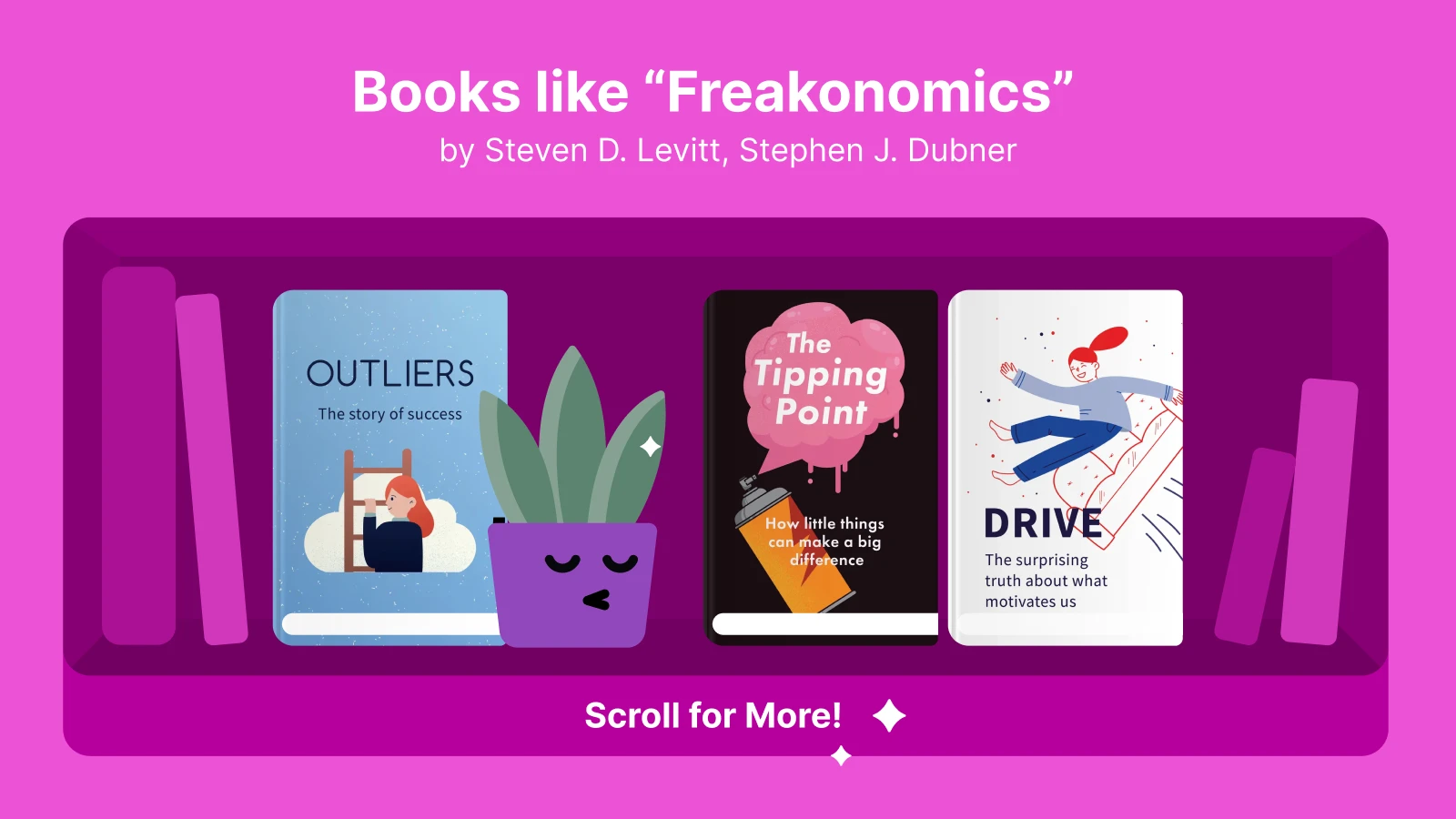
1. 'The Tipping Point' by Malcolm Gladwell
With engrossing storytelling, 'The Tipping Point' is essential for understanding the dynamics of social change.
Another great read from Malcolm Gladwell — In this book, he identifies three key principles that explain how trends, including the Law of the Few, the Stickiness Factor, and the Power of Context, and emphasizes the concept of contagiousness.
Gladwell explains how social epidemics can occur suddenly and how small triggers can lead to significant societal shifts, especially in America. With captivating storytelling, 'The Tipping Point' is essential for understanding the dynamics of social change.
Similarities between the books:
Both books explore the hidden factors influencing societal trends.
They use captivating storytelling to present complicated concepts.
Both highlight the role of context in shaping outcomes.
Each book challenges conventional wisdom about social change.
2. 'Drive: The Surprising Truth About What Motivates Us' by Daniel H. Pink
Daniel Pink's 'Drive' differentiates between intrinsic and extrinsic motivation, emphasizing that true motivation comes from within rather than external rewards. The author identifies three key elements of intrinsic motivation: Autonomy, mastery, and purpose.
Pink argues that financial incentives can be counterproductive for complex tasks requiring cognitive skills. To enhance workplace performance, he asserts that organizations should focus on creating an environment that fosters employee autonomy, ensuring that work is meaningful and has a purpose.
Similarities between the books:
Both books rethink established theories about motivation and incentives.
They use engaging storytelling to explain complex ideas.
Both highlight the importance of intrinsic factors in shaping behavior.
Each book encourages readers to challenge traditional approaches to motivation.
📘 Want to unlock real motivation? Download Headway for intrinsic drive secrets from behavioral scientists!
3. 'The Black Swan' by Nassim Nicholas Taleb
'The Black Swan' by Nassim Nicholas Taleb discusses rare, high-impact events that are unpredictable and often overlooked in traditional risk assessments. Taleb highlights the significant effects of these 'Black Swans' and critiques the financial industry's reliance on predictive models, which often fail to account for extreme events.
Taleb emphasizes developing resilience against negative outcomes and capitalizing on positive, unexpected events rather than attempting to foresee them. His philosophical approach and engaging anecdotes make 'The Black Swan' a compelling read for understanding the limitations of human comprehension of randomness.
Similarities between the books:
Both books explore the hidden factors influencing significant events.
They use captivating storytelling to present complex ideas.
Both highlight the importance of understanding uncertainty.
Each book challenges conventional wisdom about risk and prediction.
4. 'Sapiens: A Brief History of Humankind' by Yuval Noah Harari
'Sapiens: A Brief History of Humankind' takes readers on an exciting journey through human history, structured around four significant revolutions: The Cognitive Revolution, the Agricultural Revolution, the Unification of Humankind, and the Scientific Revolution. Harari argues that Homo sapiens' dominance stems from our unique ability to cooperate in large groups, enabled by shared myths and collective beliefs.
The book presents the Agricultural Revolution as a double-edged sword, discussing its role in population growth and the decline of the quality of life. Harari provides a broad and insightful perspective on human behavior and society by discussing how money, empires, and religions act as unifying forces throughout history, facilitating global interdependence.
Similarities between the books:
Both books offer a broad perspective on human behavior and society.
They use compelling storytelling to present complicated historical and sociological ideas.
Both describe the role of shared beliefs in shaping society.
Each book introduces new ways to think about human development.
5. 'The Undercover Economist' by Tim Harford
Tim Harford's 'The Undercover Economist' reveals the hidden economic principles that affect our daily lives. By exploring concepts such as opportunity cost, supply and demand, market competition, and government intervention, Harford helps readers see the world through the lens of an economist.
This book illustrates how economic thinking applies to societal issues and personal choices. It's essential for those interested in the hidden side of everything. From the division of labor to pricing strategies influenced by location and demand, Hartford's insights offer a fresh perspective on today's market conditions.
Similarities between the books:
Both books uncover under-the-radar economic principles that influence everyday life.
They make economic concepts accessible and engaging.
Both prompt readers to think critically about societal issues.
Each book uses real-world examples to illustrate economic theories.
📘 Want economics that makes sense? Try Headway for real-world insights from economic storytellers!
6. 'Thinking, Fast and Slow' by Daniel Kahneman
In 'Thinking, Fast and Slow,' Daniel Kahneman describes two systems of thinking: System 1, which is fast and intuitive, and System 2, which is slow and deliberate. Cognitive biases such as overconfidence and anchoring significantly impact our decision-making processes, and Kahneman's book delves deeply into these concepts.
Kahneman explores Prospect Theory, explaining that individuals fear losses more than they value equivalent gains, and the Endowment Effect, where people assign greater value to items they own. These insights into the inner workings of our minds make 'Thinking, Fast and Slow' a profound and enlightening read.
Similarities between the books:
Both books explore cognitive biases and decision-making processes.
They use engrossing storytelling to present complex psychological concepts.
Both highlight the role of hidden factors in shaping decisions.
Each book argues against established wisdom about human behavior.
7. 'Predictably Irrational' by Dan Ariely
Dan Ariely's 'Predictably Irrational' highlights that humans often act irrationally, and these irrational behaviors are predictable. Ariely discusses the relativity of choices — where comparisons influence decision-making — and anchoring, which affects our perception of fair pricing. He also explores the allure of 'free' items and how emotional states can distort decision-making.
The book examines how ownership influences our valuation of items and how excessive choices can lead to poor decisions. It also offers a deep dive into the unintended negative consequences of incentive schemes, making it a thought-provoking read on human behavior and economics.
Similarities between the books:
Both books explore the hidden factors influencing human behavior.
They present complex ideas with engaging storytelling.
Both highlight the role of incentives in shaping behavior.
Each book upends what we think we know about decision-making.
📘 Ready to spot your own biases? Download Headway for behavioral economics insights from Ariely and experts!
8. 'Nudge' by Richard H. Thaler and Cass R. Sunstein
'Nudge' by Richard H. Thaler and Cass R. Sunstein discusses the concept of libertarian paternalism, which influences decision-making by subtly guiding choices without restricting freedom.
This revised edition argues that small changes in the way choices are presented can lead to significant improvements in people's lives, making it a must-read for those interested in the intersection of psychology, economics, and politics.
Similarities between the books:
Both books explore the impact of subtle influences on decision-making.
They use engrossing storytelling to explain complex concepts.
Both highlight the role of incentives in shaping choices.
Each book challenges conventional wisdom about human behavior.
9. 'Think Like a Freak' by Stephen J. Dubner and Steven Levitt
'Think Like a Freak' by Stephen J. Dubner and Steven Levitt takes readers on a journey to approach problems and decision-making in unconventional ways. In their nonfiction book, the authors advocate for a mindset that challenges traditional thinking, using real-world examples to illustrate their points.
One of the main themes is the importance of questioning assumptions and looking at issues from a fresh perspective. The book also emphasizes the value of incentives and how they can drive behavior in unexpected ways. By encouraging readers to think more creatively and analytically, 'Think Like a Freak' provides practical tools for solving complex problems and making better decisions.
Similarities between the books:
Both books make readers reconsider what they think they know about human behavior and decision-making.
They explain complex ideas through the power of storytelling.
Both encourage readers to see the world from a different perspective.
Each book puts the spotlight on the role of incentives in shaping behavior.
📘 Want to solve problems like a freak? Try Headway for creative thinking strategies from innovators!
10. 'The Power of Habit: Why We Do What We Do in Life and Business' by Charles Duhigg
Charles Duhigg's 'The Power of Habit' delves into the science behind habits and habit formation and examines the significant impact they have on our daily lives. Duhigg provides compelling examples of individuals' struggles and companies' successful use of habits to achieve their goals. He introduces the 'habit loop,' which consists of a cue, routine, and reward, emphasizing that understanding this loop is crucial for changing habits.
Highlighting 'keystone habits' that trigger widespread behavioral changes, the book stresses the importance of belief in the potential for change. With practical insights focused on the impact of habits on personal and professional lives, 'The Power of Habit' is essential for understanding and transforming behaviors.
Similarities between the books:
Both books offer a deep dive into the hidden mechanisms influencing human behavior.
They use captivating narrative techniques to explain complex psychological concepts.
Both encourage readers to understand and transform their behaviors.
Each book stresses the importance of habit formation and change.
11. 'The Signal and the Noise' by Nate Silver
'The Signal and the Noise' by Nate Silver delves into the challenges and intricacies of making accurate predictions. With an Amazon rating of 4.3 and a Goodreads rating of 3.97, this book delves into the challenges and intricacies of making accurate predictions, making it a fascinating read for those interested in big data and forecasting.
Similarities between the books:
Both books focus on the secret factors that influence predictions and outcomes.
They use engaging storytelling to present complicated ideas.
Both reveal the role of data analysis in uncovering insights.
Each book upends traditional models in forecasting.
📘 Fascinated by Wall Street's secrets? Download Headway for financial insider stories from traders and economists!
12. 'Moneyball: The Art of Winning an Unfair Game' by Michael Lewis
'Moneyball: The Art of Winning an Unfair Game' by Michael Lewis tells the story of the Oakland Athletics baseball team and its general manager, Billy Beane. The book explores how Beane used data and statistical analysis to build a competitive team on a limited budget, challenging traditional baseball scouting methods.
Lewis delves into the concept of sabermetrics, the empirical analysis of baseball through statistics, and how it revolutionized the sport. The narrative highlights the tension between old-school scouts and new-school analysts, providing a compelling look at how data-driven decision-making can disrupt established industries.
Similarities between the books:
Both books offer a behind-the-scenes look at complex systems (finance and baseball).
They incorporate narrative techniques to explain intricate concepts.
Both show how hidden factors shape outcomes.
Each book challenges conventional modes of thought in its respective field.
Try Headway and satisfy your inner curiosity today!
These books, similar to 'Freakonomics', span from attempts to understand success in light of hidden variables to analyzing the results of unpredictable events. They shine a light on different ways of looking at economics, psychology, and decision-making that challenge conventional wisdom.
And the good news?
You'll be able to explore many of the books on this list right here on Headway by listening to our 15-minute summaries.
Through listening to our summaries of the books on this list, you will gain deeper perspectives, as these are the best books that confound or challenge your understanding of the world around you.
You'll broaden your depth of knowledge and achieve your goals to widen your perspective and learn more ways to look at the world.
Download the Headway app and learn why people act the way they do!
FAQs about books like 'Freakonomics'
Why should I read 'Freakonomics'?
If you're interested in what really motivates our behavior, 'Freakonomics' is for you. It identifies the hidden economic motivations behind everyday actions and incorrect assumptions we hold about the world. The book presents surprising observations that will, depending on your nature, reframe your vision on mundane items.
How long does it take to read 'Freakonomics'?
When it comes to reading 'Freakonomics,' you might spend 6-8 hours digesting it. With Headway, you can consume the main points and highlights in only 15 minutes. It's ideal when you’re limited on time but still want to read something interesting and thought-provoking quickly.
What are the five fundamental ideas of 'Freakonomics'?
Incentives drive most human behavior.
Poor decisions are fueled by an imbalance of information.
What we think we know often isn't the case.
We behave in accordance with economic incentives in surprising ways.
Just because two things happen at the same time doesn't imply a causal connection.
What is the difference between 'Freakonomics' and 'SuperFreakonomics'?
'Freakonomics' is about hidden forces that shape our day-to-day choices; 'SuperFreakonomics' goes beyond this and addresses big issues with a global reach, like climate change and terrorism. The second book continues where the first left off, picking up big, provocative issues and approaching them with the same willingness to engage in thinking about science and social forces.