Self-growth
 Apps & Digital Tools
 Business & Career
 Success
 Growth Tools
 Psychology
 Communication
 Relationships
You’ll learn
- How to make your work impossible to overlook
- Why a good offer is still worth negotiating
- About treating a career as a jungle gym
- When the safest move can narrow your choices
first KEY POINT
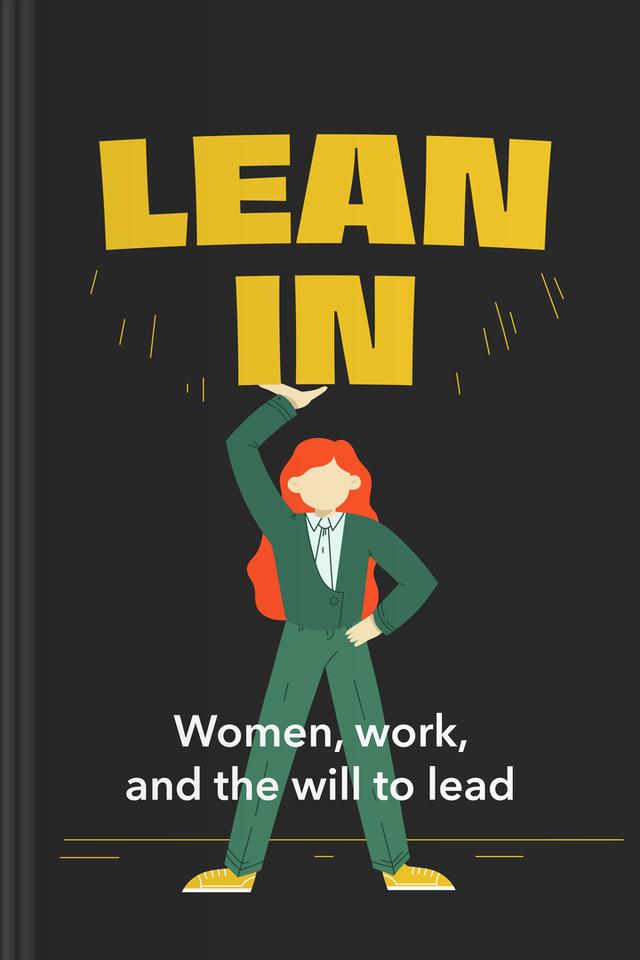
Sheryl Sandberg once hosted a lunch at Facebook for a visiting delegation from the US Treasury. Fifteen executives, a buffet, a long conference table. The senior officials filled their plates and sat down at the table.The women who had come with them ate last and took chairs along the wall. Sandberg invited them over, but they stayed where they were. Nobody had told them to sit at the side. They had been invited to that meeting as experts, but it went ahead with them positioned as the audience.Sandberg's argument in Lean In starts right there, in the gap between having a place and taking it. She spent 14 years as Facebook's chief operating officer, and with co-author Nell Scovell, she turns what she learned into a series of practical choices."Leaning in" is her shorthand for choosing to step forward rather than wait to feel completely ready. You take the seat, say the number, or put your hand up before you're certain you belong in the room. Over the next few minutes, those ideas become concrete moves you can test in your own career.
second KEY POINT
Author Samantha Ettus once described looking through her daughter's school yearbook, the kind where every child gets a page. On one page, the children had written what they wanted to be. The answers came back as job titles, stated flat, with no hedging attached. More than one of them had written "president." At that age, wanting something doesn't yet require an explanation.Sandberg argues that this changes later. By adulthood, ambition is no longer judged only by what a person can do. It's also judged by how comfortable other people are with seeing that ambition expressed.The gap's easiest to see in the numbers. In a 2012 McKinsey survey of more than 4,000 employees at leading companies, 36% of men said they wanted to reach the C-suite. Among women, it was 18%. Sandberg asks what happens along the way that makes women less likely to picture themselves there, or to say that they want to be there.
Continue reading with Headway app
Continue readingfirst KEY POINT
second KEY POINT
third KEY POINT
fourth KEY POINT
fifth KEY POINT
sixth KEY POINT
Related blog articles

Elevate the way you learn with Headway — the smart, streamlin...

Discover top apps that help you learn in just 10 minutes a da...

Curious about the Deepstash app? Find out if this app offers ...

The answer to the question "Is Blinkist worth it?" depends on...

Discover practical tips, expert insights, and book-powered to...