Self-growth
 Business & Career
 Success
 Communication
 Healing
 Relationships
 Psychology
 Happiness
Imagine yourself listening to someone speak in a meeting, only for your mind to wander. Once again, you realize that you missed half of the conversation after blinking and refocusing. Perhaps you were nodding along, maintaining eye contact, and even attempting active listening, but for some reason, your brain shut down without your knowledge. Does that experience sound familiar?
Have you ever asked yourself, "why do I zone out so much?" If so, you're not alone. Although zoning out is a common human experience, it can negatively affect your relationships, your job, and how present you feel. Consistently paying attention can be challenging, and over time, you might start to feel guilty or ashamed for not being fully engaged when it might matter most.
Zoning out happens when your brain shifts from focused attention to autopilot. It often happens due to stress, sleep deprivation, ADHD, or digital overload. Occasional mind wandering is natural, while frequent lapses may signal underlying issues.
Zoning out is often your brain's response to overload, or unmet needs related to your wellness and well-being. In this article, you will read why zoning out happens, when it's normal, when it could signal mental health issues, and strategies to regain focus.
You'll also discover actionable tips from neuroscience and psychology, plus curated book summaries via the Headway app to help train your attention and reclaim mental energy.
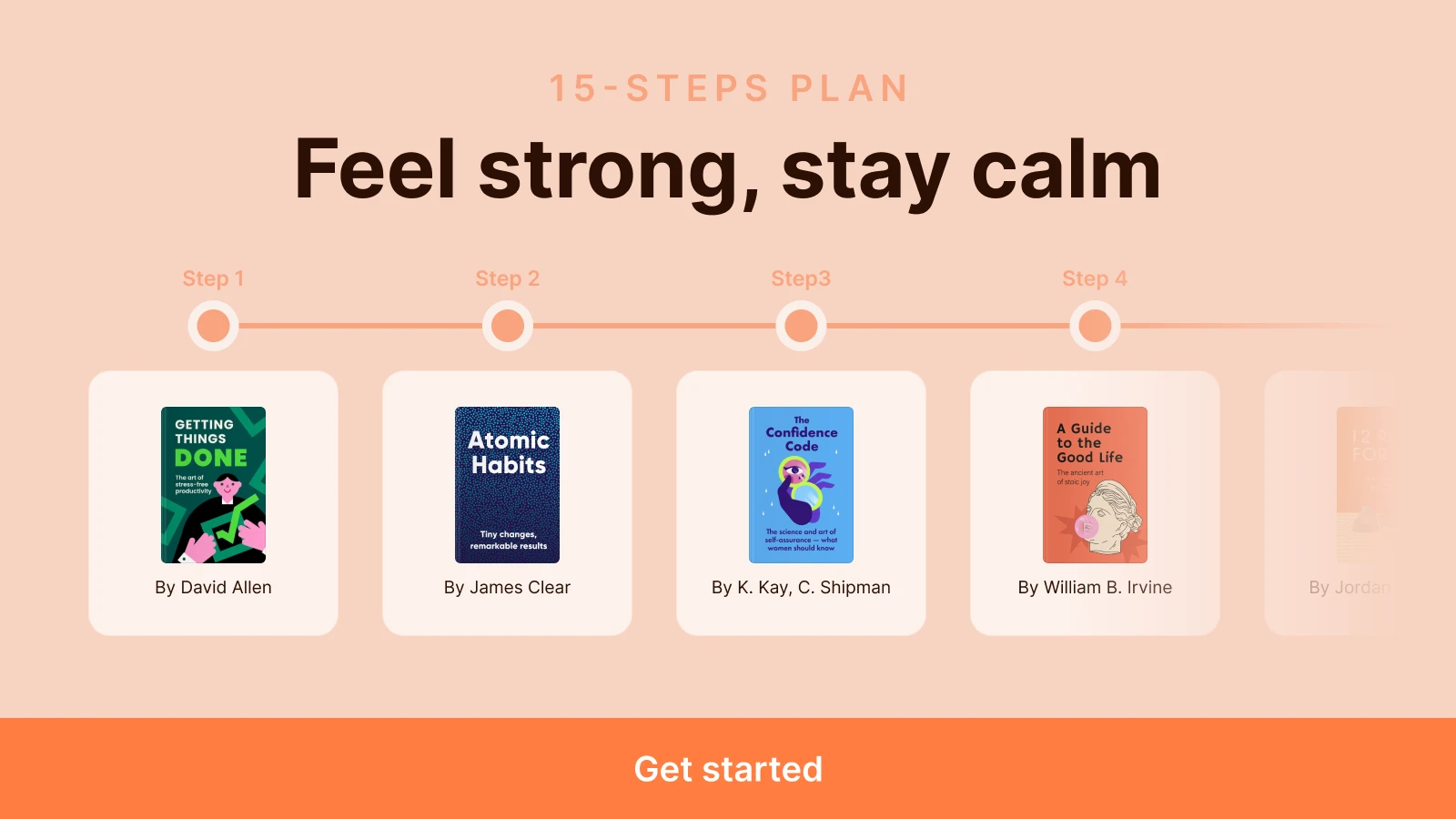
Quick answer: How to recognize zoning out and regain focus
Your brain shifts from focused mode to autopilot, leaving you to zone out.
Common triggers include lack of sleep, too much screen time, and stress.
Occasional zoning out is common, but persistent lapses may indicate deeper issues such as ADHD or dissociation.
Building habits, focused work sessions, and grounding techniques can help you regain attention.
Headway's summaries cover topics like focus, intelligence, and confidence, offering practical techniques to boost self-awareness and stay present.
What exactly does it mean to "zone out?"
Zoning out, also called spacing out or going on autopilot, happens when your attention drifts away from the task at hand, leaving you mentally absent. Neuroscience links this to the default mode network (DMN), a part of the brain that turns on when you're not focused on outside tasks. And the attention network is active when you're concentrating.
Your brain zones out to give itself a break or let your mind wander when you don't need to focus. For example, during repetitive tasks or when you're tired, your mind may drift on its own. In a way, it's a daydream that allows your brain to process things in the background.
It's important to tell the difference between normal zoning out and more serious conditions, such as ADHD, seizures, or dissociative disorders. Occasional mind wandering is normal, but if it happens often or disrupts your life, it's a good idea to talk to a mental health professional.
Understanding why you might zone out so much is the first step toward reclaiming your focus and improving your productivity.
📘 Reclaim your focus and attention — get Headway.
Top reasons for "why do I zone out so much?"
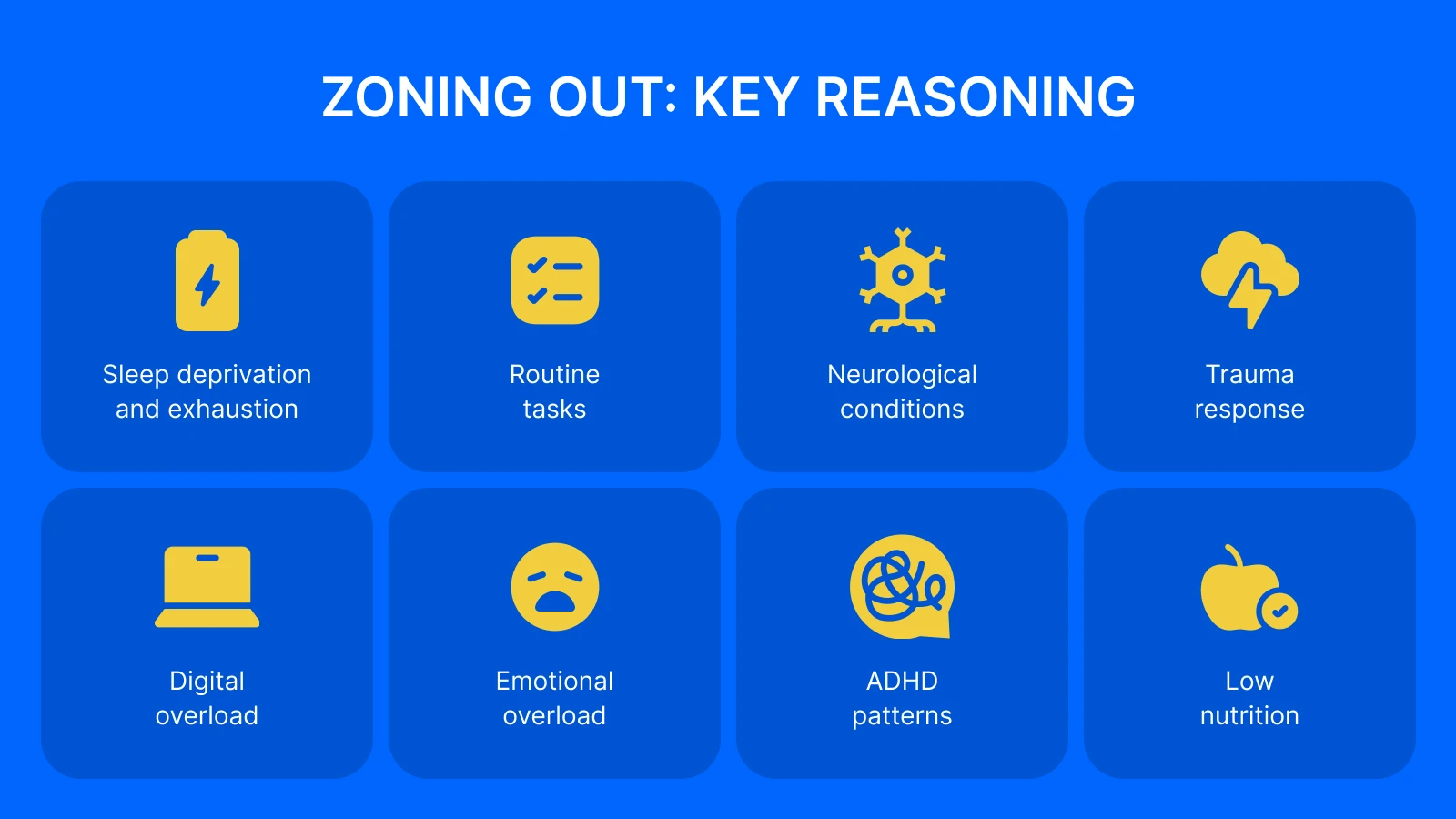
The most frequent reasons for zoning out are listed below, divided into categories that can be put into practice:
Sleep deprivation and exhaustion
One of the main reasons people find themselves zoning out is because of sleep deprivation. Research shows that when you're sleep-deprived, your default mode network becomes more active, making it harder to maintain attention on tasks.
Ask yourself, "Did I get enough sleep last night?" Occasional fatigue is normal, but chronic sleep deprivation can significantly reduce focus and increase brain fog. Prioritizing enough sleep and establishing a consistent bedtime routine can help reduce how often you zone out.
Trauma response
Zoning out might result from boredom and fatigue for some people. However, it is also a trauma-related nervous system response. For example, if a person has been through a traumatic event multiple times or within the context of a relationship, they may learn that it is safer to mentally disconnect rather than concentrate on the present. Zoning out can then become a form of dissociation — a protective mode that helps shield against overwhelming circumstances.
From a neuroscience point of view, trauma can change how your nervous system handles threats. When your brain senses emotional or sensory overload, it may pull you away from the present moment as a way to maintain psychological safety. You commonly see this in individuals with post-traumatic stress disorder, a history of chronic stress, or unresolved emotional pain.
Typical indicators that this could be trauma-related include:
Zoning out during conflict or emotionally charged conversations
Difficulty maintaining eye contact or staying present when topics feel vulnerable
Feeling disconnected from your body or surroundings
Losing track of conversations despite trying to actively listen
It's important to note that this response is not a failure of focus or willpower. It's an adaptive survival strategy that once helped you cope. With support, the nervous system can learn that it's safe to stay present again. If zoning out feels tied to past experiences or occurs alongside other mental health issues, working with a trauma-informed mental health professional or clinician trained in psychiatry can help address the root cause rather than just the symptoms.
Digital overload, multitasking, and distraction
When your brain becomes overloaded with notifications, emails, and multitasking, your mind can start to drift. Research shows that multitasking activates the DMN and lowers cognitive performance. Frequent lapses in attention are caused by overstimulation from social media, applications, and persistent notifications.
You might track how frequently you check your notifications. If you notice yourself zoning out while working digitally, you might consider using focus tools or batching tasks.
Stress, anxiety, and emotional overload
Cortisol, our stress hormone, is raised by high levels of stress and anxiety, which can affect executive function and attention. Your brain may go into autopilot as a coping strategy when your nervous system is overworked.
It's critical to consider whether high-pressure work or stressful conversations cause you to zone out. Stress can be managed by incorporating breathing exercises or brief mindfulness exercises.
Attention-deficit hyperactivity disorder (ADHD) patterns
One of the most prevalent symptoms of attention deficit hyperactivity disorder (ADHD) is zoning out. People with ADHD frequently struggle to maintain attention during repetitive tasks, lose focus, or let their minds wander.
If you often lose focus and find it difficult to finish tasks, you might think about getting an ADHD evaluation by a mental health professional. Over time, attention can be trained with the support of structured routines and the Focus Recovery Framework (see below).
Zoning out is present across mental health conditions, and it could also be a sign of a mood disorder or a dissociative disorder. Each of these conditions needs to be evaluated by a specialist because each person's presentation is unique.
Low nutrition, dehydration, blood sugar, or blood pressure issues
Your brain needs a steady supply of glucose, hydration, and proper blood flow to maintain focus. Skipping meals, dehydration, or unstable blood pressure can trigger zoning out.
It's essential to pay attention to when you feel tired and what you've eaten or drunk. Consuming a balanced diet and drinking enough water can help diminish the feeling of "zoning out."
Habitual autopilot: Routine tasks
Your brain can function automatically when performing repetitive tasks. Although this automatic processing is effective, it may cause you to lose focus when less conscious attention is needed.
You may be able to identify and monitor the tasks that cause you to zone out. Awareness alone is often enough to anchor your focus.
Substance abuse or underlying medical conditions
Zoning out often is sometimes connected to neurological conditions, migraines, mini-strokes, mental health issues, or substance abuse. It doesn't require large quantities of a substance to impair your focus, recall, and ability to be fully aware.
Episodes with disorientation, depersonalization, or memory gaps should be discussed with a healthcare professional. If zoning out comes with lightheadedness, disorientation, or safety risks, it's important to seek medical attention or medical advice from a professional.
When is zoning out normal, and when is it a red flag?
Zoning out is normal when it is occasional, brief, and context-dependent. Common signs of normal zoning out include:
Brief lapses during boring or repetitive tasks
No memory loss
Easy refocusing
Awareness of the zone-out
Some of the warning signs that your zoning out is not normal include:
Frequent zoning out that interferes with relationships, employment, or safety
Missing a lot of time
Feeling unreal or disconnected (a type of dissociation)
Dozing off during discussions that call for attentive listening
Ask yourself:
Do I frequently overlook important information?
Does zoning out affect my confidence or general well-being?
Did this pattern start during times of high stress or after traumatic events?
If more than one applies, think about consulting a mental health specialist, such as a therapist or psychiatrist.
📘 Understand your mind better — try Headway.



Why this matters for attention, focus, and confidence
Zoning out often diminishes your ability to work, concentrate, and be confident in your daily life. Your attention is similar to a muscle in that, when it frequently drifts away from its intended target, the energy you've accumulated and your level of self-control decrease proportionately.
However, you can reverse this trend by intentionally strengthening your attention. Reading and writing reviews of quality literature helps improve your concentration while developing mental fortitude and recall.
Susan Cain's 'Quiet' provides practical suggestions for increasing focus time. David Robson's 'The Intelligence Trap' explains how automatic thinking causes your mind to drift. Both books offer concrete exercises for training your attention.
Other recommended summaries include:
'Made to Stick' by Chip Heath and Dan Heath
'Enlightenment Now' by Steven Pinker
'Choose Yourself' by James Altucher
These resources combine neuroscience and psychology on attention, with actionable exercises for busy professionals.
Practical strategies and tools to reduce zoning out
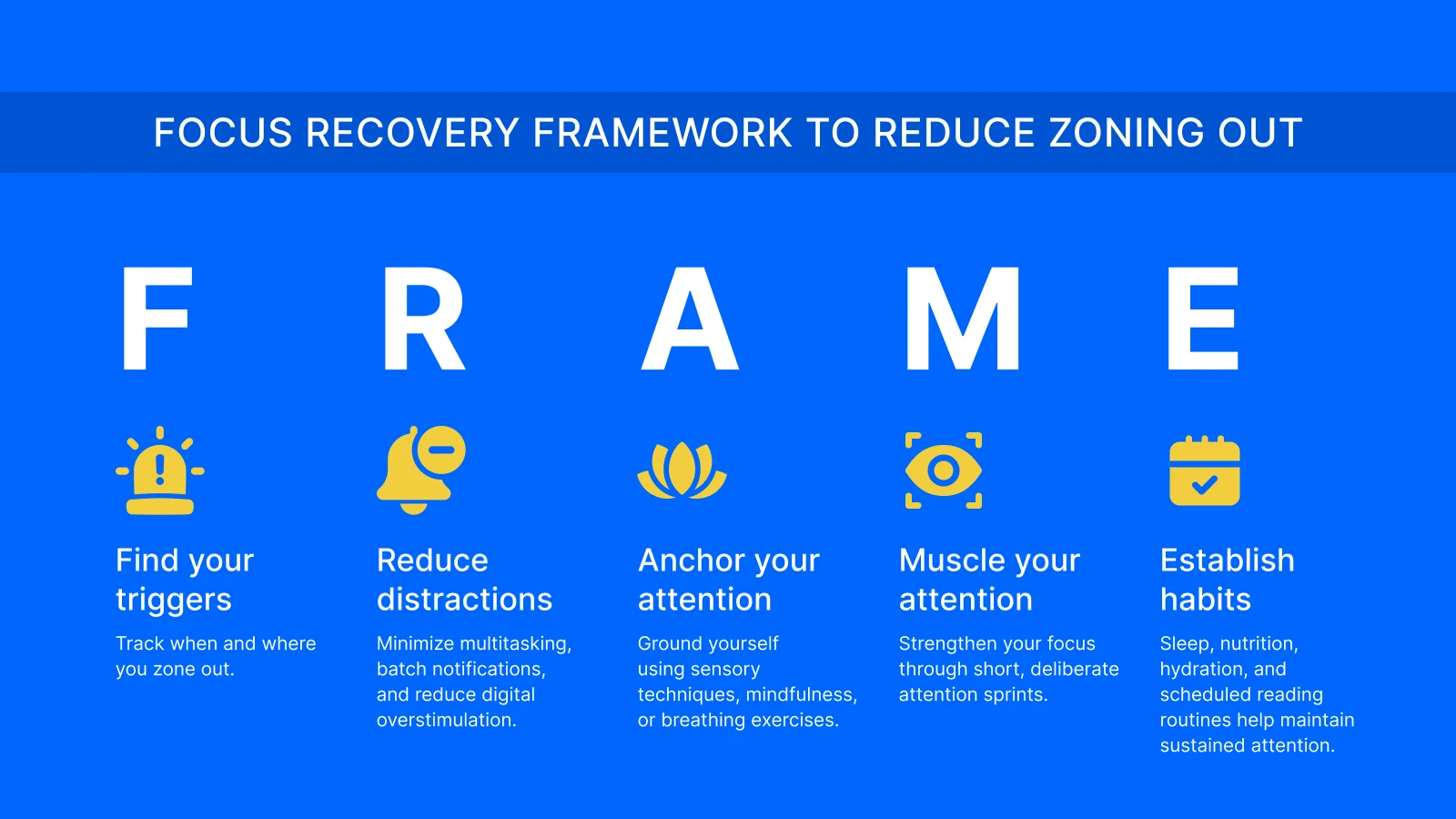
Here's the Focus Recovery Framework (F.R.A.M.E.), designed to help busy professionals stay present:
F = Find your triggers
Track when and where you zone out. Are you fatigued, overstimulated, or stressed? Awareness is the first step.
Mini-exercise: Keep a small journal noting your time management, activity, and your mental state each time you drift.
R = Reduce cognitive load and distractions
Minimize multitasking, batch notifications, and reduce digital overstimulation. Consider digital detox periods.
Mini-exercise: Apply strategies from How to Increase Focus at Work or How to Train Your Brain to Focus.
A = Anchor your attention
Ground yourself using sensory techniques, mindfulness, or breathing exercises.
Mini-exercise: Use the 5-4-3-2-1 grounding technique during meetings or study sessions.
M = Muscle your attention
Strengthen your focus through short, deliberate attention sprints. Use book summaries for structured practice:
Read a 5-minute summary, such as 'Quiet' or 'The Intelligence Trap.'
Apply a mini-reflection or note-taking exercise afterward.
E = Establish habits
Sleep, nutrition, hydration, and scheduled reading routines help maintain sustained attention.
Mini-exercise: Establish a nightly routine: review a Headway book summary before bed, journal key takeaways, and note your zoning-out triggers.
Daily practice plan for professionals
7‑day attention reboot plan:
This plan helps you reset and rebuild your attention slowly, without forcing yourself or adding pressure. It's about building awareness, not passing or failing a test.
Day 1: Sleep audit and hydration check
Today is about gathering information, not changing everything at once. Track how many hours you slept, the quality of that sleep, and how you felt upon waking. Also, notice how much water you drink throughout the day. Even mild dehydration or inconsistent sleep can significantly impact attention, mental energy, and how often you zone out.
Goal: Build awareness of how your body's basic needs affect your ability to stay present.
Day 2: Digital distraction mapping
Take notice of how many times your concentration breaks while you are receiving interruptions like phone calls, emails, or notifications. Identify which apps, patterns, or distractors occur the most frequently and in what situations — meetings, work, boredom, or stress. You do not yet need to limit any of these distractions; you just want to observe for patterns without judgment.
Goal: Identify external triggers that contribute to zoning out and attention drift.
Day 3: 10-minute summary and focus sprint
Select a brief summary from the non-fiction section on Headway that focuses on one of the following topics: focus, attention, or self-leadership. Use a timer to keep track of how long you maintain your attention on that summary (but don't stress if your mind wanders).
Next, apply one of the major concepts in that summary in your life today, such as altering your approach to organizing meetings or taking breaks.
Goal: Practice sustained attention in small, manageable doses and rebuild confidence in your ability to focus.
Day 4: Grounding practice and meeting-focused strategy
Before a meeting or a task that needs focused attention today, do a quick grounding exercise. Try taking a few deep breaths or using the 5-4-3-2-1 senses technique. When in a meeting, pay attention to where you place your feet, how you breathe, and when you make brief eye contact as a way to anchor yourself in the present moment. If you find that your thoughts are wandering, gently bring yourself back to focus on what is actually going on around you without being hard on yourself.
Goal: Become familiar with returning to the present moment during actual life situations, not just in peaceful environments.
Day 5: Check for triggers of zoning out (journaling)
Take a few minutes (up to 15) to write about your experience of an attention reboot. Think about:
What you were doing when you zoned out the most
What feelings were associated with zoning out
When it happened (during stress, boredom, conflict, or fatigue) and what you think triggered it
Understanding why you zoned out may help you identify if emotional overload, anxiety, or previous coping behaviors were at play.
Goal: Understand why your attention lapses occur, rather than simply understanding the behaviours surrounding them.
Day 6: Habit integration
Choose one small habit to support attention. A good example is reading a short book summary at night instead of scrolling through social media. Another option would be to create a bedtime routine. It's not about being perfect, but about being consistent — having a routine will help calm your nervous system, reduce overload, and increase focus over time.
Goal: Transform insight into sustainable, realistic habits that promote well-being.
Day 7: Reflection and plan for next week
Look back at your week with curiosity. Notice what worked, what didn't, and whether zoning out got better or stayed the same. Ask yourself:
• What patterns did I notice?
• What felt supportive?
• What's one thing I want to continue next week?
Use what you learn from this reflection to make a gentle plan for moving forward, instead of giving up on the practice.
Goal: Build on what you've learned and keep your progress going, rather than just doing a quick reset.
When to seek professional help
Clear signs that zoning out is more than normal include:
Memory gaps or loss of time
Inability to stay present
Safety risks (like driving)
Suspected seizures or neurological issues
A mental health professional or neurologist can perform assessments for conditions like ADHD and dissociative disorders. While this article offers strategies, it is not a substitute for therapy or a medical evaluation. For a deeper understanding, seeMedvidi's guide on zoning out.
Train your attention with Headway: How to turn zoning out into a resource
Zoning out from distractions is common, but frequent instances of zoning can be an opportunity to train your ability to stay focused on what's important. Identifying your distraction triggers, learning to stay focused deliberately, and using structured resources such as Headway to review books quickly can help you take control of your mental energy and direct it towards the tasks you want to accomplish.
If you find yourself zoning out frequently, assess your sleep habits, as these, along with grounding exercises and attention training, can help you regain focus. Choose one technique to employ each day. Example techniques include 5-minute "focus sprints" and mindful breathing exercises.
Zoning out is normal; therefore, as a mental health professional, I request that you consider it part of the natural human condition and not an indication of a flaw within yourself or as an individual.
Typically, zoning out is your body's way of managing stress (as evidenced by signs like fatigue and emotional stress). Your attention should not be dominated by force; it can only be gained through kindness, curiosity about yourself, and compassion.
If this article helped you feel a little less alone or helped you put words to an experience you've been quietly struggling with, I encourage you to consider reaching out to a mental health professional in your area to deepen your understanding of yourself. Listen to what your mind and body are asking for. And remember, learning to stay present is not a destination; it's a practice.
If you want to practice concentration and train your attention every day, Headway can be your little ally. Just 15 minutes of audio summaries will help you learn new strategies for concentration and self-development without feeling overwhelmed.
May you meet yourself with patience and find moments of presence that feel grounding,
Sophia Rodriguez, LMFT
Frequently sked questions on why do I zone out so much
Why do I zone out so much at work?
Work zoning out occurs due to fatigue, information overload, or stress. The brain seeks a break from monotonous tasks, distracted by internal thoughts or dreams. Lack of sleep, boring work, or lack of interest also exacerbate this. Short breaks, movement, and task planning help regain focus.
Why do I zone out so much while reading/studying?
When studying or reading, the brain easily switches off due to an overload of new information or a lack of immediate interest. If the topic is difficult or boring, attention involuntarily wanders. Fatigue, stress, or constant distractions only increase the "zone out". Short breaks and active repetition help to stay focused.
Why do I zone out and stare blankly?
Fatigue, information overload, and stress are all causes of zoning out at work. When the brain is overwhelmed by a recurring task, it is disrupted by internal thoughts or daydreams, so taking a break from it is helpful.
Is zoning out a sign of ADHD or something more serious?
Zoning out can be a normal reaction to fatigue, stress, or boredom. Frequent zoning out could indicate other mental health conditions, like ADHD, dissociative disorder, or mood disorder. Consult a mental health professional if attention lapses are disruptive.
How long is it safe to zone out?
Normal zoning out lasts for short periods. Continuous zoning out results in issues. Multiple episodes of zoning out, whether brief or frequent, can interfere with your job or day-to-day life. To keep yourself centered and refocused, take periodic breaks to move and breathe mindfully.
Can zoning out ever be good?
Absolutely. Creative thinking, problem solving, and the consolidation of memory are greatly aided by wandering thoughts. So, short periods of the mind "shutting down" to allow free play of thought will be beneficial for generating new ideas and resolving problems. The important factor is to limit the length of time your mind "shuts down," as it can have a detrimental effect on work or study.