Self-growth
 Apps & Digital Tools
 Business & Career
 Success
 Growth Tools
 Psychology
 Communication
 Relationships
You’ll learn
- The dark side of enlightenment
- Why intelligence isn't enough
- How your brain can lead you astray
- When to question your assumptions
- Whether intuition is a scam
first KEY POINT
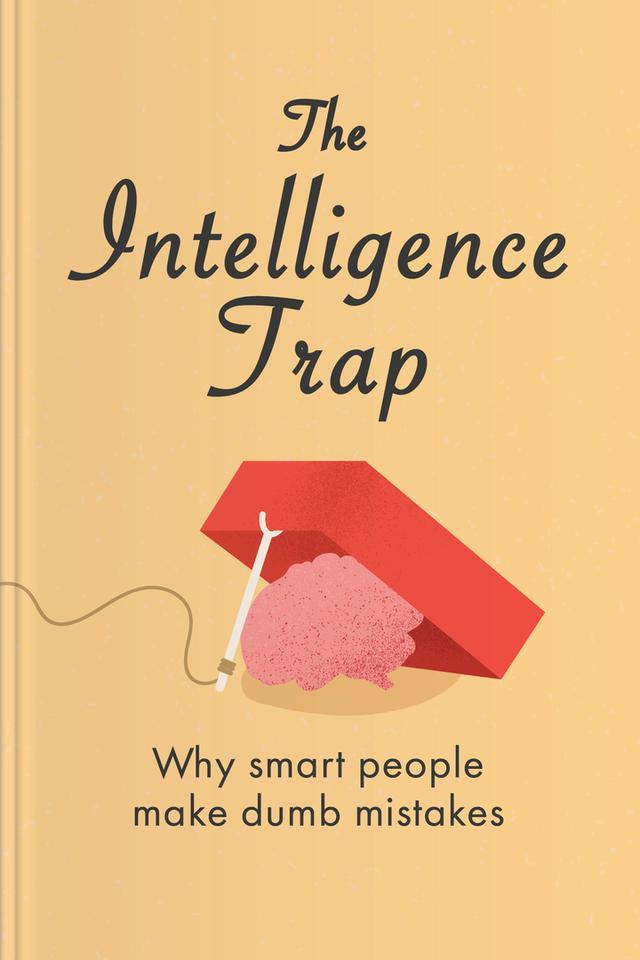
Have you ever engaged in a heated debate about the value of education? If so, you've likely stumbled upon the terms “book smart” and “street smart.” These phrases are our go-to labels for classifying different types of intellect.On the one hand, you have “book smart” people with a knack for absorbing academic knowledge. They thrive on theories, equations, and historical dates, thus excelling in traditional educational settings.On the other hand, those who are “street smart” prefer life's open classroom. They showcase an equally critical yet less formally acknowledged form of intelligence — the ability to make sound judgments based on personal experiences, easily handle social scenarios, and think on one's feet.David Robson's concept of the intelligence trap presents a fascinating bridge between these two forms of intelligence. Robson explores the paradoxical idea that the smarter you are, the more susceptible you might be to irrational behavior and poor decision-making. The danger is that intellectual titans might dismiss alternative viewpoints and become ensnared in their superiority.Interestingly, the “street smart” people, ever adaptable and learning from the school of hard knocks, might be better at avoiding this trap. Their grounding in real-life experiences often fosters readiness to adapt, willingness to learn from mistakes, and humility that guards against overconfidence.So, while the “book smart” individuals are drafting the blueprints, and the “street savvy” folks are building the house, it's clear that we can shine even brighter by learning to balance both within us.
This summary explores the misconceptions that may lead us into this trap and how to find our way out. Ready to uncover the surprising ways our smarts can betray us? Let's dive right in.
second KEY POINT
According to intelligence researcher James Flynn, the IQ bar has increased in recent decades. Moreover, it has been the case for at least a century, with every new generation intellectually soaring higher than their predecessors. This discovery, also known as the Flynn effect, starkly contrasts what psychologists have believed for years — they thought we mainly inherit intelligence from our parents.Children learning abstract thinking from an early age seems to be the exact factor driving the IQ upswing. But as our non-verbal reasoning skyrockets, skills that don’t feature in IQ tests, like navigation, seem to be slumping. It’s as if we've become grandmasters at chess but can't play tic-tac-toe anymore.Amidst our collective IQ growth, the Dunning-Kruger effect comes into play. Social psychologists David Dunning and Justin Kruger found that people who flunk their tests not only fail to realize their mistakes but believe they're acing them.Interestingly, this overconfidence isn't just for amateurs; experts can trip up too. Within the confines of their discipline, professionals excel at identifying relevant concepts. Yet, when faced with uncharted territories, they're more prone to overestimating their expertise. Moreover, they claim knowledge they don't possess.

Continue reading with Headway app
Continue readingfirst KEY POINT
second KEY POINT
third KEY POINT
fourth KEY POINT
fifth KEY POINT
sixth KEY POINT
Related blog articles

Elevate the way you learn with Headway — the smart, streamlin...

Discover top apps that help you learn in just 10 minutes a da...

Curious about the Deepstash app? Find out if this app offers ...

The answer to the question "Is Blinkist worth it?" depends on...

Discover practical tips, expert insights, and book-powered to...