Self-growth
 Business & Career
 Success
 Communication
 Healing
 Relationships
 Psychology
 Happiness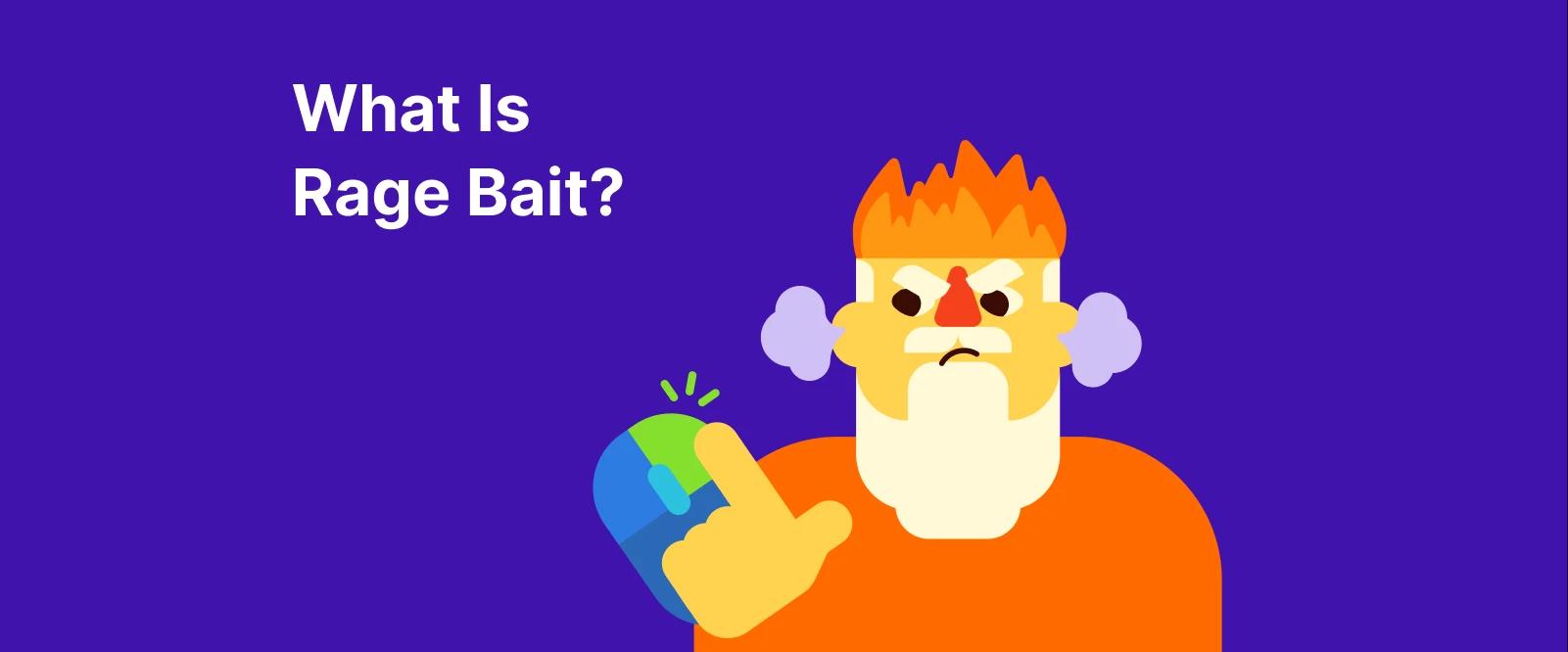
Have you ever clicked on a headline and immediately felt irritated? Congratulations, you've experienced rage bait. But what does it mean to be "rage-baited"?
Rage bait — Oxford University Press's 2025 Word of the Year — is content designed to provoke strong emotions. Online platforms use it to do more than just lure you in with clickbait. They want you angry, fired up, and ready to engage with whatever issue they're pushing.
In 2025–2026, our entire internet experience is shaped by algorithms and online content. And no, it's not just about memes and TikTok videos — rage bait drives misinformation, conspiracy theories, and manipulation. Below, we break down what rage bait is, show you real examples, and teach you how to spot it before you fall for it.
Want to know how platforms manipulate your emotional reactions and attention? Check out Headway's book summaries on the internet and manipulation. Your social media use should support your mental health, not undermine it.
📘 Try Headway and end the cycle of rage baiting once and for all!
Quick answer: What is rage bait? Definitions and origins
Rage bait (also "ragebait" or "rage-bait") is content designed to make you angry so you'll click, comment, or share.
Merriam-Webster defines it as:
"Content (usually, but not always, found online) that tries to provoke anger or outrage, as a means of gaining attention or making money."
Cambridge Dictionary goes even simpler:
"Information, images, videos, etc. that are put on the internet to deliberately make people angry."
The term first showed up in 2002 on Usenet, describing drivers who deliberately provoked road rage. By the 2010s, it migrated to social media platforms and became what you see today: Headlines, clips, memes, and commentary that are crafted to stir an emotional response.
What happens in your brain when you see rage bait?
Your brain treats outrage bait like a real threat. When you see something infuriating online, your amygdala — the part handling fight-or-flight — kicks in before you can think rationally. That's why you're typing angry comments before you've actually processed what you read.
A 2024 Tulane University study found that people engage far more with posts that contradict their beliefs, especially when core values feel challenged. Your strong reaction isn't a character flaw — it's biology.
Social-media algorithms caught on years ago. They track what keeps you scrolling, and anger beats everything else. Facebook, TikTok, Instagram — they don't care if you're happy or furious. They just need you glued to the screen. More engagement equals more ads and more money.
Content creators adapted fast. Post something bland? Crickets. Post rage bait? Thousands of shares and furious comments. The attention economy pays for rage, so rage is what gets produced.
📘 Understand how your mind works — get Headway today!
Examples of rage-bait (2025 edition)
Every trending Elon Musk or Donald Trump tweet, every podcast clip stripped of context, every headline designed to make you furious — same formula every time. Here's what to watch for:
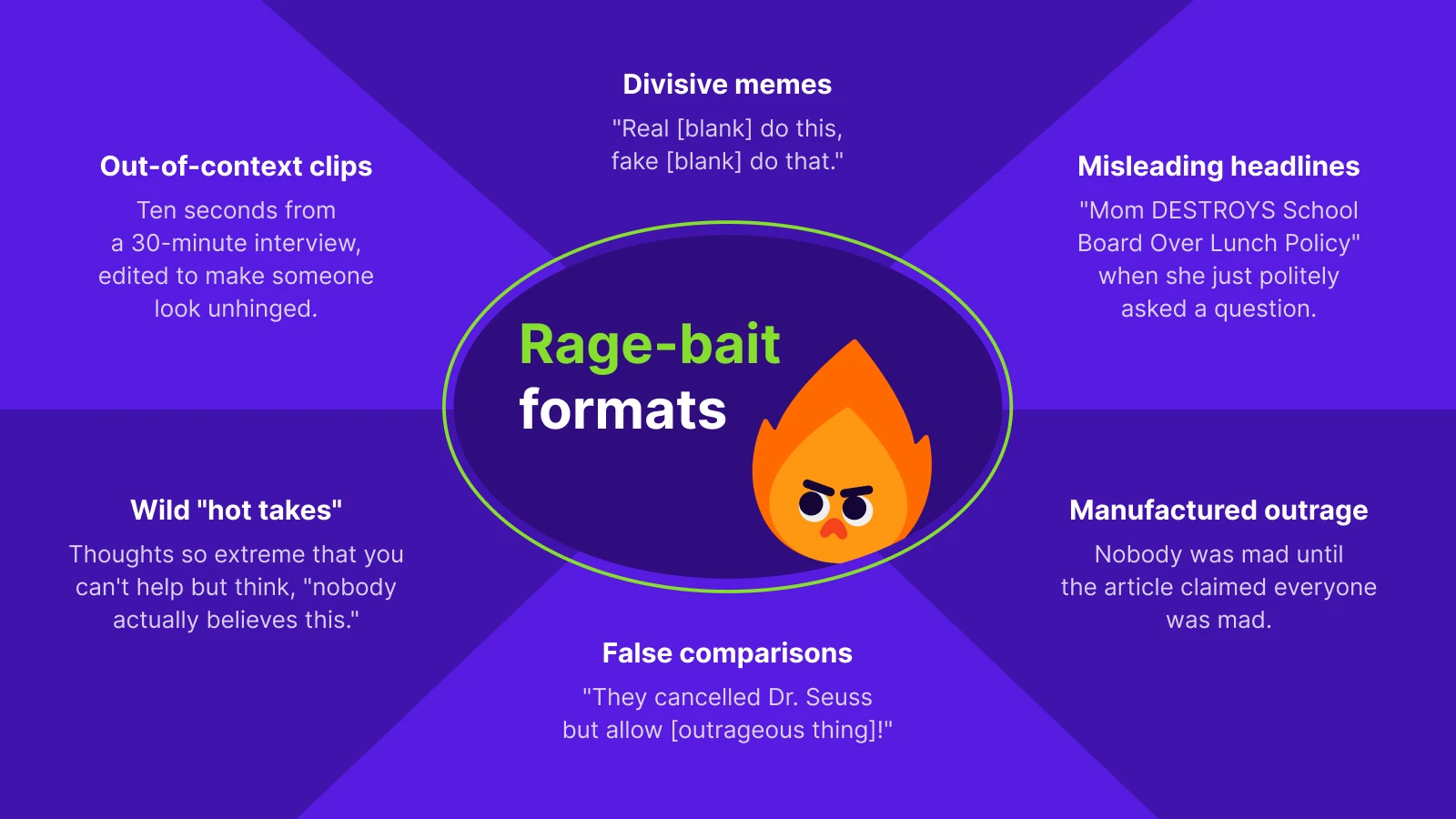
Common formats
Misleading headlines: "Mom DESTROYS School Board Over Lunch Policy" when she just politely asked a question.
Out-of-context clips: Ten seconds from a 30-minute interview, edited to make someone look unhinged.
Wild "hot takes": Thoughts so extreme that you can't help but think, "nobody actually believes this." And you'd be right, they're just baiting you.
Divisive memes: "Real [blank] do this, fake [blank] do that."
False comparisons: "They cancelled Dr. Seuss but allow [outrageous thing]!"
Manufactured outrage: Nobody was mad until the article claimed everyone was mad.
Everyday rage bait you've probably seen
TikTok: Deliberately terrible cooking, questionable parenting clips, and relationship advice so bad it can't be real.
Instagram Reels: Influencers organizing fridges chaotically, folding clothes in the worst possible way, and doing basic tasks wrong.
News cycles: Monthly "Generation Z is KILLING [industry]" articles. Different industry, same formula.
Political commentary: Politicians' quotes with all context removed. "Can you BELIEVE they said this?"
Celebrity gossip: "Celebrity X said [inflammatory thing]" except they were joking or got misquoted entirely.


Why rage bait is dangerous — for you and for society
Your mental health suffers. Scrolling through rage bait all day keeps your stress spiked. You're doom-scrolling, getting mad at strangers, and your brain starts expecting every post to be terrible. You feel exhausted but too wound up to stop. Over time, being on edge becomes your default state.
Society gets worse too. Everyone retreats to their corner, convinced the other side has lost their minds. Misinformation spreads fastest when people are angry — they share before fact-checking. Comment sections become toxic because platforms reward outrage with visibility.
Politicians and influencers know rage spreads — so they lean into it. When your feed is dominated by outrage, you're too angry to think straight about real issues that actually need fixing.
📘 Learn how to protect your well-being from rage bait with Headway!
How to spot rage bait — A practical detection checklist
Before you comment or share, run through this quick check:
Look at the headline. Words like "SLAMS," "DESTROYS," "you won't believe," or "everyone's saying"? Yeah, that's bait.
Notice your gut reaction. Instantly furious before you've read past the first line? Someone engineered that feeling.
Look for missing context. A 10-second clip? A quote with nothing around it? They cut out the parts that would calm you down.
Watch for strawman setups. "People are saying we should [absurd extreme thing]" — who exactly? One random person on Twitter (X)?
Check engagement patterns. Thousands of angry comments, barely any likes? Working as intended.
Spot the false choice. "Either you support this or you're awful" leaves no middle ground, because they don't want you to think.
Question big claims. "This ONE thing is destroying everything" probably isn't.
Notice when you're being told how to feel. "You should be furious" means they're deciding your emotions before you've formed your own opinion.
No, this isn't clickbait — just download Headway!
Rage bait works because your brain can't help reacting to threats. Algorithms figured this out and now profit from keeping you perpetually angry. The enraging headlines, context-free clips, trolling, fake controversies — all designed to hijack your attention.
But at least you can spot it now. Instant fury when you see a post? That's not organic. Wild claims with no nuance? Bait. Suspiciously missing context? Yeah, they cut that part out for a reason.
You don't need to quit social media. But you can reclaim those 15 minutes you waste getting mad at strangers and spend them on actual ideas that make you smarter, not angrier.
📘 Turn scroll time into growth time — download Headway and start today!
Frequently asked questions about what rage bait is
What is the 2025 word of the year?
Oxford University Press picked "rage bait" as 2025's Word of the Year. It beat out "aura farming" and "biohack" after over 30,000 people voted. Usage of the term tripled in the past year as more people caught on to how online content manipulates emotions for clicks. You've probably been rage-baited three times today without realizing it.
How do I spot rage bait?
Headlines screaming "DESTROYS" or "SLAMS" are your first clue. Instant fury before you've read anything? Someone engineered that feeling. Watch for missing context — short clips, quotes with nothing around them. False choices like "either you agree, or you're terrible." Tons of angry comments but barely any likes? That's rage bait doing its job perfectly.
What was the first clickbait?
The term "clickbait" emerged around 1999, but sensational headlines existed long before that. Early internet forums featured "flamebait" posts designed to provoke arguments. Tabloids have used this formula for over a century. The exact first clickbait headline is impossible to nail down, but "You Won't Believe What Happens Next" exploded in the 2010s thanks to Upworthy and BuzzFeed.
What is rage-baiting in a relationship?
When someone deliberately provokes their partner to get an angry reaction. They bring up old fights, say things they know hurt, or twist your words until you explode. It's manipulation — they want you emotional so they can control things or play victim afterward. Same concept as online rage bait, just happening in your living room instead of your feed.
What is toxic baiting?
Provoking someone until they react, then using their reaction against them. They push and push until you snap, then suddenly you're the problem. "Why are you so sensitive?" or "It was just a joke, relax." Shows up in toxic relationships and manipulative workplaces. They engineer the blowup, then act reasonable while you look unhinged, even though they started it.