Self-growth
 Business & Career
 Success
 Communication
 Healing
 Relationships
 Psychology
 Happiness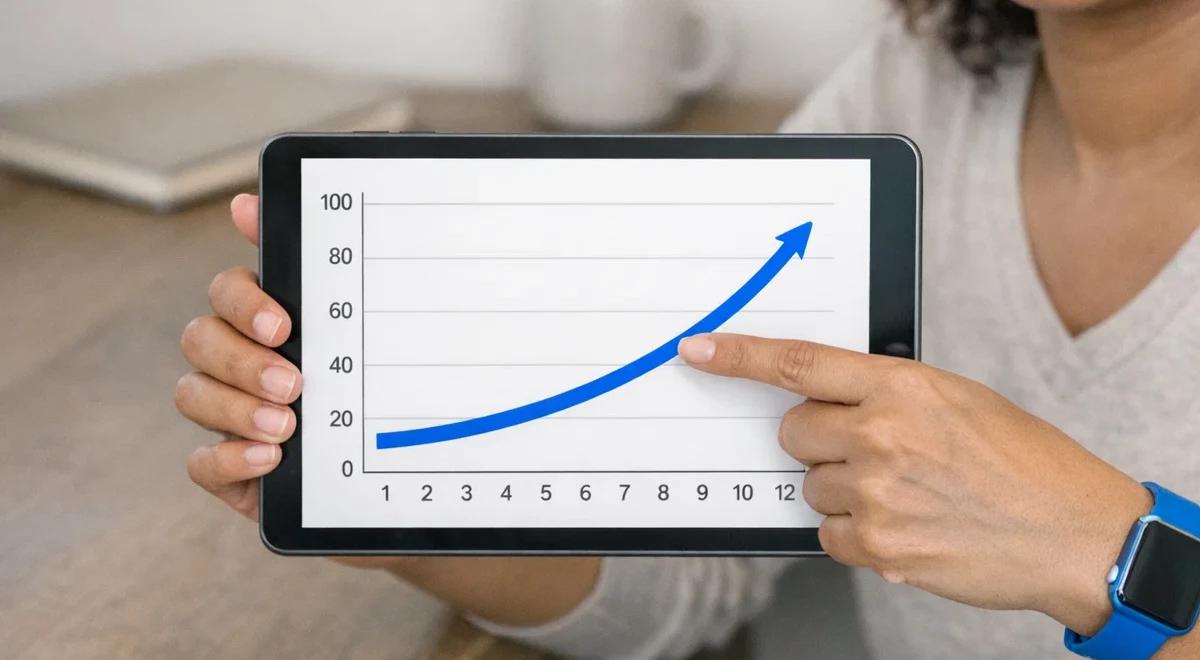
A systematic self-improvement technique focuses on measurable progress rather than random motivation. Instead of trying everything at once, it helps you improve specific areas of your life step by step.
Think of it like this: waking up one Monday and deciding to "become a better person" is not a system. Writing down one habit you'll practice for the next 30 days and tracking it — that's a system. One gives you a rush. The other gives you results.
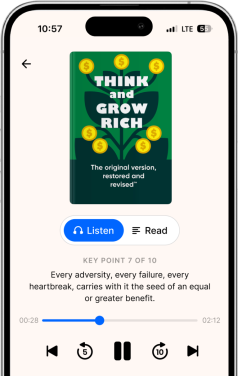
If you enjoy learning from self-improvement books but want quick, actionable insights, the Headway app offers audio summaries of top nonfiction books on personal development, daily self-growth challenges, and curated collections to help you turn learning into a daily routine, not just inspiration.
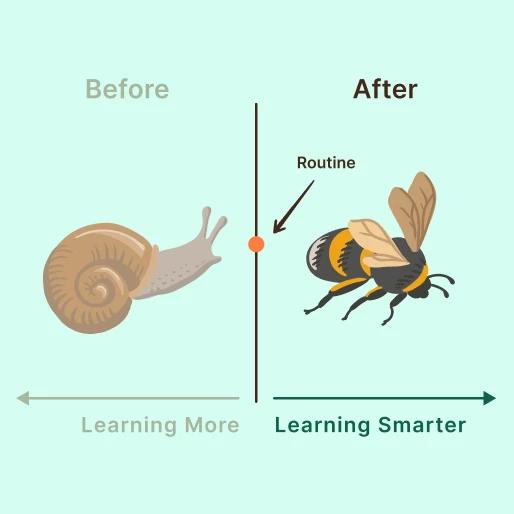
Unlock your daily growth superpower
Transform your routine to fuel continuous learning and effortless improvement.
Let's startQuick answer: What is a systematic self-improvement technique?
A systematic self-improvement technique is a structured approach to personal development that includes clear goals, measurable actions, regular self-reflection, and continuous improvement over time. It works in daily life, not just on your best days. You build it step by step, and it keeps working even when motivation runs low.
What makes self-improvement "systematic"?
Random self-improvement feels good for a week. You download a new app, buy a journal, and watch motivational videos. Then life gets busy, and it all quietly disappears.
A systematic approach is different. It doesn't rely on how you feel. It relies on a plan.
Here's what makes any self-improvement technique actually systematic:
Clear goal setting: You define what you're working toward, not just what you want to feel.
Measurable progress: You can see if it's working. Numbers, habits tracked, skills practiced.
Consistent daily routines: The system runs every day, even for 10 minutes.
Regular self-reflection: You check in with yourself honestly and adjust when needed.
Continuous learning and adjustment: You don't quit when it gets hard — you update the plan.
Here's what that looks like in real life. Instead of "read more," it becomes "read 10 minutes every morning using one book summary." Instead of "be healthier," it becomes "walk 7,000 steps daily and check my energy levels at 3 pm." These aren't perfect goals. They're just specific enough to actually do.
📘 Build your daily growth system — download Headway.



Systematic vs random self-improvement: What's the difference?
Most people have tried random self-improvement. It's not a bad thing — it just doesn't stick.
Random self-improvement:
Starts with emotion ("I need to change")
No tracking, no plan
Falls apart during stressful situations
Produces short bursts of effort
Systematic self-improvement:
Based on a real plan with achievable steps
Measurable, so you know what's working
Fits into daily life and routines
Designed for long-term personal growth
The difference isn't willpower. Its structure. A growth mindset helps, but even the most motivated person burns out without a real system behind them.
Here's a small example. Say you want to build self-confidence. Random self-improvement says, "I'll just try to be more confident." Meanwhile, systematic self-improvement says, "I'll practice one public speaking moment per week, journal afterward, and read one book summary on communication per month." Same goal. Very different outcomes.
Five examples of systematic self-improvement techniques
1. The 1% daily improvement rule
This one comes straight from James Clear's 'Atomic Habits.' The idea is simple: improve by 1% every day, and after a year, you're 37 times better. That's not a motivational slogan — it's math.
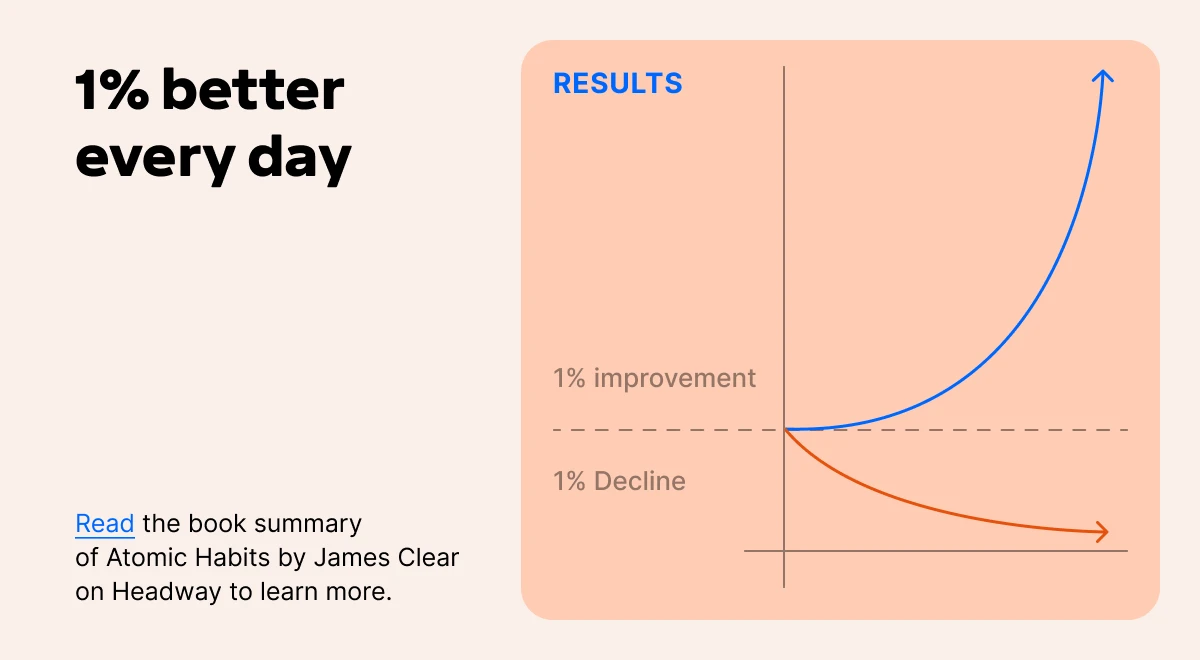
In practice, it means finding one thing you can do slightly better today than yesterday. Not a dramatic overhaul. Just a small step. Over time, small steps become second nature.
Headway has a 15-minute summary of 'Atomic Habits' that covers the core framework clearly, without reading the full book first.
2. The weekly self-reflection system
Every Sunday, ask yourself three questions:
What worked this week?
What drained my energy levels?
What will I adjust next week?
That's it. Ten minutes. No need for a fancy journal or a perfect setup. Self-reflection done consistently is one of the most underrated tools for mental well-being. It builds self-awareness fast.
3. The skill-building framework
Pick one new skill per quarter. Then spend 15 minutes a day on it — no more, no less. It sounds small, but 15 minutes a day adds up to over 90 hours in a quarter. That's enough to genuinely get good at something.
And that's where Headway fits naturally. The app is built around 15-minute audio summaries, so learning a new skill — negotiation, emotional intelligence, problem-solving — becomes part of your daily commute or lunch break. It's continuous learning without the extra time commitment.
4. Goal setting with SMART goals
SMART goals are: Specific, Measurable, Achievable, Relevant, and Time-bound. Most people have heard of them. Fewer actually use them.
The reason SMART goals work is that they force clarity. "I want to improve my self-esteem" is not a goal. "I'll write three things I did well every day for 30 days and check how I feel after" is a goal.
Pair SMART goals with a gratitude journal or daily affirmations, and you've got a simple personal development system that works.
5. The feedback loop method
Learn → Apply → Reflect → Adjust. That's it.
You read something useful. You try it this week. You note what happened. You tweak it. This practice is how mentors teach, how athletes train, and how strong teams operate. You don't need perfect conditions to start — you just need to complete the loop.
Gary John Bishop's'Unf*k Yourself' covers a similar idea: stop waiting for the right moment and just move. The summary on Headway takes 15 minutes and cuts straight to the point.
How to build your own systematic self-improvement plan
You don't need to overhaul your life. You need one clear starting point.
Here's a simple step-by-step:
Pick one growth area: Mental health, physical health, career, work-life balance — choose one.
Define a measurable outcome: "Feel less anxious in the mornings" is vague. "Meditate 5 minutes before checking my phone, 5 days a week" is measurable.
Choose one daily micro-action: One thing. Not five.
Schedule it: Add it to your calendar as a meeting.
Track it: A simple checkbox works.
Reflect weekly: Use the three Sunday questions from above.
Here's a real-world example. Say you want a better work-life balance. Start by reading one book summary per week on productivity or boundaries. Apply one idea from it. Track your stress levels before and after. After four weeks, you'll know if it's working — and you'll have the data to adjust.
Tools like Headway make continuous learning part of your daily routine. You're not adding hours to your schedule. You're using the 15 minutes you already have — during a commute, a lunch break, a walk — to grow intentionally.
Kamal Ravikant's 'Love Yourself Like Your Life Depends on It' is worth reading here too. The core idea: self-improvement that doesn't start with self-acceptance usually falls apart. And its Headway summary covers this idea clearly.
What gets in the way (and how to handle it)
Even the best system runs into resistance. Here's what usually goes wrong.
You try to do too much at once: Start with one habit, one goal, one area. Scale up only after it sticks.
You skip during stressful situations: This is normal. The system isn't built for perfect weeks — it's built for real ones. Missing one day is not a failure. Missing two weeks without adjusting is.
You don't track anything: You can't improve what you don't measure. Even a basic note in your phone counts. Headway's growth plans give you a pre-built structure if you prefer a more guided approach.
You compare your progress to someone else's: The whole point of a systematic technique is that it's yours. Your core values, your schedule, and your pace.
Visualization helps here. Before the week starts, spend two minutes imagining what success looks like. Not a perfect life — just a slightly better version of this week. That mental image keeps you oriented when things feel off.
Can ChatGPT help with systematic self-improvement?
Yes, but with limits. ChatGPT can help you brainstorm goals, create templates, draft journal prompts, or outline a learning plan. It's a useful starting tool — like a thinking partner you can bounce ideas off at any time.
What it can't do is replace the actual doing. Affirmations written by an AI don't stick unless you practice them. A SMART goal generated by a chatbot means nothing if you don't track it. The system still has to live in your daily life, not just in a conversation window.
Pair AI tools with real mentors or mentorship communities when possible. Books are a form of mentorship too — and reading the right one at the right time can shift your new perspectives in ways that a prompt rarely manages.
 📘 Get mentorship from the best minds — download Headway.
Build your system, starting today with Headway
A systematic self-improvement technique doesn't need to be complex. It just needs to be consistent. One goal, one daily action, one weekly check-in. That loop, repeated over time, creates genuine personal development — not the kind that looks good on social media, but the kind that actually changes things.
Want to know the best part? You already have the tools. A notebook, a phone, and those 15 minutes. That's enough to start.
If you want a powerful tool to make learning part of that system, download Headway and explore 15-minute audio summaries of the top self-help and personal development books — organized by goal, available any time, and designed to fit into your actual life.
Your full potential doesn't require a perfect plan. It just requires that you keep going.
Frequently asked questions
Is self-improvement a skill or a habit?
It's both. Self-awareness and problem-solving are skills you develop. Daily routines and reflection are habits you build. The best self-improvement journey combines both — you learn the skill and then make it automatic through repetition.
What are the best systematic self-improvement techniques for beginners?
Start with something small and clear. The feedback loop method (Learn → Apply → Reflect → Adjust) works well for first-time learners, as does the weekly self-reflection practice. Both require minimal setup and show results fast. The Headway app is also a good place to start — 15-minute summaries make continuous learning easy without feeling overwhelming.
How long does systematic self-improvement take?
Research on habit formation suggests it takes anywhere from 18 to 254 days for a new behavior to feel automatic, with the average sitting around 66 days. That's about two months for one habit to start feeling like second nature. So, don't measure success after one week; measure it after one quarter.
Can self-improvement techniques improve mental health?
Yes, in real ways. Regular self-reflection reduces rumination. Goal setting improves your sense of control. Continuous learning supports mental well-being by keeping the brain engaged. That said, systematic self-improvement isn't a replacement for therapy or clinical support. If you're navigating serious mental health challenges, please speak with a professional alongside building your personal growth habits.
How do I stay happy with myself during the process?
Track progress, not perfection. Celebrate small wins. And make sure your goals connect to your core values — not just what you think you "should" want. When the system reflects who you actually are, it feels a lot less like discipline and a lot more like just living well.