Self-growth
 Business & Career
 Success
 Communication
 Healing
 Relationships
 Psychology
 Happiness
Imagine finishing an incredible book. You feel energized and full of ideas that you're eager to put into action right away. Then six months go by, and someone asks you what that book was about — but you struggle to recall anything beyond the title. Does this sound like you? If so, don't worry. That's just how the brain operates — information fades fast.
That's why a spaced repetition app is so valuable for serious learning. Your casual book skimming will lead to knowledge retention that you can recall and use. Want to learn a new language? Study for tests? Apply what you learned from a self-help book? Even a free spaced repetition app can turn knowledge into actionable tips.
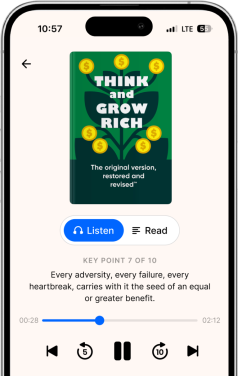
But here's a truth: Reading alone isn't enough. Yes, Headway gives you access to thousands of summaries in 15-minute formats. But the real magic happens when you combine these summaries with spaced repetition flashcards — that's when you shift from passively consuming content to actively learning it.
With student-friendly learning apps with quizzes, you can test your knowledge as you go, making learning interactive, fun, and much more likely to stick.
📘 Download Headway today and develop an effective learning system that sticks!
What is a spaced repetition app — and how does it work?
A spaced repetition app is a type of learning device that shows you information at nicely spaced intervals, just before you're about to forget it. Rather than cramming the information, which does not work well, these apps spread out the reviews based on your level of knowledge of the information.
How the science works:
The spaced repetition system app is based on a concept known as the forgetting curve, which psychologist Hermann Ebbinghaus first introduced in the 1880s. He found that after we learn something, we tend to forget it relatively quickly; however, if we revisit it at spaced intervals, we can shift that learning into long-term memory.
Here's how a spaced repetition app works:
First review: 1 day after learning
Second review: 3 days later
Third review: 1 week later
Fourth review: 2 weeks later
And so on, with intervals getting progressively longer. This pattern works because every time you successfully recall a memory, you strengthen it, and it becomes more deeply ingrained in your brain. The spaced repetition algorithm automatically adapts based on whether you got the answer correct or not.
Four popular apps that do this well:
There are several best apps that have built their reputation on a solid spaced repetition system (SRS):
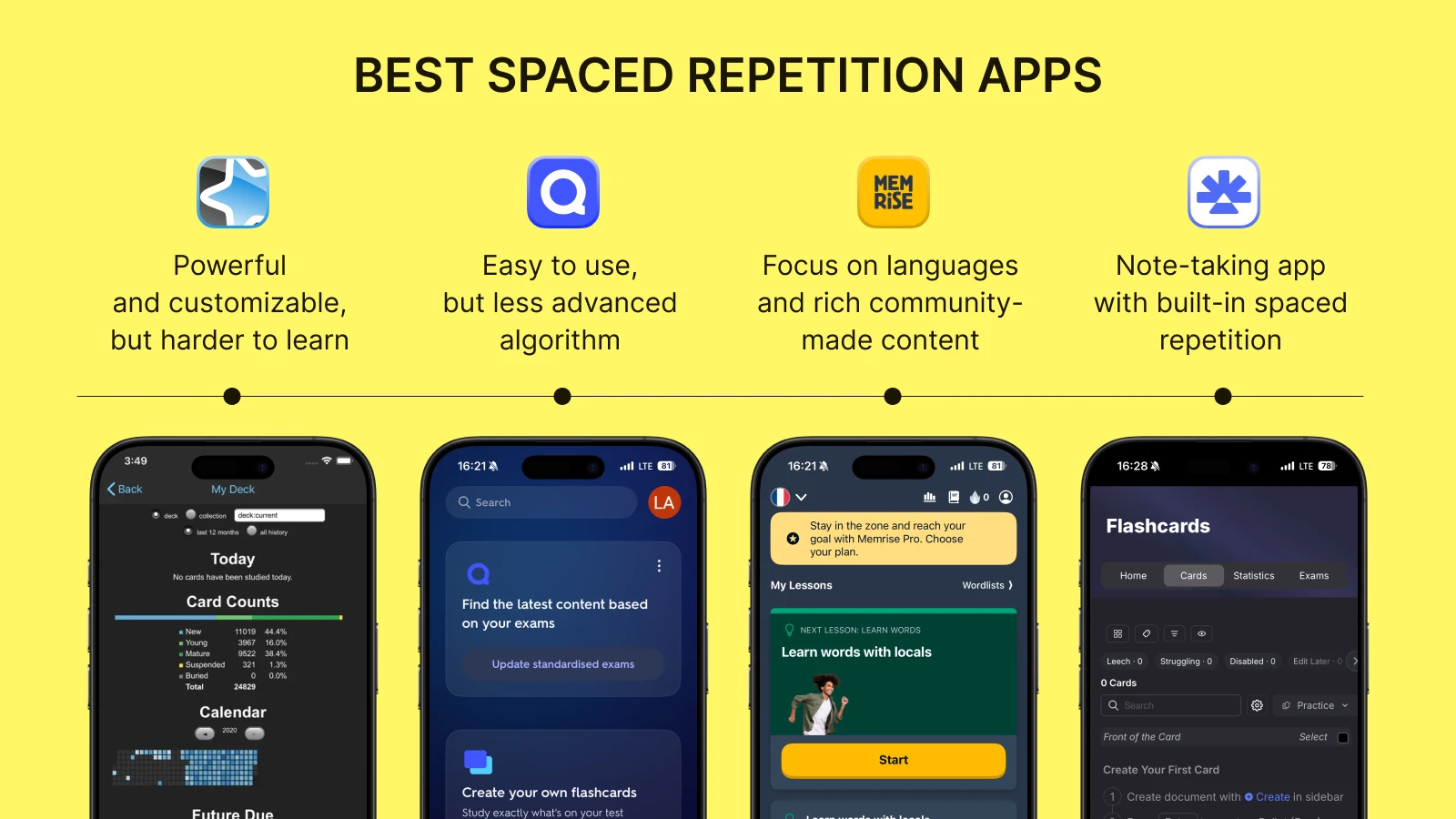
Anki: The heavyweight champion of serious learning. It has a fully customizable layout, but there's a learning curve.
Quizlet: A student favorite that's easier to navigate than Anki, but not as sophisticated with its algorithm.
Memrise: The app is focused on language learning, with lots of built-in courses and community-created content.
RemNote: A note-taking app with spaced repetition built in. It's great if you want everything in one place.
Are these apps better than paper flashcards?
Of course, you can do all of this with physical flashcards, but here's why a learning app wins every time:
The algorithm does the scheduling for you.
No physical clutter — everything lives on your phone.
Access your study materials on both iOS and Android.
Add images and audio to cards. Everything syncs automatically.


Why you should use a spaced repetition app: Four benefits
Alright, the science is great, but what does it actually do for your life? Let's be realistic about why using a spaced repetition app is more effective than simply reading and hoping it sticks.
The real benefits you see:
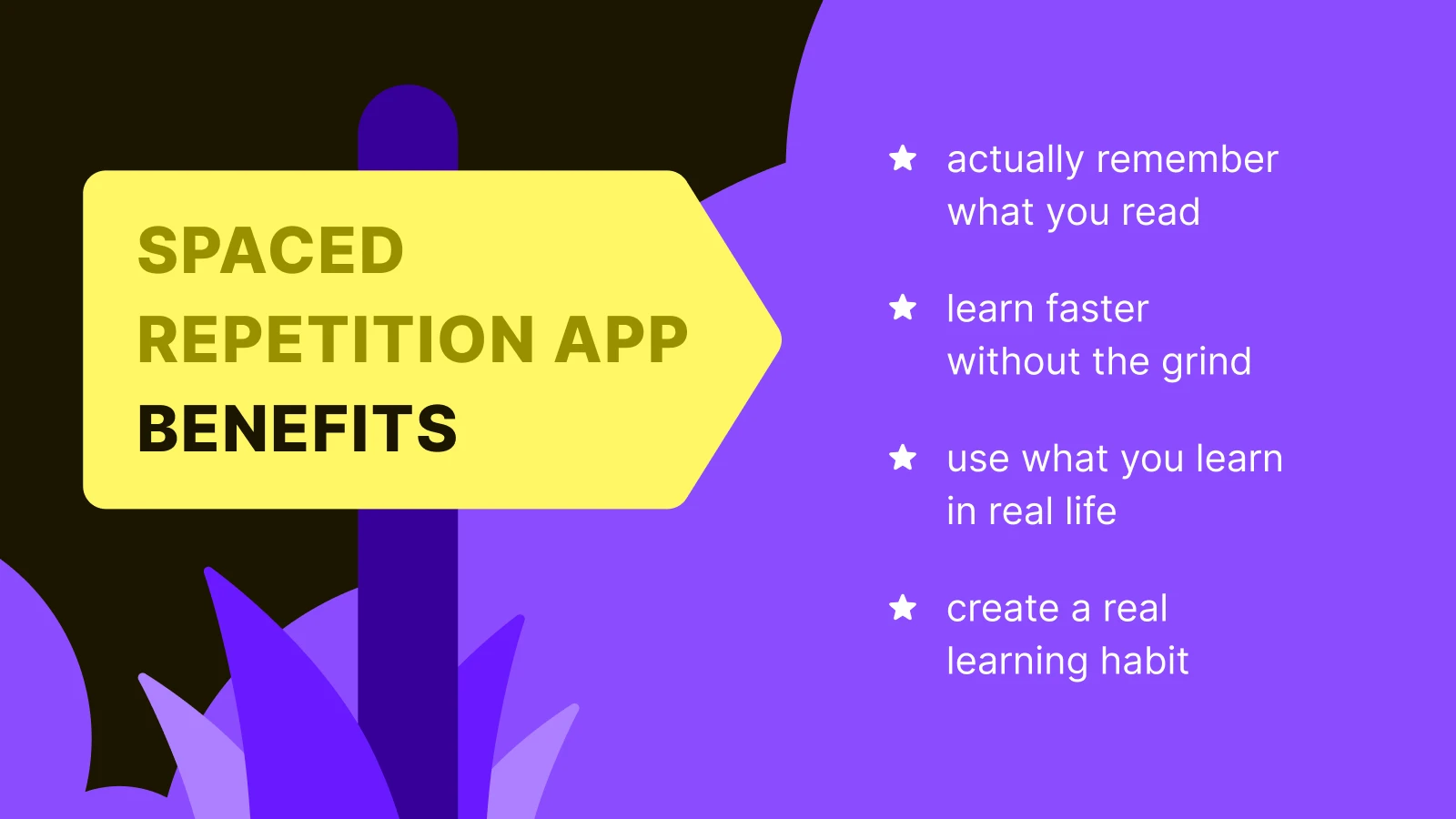
Benefit: Actually remember what you read. Stop losing 80% of what you learned within a week. Spaced repetition helps transfer information to long-term memory, so months later, you still remember the key ideas.
Benefit: Learn faster without the grind. Cramming might work for that test tomorrow, but it's a complete waste of time when it comes to actual learning. With spaced repetition flashcards, you review exactly when your brain needs it, making your study time unbelievably efficient.
Benefit: Use what you learn in real life. Reading book summaries is awesome, but if you read something a month ago, how are you supposed to use those frameworks if you can't recall them? A spaced repetition system helps you remember information later — when you're in that tough conversation, or when you need that productivity hack at work.
Benefit: Create a real learning habit. Most flashcard apps feature daily tracking, making studying automatic and efficient. The repetitions add up, and suddenly, you're remembering information from dozens of books instead of just one or two concepts.
What you remember with spaced repetition vs. reading once:
Have 85% better retention after 30 days compared to just reading
Content you can actually recall in conversations or real-life situations
Confidence when discussing topics because you genuinely understand the material
Less time re-reading material you've already forgotten
📘 Want to remember what you read? Try Headway's spaced repetition feature and see the difference for yourself.
How to pick the best spaced repetition app for your needs
Not all spaced repetition apps are created equal. Some are designed for intense language learning and academic studying, while others are more geared toward relaxed learning.
| Criteria | What to look for | Why it matters |
|---|
Algorithm strength | Customizable intervals, proven spaced repetition algorithm | Weak algorithms = poor long-term learning results |
Platform & sync | Works on iOS, Android, and web with cloud sync | You need access everywhere — phone, tablet, and computer |
Ease of use | Clean interface, simple card creation | Complicated tools kill motivation fast |
Study modes | Active recall, multiple-choice, and typing answers | Different learning techniques for different materials |
Cost | Free tier or reasonable pricing | Some charge $10/month for basic features |
Content library | Pre-made decks or create your own flashcards | Depends on whether you want ready-made or custom content |
Integrations | Works with note-taking apps, imports easily | Seamless workflow = better habits |
Top features that set the best spaced repetition apps apart
There are specific features that separate great apps from good ones. Here's what to look for when evaluating flashcard apps.
Things you need in a flashcard app (non-negotiable):
Adaptive scheduling that works: The spaced repetition algorithm schedules flashcards based on your performance. If this core function isn't there, you're just using expensive digital index cards.
Active recall prompts: Active recall is why spaced repetition is effective. Passive recognition doesn't cut it.
Multimedia support: Images, audio, and video help information stick better. This feature is especially essential for language learners.
Progress tracking: Good apps track daily streaks, cards you've mastered, and areas where you struggle.
Habit triggers: Streaks, points, levels — whatever keeps you coming back.
Nice-to-have features (serious upgrades): Community decks, reading app integration, offline mode, customizable templates with formatting options, and AI-powered card generation.
Real-life case study: How Jessica transformed her mornings with Headway
Before discovering Headway, Jessica spent her coffee time watching TV or scrolling through social media. When she started reading with intention, her mornings became more intentional and purposeful.
Jessica follows curated Challenges in Headway, like the 21-day Wellness Challenge. This feature helps her stay consistent and learn about new topics.
The impact:
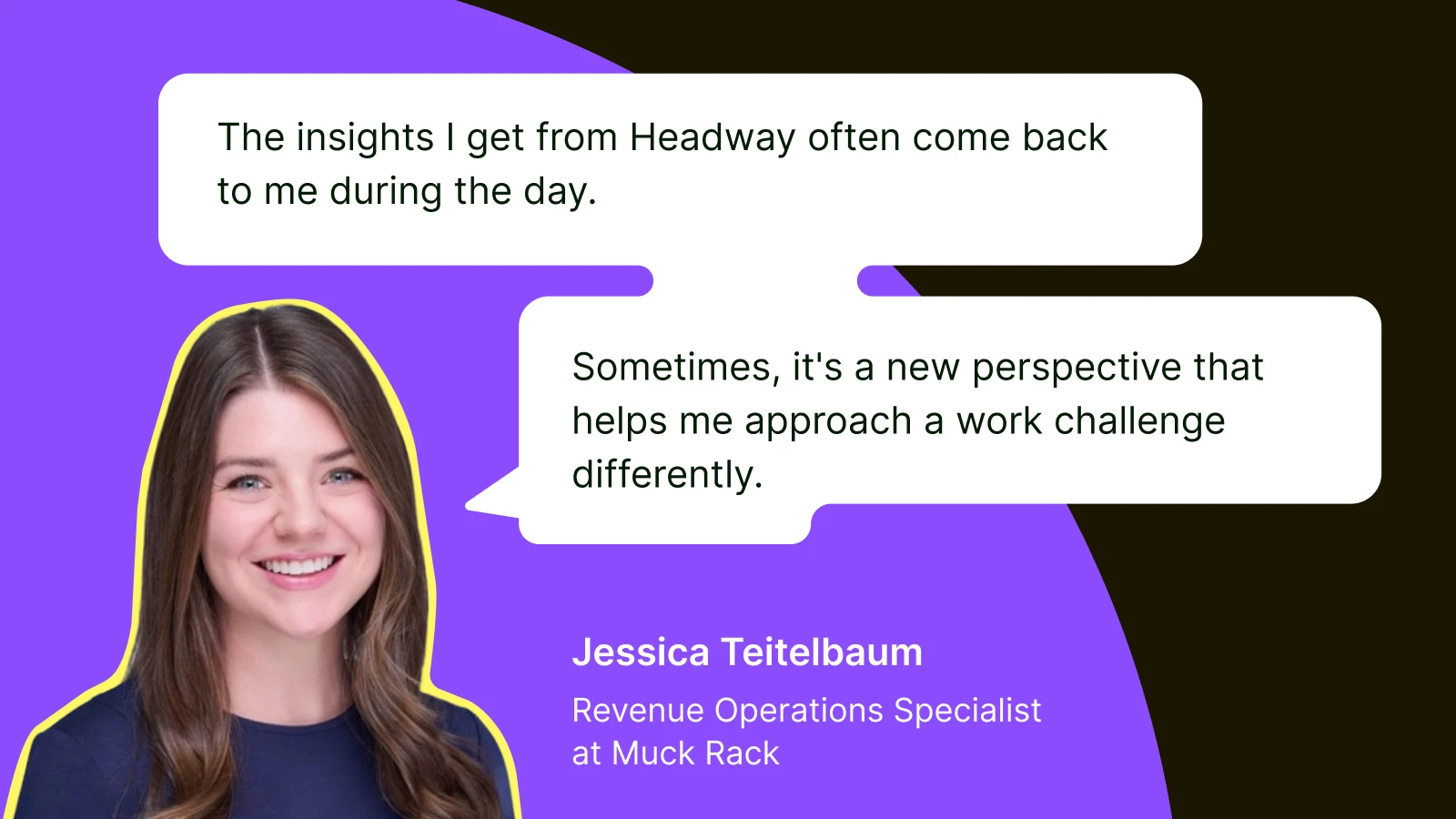
"The insights I get from Headway often come back to me during the day. Sometimes, it's a new perspective that helps me approach a work challenge differently."
And now Jessica can use Headway's flashcard feature and progress tracking to solidify her learning — combining book summaries with spaced repetition in one user-friendly app. No separate tools needed. It's reading plus retention in a single learning experience.
Turn reading into lasting knowledge with Headway!
In short, reading more doesn't make you smarter. Remembering what you read does. A spaced repetition app converts passive consumption into long-term memory.
Your action plan: Choose a spaced repetition learning app that fits your needs, whether that's a more powerful Anki spaced repetition app, a simpler one like Quizlet, or a language learning app like Memrise. Then, commit to doing 5–10 minutes of daily review.
The real magic begins when you combine 15-minute book summaries from Headway with spaced repetition. Read a summary. Create a few flashcards on key ideas and let the algorithm help them lock into memory. Or better yet, just use Headway's built-in flashcards along with the progress tracker.
Stop forgetting what you read, and start stacking your expertise over time.
📘 Download Headway now and watch your retention of some of the world's best nonfiction titles take off!
Frequently asked questions about a spaced repetition app
What is the spaced repetition app?
A spaced repetition application is a tool that schedules "reviews" of information at ideal time intervals, just before you're likely to forget. Apps like Anki, Quizlet, and Memrise schedule flashcards for you, showing them more often when you're struggling to recall and less often once you've mastered them.
How can I incorporate spaced repetition into my daily routine?
Start with 5–10 minutes during your daily routine — while drinking coffee or commuting. Here's the process: Read a Headway summary. Right after, create 3–5 flashcards on key insights using your preferred spaced repetition app. Then review those flashcards. Headway also offers built-in spaced repetition flashcards, making this practice even simpler.
Can ChatGPT do spaced repetition?
No. ChatGPT can create flashcards or help with explanations, but it doesn't have a spaced repetition functionality that schedules review sessions based on your performance. You need a dedicated flashcard app, such as Anki, Quizlet, or Headway's built-in feature, which tracks your performance and automatically adjusts review intervals.
How can I memorize 100 words quickly?
Instead of cramming, use spaced repetition flashcards or a flashcard maker app with spaced repetition. Group 10–15 words and make a card with the word on one side, and the definition/example on the other. Then review it weeks later using active recall. A spaced repetition app schedules the reviews for you, moving the words you remember well into long-term memory, while keeping the ones you struggle with in rotation.
Can spaced repetition help with ADHD?
Yes. Spaced repetition can be particularly beneficial for people with ADHD. The short study sessions (5–10 minutes), immediate feedback, and gamification features provide a structure and dopamine hits that work well for individuals with ADHD. Select an app that is engaging and user-friendly, featuring good visuals for tracking progress and streaks to help build consistency.
What is the best app for spaced repetition if I’m just starting?
The "best" choice depends on your goal. For those looking for a versatile, all-in-one experience, Headway is the best app for spaced repetition because it combines expert book summaries with automated review tools. If you are looking for highly technical, open-source customization, Anki remains a powerhouse. The key is to find an interface that you actually enjoy using every day.
How do I find a high-quality spaced repetition app for free?
If you are on a budget, you have excellent options. Anki is widely considered the best free spaced repetition app for desktop and Android users. Many learners also look for a spaced repetition app free of complex setups, in which case the basic versions of Quizlet or Memrise provide a great entry point into the world of algorithmic learning without an upfront cost.
How does an active recall and spaced repetition app actually work?
An active recall and spaced repetition app forces your brain to retrieve information rather than just passively re-reading it. When you see a flashcard, you have to "pull" the answer from your memory (active recall). The app’s algorithm then acts as a spaced repetition schedule app, calculating exactly when you should see that card again based on how difficult it was for you to remember it.
Is there a specific spaced repetition vocabulary app for language learners?
Yes, if your goal is specifically linguistics, using a dedicated spaced repetition vocabulary app like Memrise or Duolingo’s flashcard features is ideal. For those who want to learn professional or "power" vocabulary from the world's best nonfiction books, Headway acts as a specialized spaced repetition reminder app, notifying you exactly when it's time to review your saved insights so they never slip your mind.
What makes the Synap spaced repetition app different from others?
The Synap spaced repetition app is often favored by students and professionals preparing for high-stakes exams. Unlike basic flashcard tools, it focuses on practice multiple-choice questions and mock exams, using its algorithm to highlight your weak areas. It’s a great example of how modern tools are evolving beyond simple cards into full-scale exam-prep systems.