Self-growth
 Business & Career
 Success
 Communication
 Healing
 Relationships
 Psychology
 Happiness
It starts around early February. The drugstore aisles fill with red and pink. Your group chat goes quiet because everyone's making couple plans. Your aunt texts to ask if you're "seeing anyone special." And somewhere in the back of your mind, familiar worries surface: about being alone, about being unchosen, about what it all means.
You're not imagining the pressure. Clinical reports note heightened loneliness, anxiety, and depression around Valentine's Day for many singles — especially those recently out of relationships or grieving a loss — with distress often building in the weeks before the actual day. A 2020 Plenty of Fish survey of 2,000 singles revealed that 43% viewed Valentine's Day as the most pressure-filled holiday of the year. More stressful than Christmas. More loaded than New Year's Eve.
And what do most of us do when that pressure builds? We reach for our phones. We scroll through couple content that research links to intensified loneliness through social comparison and validation-seeking. A 2025 study in JAMA Network Open found that young adults aged 18 to 24 who limited social media to 30 minutes daily for just one week saw depression symptoms drop 24.8% and anxiety decrease 16.1% on average. The problem isn't the screen time itself — it's the passive consumption that leaves you feeling worse than when you started.
The four books below won't guarantee you a partner by next February. They do something more useful: they help you unpack why you keep reaching for that phone, how to actually enjoy your own company, and what self-care looks like when it's not just a hashtag.
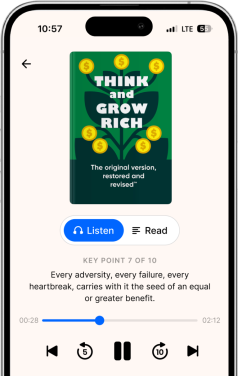
📘 When you're feeling low, starting a 300-page book can feel like another task you'll never finish. That's why over 55 million people use Headway — quick summaries that give you the insight without the overwhelm. With 2,500+ titles on self-worth, loneliness, confidence, and relationships, whatever you're wrestling with this Valentine's Day, there's a book for it. And you can actually get through it before your coffee gets cold.
➡️ What is Headway and how does it work?
'How to Be Alone' by Lane Moore
Lane Moore didn't choose solitude as a lifestyle philosophy. She was dealt it. Her childhood lacked the stable connections most people take for granted, and she spent years figuring out how to exist in a world that constantly pushes for togetherness when being together never felt natural to her.
That's what makes this book different from the usual "learn to love yourself" advice. Moore isn't writing from a place of having figured it all out. She's writing from the middle of it — the loneliness that persists even in a crowd, the exhaustion of pretending you're fine, the complicated feelings that arise when you're single not by choice but by circumstance.
The book blends personal stories with cultural observations about how society treats people who are alone. Moore points out the messages we absorb without realizing it: that being single means something is wrong with you, that solitude is a problem to be solved rather than a state that can have its own meaning. She doesn't pretend solitude is always pleasant. But she shows what it looks like to stop fighting it and start finding something real there.
For anyone spending Valentine's Day feeling the weight of being alone, this book offers something rare: a compassionate companion who understands that wanting connection and struggling with it can exist in the same person at the same time.
'Buy Yourself the F*cking Lilies' by Tara Schuster
The title comes from a moment Schuster had in a grocery store. She was waiting for someone else to buy her flowers, to recognize her, to make her feel special. And then she realized she could just... buy them herself. That small act of treating herself the way she wanted to be treated changed something.
Schuster grew up in what she calls a "home in name only" — parents who were physically present but emotionally absent. By her mid-twenties, she had a successful career and a life that looked good from the outside. Inside, she was miserable, self-destructive, and running on a combination of wine and anxiety. This book documents how she rebuilt herself from the inside out.


What separates this from typical self-help is Schuster's humor and honesty about how awkward it feels to start taking care of yourself when no one taught you how. She writes about making her bed for the first time at 25, learning to cook actual meals, and creating small rituals that slowly accumulated into a life she wanted to live.
If you're spending Valentine's Day solo, consider this: instead of waiting for someone to show up with roses, you could spend the evening building the kind of relationship with yourself that makes every other relationship better. Schuster gives you the practical rituals to actually do that, from morning pages to evening wind-downs.
'Sex Talks' by Vanessa Marin and Xander Marin
Wait — a book about couples' communication on a list for singles? There's a reason this one's here, and it's not irony.
Vanessa and Xander Marin, a licensed sex therapist and her husband, wrote 'Sex Talks' to address the conversations couples avoid having: about desires, boundaries, fantasies, and what intimacy actually means. But here's what they discovered: most people never learn how to have these conversations before they're in a relationship. Then they stumble through them badly, or don't have them at all.
Reading this book while single is like getting the manual before you need it. The Marins break down five crucial conversations that determine whether intimacy grows or dies in a relationship. Understanding these conversations now means you'll enter your next relationship knowing how to talk about things most people spend years avoiding.
But there's another reason to read this now: self-knowledge. The exercises and questions in the book force you to think about what you actually want from intimacy, not just what you think you're supposed to want. That clarity is valuable whether you're coupled or not. And honestly, a Valentine's Day spent getting clear on your own desires beats a Valentine's Day spent watching strangers open gift boxes on your phone.
📘 Clarify intimacy conversations with Headway.
Saturday is yours. Spend it alone — or with Headway
Something shifted in 2025. Restaurants started promoting "table for one" specials without the pity undertone. Spas rolled out solo packages that weren't labeled "treat yourself while you wait for someone better." The self-partnered movement went from a quirky Emma Watson quote to an actual market category. Being single on Valentine's Day stopped being something to apologize for — and started being something retailers actually designed experiences around.
That trend isn't slowing down in 2026. This year, February 14th falls on a Saturday. That's a full day with no work obligations, no rushing home from the office to meet someone else's expectations. Most people in relationships will spend it coordinating dinner reservations and stressing about whether the gift is enough. You get to spend it however you want. That's not a consolation prize. That's freedom.
You don't have to read all four books this week. Pick the one that speaks to where you are right now. If you're constantly seeking approval online, start with Susie Moore. If you're struggling with being alone, Lane Moore gets it. If you want to build actual self-care habits, Tara Schuster has the blueprint. And if you want to prepare for the relationship you'll eventually have, the Marins offer the conversations you'll need.
These four books are just the starting point. On Headway, you'll find 2,500+ titles — on building confidence, setting boundaries, healing from past relationships, learning to trust yourself again. 55 million readers have used the app to find answers to exactly the kind of questions that surface around Valentine's Day. Your question has a book. Probably several.
📘 Find answers that matter with Headway now.
However you decide, make this Saturday different. The algorithm will be there on the 15th — but you don't have to be the old version of yourself.
Frequently asked questions about books for a solo Valentine's Day
What is the best book for someone feeling lonely on Valentine's Day?
'How to Be Alone' by Lane Moore is the most compassionate choice for anyone struggling with unwanted solitude. Moore doesn't pretend loneliness is easy or that positive thinking will fix it. She writes from personal experience about navigating a world designed for couples when being alone wasn't something you chose. The book validates difficult feelings while offering genuine insight into finding meaning in solitude rather than just tolerating it.
Why is it so hard to stop scrolling TikTok when you're feeling down?
TikTok's algorithm creates what researchers call a "closed-loop relationship" between your viewing and what you're shown next, making it uniquely hard to stop. A Baylor University study found TikTok scored higher than Instagram Reels or YouTube Shorts on perceived effortlessness, recommendation accuracy, and the surprise element that keeps people scrolling. When you're already feeling low, the passive consumption requires zero effort — which is exactly why it leaves you feeling emptier rather than connected.
How does social media affect mental health on Valentine's Day specifically?
Valentine's Day amplifies social media's comparison effects because feeds become saturated with relationship content. Research published in JAMA Network Open found that unhealthy use patterns — negative comparison to others, seeking outside approval, or feeling addicted — were strongly linked to depression, anxiety, and insomnia. On a holiday culturally designed around couples, these comparison triggers intensify, making single users particularly vulnerable to feeling inadequate or left behind.
What are the best self-care practices for a solo Valentine's Day?
The most effective solo Valentine's Day involves intentional rituals rather than passive distraction. Tara Schuster's 'Buy Yourself the F*cking Lilies' recommends small acts of self-treatment: buying yourself flowers, cooking a proper meal, and creating an evening wind-down routine. Research on the "self-partnered" movement shows that actively choosing how to spend your time builds confidence and autonomy. The key is doing something that feels like a choice rather than something you're enduring until the holiday passes.
Is it normal to feel sad on Valentine's Day when you're single?
Completely. Valentine's Day carries decades of cultural messaging that equates romantic partnership with success and singleness with failure. In the U.S., nearly half of adults are unpartnered, so if you're feeling the weight of the holiday, you're in good company. What helps is acknowledging the feeling without judging yourself for having it. Lane Moore's 'How to Be Alone' and other books on this list validate that wanting connection and struggling with solitude can coexist — and neither makes you broken.
How can Headway help if I'm feeling alone before Valentine's Day?
When you're in that pre-Valentine's slump, the last thing you need is another 300-page book staring at you from the nightstand. Headway gives you the core insight in 15 minutes — just enough to shift your perspective before the feeling spirals. The app has 2,500+ titles on loneliness, self-worth, building confidence, and healing from past relationships.55 million people use it to work through exactly these moments. You can explore what resonates, skip what doesn't, and actually finish something — which, when you're feeling low, is a win in itself.