Self-growth
 Business & Career
 Success
 Communication
 Healing
 Relationships
 Psychology
 Happiness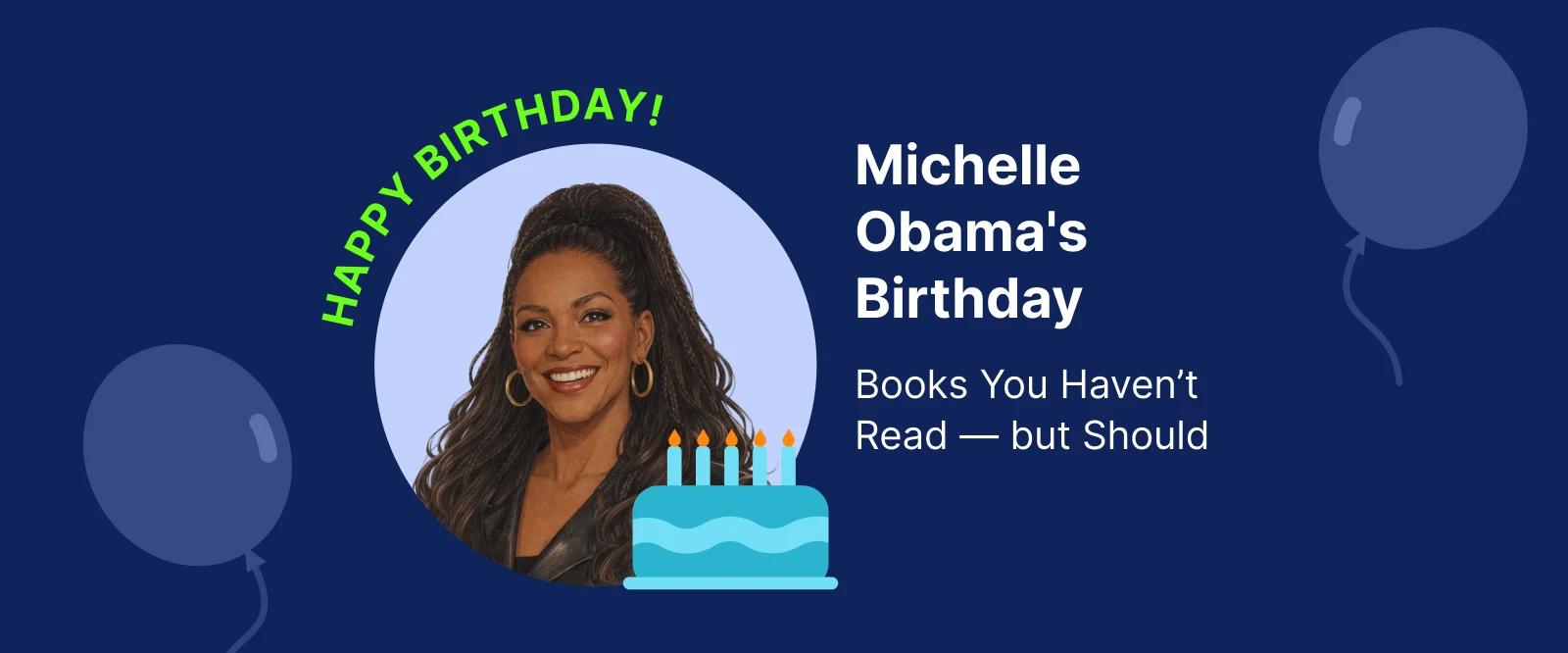
How do you keep growing when you're already supposed to have it all figured out?
Michelle Obama turns 62 on January 17. Her life achievements are prolific: a First Lady, a bestselling author, and a Harvard Law graduate. However, her books tell a different story: Michelle writes about feeling like a fraud at elite universities.
Quitting a corporate law job that paid well but felt empty. Due to her husband's political ambitions, she remained at home with their daughters. Are all of these mentioned facts true?
'Becoming' and 'The Light We Carry' aren't about perfection or having all the right answers. They're about growth when nothing feels certain.
📘 Take Michelle's lessons into your own hands and get Headway summaries of these must-read memoirs.
Quick answers: Growth lessons from Michelle Obama's books
Imposter syndrome doesn't mean you don't belong. Michelle felt like a fraud at Princeton and Harvard, but she went there anyway. Self-doubt tells you the challenge is new, not that you're incapable.
Leave jobs that wreck you, even when they pay well. She walked away from corporate law without a backup plan. Sunday night dread and collecting paychecks while disliking your days means something's wrong, and a high salary doesn't fix that.
Fear stays — you just function while scared. Michelle parented in the White House, terrified daily. The concept of "small power" from 'The Light We Carry' helped her: control what you can when everything else spins out, and ignore the rest.
Growth lesson #1: The South Side girl who questioned everything
Michelle grew up in a one-bedroom apartment on Chicago's South Side. Her father worked at the water plant. When she got to Princeton, she kept waiting for someone to tell her she didn't belong.
Other students seemed to know things she didn't — how to navigate campus, which professors mattered, what unspoken rules existed. Harvard Law felt worse: everyone around her seemed effortlessly brilliant while she scrambled to keep up.
Michelle writes in 'Becoming,'
"If you don't get out there and define yourself, you'll be quickly and inaccurately defined by others."
Decades later, she came to understand that feeling differently. Self-doubt meant she was doing something hard in unfamiliar territory, not that she was inadequate. The students who looked confident? Mostly faking it. They had just practiced in environments that prepared them for elite schools.
➡️ That "everyone knows something I don't" feeling shows up at new jobs, after promotions, in unfamiliar cities, but it doesn't mean you're failing.
Growth lesson #2: When the plan falls apart
Michelle had the degree, the law firm job at Sidley Austin, and the six-figure salary. Everything lined up exactly as planned, but she was unhappy.
Sunday nights, she'd lie awake dreading Monday. Not because the work was difficult — she handled it fine, but it just felt empty. Billable hours, client meetings that seemed pointless. When her father died, she realized she was wasting time on work that didn't matter to her.
She quit without another job lined up. Took a massive pay cut for public service work with the city. Her law school friends thought she'd lost it.
In 'Becoming,' she says:
"Do we settle for the world as it is, or do we work for the world as it should be?"
Later, she proceeds to describe that corporate job as looking good from the outside while feeling hollow inside. The salary didn't fix the dread. The prestige didn't make Sundays easier.
➡️ She writes about being terrified of making that leap. However, staying in a job that drained her felt worse than the uncertainty of leaving.
Growth lesson #3: Marriage isn't a fairy tale
Michelle and Barack Obama appeared to be the perfect partnership from the outside. However, like every couple, they faced certain challenges along the way.
He was campaigning, networking, building his political future. She was home with two small daughters, handling everything: doctors, tantrums, bedtime. He'd breeze in asking how her day went.
The resentment built for years, and eventually, they ended up in couples therapy. Her problem wasn't that he was a bad husband; it was about her ambitions: they had gotten smaller while his expanded. She'd made herself secondary without noticing it happen gradually.
In 'Becoming,' Michelle states:
"Your story is what you have, what you will always have. It is something to own."
Therapy forced actual conversations about imbalance instead of both of them pretending things were manageable. She writes openly about this because the "power couple" image wasn't always that powerful.
➡️ Real partnerships include resentment sometimes. The question is whether you discuss it or let it fester quietly until everything falls apart.


Growth lesson #4: Fear as companion, not enemy
Michelle spent eight years in the White House, terrified for her daughters. Malia and Sasha grew up with Secret Service, public scrutiny, and constant threats. Some she knew about, most she probably didn't, but the fear never went away.
'The Light We Carry' doesn't promise you'll eventually stop being scared. She writes,
"Our hurts become our fears. Our fears become our limits. For many of us, this can be a heavy inheritance, carried by generations. It's a lot to try to push back against, to try to unlearn."
What helped was her "small power" idea: control what you can when everything else spins out. During campaigns, she was unable to control media attacks or shape political narratives, but she could control family dinners, bedtime routines, and create small moments of normalcy for her kids.
➡️ Parenting, work pressure, uncertainty — fear shows up regardless. She just quit treating it like a problem that needed solving before she could move forward.
Growth lesson #5: What 62 looks like
Michelle Obama still feels uncertain about things, even at 62. She writes about questioning choices, making mistakes, and examining them later. But her focus now: mentorship for young women, writing, time with family. Malia and Sasha are grown, and Barack's out of the office, so the constant scrutiny dropped.
In 'The Light We Carry,' Michelle writes:
"It's okay to pace yourself, get a little rest, and speak of your struggles out loud. It's okay to prioritize your wellness."
She talks about the relief of no longer performing for public judgment. Decades of criticism about what she wore, how she smiled, and every word she said. That pressure has mostly lifted. Now, she's doing work she wants without the constant evaluation. Michelle isn't trying to reach some finished state where growth stops.
➡️ Just less concerned with appearing perfect while figuring things out. At 62, she's allowed to still be in progress.
Headway for when you need the lessons, not the life story
Michelle Obama's books aren't specifically about being First Lady. She wasn't afraid to share her wisdom and open up to the public about:
Imposter syndrome at Princeton
Quitting a job that pays well but wrecks you
Fear while parenting
At 62, she's still figuring things out. Similar to 32, but with less concern about appearing perfect while doing it. You can get these growth lessons on Headway: our app has book summaries of 'Becoming' and 'The Light We Carry.' It is an ideal choice if you want Michelle's wisdom without committing to hundreds of pages.
Growth doesn't end, but it doesn't get tidy either — you just quit expecting it to.
Frequently asked questions about Michelle Obama
What is Michelle Obama's birthday?
Michelle Obama was born on January 17, 1964. She'll be turning 62 in 2026, continuing to inspire with her personal growth and journey. Michelle is a renowned public figure, former First Lady, attorney, mother, and author.
How does Michelle Obama define "small power"?
Michelle defines "small power" as something that you can actually control in this exact moment. In 'The Light We Carry,' she explains that focusing on things and events that you have full control over is helpful and helps destroy chaos around you.
How can I embrace fear and use it for personal growth?
Michelle explains in her memoirs that fear is part of growth. So, instead of letting it stop you, use it as a signal that you're pushing yourself to the limit. Embrace the fear, try to move forward anyway, and let it drive you to take action.
What are Michelle Obama's most famous books?
Michelle Obama's most famous books are 'Becoming' (2018) and 'The Light We Carry' (2022). Both of these are personal stories, thoughts, feelings that are shaped in the form of growth and wisdom. Michelle teaches us how to find strength even during the most challenging times.
What does it mean to 'define yourself' as Michelle encourages?
Michelle believes that defining yourself is about owning your story and not letting others shape it for you. In 'Becoming,' she emphasizes the importance of staying true to who you are, regardless of outside pressures and obstacles.