Self-growth
 Business & Career
 Success
 Communication
 Healing
 Relationships
 Psychology
 Happiness
While great for getting started, many popular language-learning methods rarely get you to real-world fluency. They teach you vocabulary, but they don't teach you how to think or speak naturally.
If you're ready to move past the simple daily practice and find a method that truly works for your brain and your goals, this is your guide.
This article isn't just about swapping one Duolingo alternative for another. It's a comprehensive plan for building a complete language strategy, showing you how polyglots (people who speak many languages) learn quickly.
Whether you want to learn your first foreign language or are dealing with your tenth, these tips and tools are worth your attention!
Quick answer: What are the best language learning apps for digital learners?
| App name | Primary focus | Best for | Learning style |
|---|
Babbel | Conversational dialogue & grammar | Speaking with confidence, travel | Reading/writing, auditory |
Busuu | Community feedback & grammar | Complete beginners, real-world practice | Visual, reading/writing |
Headway | Vocabulary expansion through reading and listening | Intermediate/advanced learners, knowledge seekers | Reading/listening |
Pimsleur | Pure audio, spaced recall | Commuters, developing an authentic accent | Auditory |
LingoDeer | Asian languages & structured grammar | Grammar depth, visual learners | Visual, reading/writing |
Memrise | Video clips and spaced repetition | Vocabulary, learning from native speakers | Visual, auditory |
Mondly | Quick daily lessons, unique tech | Fast, diverse vocabulary, VR/AR exploration | Kinesthetic, visual |
Anki | Custom flashcards & deep memorization | Polyglots, medical/law students, total customization | Visual, reading/writing |
The 12 best Duolingo alternatives in 2026 (8 apps like Duolingo and 4 tools that go beyond)
We've rounded up the 12 best Duolingo alternatives for 2026 — eight excellent apps and four dedicated tools — to help you find the perfect match for your goals.
Please note: While many offer free tiers or trials, subscription prices often vary by country and platform (App Store/Google Play vs. website), and significant discounts are common during special sales periods throughout the year.
1. Babbel
Babbel is one of the most direct and popular Duolingo alternatives. Its curriculum is built around real-life scenarios. Babbel's lessons start with a short dialogue and then break down the vocabulary and grammar, which are the most necessary steps needed to start speaking fluently.
Best for: Learners who want to start babbling.
Key features:
Dialogue-based lessons: Focus on conversations you'd have (checking into a hotel, ordering food).
Grammar integration: The app explains rules clearly, not just implies them, supporting the Reading/Writing learner.
Speech recognition: Helps fine-tune your pronunciation.
Courses in 14 languages: Including Spanish, Turkish, Swedish, and Italian.
Pricing (current as of November 2025): Babbel does not offer a free tier, but all subscriptions include access to all available languages and come with a 20-day money-back guarantee.
Subscription options:
3-month plan: $15.25/month (billed as $45.75).
6-month plan: $13.45/month (billed as $80.70).
12-month plan: $8.95/month (billed as $107.40) — Save 41%.
Lifetime plan: One-time payment of $299.99, with permanent access to all languages.
| Pros | Cons |
|---|
Focus on practical, adult-level dialogues | Less engaging or game-like than other apps |
Clear and concise grammar explanations | Subscription model can be more expensive than competitors |
Lessons are short (10–15 minutes) and flexible | Limited language selection compared to some free platforms |
2. Busuu
Busuu is unique because it integrates human interaction directly into its learning process. You complete lessons created by language experts, but then you practice your writing and speaking by submitting exercises to native speakers within the Busuu community. In the Duolingo vs Busuu debate, the real differentiator comes down to the human element.
Best for: Social learners who thrive on peer-to-peer feedback and want to master both writing and speaking with the help of real people.
Key features:
Native speaker correction: Get direct, friendly feedback from native speakers on your pronunciation and short written paragraphs. You do the same for people learning your language, creating a true exchange.
Official certification: Busuu offers McGraw-Hill certifications (A1, A2, B1, B2) as proof of your skills, which can be useful for academic or professional goals.
Structured curriculum: Courses are based on the CEFR (Common European Framework of Reference for Languages) levels.
Pricing (current as of November 2025):
A Free plan with limited access to flashcards and lessons is available.
Premium plans (Busuu Premium for $14.99 and Premium Plus for $19.99) are subscription-based. They include features like offline mode, grammar review, and official tests. The Lifetime Price is $199.99 (Premium Plus).
| Pros | Cons |
|---|
Real-time, human feedback is invaluable | The quality of feedback depends on the community member |
Courses follow a professional framework (CEFR) | Less comprehensive for less common languages |
The community aspect keeps motivation high | Full features require a paid plan |
3. Headway
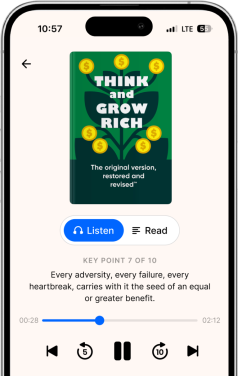
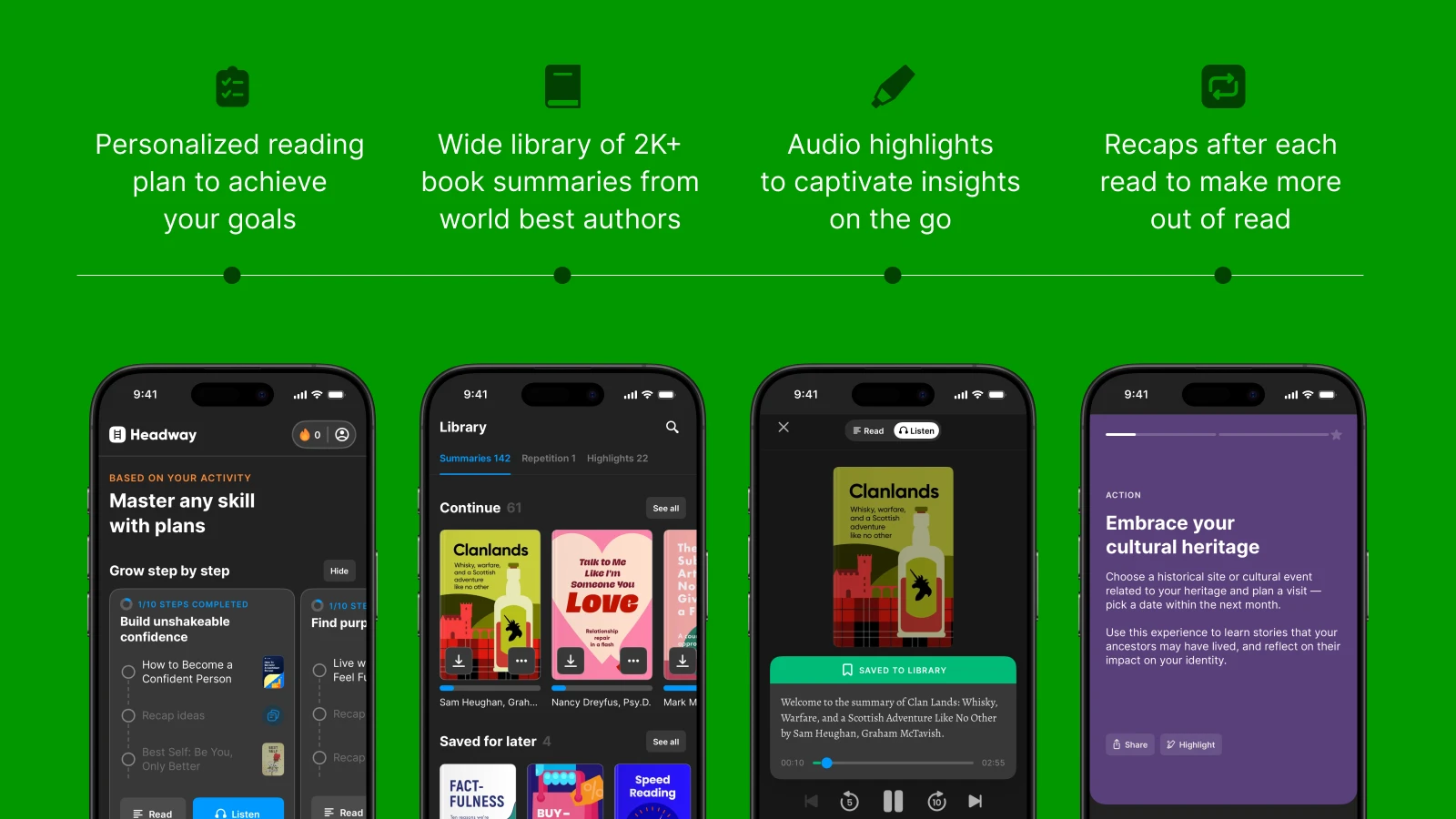
Headway will help you learn a new language differently. It's not a course-based app, but a tool designed for intellectual growth. Headway helps you read or listen to summaries of global nonfiction bestsellers, like 'The 7 Habits of Highly Effective People' or 'Atomic Habits,' in just 15 minutes.
How does this help with a new language?
For intermediate and advanced learners (B1/B2+), vocabulary is the biggest barrier to fluency. By reading or listening to complex concepts in your target language, you bypass simple flashcards and learn advanced, contextual vocabulary related to business, psychology, and personal development.
Best for: Intermediate to advanced learners who want to bridge the gap between simple chat and complex reading/discussion.
Key features:
Contextual vocabulary: Learn words in a real context. Currently, available languages include: English, French, German, Italian, Portuguese, and Spanish. This list is constantly growing.
15-minute summaries: Keep your language practice short, focused, and intellectually stimulating.
Reading & audio: Allows both Visual and Auditory learners to practice comprehension.
Knowledge transfer: You're not just learning a language; you're learning about business, relationships, and science simultaneously.
➡️ What is a book summary, and how can they help you achieve your goals?
Pricing (current as of November 2025):
All new subscribers get a free 7-day trial.
Headway offers three subscription options: $12.99 per month for the monthly plan, $29.99 for three months, or $89.99 for a full year (which works out to about $7.50 per month).
| Pros | Cons |
|---|
Exceptional for pronunciation and listening skills | The pure audio format can feel repetitive or slow to visual learners |
Perfect for learning while driving, exercising, or doing chores | Doesn't offer a strong focus on reading or writing initially |
Proven scientific method for long-term memory | Higher cost, especially if buying multiple levels |
4. Pimsleur
Pimsleur is based on the methods developed by linguist Dr. Paul Pimsleur. It uses a scientific principle called Graduated Interval Recall to introduce, recall, and reinforce vocabulary at precisely the right moments, forcing your brain to form long-term memories.
Crucially, Pimsleur is almost entirely audio-focused. You do 30-minute core audio lessons focusing on pronunciation and listening comprehension.
Best for: Auditory learners and anyone prioritizing a native-sounding accent.
Key features:
Concise 30-minute core lessons: Designed to be listened to once a day. This consistency is the secret sauce.
Graduated interval recall: It teaches you a word and brings it back minutes later, then hours later, then days later, until it sticks.
Focus on core vocabulary: You only learn the essential words that comprise most spoken conversation.
Over 50 languages: Pimsleur has one of the widest selections, including more niche languages.
Pricing (current as of November 2025):
Pimsleur offers monthly subscription plans (Single Language Premium and All Access) for around $15–$20.
You can also buy entire levels or courses outright, which may cost between $150 and $200 per level. It offers lifetime access without recurring fees.
| Pros | Cons |
|---|
Exceptional for pronunciation and listening skills | The pure audio format can feel repetitive or slow to visual learners |
Perfect for learning while driving, exercising, or doing chores | Doesn't offer a strong focus on reading or writing initially |
Proven scientific method for long-term memory | Higher cost, especially if buying multiple levels |
5. LingoDeer
If you've hit a wall trying to learn Japanese, Korean, or Mandarin, check out LingoDeer. The app was released in 2017 to help people understand complex East Asian languages, but it has since expanded to include many languages from the Indo-European language family.
Best for: Learners who struggle with grammar.
Key features:
Detailed grammar notes: You are guaranteed to receive clear explanations for every grammar point.
Focus on scripts: Excellent for mastering Japanese, Chinese, or Korean writing systems.
HD audio from native speakers: Uses high-quality recordings that don't sound like a robotic text-to-speech.
Review features: Built-in quizzes target weak spots.
Pricing (current as of November 2025):
LingoDeer offers a 7-day free trial.
Premium subscriptions (monthly for $14.99, quarterly for $39.99, annual for $95.99, and lifetime for $199.99) provide full access to all courses and features across all languages.
| Pros | Cons |
|---|
Best in class for teaching complex Asian scripts and grammar | European language courses are good, but not as strong as Babbel |
The curriculum is designed by language teachers, not developers | Less of a community aspect compared to Busuu |
Offline mode available | Requires a commitment to reading the grammar explanations |
6. Memrise
Memrise blends user-generated content and official courses, centered around its core feature: video clips of native speakers. This function allows you to hear words pronounced by real people, making the learning feel less "textbook."
Best for: Visual and auditory learners who want to rapidly build vocabulary and enjoy seeing and hearing a variety of native accents.
Key features:
"Learn With Locals" videos: Short, engaging videos show how native speakers use phrases in natural conversation.
Spaced repetition system (SRS): An algorithm that tests you on words at increasing intervals to ensure a long-term learning effect.
Massive library: Offers courses and thousands of community-created decks for almost any language imaginable.
Pricing (current as of November 2025):
Memrise has a generous free tier, allowing you to access a lot of content, especially the community decks.
A Pro Subscription (monthly for $12.99, annual for $59.99, lifetime for $179.99) is available that unlocks review modes, advanced learning statistics, and a chatbot feature.
| Pros | Cons |
|---|
The video clips are incredibly valuable for authentic listening | Grammar explanation is light — it's primarily a vocabulary tool |
Huge library of courses | Quality of community-created decks can vary |
Excellent use of Spaced Repetition for long-term memory | Less effective for structured conversation practice |


7. Mondly
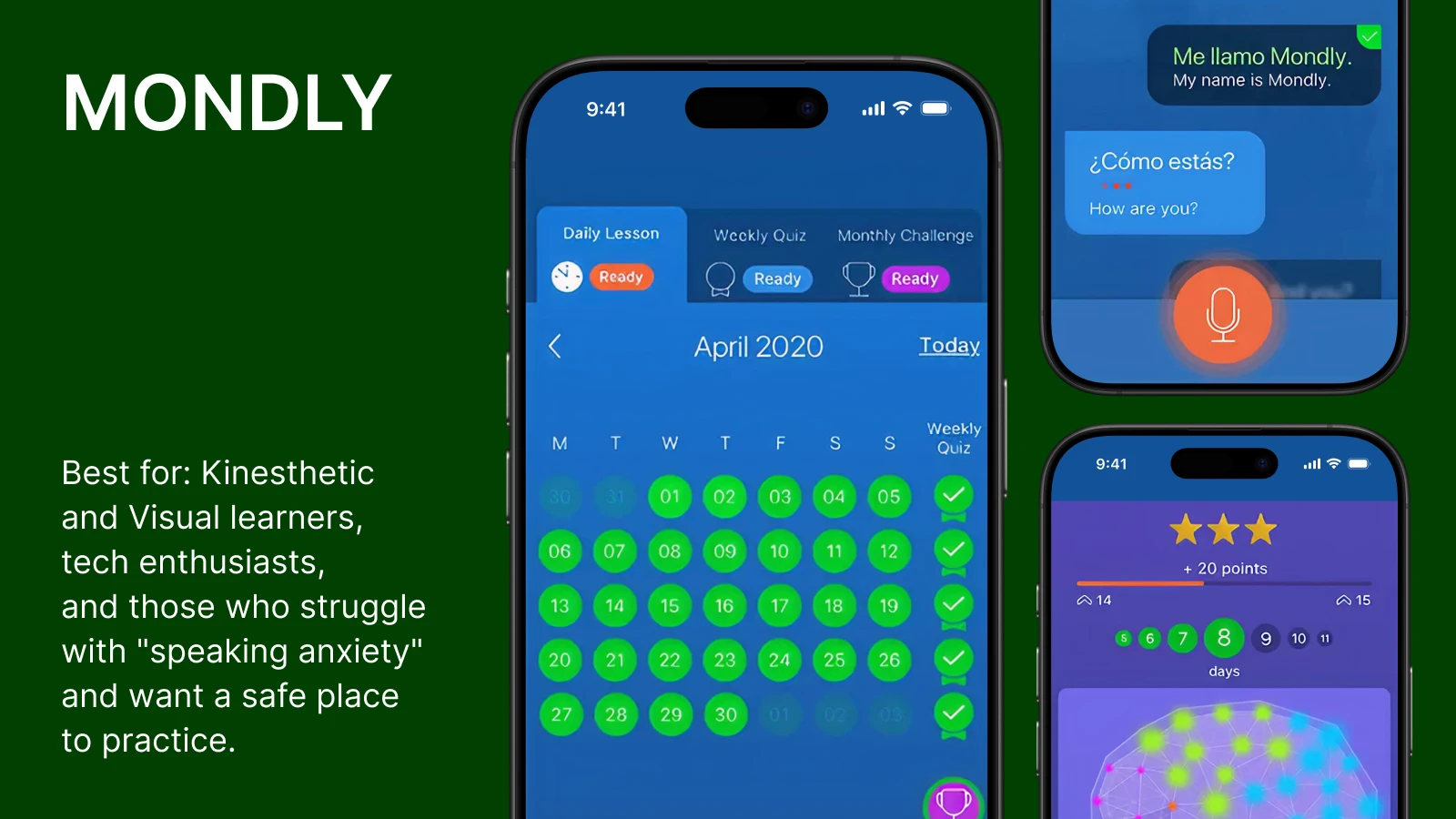
Mondly differentiates itself by embracing cutting-edge technology like Virtual Reality (VR) and Augmented Reality (AR). The goal is simple — to simulate real-world conversations. If you have a VR headset, you can step into a virtual classroom or a train station and practice speaking with AI characters.
Best for: Kinesthetic and Visual learners, tech enthusiasts, and those who struggle with "speaking anxiety" and want a safe place to practice.
Key features:
Chatbot conversation: Practice conversations with an AI that listens to your voice and responds in real-time.
VR/AR modules: The core differentiator. It's the closest you can get to real immersion without leaving your house.
Daily lessons and quizzes: Fast, easy-to-digest content across many languages (over 40).
1000+ language combinations: You can learn from your native language to the target language, not just from English.
Pricing (current as of November 2025):
A limited Free version is available.
Premium Subscriptions (monthly for $10–$12, annual for $48–$60, and lifetime for $89–$129) unlock all lessons, the VR/AR component, and full access to all 40+ languages.
| Pros | Cons |
|---|
Unique VR/AR experience combats speaking fear | Conversation is AI-driven, so it lacks the nuance of a real person |
Wide selection of over 40 languages | The daily lessons can sometimes feel shallow compared to Babbel or Busuu |
Excellent voice recognition for pronunciation practice | VR/AR requires specific hardware to get the full experience |
8. Anki
Anki is one of the best alternatives to Duolingo. It is not a course — it's a powerful, open-source flashcard program that uses a world-class Spaced Repetition System (SRS). If you are a medical student, a law student, or a polyglot, this is the tool you use to memorize thousands of facts, including vocabulary.
Anki decks can be highly customized. You can create flashcards with text, images, and audio, or download vast community decks (often containing tens of thousands of words) for almost any language.
Best for: Polyglots, highly disciplined self-learners, or anyone needing to memorize large volumes of vocabulary and facts, like students preparing for tests.
Key features:
Superior SRS algorithm: The core strength. It is highly efficient and minimizes the time needed for review.
Total customization: Control every aspect of your cards and review sessions.
Desktop app is free: The computer version is entirely free and open-source.
Syncing: The free AnkiWeb service syncs your progress across all devices.
Pricing (Checked November 2025):
Desktop (Windows/macOS/Linux): Free.
Android (AnkiDroid): Free.
iOS (AnkiMobile): A one-time purchase fee (typically around $25) that supports the development of the entire platform.
| Pros | Cons |
|---|
World-class memorization efficiency | Requires significant effort to set up or find a good deck |
Free on desktop and Android | No actual language "teaching" or grammar explanation |
Can handle 100,000+ cards easily | The interface is functional, but definitely not "fun" or game-like |
Beyond the apps: A holistic approach to language mastery
If you are a polyglot, you know the secret: sites like Duolingo are only one part of the puzzle. The fastest way to achieve fluency is through blended learning, combining the structure of digital tools with the invaluable chaos of human interaction and traditional study.
Below are the best non-app methods for turbocharging your progress and providing a pleasant learning experience.
9. Language classes and tutors
Not all Duolingo alternatives for language learning have to be apps. This practice is the tried-and-true method that technology can't fully replace. A real human expert gives you feedback that no algorithm can match.
What it is: Group classes at a local college or school, or one-on-one sessions (in-person or online) with a professional tutor.
Best for: Learners who need accountability and expert, personalized correction on their pronunciation, intonation, and complex grammar usage. This method is ideal for auditory and kinesthetic learners.
Key benefits:
Instant correction: A tutor can assume why you made a mistake and explain the rule.
Structured curriculum: Tutors follow professional course books, so your path is clear.
Motivation and accountability: Having a standing appointment motivates you to study.
Where you can find them:
Local: Community colleges, university extension programs, or language centers (like the Alliance Française or Goethe-Institut).
Online platforms: Sites like iTalki or Preply connect you with tutors globally for flexible one-on-one sessions. You can filter by price, experience, and specialty.
10. Language exchange meetups
This method is for when you're ready to jump into the deep end without the pressure of a teacher watching your every mistake.
What it is: Informal meetups (either in-person or using apps like HelloTalk or Tandem) where you trade time with a partner: 30 minutes practicing their target language (your native language) and 30 minutes practicing your target language (their native language).
Best for: Gaining conversational confidence, learning slang, and understanding how different people speak without preparation.
Key Benefits:
Free and flexible: It costs nothing but your time.
Cultural immersion: You get real-time insight into current events and local opinions.
Low-pressure: Since you're both learners, there's a mutual understanding that mistakes are okay.
Where you can find them:
In-person: Check local community centers or search for events on Meetup.com, such as "Spanish Language Exchange," in your city.
Online: Apps like HelloTalk or Tandem are perfect for finding conversation partners globally.
11. Textbooks and workbooks
Don't ignore the old ways! A good textbook provides the structure and clarity that gamified apps often lack. This method is the backbone for the dedicated, academic student.
What it is: Traditional printed or digital textbooks, especially those designed for university-level language departments (often called "language series").
Best for: Learners who want a deep, systematic understanding of grammar rules and verb conjugation before they start speaking. It is also perfect for Reading/Writing learners who need to see the logic.
Key benefits:
Comprehensive structure: Textbooks are designed to take you from A1 to B2 in a logical, step-by-step manner.
Systematic grammar: They clearly lay out every tense, case, and exception, giving you the context to build correct sentences.
Affordable: A good textbook can be a one-time purchase that lasts a year or more.
How you can use them:
Use the textbook for the grammar explanation.
Use an app (like Anki or Memrise) to memorize the vocabulary presented in the chapter.
Use a tutor or language exchange partner for the speaking practice related to the chapter's topics.
12. Learning with AI Tools like ChatGPT
This approach is the ultimate modern hack for language learning, favored by many advanced learners today. AI chatbots provide a private, judgment-free space to practice whenever you have a few minutes.
What it is: Think of this as one of the better alternatives to Duolingo for non-language microlearning — a way to turn large language models (LLMs) like ChatGPT, Google’s Gemini, or Microsoft’s Copilot into your own endlessly patient tutor. These tools adapt to your level instantly, guide you through conversations, explain grammar on the fly, and generate personalized practice based on your goals.
Best for: On-demand conversation, immediate translation of complex phrases, and instant generation of custom exercises.
How you can use AI for language mastery:
Role-play scenarios: Open ChatGPT or other LLM tool and say, "I am learning Spanish. I want you to act as a train station attendant in Madrid. Only speak Spanish. Correct my mistakes gently."
Custom grammar explanations: Ask the AI to explain a complex grammatical concept, such as the German Dative case or the Spanish Subjunctive mood, "like I am five years old," or "using only examples from Harry Potter."
Vocabulary generation: If you learn a new word like ubiquitous, ask the AI: "Give me 10 sentences using the word ubiquitous in Portuguese at a B2 level."
Error correction and politeness: Paste an email draft or a social media comment you plan to write and ask, "Please correct my French for grammar and spelling, and then tell me how a native speaker would phrase this to sound more polite/formal."
Let's find your perfect path to language mastery
Before you download another app, the most crucial question is: What kind of learner are you, and what is your goal?
You wouldn't use a hammer to cut wood. Similarly, you shouldn't use a vocabulary flashcard app when you need conversation practice.
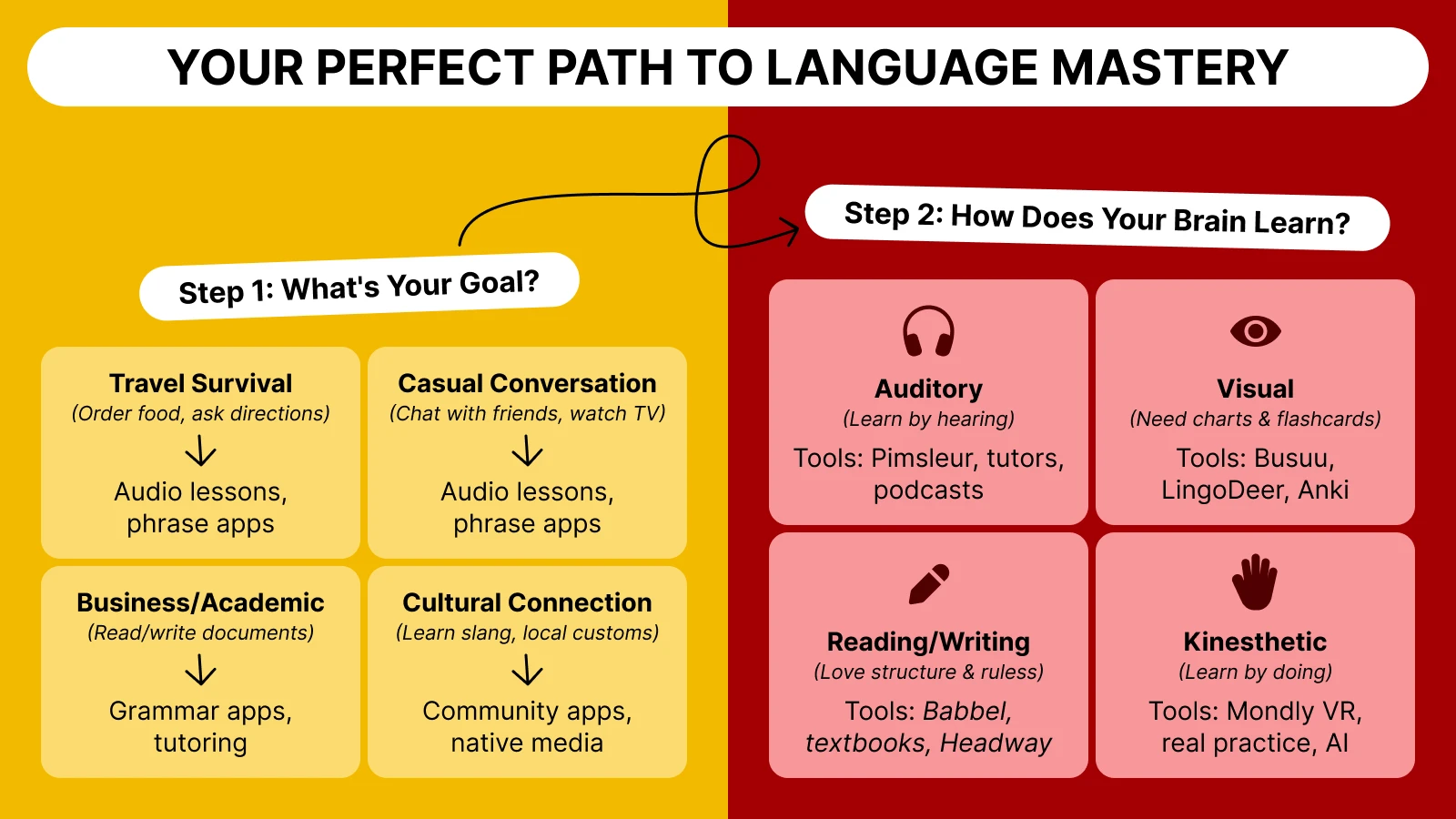
Step 1: Define your goal
What does "success" look like to you? Be specific!
| Goal | What it requires | Best method type |
|---|
Travel survival | Ordering food, asking for directions, basic greetings | Phrase-based apps, audio lessons |
Casual conversation | Chatting with friends, following TV shows | Speaking-focused apps, language exchange |
Business/academic | Reading complex documents, debating, formal writing | Grammar-focused apps, formal tutoring, reading extensive content |
Cultural connection | Understanding local customs, slang, and humor | Community apps, real-world media, native content |
➡️ Check out this article about what setting unrealistic goals leads to.
Step 2: Understand how your brain learns
Everyone learns differently. Knowing your primary style helps you pick tools that stick.
The Auditory Learner: You remember things best when you hear them. You might enjoy podcasts, audio lessons, songs, or talking out loud. Best tools for you: Pimsleur, live tutors, and language exchange partners.
The Visual Learner: You need to see the words, charts, and flashcards. You thrive on clear layouts, color-coded notes, and subtitles. Best tools for you: Busuu, LingoDeer, and Anki (custom cards).
The Reading/Writing Learner: You love structure, rules, and notes. You learn best by reading explanations, studying grammar books, and writing essays. Best tools for you: Babbel, textbooks, Headway.
The Kinesthetic Learner: You learn by doing. You need to move, gesture, and role-play the words and phrases you learn. Best tools for you: Real-life practice, Mondly VR/AR, in-person classes, and role-playing with AI.
Putting it all together: Your personalized language plan
The most successful language learners don't use just one tool; they use a toolkit. You can use one of the best free language learning apps 2026, but it still won't be enough. Here are three sample plans for different types of learners — pick the one that best fits your goals and schedule, and get started today!
Plan 1: The busy traveler (focus: survival & confidence)
You have a trip in three months and want to be able to handle basic situations and feel polite. You have 20–30 minutes a day.
| Tool | Daily time | Why it works |
|---|
Pimsleur | 30 mins (hands-free) | Builds an excellent, natural accent and listening skills while commuting or exercising |
Babbel | 15 mins (active) | Focuses on travel-specific phrases (airport, restaurant, and hotel) for immediate practical use |
ChatGPT/AI | 5 mins (as needed) | Quick, private role-play practice (like ordering food) right before bed to cement phrases |
Total daily time: 50 minutes
The result: You bypass unnecessary complexity and go straight to functional communication. You'll be able to navigate a foreign city with confidence and be understood clearly by native speakers.
Plan 2: The dedicated student (focus: academic & fluency)
You are serious about reaching B2/C1 fluency, are willing to spend an hour a day, and understand the importance of grammar.
| Tool | Daily/weekly time | Why it works |
|---|
Weekly tutor/class | 1–2 hours/week | Provides professional structure, live correction, and accountability |
LingoDeer/Busuu | 30 mins (daily) | Used as a "textbook replacement" for clear, structured grammar lessons and exercises |
Anki (SRS) | 15 mins (daily) | Memorizes the vocabulary and verb conjugations from your LingoDeer or class lessons |
Headway | 15 mins (daily) | The fluency booster. Reading and listening to different topics and gamification expand your vocabulary into sophisticated, abstract concepts |
Total daily time: 60 minutes
The result: You develop a deep, structural understanding of the language (from the class/LingoDeer) combined with an ever-expanding vocabulary (from Anki/Headway). This method is the formula for true mastery.
Plan 3: The social explorer (focus: cultural connection & slang)
You already know the basics and want to get into the flow of real-life conversation, slang, and cultural context.
| Tool | Daily/weekly time | Why it works |
|---|
Busuu | 15 mins (daily) | Used primarily for its community feature to get feedback on your writing and practice with native speakers |
Memrise | 15 mins (daily) | Uses the "Learn with Locals" feature to pick up natural phrasing and various accents |
Language exchange partner | 1 hour (weekly) | Dedicated time for real, messy, unscripted conversation, where you learn to handle flow and interruptions |
Native media | 30 mins (daily) | Watching a TV show with subtitles or listening to a podcast in the target language |
Total daily time: 60 minutes
The result: You stop sounding like a robot reading from a textbook and start sounding like a person. You gain the confidence and cultural knowledge necessary to truly connect with native speakers.
The best tool is consistency
How long ago did you start this journey? Whether it was last month or five years ago, the only thing that truly matters now is your consistency.
Finding an alternative to your current learning materials is the first step toward a breakthrough. Whether you pick a random forum, the conversation-focused Babbel, the community-driven Busuu, or the hands-free audio of Pimsleur, the key is showing up every day.
Start with one or two of the best apps from this list, stick with them for 30 days, and adjust as you discover what truly makes the language "click" in your brain. Your fluency breakthrough is closer than you think.
And if you want to grow and feel more in control, but life keeps getting in the way — try Headway. It fits into busy days and helps you build progress, one small step at a time. With Headway, you'll not only boost your vocabulary, reading, and listening skills but also find the motivation to keep learning languages.
Frequently asked questions about Duolingo alternatives
Does Duolingo have any competitors?
Yes, there are many Duolingo competitors. Babbel and Busuu offer more grammar depth, Pimsleur focuses on audio immersion, and Memrise uses native speaker videos. LingoDeer excels in Asian languages, while Mondly offers quick, topical practice. Each competitor takes a different approach to language learning, so your best choice depends on your goals and learning style. And it's up to the users to decide whether these apps better than Duolingo.
Why do people stop using Duolingo?
Most quit because progress feels slow after the beginner phase. The gamification gets repetitive, grammar explanations are minimal, and speaking practice is limited. You're translating sentences but not having real conversations. Many learners realize they need more practical speaking opportunities to become conversational.
Is Duolingo or Busuu better?
Busuu beats Duolingo for serious learners. You get native speaker feedback on your pronunciation and writing, detailed grammar explanations, and official McGraw-Hill certificates. Duolingo is free and more game-like, making it better for casual learners. If you want accountability and human corrections, choose Busuu. For light practice, Duolingo works fine.
Is Babbel better than Duolingo?
Babbel wins for adult learners who want to practise conversation skills. Its lessons teach real-world phrases you'll use immediately. However, Babbel requires a paid subscription while Duolingo is free. If you're willing to invest money for quality instruction focused on speaking, Babbel delivers better results faster.
What are free Duolingo alternatives?
If you are looking for free alternatives to Duolingo, you have several options. Memrise offers introductory courses for free with native speaker videos. Busuu's free plan includes limited lessons with community feedback. Anki is one of the best Duolingo alternatives free since it's completely free for vocabulary drilling on desktop and Android. Headway gives you one book summary per day free — learn language learning strategies from polyglots and experts or read summaries in different languages. HelloTalk connects you with native speakers for free conversation exchanges.
Which free app is best for English learning?
Duolingo remains the strongest free option for English learners because it provides users with gamified lessons and speech recognition. For vocabulary building, try Anki or Memrise. For overall development, not just in language, try Headway. Headway offers one free daily summary to help boost your reading and listening skills.
What are the best alternatives to Duolingo for Spanish learners?
The top Duolingo alternatives Spanish include Babbel for conversational practice, Pimsleur for audio immersion, and Busuu for native speaker feedback. Headway offers Spanish book summaries for advanced vocabulary building. Each alternative to Duolingo for Spanish targets different skills, so combining apps accelerates your progress beyond what single-platform learning provides.
Are there Duolingo alternatives no AI that use human instruction?
Yes, several Duolingo alternatives language learning apps prioritize human interaction over AI. Busuu connects you with native speakers for corrections, iTalki and Preply offer live tutoring sessions, and language exchange meetups provide real conversation practice. These alternatives to Duolingo language learning apps deliver personalized feedback that algorithms can't match, making them ideal for serious learners.
Which language learning apps are better Duolingo alternatives overall?
The best Duolingo alternatives language learning apps depend on your goals. Babbel excels at practical conversation, Pimsleur builds authentic pronunciation, and LingoDeer masters Asian languages. Headway develops advanced vocabulary through content. Unlike Duolingo's gamified approach, these alternatives to Duolingo focus on specific outcomes, helping you achieve fluency faster through targeted methods.
How much is Duolingo compared to its premium alternatives?
While the basic version is free, the Duolingo price for a premium subscription generally sits between $7.99 and $12.99 per month. When you weigh the Duolingo cost against specialized platforms like Babbel or Pimsleur, you'll find that while the owl is budget-friendly, paying for a competitor often provides a much faster track to actual conversational fluency.