Self-growth
 Business & Career
 Success
 Communication
 Healing
 Relationships
 Psychology
 Happiness
If you quietly ask yourself, "What should I do with my life?" between meetings, doomscrolling on social media, or thinking back to high school and wondering when everyone else figured out their dream job, you're not alone.
Many people reach a point where their current career path, nervous system, and daily reality no longer align. You might be working full-time, managing a family, watching your mental health and well-being wobble, and still feel unsure about the life you want or whether you're on the right path.
This guide provides a practical, step-by-step approach: A simple five-step framework, a quick quiz, reflection prompts, and tools for real-world experiments.
To make it easier, you can deepen your understanding at every step with micro-learning in the Headway app, where you'll find summaries of books like 'Atomic Habits,' 'Frames of Mind,' 'How to Change,' 'Keep Moving,' and 'The Mental Toughness Handbook.'
If you don't have the time or energy to read whole books right now, these summaries give you the essentials you can act on immediately — and you can start your first one today with Headway.
Quick summary: Five steps to answer "What should I do with my life?"
Here's the core answer upfront:
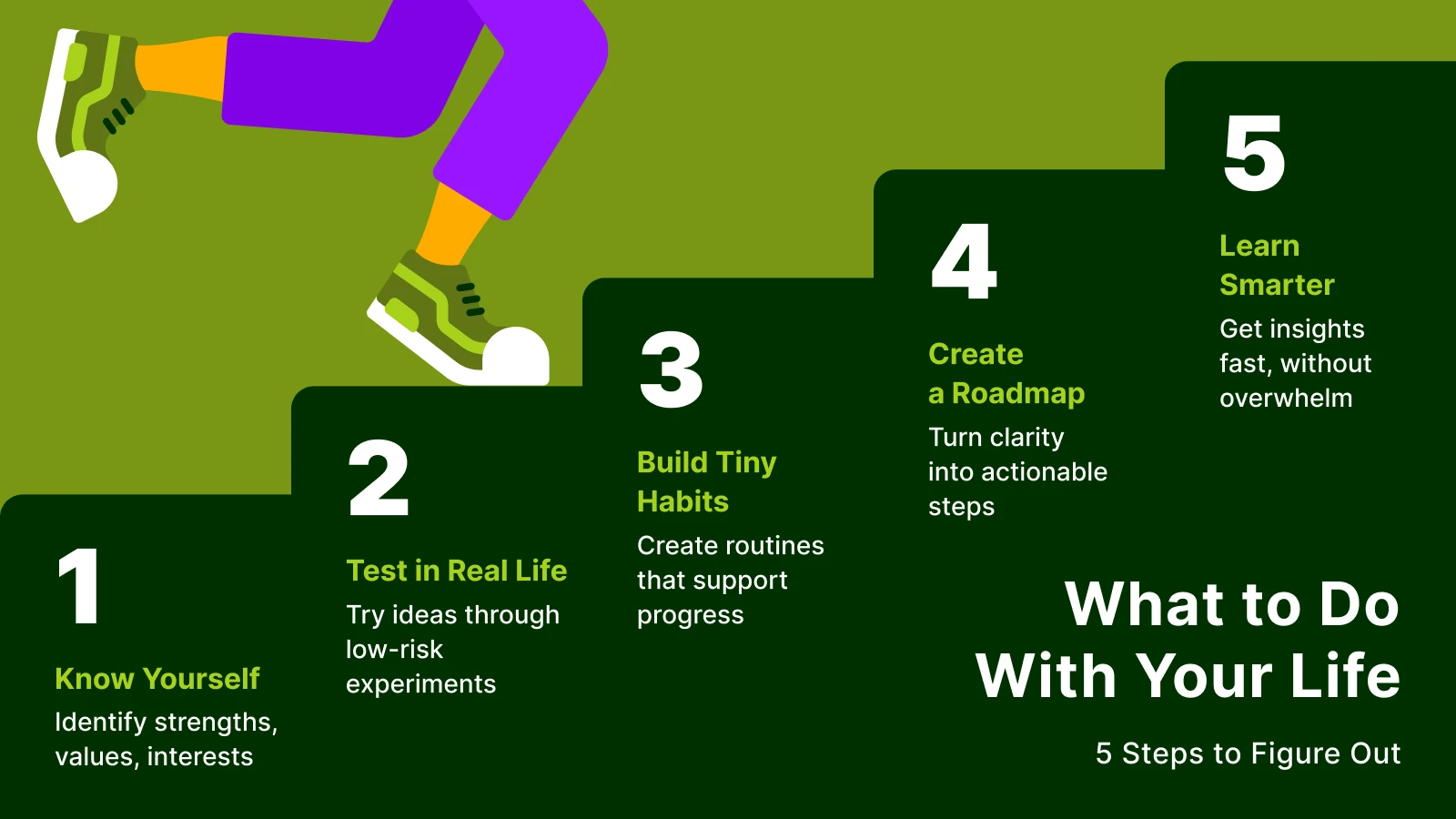
Clarify your strengths, core values, and passions: Build self-awareness about what you're good at, what matters most, and where you naturally lose track of time.
Test things out in real life: Try different paths, pick up new skills, and see what clicks.
Start small, stay consistent: Build routines you can actually keep up with. You're not trying to grind yourself into dust here — just make habits that work with your life, not against it.
Map out what matters to you: Take the vague stuff bouncing around in your head and break it down into real steps.
Use clever learning shortcuts and regular check-ins: Lean on book summaries, mentors, and reflection to adjust your path as you grow.
Quiz: Discover your exact life-purpose stage (and what to do next)
Choose the answer that feels most true for you.
Use your stage as a filter: keep in mind that you don't have to do everything at once. Start where you are.
Step one: Map what you're actually good at (before wasting time on wrong paths)
Before planning a career change or chasing a dream job, get clear on who you actually are.
That means looking at:
What you're naturally good at (talents).
What matters to you as non-negotiables (core values).
What you genuinely care about doing or creating (passions and mission).
Put these together, and you've got your "talents — passions — mission" map. Yes, this is what real self-discovery looks like. You can do things differently, but without a map, you're basically throwing darts blindfolded.
How to figure out what to do with your life: Quick self-reflection exercise
Open your notes app or grab whatever notebook's around. Or record an audio memo, whatever works best for you.
Three things you're just naturally good at
You know, things like:
You can explain confusing things so people actually get it.
You see a disaster and know exactly how to fix it.
You walk into a room and immediately pick up on the vibe.
Pay attention to these. These skills are not random — they're showing you how your brain works.
Three things you wouldn't give up, even for more money or a better title
Like:
Having control over your schedule.
Not having to lie or play games at work.
Actually getting to be creative and mess around with ideas.
Knowing you're not going to get laid off next month.
Times you lost track of time in a good way
Think about moments you were deeply engaged: A project, a hobby, volunteering, or even a small part of your current job. These are signals toward the life you want and your potential dream career.
As you do this, notice your body too. When you picture living closer to your core values, does your chest feel lighter? Does your jaw unclench? That somatic response is data about your life's purpose.
If self-doubt makes this hard, Headway's article on building self-confidence can help you recognize your strengths more clearly.
Use this 60-second evening habit to build your new identity
In 'Atomic Habits,' James Clear shows how small habits shape identity. A simple daily habit:
Each evening, write down one small win where you used a strength or honored a core value.
Taking notes trains your brain to see evidence of who you are and what matters, rather than focusing only on what's missing.
Step two: Test your ideas in real life (without blowing up your career)
Once you know more about your core values and strengths, you don't need a twenty-year plan. You need small experiments.
Clarity comes from trying things in the real world, not just thinking about them. Experiments help you test different career choices, see how they affect your mental health, and find out what actually fits.
Practical ways to safely leave your comfort zone
Try low-risk actions such as:
Starting a small side project related to your interests.
Volunteering in an area that reflects your values.
Shadowing someone in a role you're curious about.
Taking a short course to build new skills.
Talking to professionals on LinkedIn about their day-to-day reality.
Testing whether you enjoy a startup vibe, a large company, or having a business of your own.
List out ten things you could actually try. Like: show up to a meetup.
Text someone in that field and ask if they'd be willing to grab coffee. Sign up for a weekend workshop. See if a friend needs help with their business.
Pick whichever one makes you go "Okay, I could do that," but also gives you at least a tiny bit of energy.
You're just testing — does this move me closer to what I want or not? If you'd like a structured challenge, this guide on changing your life in 30 days offers ideas for short, focused experiments.
For neurodivergent brains: If the idea of trying new things feels overwhelming, start with whatever sparks genuine curiosity — even if it's not the "sensible" first choice.
Your brain thrives on interest-based momentum more than anything else, so why abide by common logic?
Make experiments stick with these proven behavior nudges
In 'How to Change,' Katy Milkman talks about using small "nudges" to make action easier:
Tie experiments to existing routines (for example, "Every Tuesday evening I conduct research of one potential path").
Create simple commitment devices (tell a friend you'll send a weekly update).
Pair experiments with learning (read a Headway summary, then do one real-world step based on it — to ground it properly).
You'll notice how, over time, these experiments will show you whether a new career path, new skills, or even a move to a place like New York fits your nervous system, not just your imagination.


Step three: Build tiny habits and routines that support your direction
Once you've tested some options, the question becomes: "How do I keep moving without burning out?"
Habits are how you turn big questions about life's purpose into daily actions. Even five minutes a day can slowly shift your entire life if you use it intentionally.
Five-minute daily purpose ritual
Pick a time that works — after breakfast, on the train, or right before bed. There is a technique called "habit stacking," meaning you stack it onto something you're already doing, so you don't forget.
Ask yourself: "What would one percent closer to the life I want look like today?"
Do one tiny thing:
Text someone you want to learn from.
Read a ten-minute Headway summary on habits, purpose, or whatever you need right now.
Change one line on your resume or LinkedIn, so it actually reflects where you're going at the moment.
Work on a side project for ten minutes — something connected to what you actually want to do.
End with: "Today, I honored my values by…"
It's supposed to be simple. Even on your messiest days, you can do this. And if you're struggling to stay motivated at all, check out Headway's stuff on how to stay motivated and how to achieve goals, which can support you.
Somatic check-in: Let your body vote
After each action, pause for ten to twenty seconds and ask:
Did this feel regulating, neutral, or draining?
Am I moving toward burnout or toward a sustainable, fulfilling life?
Also, if your "dream career" leaves you anxious and exhausted every time, pay attention to that.
You don't have to choose between success and not falling apart. And if you're in a phase where you want to cut out distractions and really focus for a bit, check out monk mode.
It's basically a way to go deep on something without it taking over your entire existence.
Step four: Turn your direction into a realistic roadmap
Great, you know what energizes you. Now what? This step is where most people stall out — turning that feeling into an actual plan. You don't need your whole life mapped out.
You just need a roadmap that's clear enough to follow but flexible enough to adjust. Something with real milestones you can actually hit.
This practice works whether you're thinking about switching careers, chasing something you've always wanted to do, or testing out the whole entrepreneur thing.
Simple goal-setting table
Use this structure to make your ideas tangible:
| Timeframe | Goal | Why it matters | Habit to support it | Review date |
|---|
One month | Complete three Headway summaries on habits and purpose | You want language and frameworks to guide your career choices | Read or listen for fifteen minutes after dinner, four days a week | In four weeks |
Three months | Test two new paths (course and volunteering) | You want real data before any significant career change | One outreach message per week | In three months |
Six months | Align your CV and LinkedIn with your new direction | You want the external story to match the life you want | Thirty minutes each Sunday | In six months |
Add milestones like: First informational interview, first small paid project, or first time you speak to a career counselor.
These milestones help you see progress, even when change feels slow. If you tend to set massive, unrealistic goals and then crash, read this guide on the consequences of unrealistic goals to stay ambitious and kind to yourself.
If you have a neurodivergent brain (ADHD, autism, or dyslexia), you might naturally think in bigger leaps rather than tiny steps — and that's okay. The key is finding a goal-setting rhythm that works with your brain, not against it.
Protect your mental health while pursuing significant career changes
Mental toughness is not about pushing yourself into burnout. In 'The Mental Toughness Handbook,' it's about:
Preparing for setbacks in advance ("If I miss three days, I restart with two minutes").
Reframing discomfort as growth, not failure.
Protecting your mental health while still moving forward step by step.
This mindset is fundamental if your new career path or dream job doesn't look "traditional" to people around you.
Step five: Learn what you need fast (without reading 100 books)
You don't need to read hundreds of complete books to decide what to do next. You need targeted insight plus reflection.
Micro-learning with summaries helps you:
Explore many ideas quickly.
Decide which books are worth a deep dive.
Stay consistent even when you're busy.
A focused reading list for life direction
Inside Headway, you can use:
'Atomic Habits': To build identity-based habits that support your long-term direction.
'Frames of Mind': To understand different intelligences and why your brain may be suited to a different kind of work than you thought.
'How to Change': To design behavior change that actually works for your schedule and energy.
'Keep Moving': To stay grounded through grief, uncertainty, and significant life transitions.
'The Mental Toughness Handbook': To strengthen your resilience as you take new risks.
Monthly reflection check-in
Once a month, set aside 20 to 30 minutes and:
Choose one summary related to your current pain point (burnout, purpose, habits, or confidence).
Read or listen in one go.
Journal briefly:
What idea stood out the most?
How does this change how I see my future career path or life's purpose right now?
What one five-minute action will I take this week based on this?
Over time, these check-ins help you gently course-correct instead of waiting for a crisis to force change.
Self-reflection prompts to clarify the life you want
Use these prompts as journaling questions, voice notes, or walking reflections:
Think about what you're good at, even when you're exhausted.
When have you completely lost track of time? What were you doing?
What drains you no matter what, even stuff you're "supposed" to like?
What results actually feel meaningful to you — not on paper, in real life?
What would a fulfilling life look like day to day, not just on paper?
If you stripped away external expectations, what would be the most important thing about your work and relationships?
If you zoomed out and looked at your entire life as a story, what do you want this chapter to be about?
You don't need to answer all of these at once. Pick one or two, and let your answers evolve as you experiment and grow.
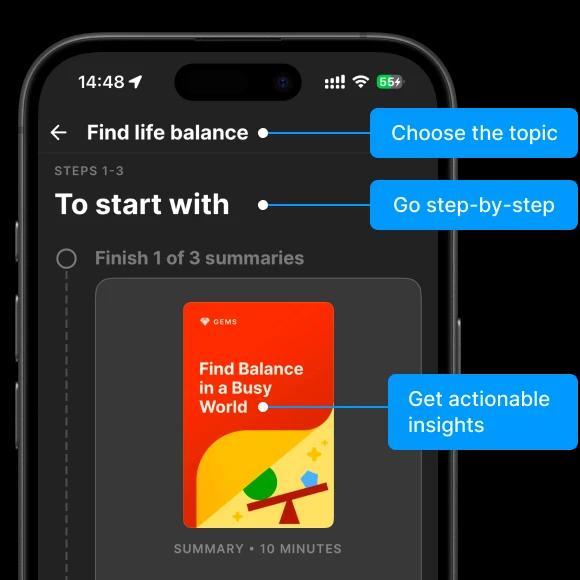
A step-by-step plan to reach your goals
Clear guidance that turns big ambitions into simple, achievable actions
Get startedWhy you're asking "What should I do with my life?" (and why it's a healthy question)
Most people hit this question at a specific moment. Maybe you got promoted and realized you don't actually want to climb higher.
Or you got laid off and thought, "Thank God." Maybe you're just burnt out — exhausted, unmotivated, and numb to everything. Or you graduated, had a kid, ended a relationship, or moved somewhere new.
Big life shift; suddenly nothing feels certain. Or — honestly — you saw someone's LinkedIn update and thought, "How did they figure it out, and I'm still here?"
Underneath all of this is usually one realization: My current reality doesn't fully match my core values and strengths. And that realization hurts, but it's also a decisive moment of self-awareness.
Asking "What should I do with my life?" isn't a sign that you've failed. It's a sign your inner compass is waking up and asking for a new direction.
Spot the signs you're ready for a new direction
Not sure if you're truly ready for change or just tired? These signs suggest it's time to take yourself seriously:
Consistent mismatch between your values and daily tasks:
You value creativity or impact. Still, your work is mostly admin or feels meaningless.
Persistent burnout symptoms: Even after rest, your mind and body don't reset. Your mental health feels fragile, and your well-being doesn't improve.
Ongoing restlessness or emptiness: Your work milestones land, but feel flat. You keep wondering if a different career path or a new career is possible.
Growing numbness or resentment: You check out emotionally at work, scroll all evening, and feel disconnected from your own goals.
Recurring fantasies of "starting over": This sign looks like moving cities, leaving your job, starting a startup, or starting your own business. Instead of dismissing this, you can turn this lifestyle into small, safe experiments.
These signs are not proof that your entire life is wrong. They're signals that a part of you is ready for something more aligned with who you are.
Stop spinning your wheels. Get your first clear step with Headway today
You don't need to map your entire life in one sitting. You only need the next clear step that supports your mental health, core values, and curiosity.
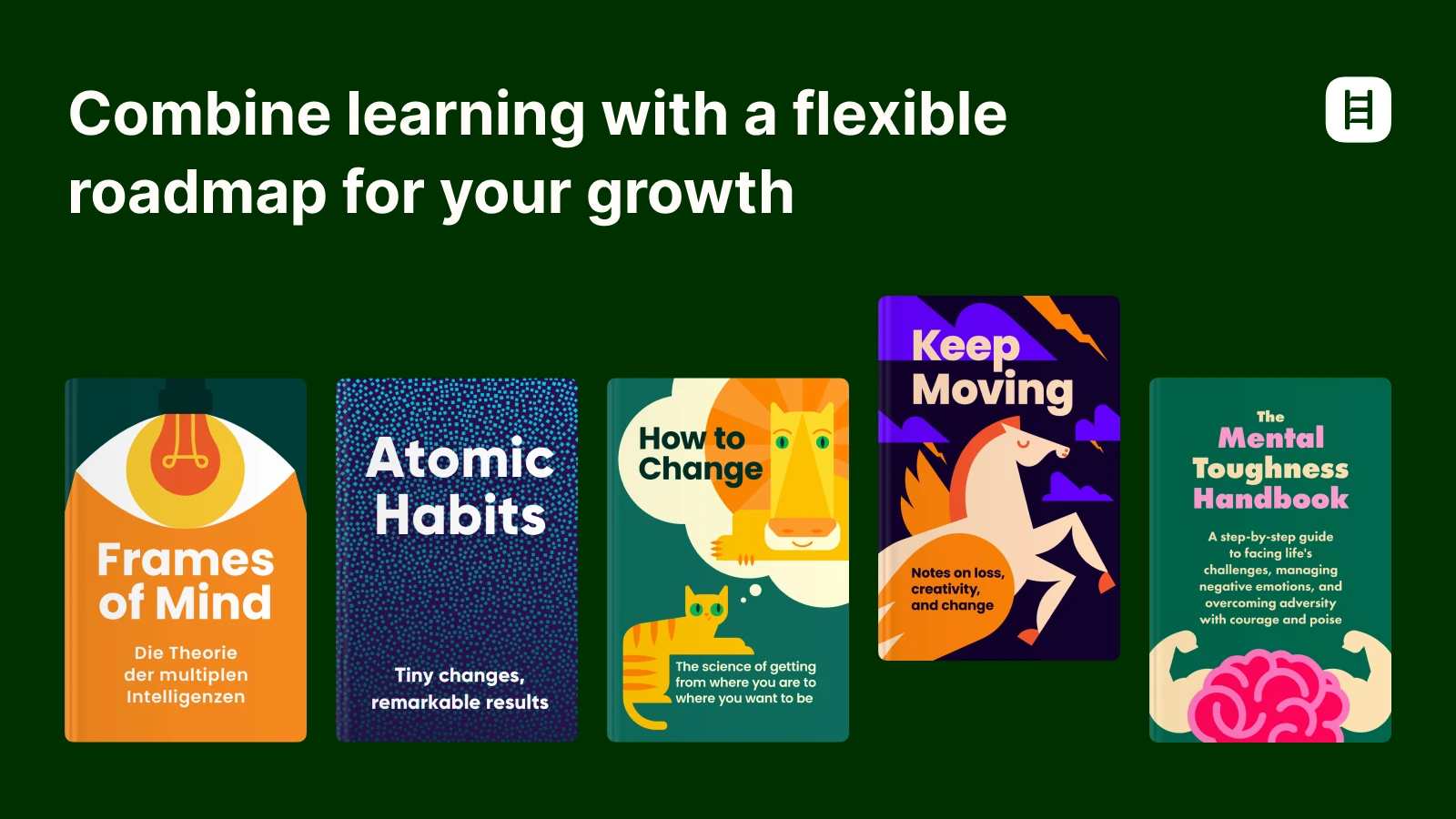
Headway can make this easier:
Explore summaries of books like 'Atomic Habits,' 'Frames of Mind,' 'How to Change,' 'Keep Moving,' and 'The Mental Toughness Handbook' in bite-sized format.
Use the app to turn insights into daily micro-habits.
Combine learning with real-world experiments, regular check-ins, and a flexible roadmap for your growth.
If you're ready to stop circling the question "What should I do with my life?" and start moving forward, take a straightforward action today: Get the Headway app, choose your growth goals, and start your first summary today.
FAQs
How do I find my life's purpose if I feel completely lost?
Look, nobody actually starts with "life's purpose." That's way too big and somewhat paralyzing. Start smaller. What are you good at? What actually matters to you? What doesn't make you miserable? Then just try stuff. Volunteer somewhere. Pick up a hobby. Do something different at work. See what happens. You'll start noticing patterns as you go. Purpose isn't this lightning bolt moment — it builds up from doing things, seeing what fits, and doing more of that.
How do I find my passion if my current career path feels wrong?
Start by noticing what pulls you in. When do you lose track of time? What makes you feel genuinely engaged? Test those things in the real world through side projects, classes, or small commitments that push you slightly outside your comfort zone. Here's the thing: Passion usually develops as you get better at something, not from instant love at first contact.
Is it too late to change my career if I'm in my forties or fifties?
Not even close. You actually have advantages now: More self-awareness, real experience, and clearer values. Start with reflection, then test things small through informational interviews, a short course, or a part-time project. You don't have to blow your life up. Small, deliberate moves can lead to an entirely new career.
How do I balance my mental health with searching for a dream job or a new career?
Mental health comes first. Not negotiable. Get the basics down — sleep, exercise, and some kind of daily routine. That's your foundation. Then add small things on top. Read a Headway summary. Talk to someone who's done what you want to do. Maybe reach out to a career counselor if you need one. Small steps you can keep up with are better than pushing yourself for two weeks and then collapsing.
How do I know if I'm on the right path or just scared to leave my comfort zone?
Ask yourself: Does this path actually fit what matters to you? Are you growing? Or are you just staying because it's familiar and safe? Try this. Close your eyes and picture yourself staying where you are. How does your body feel? Tense? Relaxed? Now, picture yourself making a change. What happens? Then test it in real life. Do something small that pushes you in a new direction. If it gives you even a little energy or clarity, you're probably onto something.