Self-growth
 Business & Career
 Success
 Communication
 Healing
 Relationships
 Psychology
 Happiness
Doomscrolling is the compulsive habit of spending excessive screen time consuming negative news and distressing content on social media, even though it makes you feel worse. Think of it as your brain's survival instincts colliding with endless newsfeeds that are winning.
Three things define this habit:
Compulsive loop. You keep scrolling even though you want to stop.
Negative valence. The content is sad, scary, or anger-inducing.
Loss of time awareness. Hours vanish without you noticing.
If this sounds familiar, you're far from alone. And here's the good news: you can break the cycle. The Headway app offers 15-minute book summaries on topics like stress, habits, and mental well-being — turning your scroll time into growth time.
📘 Download Headway and start reclaiming your screen time today.
Where did the term doomscrolling come from?
The word "doomscrolling" first appeared on Twitter back in October 2018, but it took a global crisis to make it stick. During the COVID-19 pandemic, millions found themselves trapped in a pattern of compulsive news consumption while stuck at home during lockdown.
Canadian finance reporter Karen K. Ho helped popularize the term through her late-night Twitter reminders telling people to stop doomscrolling and go to bed. Her posts gained thousands of followers almost overnight.
In September 2023, Merriam-Webster officially added "doomscroll" to its dictionary, defining it as spending excessive time online scrolling through content that makes you feel sad, anxious, or angry. The word had finally graduated from internet slang to recognized vocabulary.
The term stuck because it captured something fundamental: the collision of smartphones, social media platforms, global uncertainty, and algorithms designed to keep you engaged.
Why do we doomscroll? (Hint: It's not your fault)
Your brain isn't weak. It's a pattern wired for survival, and that wiring is being hijacked.
Your primal threat detector is always on
Humans evolved to scan for danger. Back when predators lurked in tall grass, noticing threats first meant staying alive. Your brain still operates this way, prioritizing negative information over positive. Psychologists call this negativity bias, and it explains why bad news grabs your attention more than good news ever could.
The illusion of control
When the world feels chaotic, consuming more negative information can feel like preparation. If you know about every possible threat, you can somehow stay safe. But this sense of control is an illusion. Knowing about a wildfire across the country doesn't protect you; it just raises your stress hormones.
Algorithms feed you what keeps you scrolling
Social media platforms are designed to maximize engagement, not your well-being. Their algorithms learn that distressing news keeps you glued to your social media feed longer. More scroll time means more ad revenue for them and more psychological distress for you.
The dopamine rabbit hole
Each scroll promises something new. Your brain releases dopamine in anticipation of finding good news or closure among all that negativity. But the relief rarely comes. Instead, you keep chasing that hit, falling deeper into the rabbit hole. This loop mirrors gambling psychology — variable rewards are incredibly addictive.
Fear of missing out (FOMO) makes it worse. You worry that stepping away means missing crucial information that everyone else will know.
📘 Break digital habits with Headway.
The real cost: How doomscrolling affects you
The effects of doomscrolling go beyond feeling bummed out. Research from 2023 and 2024 paints a clear picture of how this habit impacts both mental and physical health.
Mental health effects
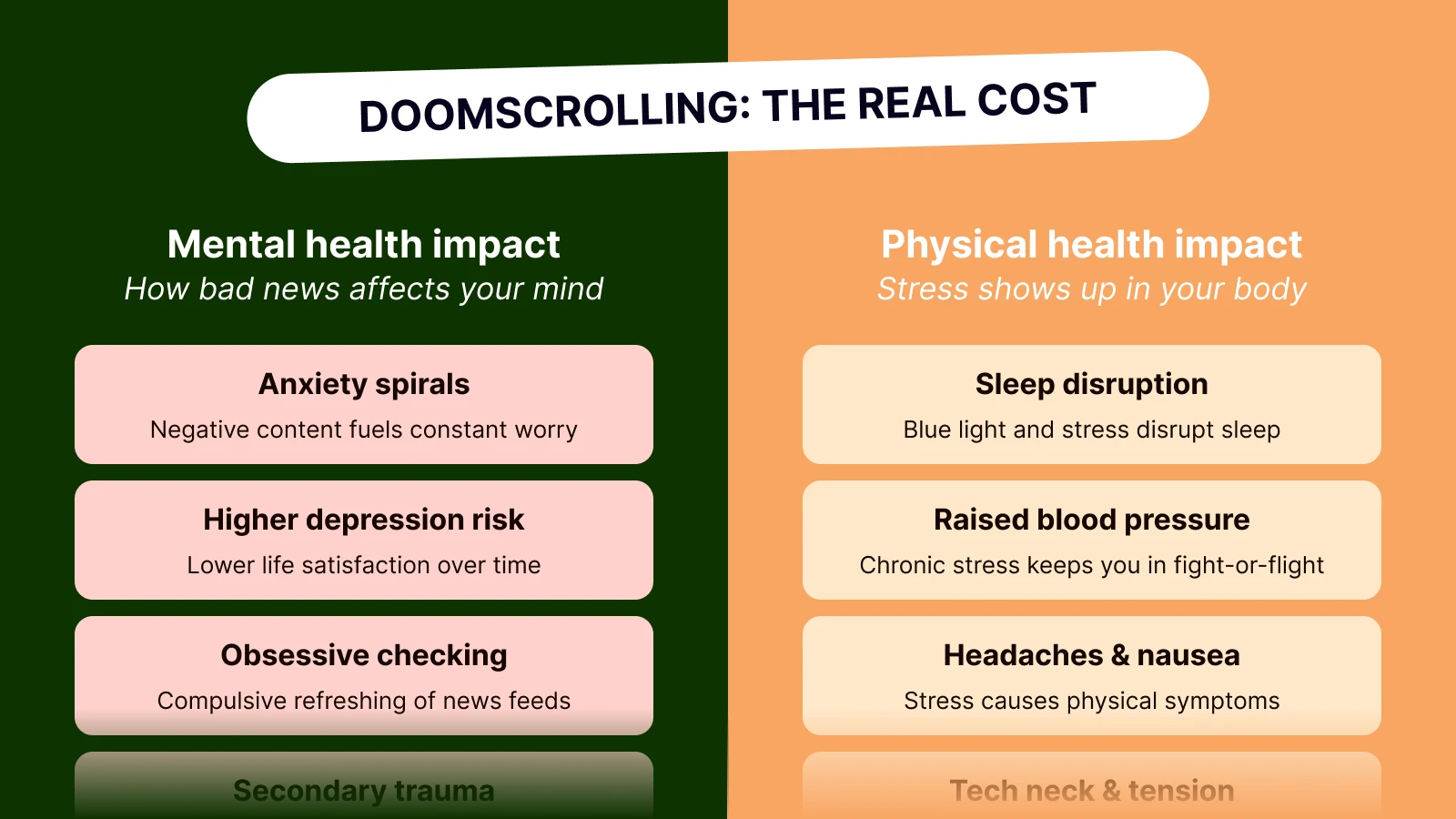
Anxiety spirals. Constant exposure to negative content feeds negative thoughts. A 2024 study found that doomscrolling triggers existential anxiety — worry about life, death, and your place in the world.
Depression risk. Research shows doomscrolling is linked to reduced life satisfaction and increased psychological distress.
OCD-like checking. Some people develop obsessive patterns around news sources, refreshing feeds compulsively, looking for updates.
Secondary trauma. Viewing graphic or disturbing content repeatedly can traumatize you even though you didn't experience the events directly.
Physical health effects
Sleep disruption. Blue light plus cortisol (the stress hormone) equals trouble falling asleep. Scrolling before bed is one of the worst things you can do for sleep quality.
Elevated blood pressure. Chronic stress from negative content keeps your body in fight-or-flight mode, raising blood pressure over time.
Tech neck and muscle tension. Hours hunched over your phone create physical pain in your neck, shoulders, and back.
Headaches and nausea. Prolonged stress responses can cause physical symptoms unrelated to your phone screen.
Doomscrolling vs doomsurfing: What's the difference?
Both terms describe consuming excessive negative content, but they do so in different ways.
Doomscrolling is passive. An algorithm feeds you content on your social media feed. You scroll through whatever appears, absorbing one piece of negative content after another without actively choosing topics.
Doomsurfing is active. You're specifically searching for news stories on topics that worry you. You hunt for information, clicking from link to link, seeking updates on particular events.
Both lead to the same negative effects on mental well-being. The intent differs — passive versus active — but the outcome doesn't. Your brain doesn't care whether you stumbled onto distressing news or went looking for it.
📘 Break negative scroll cycles with Headway.


How to stop doomscrolling: Practical tips you can try today
Breaking a doomscrolling habit takes strategy, not just willpower. Here's what actually works:
Set time limits. Use your phone's screen time settings to cap social media use. Even seeing the notification "You've reached your limit" creates a pause that lets you choose differently.
Turn off notifications. Every buzz from news apps pulls you back in. Deactivate all but essential notifications, so you're not constantly triggered.
Unfollow toxic accounts. Curate your feeds deliberately. If an account makes you feel worse, remove it regardless of how "important" it seems.
Phone down rule. Keep your phone out of the bedroom entirely. Charging it in another room removes the temptation to scroll first thing in the morning and last thing at night.
Schedule specific times for news. Check the news once or twice daily at set times instead of constantly. You'll still stay informed without the endless cycle.
Practice self-care basics. Movement, sleep, and real-world connection all reduce the urge to escape into screens.
These steps help, but they're still fighting the urge to pick up your phone. What if you could redirect that urge instead of just resisting it?
The better solution: Don't just stop — replace doomscrolling with Headway
Willpower alone rarely wins against habits built into your brain. The smarter approach is hijacking the habit loop itself.
Here's the truth: you're going to pick up your phone. You have 15 minutes of spare time, and reaching for a screen feels automatic. The goal isn't to stare at a wall instead — it's to look at something that builds you up rather than tears you down.
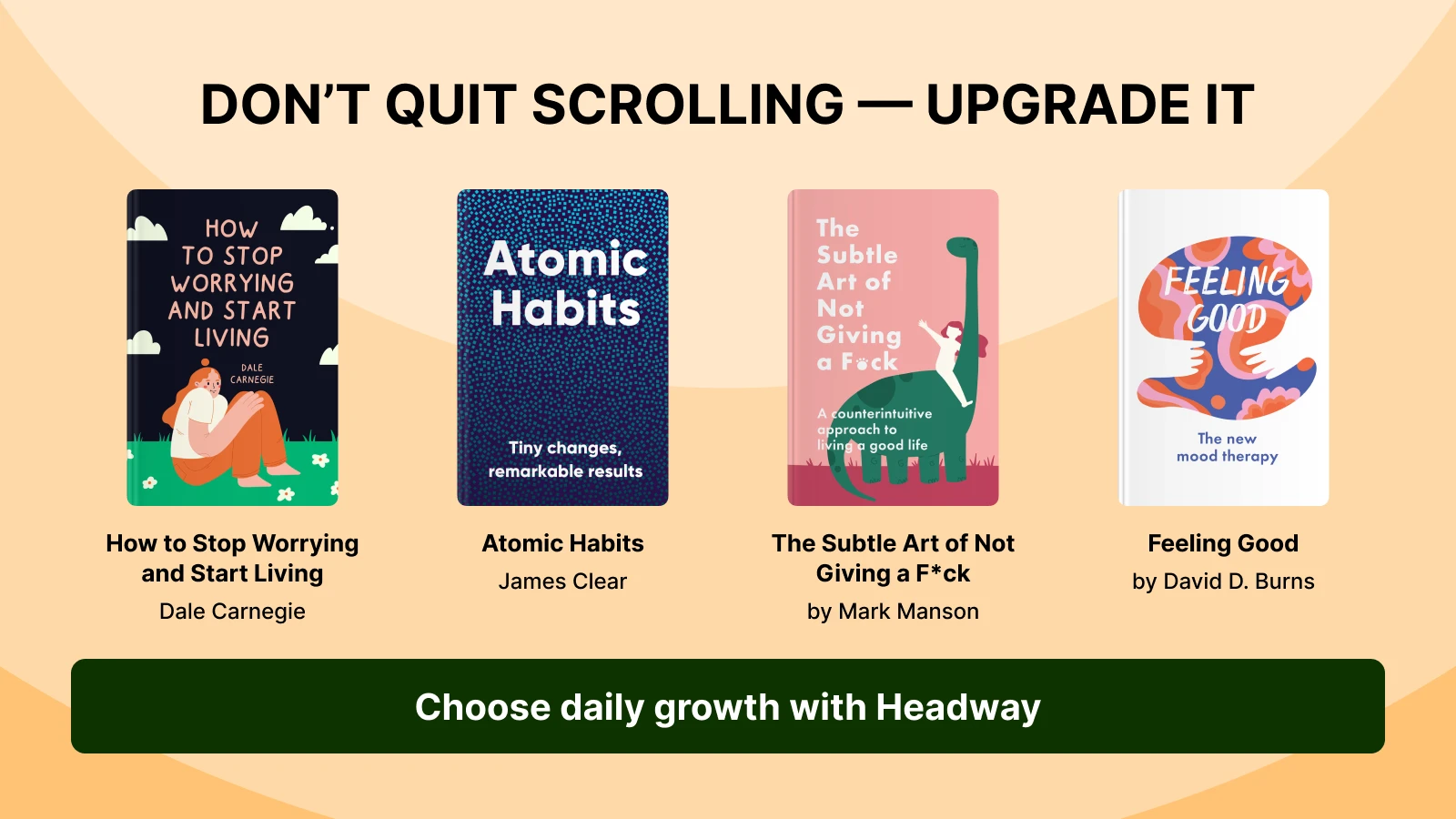
Instead of reading about world disasters, you could read a summary of 'How to Stop Worrying and Start Living.' Instead of the dopamine hit of outrage, you get the dopamine hit of achievement. Same screen time, completely different result.
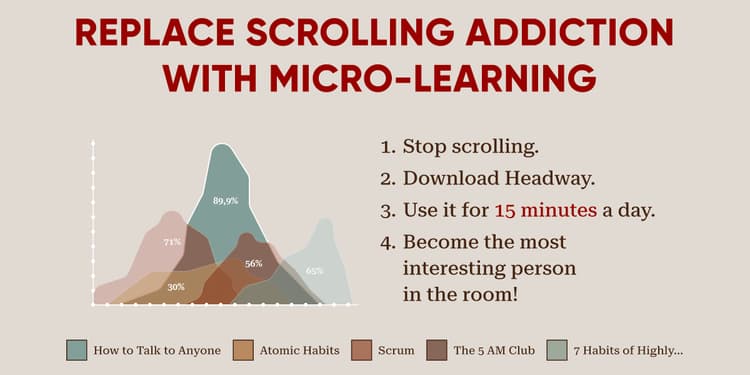
The Headway app makes this swap easy. Each book summary takes about 15 minutes — the same time you'd spend doomscrolling. You get insights from bestselling titles on topics like anxiety management, habit formation, and mental wellness.
Books available on Headway that directly address the feelings doomscrolling creates include Atomic Habits, The Subtle Art of Not Giving a F*ck, and Feeling Good. You learn something valuable and feel better afterward instead of worse.
Ready to make the switch? Download Headway and see how 15 minutes of real-world growth beats 15 minutes of scrolling through bad news every single time.
Frequently asked questions about doomscrolling
What is doomscrolling?
Doomscrolling means scrolling through bad news on social media even when it makes you feel worse. You keep going even though you want to stop. The word mixes "doom" with "scrolling" — that thumb movement we all know too well in 2026.
Is doomscrolling a disorder?
Doomscrolling isn't a clinical disorder in itself. But researchers connect it to internet addiction and compulsive behavior patterns. Studies show it can make anxiety and depression worse if you already struggle with them. If it's hurting your daily life, talking to a professional can help.
What are the symptoms of doomscrolling?
Watch for these signs: losing track of time while scrolling, trouble stopping even when you want to, and feeling worse after reading the news. You might also check your phone right when you wake up. Physical signs include poor sleep and feeling stressed or on edge throughout the day.
How long is too long on social media?
There's no magic number from research. But if scrolling often leaves you anxious, messes with your sleep, or steals time from things you enjoy — that's too much. What you scroll matters too. Negative content does more damage than neutral posts, even in shorter sessions.
Is doomscrolling the same as mindless scrolling?
They're different. Mindless scrolling is browsing any content without noticing the time passing. Doomscrolling focuses on negative or upsetting content specifically. Both waste time, but doomscrolling hits harder. The bad news activates your stress response and can spiral into lasting anxiety.
Can doomscrolling cause PTSD?
It won't cause clinical PTSD directly. But it can lead to secondary traumatic stress from seeing disturbing news over and over. This pattern shows up as intrusive thoughts, feeling on high alert, and emotional exhaustion. People with past trauma or anxiety face a higher risk from this habit.
What is doomsurfing?
Doomsurfing means actively seeking out bad news rather than just scrolling past it. You search for updates on things that worry you. Kevin Roose coined the term in a New York Times piece in March 2020. The method differs from doomscrolling, but both raise your stress levels.
What is joyscrolling?
Joyscrolling flips the script. Instead of absorbing negativity, you seek out positive and uplifting content on purpose. You curate your feeds to show things that boost your mood. Think of it as teaching your algorithm what actually makes you feel good — not just what grabs attention.