Self-growth
 Apps & Digital Tools
 Business & Career
 Success
 Growth Tools
 Psychology
 Communication
 Relationships

Slow living shows up everywhere right now: books, podcasts, TikTok, lifestyle newsletters, and every third Instagram caption about oat milk lattes. It’s a philosophy built around presence, intention, and a slower pace instead of speed and volume, and it traces back to the Italian Slow Food movement in 1989.
But the more visible slow living gets, the louder the skepticism gets too. Most advice either glorifies busyness or tells you to move to a farm, and slow living sits somewhere in between. This article skips the aesthetic and looks at what the research says, what critics get right, and what parts hold up no matter your schedule or income.
Along the way, we’ll pull practical exercises from books like ‘The Ruthless Elimination of Hurry’ by John Mark Comer and ‘Digital Minimalism’ by Cal Newport.
If you want the ideas from these books in a format that fits your actual day, download Headway and start with just one summary.

Quick summary: What experts agree on about slow living
Before getting into the debate, here’s what the evidence actually settles.
Slow living is a philosophy that prioritizes presence and quality over quantity and speed.
Carl Honoré popularized the term with his 2004 book ‘In Praise of Slowness: Challenging the Cult of Speed’, arguing that speed had become a kind of addiction rather than a neutral value.
A 2025 Nature Human Behavior trial of nearly 2,900 employees found that doing less per unit of time reduced burnout and improved well-being without hurting performance.
Critics argue the aesthetic version of slow living is financially inaccessible, but researchers and practitioners say the core habits (fewer commitments, more focused attention) cost nothing.
Headway’s book summaries let you explore slow living, minimalism, and digital detox from Comer, Newport, and others in a shorter format, so you can decide which ideas are worth your full attention.
Keep reading for the full breakdown of what actually works.
What slow living means (the version without the linen curtains)
The term “slow living” has picked up some pretty specific visual baggage: sourdough starters, unstructured mornings, cottagecore kitchens. The original philosophy is a lot less photogenic than that.
Carl Honoré framed it as taking the time to do things properly, and enjoying them more as a result. The core claim isn’t that slower means lazier. It means more deliberate. Quality over quantity, basically.
Slow living grew out of Petrini’s Slow Food movement, which later expanded into Cittaslow (slow cities), slow travel, slow fashion, and eventually the broader slow living lifestyle you see referenced today.
Here’s a quick reality check on what the concept actually claims versus what people assume it means.
Slow living: Myth vs. what experts say
| Myth | What the evidence shows |
|---|---|
Slow living means doing less work | It means doing work with more focus and fewer competing demands. |
It's only for people who can afford not to hustle | Core habits, like fewer commitments and more focused attention, cost nothing. |
You have to opt out of modern life | Honoré describes choosing which parts of modern life deserve your rush and which don't. |
Slow living is anti-ambition | Research links it to higher sustained performance, not lower output. |
It requires a full lifestyle overhaul | Most people start with one domain, not a total reset. |
📘 Slow down the right way. Headway breaks big ideas into 15-minute pieces you can actually use.
Where the slow living movement came from (and why it accelerated recently)
Slow living didn’t start on social media. It has actual institutional roots and a pretty clear timeline.
In 1989, Carlo Petrini founded Slow Food in Italy as a protest against a McDonald’s opening near the Spanish Steps in Rome. Fifteen years later, in 2004, Carl Honoré published his book arguing that speed had become a cultural pathology rather than a strength, and the phrase “slow living movement” started spreading beyond food into daily life more broadly.
Post-pandemic burnout data sharpened the argument considerably. Gallup’s 2025 report tied that 21% global engagement figure to an estimated $438 billion in lost productivity worldwide.
Around the same time, researchers started using the phrase “time poverty” to describe the chronic feeling of never having enough hours, which is part of why interest in a slower life and a simpler life grew alongside those burnout numbers.
If you’ve ever felt like busyness was treated as a personality trait rather than a problem, that’s the cultural backdrop slow living is pushing against. If your evenings feel just as scattered as your workdays, this evening routine guide covers how to build in more intentional downtime.
What the research says (and why it matters more than the aesthetic)
Researchers Wen Fan and Juliet Schor at Boston College ran the largest controlled trial of a four-day workweek ever conducted. Their 2025 Nature Human Behavior study tracked 2,896 employees across 141 organizations in six countries over six months.
Employees reported reduced burnout, higher job satisfaction, and better mental and physical health, with no drop in performance. The main driver seemed to be better sleep and less fatigue overall.
A separate 2022 study on mindfulness-based stress reduction found something similar: participants who felt more “time affluent,” meaning they felt like they had enough time, reported significantly higher well-being. Both studies point to the same underlying idea. Reducing the density of demands, not eliminating them entirely, is what produces the benefit.
The verdict on that core slow living claim, that a slower pace improves output and well-being at the same time, holds up under peer review. That’s a stronger claim than most wellness trends can make.
📘 See what the science supports. Headway covers the research behind burnout, focus, and rest.
The criticism worth taking seriously
Slow living has real critics, and some of what they say lands.
The access argument is the strongest one. For workers in hourly jobs, caregivers without backup support, or people juggling two or three jobs, “just slow down” isn’t practical advice in the way it is for someone with more flexibility. That’s worth naming directly instead of glossing over.
There’s also an aesthetics trap. The Instagram version of slow, simple living sells a specific look, neutral tones, artisanal goods, a rural setting, that has nothing to do with the underlying philosophy and prices people out of a concept they could otherwise use for free.
Then there’s the productivity guilt paradox. Research on rest consistently shows that people who feel guilty resting don’t actually recover from that rest. If you’ve wondered how to rest without feeling guilty or how to do less without feeling lazy, the honest answer is that your mind requires psychological permission first, not just an open afternoon.
The claim that a slower lifestyle is expensive is partly true for the aesthetic version and mostly false for the practical one, which is really about attention management rather than spending patterns.
What slow living looks like in practice (not on social media)
The practical version doesn’t require a farmhouse, a capsule wardrobe, or early retirement. It starts with one domain and one habit.
Here’s what that can actually look like:
Mornings: not checking messages for the first 20 minutes after waking up.
Meals: eating one meal a week without a screen or a second task running alongside it.
Work: picking two tasks a day that deserve full attention instead of splitting focus across everything through multitasking.
Information: choosing which topics genuinely matter to you instead of consuming news and social media out of habit.
Relationships: setting aside one interaction a week with no agenda beyond being present.
Hobbies: slower, single-focus activities like knitting or yoga that don’t compete for your attention the way a phone does.
Here’s the difference between the version people picture and the one that actually works.
Two versions of slow living
| Instagram slow living | Practical slow living |
|---|---|
Early morning routines with perfect lighting | Protecting the first 15 minutes of your day from demands |
Artisanal products and minimal decor | Fewer recurring commitments, regardless of what you own |
Rural or cottage settings | One quiet habit inside an otherwise ordinary environment |
Rejecting productivity culture entirely | Filtering which demands get your focused hours |
A specific aesthetic and spending pattern | An attention strategy that costs nothing |
If the mental noise is the real obstacle rather than your schedule, this guide on quieting your mind is worth a read.
📘 Build a slower routine one summary at a time with Headway.
Top five expert tips on simplifying life and finally slowing down
The slow living philosophy has been explored across dozens of nonfiction books, from philosophy to habit design to minimalism.
Headway offers summaries of the most relevant ones, so you can grab the core ideas first and decide which books about slow living are worth reading in full.
1. Name what hurry is doing to your body, not just your calendar
‘The Ruthless Elimination of Hurry’ by John Mark Comer
Comer argues that hurry isn’t a time problem. It’s a physiological and relational one, and the damage shows up before your schedule does.
Try this: spend five minutes listing what hurry actually costs you. Not “I’m less productive,” but specifics, like “I cut my partner off mid-sentence” or “I haven’t finished a book in two months.” Naming the cost makes the pattern concrete instead of abstract.
2. Reclaim your attention before you try to reclaim your time
‘Digital Minimalism’ by Cal Newport
Newport separates reducing screen time as a number goal from reclaiming attention as a value choice, and the second one produces lasting change while the first usually doesn’t.
Try this: pick one app you open out of habit, not purpose. For seven days, remove it from your home screen and track what you reach for it to do instead. This is basically a small digital detox, and most people discover the habit was filling a gap rather than meeting a real need.
3. Test the feeling of less before committing to a philosophy of it
‘The Year of Less’ by Cait Flanders
Flanders ran a one-year spending freeze not as a financial exercise, but to figure out which purchases were habitual versus genuinely meaningful. The same method works for commitments, not just objects.
Try this: pause one recurring commitment, a subscription, a social obligation, a weekly meeting, for 30 days without explaining yourself. At the end, notice whether you missed the thing itself or the identity it gave you.
4. Notice how much mental space your stuff takes up
‘Goodbye, Things’ by Fumio Sasaki
Sasaki’s core observation is that possessions don’t just take up physical space. They create ongoing mental labor: cleaning, organizing, upgrading, feeling guilty for not using them.
Try this: pick one category where things pile up unused, a shelf, a drawer, a closet. Declutter one item a day for two weeks without replacing it, and notice whether the extra space feels like loss or relief.
5. Apply the slow mindset to one domain before you expand it
‘The Art of Going SLOW’ by Damon Zahariades
Zahariades argues that trying to slow down everywhere at once is itself a form of the speed addiction it’s supposed to fix. Start with one “slow zone” instead.
Try this: choose one activity you usually rush, a meal, a walk, a conversation. Do it slowly for two weeks with full attention and no parallel tasks. This one experiment tends to build an appetite for more, without forcing a full lifestyle change.
If overthinking tends to creep in during these quiet moments, this piece on how to control your thoughts pairs well with the exercises above.
Why Headway works for a slower, more intentional routine
Reading is one of the last high-attention activities left in a distracted world, and choosing what’s worth your attention is part of the slow living practice itself.
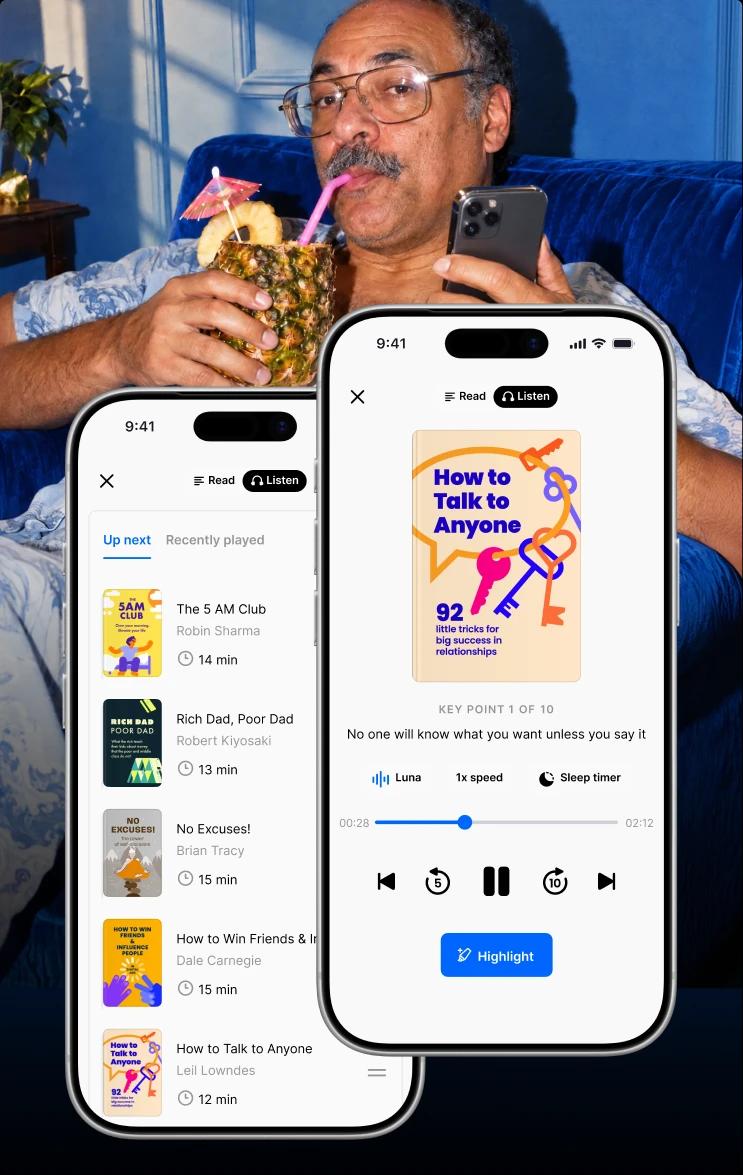
Headway turns books like the ones above into 15-minute text or audio summaries, so you get the core ideas from Comer, Newport, Flanders, Sasaki, and Zahariades without committing hours you don’t have. The app builds a personalized growth plan based on what you’re working on, whether that’s reducing stress, cutting screen time, or simplifying your routine.
Spaced repetition and saved highlights help ideas actually stick instead of fading after a week, and offline mode means you can keep learning on a walk or a flight with no signal.
CarPlay and Android Auto support turns a commute into quiet listening time instead of another scroll session, and daily streaks build consistency without turning self-care into another chore. It’s one of many slow-living resources out there, just built to fit into the minutes you already have.
📘Get the ideas without the time commitment. Try Headway for 15 minutes a day.

Start exploring a slower, calmer life with Headway
Slow living isn’t about abandoning your goals or moving somewhere with fewer people. It’s about choosing which parts of your day deserve your rushed attention and which deserve your full attention, and the research backs that distinction up more than most wellness trends can.
Headway makes that first step manageable. You get 15-minute summaries in text or audio, a growth plan built around what you’re actually trying to change, spaced repetition so the ideas stick, and offline access for whenever you actually have a quiet minute. None of it requires a lifestyle overhaul before day one.
If burnout, busyness, or a constant feeling of falling behind has been weighing on you, download Headway and start with one summary today.

Small, slower steps count more than people think.
Frequently asked questions about slow living
What does slow living mean?
Slow living means prioritizing presence and deliberate pacing over speed and volume in daily life. Carl Honoré described it as taking the time to do things properly and enjoying them more as a result. It isn’t about rejecting ambition or moving to a rural area. It’s a mindset shift toward intentional living and quality over quantity in how you spend your time and attention.
Is slow living realistic for busy people?
The aesthetic version isn’t realistic for most people, but the philosophical version is. Starting with one habit, like protecting your first 15 minutes after waking or pausing one recurring commitment, is accessible on any schedule. The book-based exercises above show that small, specific changes count more than a full lifestyle reset.
Does slow living mean being less productive?
No. A 2025 Nature Human Behavior study of nearly 2,900 employees found that working fewer hours reduced burnout and improved well-being without any drop in performance. Slow living targets sustained output and health, not raw speed, which is a different goal entirely from simply working less.
What are examples of slow living?
Examples include not checking messages for 20 minutes after waking up, eating one screen-free meal a week, choosing two focused tasks a day instead of constantly multitasking, and choosing slower hobbies like yoga or knitting. None of these require money or a lifestyle overhaul, just a change in how you spend your existing time.
Is a slow living podcast or book a good place to start?
Yes, if you want context before changing habits. Books like ‘In Praise of Slowness’ or ‘Digital Minimalism’ explain the philosophy’s reasoning, while podcasts offer ongoing reminders and a sense of community. Headway summarizes several of the best slow living books in 15-minute formats, which works well if you want the ideas without a long reading commitment.
Is slow living expensive?
The aesthetic version, with specific decor and artisanal products, can get pricey. The actual practice isn’t. Core habits like fewer commitments, more focused attention, and slower routines cost nothing. The confusion comes from marketing that’s attached itself to the term, not from the underlying philosophy.
How do I stop feeling guilty for resting or slowing down?
Research on rest shows that people who feel guilty resting don’t actually recover from it, so guilt has to be addressed before the schedule changes. Naming the guilt directly, rather than pushing through it, tends to help more than adding another productivity hack on top of an already full day.
What is the difference between slow living and minimalism?
Minimalism focuses mainly on reducing physical possessions, while slow living focuses more broadly on pace and attention. They overlap a lot, since decluttering often supports a calmer pace, but slow living also covers relationships, work, and information habits, not just what you own.