Self-growth
 Apps & Digital Tools
 Business & Career
 Success
 Growth Tools
 Psychology
 Communication
 Relationships

When was the last time your mind felt quiet?
If you had to think about it, you're in the right place. Deadlines pile up, notifications never stop, and by 9 p.m. your brain is still running laps. The best books for stress relief won't erase your to-do list, but they can teach you how to respond to it — with a calmer nervous system, fewer racing thoughts, and a few practical exercises you can use the same day.
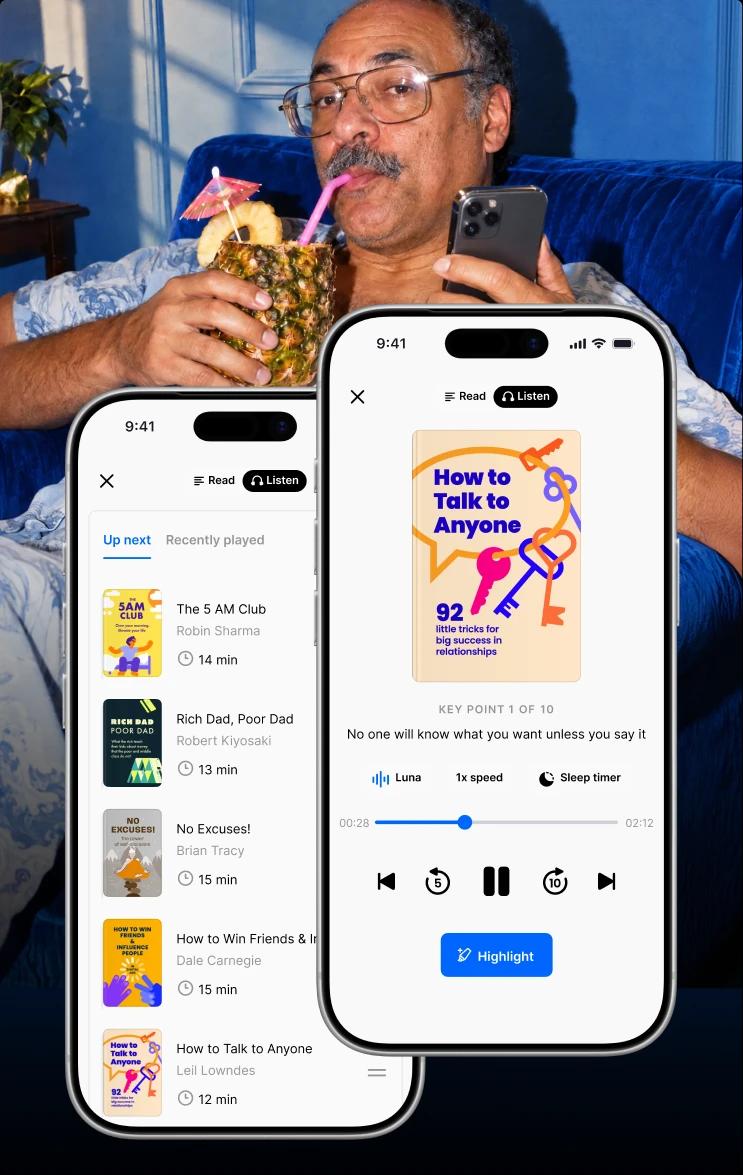
The catch? Stressed people rarely have the energy to read a 300-page book about stress. That's exactly the gap Headway closes: 15-minute summaries of the world's best stress management books, in text and audio, so you can start feeling the difference on today's commute instead of "someday."
📘 Take Headway's quick quiz and get a personalized plan built around calm.
Quick answer: What are the best books for stress relief?
Our editorial team at Headway believes the best books for stress relief combine science, self-compassion, and simple techniques you'll use in real life. Here are the top five picks:
'Why Zebras Don't Get Ulcers' by Robert M. Sapolsky: Understand what chronic stress does to your body — and why that knowledge changes everything.
'Burnout' by Emily Nagoski & Amelia Nagoski: Learn to complete the stress cycle instead of carrying it around all day.
'10% Happier' by Dan Harris: A skeptic's funny, honest case for meditation as an anxiety tool.
'Don't Feed the Monkey Mind' by Jennifer Shannon: A CBT-based method for breaking the worry loop.
'The Ruthless Elimination of Hurry' by John Mark Comer: A guide to slowing down in a culture that never does.
All 26 titles below are available on Headway as 15-minute summaries, so you can sample several tonight and pick the one that fits your kind of stress.
📘 Start your Headway plan and read the ideas that calm your mind first.

Can books really relieve stress? What the research says
Reading is one of the cheapest stress reduction tools you have, and there's evidence behind it. A longitudinal study of 231 university students, published in the Journal of American College Health in 2020, found that recreational reading was linked to lower psychological distress over the school year. One detail matters: the benefit was greatest for students who read because they wanted to, so pick books that genuinely interest you, not ones you feel you "should" finish.
➡️ If you're a student yourself, our list of the best books for college students is a good companion to this one.
Books work on stress from two angles. First, the act of reading gives your attention one calm anchor, which interrupts rumination the way a walk or a breathing exercise does. Second, the right books teach coping strategies you keep forever: how the stress response works, which relaxation techniques switch it off, how to spot anxious thought patterns, and how to build routines that protect your energy.
That second part is where this list comes in. Every book below was chosen because it offers something you can practice, whether that's mindfulness, cognitive behavioral therapy techniques, or a smarter to-do list. And if the psychology behind it all hooks you, keep going with our roundup of psychology books for beginners.
Best mindfulness books for stress: Learn to be where you are
Mindfulness has one job: pulling your attention out of the "what if" spiral and back into the present moment. These five books teach that skill from very different angles, from clinical programs to celebrity honesty.
1. 'Wherever You Go, There You Are' by Jon Kabat-Zinn
Jon Kabat-Zinn is the scientist who brought mindfulness into hospitals through his famous stress reduction program at the University of Massachusetts. This book strips the practice down to its core: paying attention, on purpose, without judging what you find. The chapters are short and plain-spoken, so you can read one over coffee and carry a single idea into your day.
Kabat-Zinn's big point is that you don't need a retreat or an hour of silence to practice. Watching your breath at a red light counts. Noticing your shoulders creep up during a meeting counts. The Headway summary distills his key practices into 15 minutes, which is a fitting way to meet the book's aim of doing less with more attention. (Fans who want the full clinical program later can graduate to his denser classic, 'Full Catastrophe Living' — more on that in the bonus shelf below.)
2. 'Mindfulness' by Mark Williams & Danny Penman
If Kabat-Zinn gives you the philosophy, Williams and Penman give you the schedule. This book lays out an eight-week program based on mindfulness-based cognitive therapy, developed at Oxford, with specific meditations for each week. Some practices take as little as three minutes, which removes the classic excuse of having no time.
The authors also include "habit releasers" — small disruptions like sitting in a different chair or taking a new route to work. These nudges wake you up from autopilot, where a lot of low-grade stress hides. It's a structured, patient path toward mental clarity, and the weekly format makes progress easy to feel.
3. 'Calm' by Fearne Cotton
Fearne Cotton is a British broadcaster who has been open about her own anxiety, and this book reads like advice from a friend who has been through it. She mixes personal stories with journal prompts, breathing exercises, and small rituals for finding pockets of calm in loud, busy days. No jargon, no lecture, just honest trial and error.
This is the pick for anyone who finds clinical books cold. Cotton admits she still loses her calm regularly, which makes her practical suggestions feel doable rather than preachy. If perfect serenity sounds fake to you, her version of "calmer, more often" will land better.
4. 'The Art of Stillness' by Pico Iyer
Here's a fun twist: one of the world's most traveled writers arguing that the best trip is going nowhere. Pico Iyer makes the case that stillness, silence, and solitude are where we process our lives, and that constant movement keeps us skimming the surface. He shares how figures like singer Leonard Cohen found more adventure in sitting still than in fame.
It's a slim, beautiful read you can finish in an evening, and it pairs well with our list of quick reads for adults if short books are your speed. Consider it the "why" behind every other book here: without some stillness built into your week, every other stress management technique is running uphill.
5. '10% Happier' by Dan Harris
Dan Harris was a rising ABC News anchor until he had a panic attack on live television in front of millions of viewers. That very public low point sent him on a reluctant, often hilarious search through the world of meditation, which he initially dismissed as nonsense for people with crystals. Spoiler: the skeptic got converted, but only partially — hence the title.
This is the best entry point for anyone who rolls their eyes at wellness talk. Harris explains how meditation quiets an overactive mind and manages anxiety without promising bliss or enlightenment. Ten percent happier is a modest claim, and that modesty is exactly why readers trust him.
📘 Short on time? Answer a few questions, and Headway will line up calming reads that match your goals.
Books for stress and anxiety: Quiet the worry and the overthinking
Stress and anxiety feed each other. These eight books to help with stress go after the thought patterns themselves — the worry loops, the reassurance-seeking, the 2 a.m. mental replays — with tools drawn from CBT, psychology, and plain common sense.
6. 'Be Calm' by Jill Weber
Psychologist Jill Weber organized this book like a first-aid kit. Instead of reading it cover to cover, you look up what you're feeling — racing thoughts, a pounding heart, the urge to avoid something — and flip straight to techniques for that exact moment. Each strategy is grounded in clinical practice and explained in a few clear pages.
That lookup format is a quiet act of kindness, because nobody mid-spiral wants to hunt through chapters for help. Keep it on your nightstand or in the Headway app for the moments when anxious thoughts show up uninvited. Over time, the techniques become reflexes.
7. 'Hardcore Self Help: F**k Anxiety' by Robert Duff, Ph.D.
Robert Duff is a licensed psychologist who got tired of self-help books that sound like textbooks, so he wrote one that sounds like your funniest friend explaining the fight-or-flight response over pizza. It's short, blunt, and sweary, and underneath the jokes sits legitimate psychology: why anxiety happens, why avoidance makes it worse, and what to do instead.
The casual tone is the point. Plenty of people — especially guys who'd never touch a book with a lotus flower on the cover — will take advice from Duff that they'd ignore from anyone else. If that's you or someone you love, this book and our roundup of self-help books for men are a solid starting lineup.
8. 'Don't Overthink It' by Anne Bogel
Overthinking is stress with a steering wheel, driving you in circles. Anne Bogel shows how repetitive, unhelpful thoughts drain time and energy, then offers a way out: build values-based defaults so small decisions stop demanding debate. What to cook, what to wear, whether to speak up — decide the framework once, and the daily friction disappears.
Bogel also tackles analysis paralysis, the freeze that hits when every option feels risky. Her fixes are refreshingly concrete, like setting a decision deadline or capping your research to a set window. For overthinkers, this book feels less like advice and more like someone finally handing you the off switch.
9. 'Anxious for Nothing' by Max Lucado
Pastor Max Lucado built this book around a single verse from Philippians — "be anxious for nothing" — and turned it into a four-part practice with the acronym CALM: celebrate God's goodness, ask for help, leave your concerns, and meditate on good things. It's warm, story-driven, and written for readers who want their faith and their stress management in the same place.
Even if you're not religious, the underlying moves will look familiar: gratitude, asking for support, letting go of what you can't control, and directing your attention deliberately. For readers of faith, though, this one offers something the clinical books can't — the sense that inner peace has a foundation deeper than technique.
10. 'Don't Feed the Monkey Mind' by Jennifer Shannon
Therapist Jennifer Shannon pictures anxiety as a nervous monkey in your head, shrieking about danger. Every time you seek reassurance, double-check, or avoid something scary, you're tossing the monkey a banana — and a fed monkey screams louder tomorrow. Her CBT-based method teaches you to spot the three mindsets that keep the cycle going: intolerance of uncertainty, perfectionism, and over-responsibility.
The counterintuitive fix is to welcome uncertainty in small doses instead of fighting it. Send the email without rereading it five times. Leave the "what if" unanswered. Each time you do, the monkey quiets down a little, and Shannon's worksheets make the practice systematic rather than random.
11. 'Declutter Your Mind' by S. J. Scott & Barrie Davenport
Scott and Davenport treat mental clutter like a messy garage: negative thinking, endless worry, too many commitments, and unresolved relationship tension all piled on top of each other. The book walks through clearing each pile, with breathing exercises for the acute moments and reframing techniques for the recurring thoughts.
What sets it apart is scope. The authors argue that a cluttered calendar and a cluttered mind are the same problem wearing different outfits, so they help you prune obligations, not just thoughts. It's a practical, checklist-friendly read for anyone whose stress comes from having too much of everything.
12. 'How to Stop Worrying and Start Living' by Dale Carnegie
This classic has been in print since 1948 for one reason: the advice keeps working. Carnegie teaches you to live in "day-tight compartments," sealing off yesterday's regrets and tomorrow's fears so today gets your full attention. His worst-case technique is just as durable — name the worst that could realistically happen, accept it mentally, then work to improve on it. Worry loses most of its grip once the monster has a face.
Carnegie fills the book with stories of ordinary people who worried themselves sick and found their way out, which keeps the lessons vivid decades later. If his style clicks with you, Headway's library also carries 'How to Win Friends and Influence People in the Digital Age' by Dale Carnegie & Associates — useful when other people are your main source of stress.
13. 'Don't Sweat the Small Stuff... and It's All Small Stuff' by Richard Carlson
Richard Carlson's mega-bestseller delivers 100 tiny strategies, each a couple of pages long, for letting minor irritations stay minor. His signature question — will this matter a year from now? — deflates most daily frustrations on contact. Other gems include letting others have the last word and treating interruptions as part of the plan rather than an attack on it.
The bite-sized format is perfect for stressed readers: one chapter with your morning coffee, applied before lunch. Carlson's core message is gentle but sturdy — most of what spikes your blood pressure today won't even be a memory next month. Perspective, practiced daily, becomes its own relaxation technique.
Stress management books that explain your body's alarm system
Sometimes the fastest route to relief is understanding what's happening under the hood. These four books turn the biology and psychology of stress into stories you'll retell at dinner.
14. 'The End of Stress' by Don Joseph Goewey
Don Joseph Goewey argues that most of our stress response is a habit the brain learned — which means the brain can learn something else. His four-step approach centers on catching fear-based reactions early, choosing a calmer stance on purpose, and repeating that choice until it becomes your new default. He leans on research about the brain's ability to rewire itself with practice.
The title promises more than any book can deliver, and Goewey knows it; the real offer is a steadier baseline, not a stress-free life. Readers who like a clear system with morning-to-evening structure will get the most out of it, and the emotional resilience it builds compounds over months.
15. 'Why Zebras Don't Get Ulcers' by Robert M. Sapolsky
Stanford neuroscientist Robert Sapolsky opens with a simple observation: a zebra sprints from a lion, and minutes later it's calmly grazing again. Humans, meanwhile, can trigger that same emergency system with a memory, a mortgage, or a Monday. Because our stress response fires constantly instead of in short bursts, chronic stress chips away at the heart, digestion, sleep, memory, and immune function.
That sounds grim, but Sapolsky is genuinely funny, and the knowledge is motivating rather than scary. Once you understand that your body treats an unread email like a predator, taking relaxation seriously stops feeling indulgent. This is the science backbone of the whole list, and the Headway summary captures its core in one lunch break.
16. 'When the Body Says No' by Gabor Maté, MD
Physician Gabor Maté spent decades noticing a pattern in his patients: the ones who never expressed anger, never set boundaries, and always put everyone else first were often the ones whose bodies eventually rebelled. Drawing on case studies and research on the stress-disease connection, he argues that chronically suppressed emotion is a physical stressor — and that saying "no" out loud can spare your body from saying it for you.
Some of Maté's conclusions reach further than mainstream medicine is ready to go, so read it as a lens rather than a diagnosis. Even so, the core insight lands hard for chronic people-pleasers: emotional honesty is a health practice, not a luxury. If this book resonates, Headway's library also carries his 'The Myth of Normal,' which widens the argument to the culture we all live in.
17. 'The Highly Sensitive Person' by Elaine N. Aron
Psychologist Elaine Aron's research suggests that roughly one in five people has a nervous system that processes everything more deeply — noise, light, other people's moods, caffeine, criticism. If crowded rooms drain you fast and you need more downtime than everyone around you, this book may explain half your stress in one sitting. Aron reframes high sensitivity as a normal trait with real strengths, from empathy to noticing what others miss.
The practical chapters are where the stress relief happens: managing stimulation, building recovery time into your schedule, and setting up work and relationships so overwhelm stops being your default state. For readers who've spent years wondering why they can't just "toughen up," Aron's answer — you were never broken, just wired differently — comes as genuine relief.
Books for burnout and stress: Recover your energy and your pace
Burnout isn't fixed by a nap or a vacation. These three books address the deeper problem — emotional exhaustion and a culture that treats rest as laziness — and show you how to actually recover.
18. 'Do Nothing' by Celeste Headlee
Journalist Celeste Headlee traces how we came to worship busyness, from the industrial revolution to hustle culture, and shows the price: worse health, thinner friendships, and work that expands to eat every free hour. Her argument is that leisure, real leisure without a productivity goal attached, is a skill modern life trained out of us.
The book offers ways to retrain it: untracked time, single-tasking, more face-to-face connection, and a clean border between work and life. If you feel guilty every time you rest, Headlee will show you where that guilt was manufactured — and how work-life balance returns when you stop treating yourself like a machine.
19. 'Burnout' by Emily Nagoski & Amelia Nagoski
The Nagoski sisters make one distinction that changes everything: dealing with your stressors is not the same as dealing with your stress. You can finish the project, and your body can still be stuck mid-alarm, full of unspent adrenaline. Their research-backed answer is to complete the stress cycle physically — through movement, deep breathing, laughter, crying, or a long hug — so your nervous system gets the message that the danger has passed.
Written especially for women worn down by impossible expectations, it's equally useful for anyone running on fumes. Browse Headway's self-help collection for women for more in this spirit. Few books on this list produce faster "oh, so that's what's wrong" moments.
20. 'The Ruthless Elimination of Hurry' by John Mark Comer
John Mark Comer, a former megachurch pastor who stepped back from his own overloaded life, names hurry as the great enemy of a calm and meaningful existence. His answer is a set of old practices with new relevance: silence and solitude, a real day off each week, simplicity, and deliberately slowing down — even driving in the slow lane on purpose.
The book has a spiritual thread, but its advice works for any reader whose calendar has become their boss. Comer's writing is punchy and honest about how hard slowing down feels at first. Stick with it for a few weeks, and an unhurried hour stops feeling like wasted time and starts feeling like your life again.
📘 Running on empty? Get your personalized plan and rebuild your energy 15 minutes at a time.
Hands-on books to calm your mind: Systems and techniques that lighten the load
For some of us, stress lives in the logistics — the open loops, the overloaded lists, the tension the body carries. These six books offer concrete tools, from productivity systems to mind-body techniques.
21. 'Getting Things Done' by David Allen
David Allen's classic starts from a sharp insight: your brain is for having ideas, not holding them. Every task floating around in your head is an open loop, and open loops generate background stress even when you're off the clock. His system captures everything into one trusted place, then breaks each item into a clear next action.
The payoff is what Allen calls a "mind like water" — calm because nothing is being juggled mentally. GTD has a learning curve, and the Headway summary is a smart way to grab the core method before committing to the full system. Even adopting the capture habit alone will lower your task-related stress noticeably.
22. 'The Tapping Solution' by Nick Ortner
Nick Ortner introduces EFT tapping: you tap a sequence of acupressure points on the face and body while naming the stress or worry out loud. The ritual pairs physical touch and slow breathing with honest acknowledgment of what's bothering you, which many people find genuinely settling.
Full transparency: the scientific evidence on EFT is still developing, and researchers debate how much of the effect comes from the tapping itself versus the built-in relaxation and exposure. That said, the practice is free, takes five minutes, and harms nothing. If it becomes the pause button that keeps you from doomscrolling through your anxiety, it has earned its spot.
23. 'To-Do List Formula' by Damon Zahariades
Ever finish the day exhausted with your to-do list somehow longer than it was at breakfast? Damon Zahariades explains why most lists fail — they're wish lists, not plans — and walks through better formats, from daily top-three lists to time-blocked schedules. Each system comes with pros, cons, and instructions.
The stress angle is direct: an unrealistic list guarantees you end every day feeling behind, and feeling chronically behind is a recipe for overwhelm. A well-built list does the opposite, giving you a finish line you can cross. Small fix, outsized effect on your evenings.
24. 'The Subtle Art of Not Giving a F*ck' by Mark Manson
Mark Manson's central math is brutally simple: you have a limited supply of care to give, and spending it on everything means having none left for what matters. He also names the "feedback loop from hell" — feeling anxious, then anxious about being anxious — and shows how accepting a negative feeling drains its power faster than fighting it ever will. If you've read about acceptance and commitment therapy, you'll recognize the overlap: make room for discomfort, then act on your values anyway.
It's crude, funny, and more disciplined than the title suggests. Manson doesn't tell you to care less overall; he tells you to care precisely. Headway's library also carries his 'Everything Is F*cked,' 'Models,' and 'Will,' the memoir he co-wrote with Will Smith, if his voice keeps you turning pages.
25. 'Calm the F*ck Down' by Sarah Knight
Sarah Knight's method fits on a napkin: figure out what you can control, act on that, and stop spending energy on the rest. She sorts worries into categories, walks through the math of "probable versus possible" disasters, and prescribes what she calls productive, helpful, effective responses instead of spiraling.
The profanity and jokes carry a genuinely sturdy framework — it's Stoicism in streetwear. Knight is especially good on the moment after something bad has already happened, when panicking feels mandatory but choosing your next move is what helps. Read it when your group chat is on fire, and your brain wants to catastrophize.
26. 'Healing Back Pain' by John E. Sarno
Dr. John Sarno, a rehabilitation physician at NYU, spent decades arguing that much chronic back pain is driven by tension and repressed emotional stress rather than structural damage alone. His prescription was radical for its time: understand the mind-body connection, address the buried stress, and return to normal activity instead of fearing movement.
Sarno's theory remains debated in medicine, and new or severe pain always deserves a proper medical evaluation first. Still, generations of readers credit this book with relief after everything else failed, and modern pain science increasingly recognizes how strongly stress and emotion shape pain. At minimum, it will change how you think about what your body is telling you.
Bonus shelf: Classic stress relief workbooks and guides to read in full
A quick honesty break: the five titles below aren't in the Headway library. They're mostly workbooks — built around written exercises, practice logs, and guided programs — which means they work best in full, with a pen in hand. If you want to go deeper after the summaries above, these are the classics readers and clinicians keep recommending:
'Full Catastrophe Living' by Jon Kabat-Zinn: The complete, clinical-depth version of the mindfulness-based stress reduction program behind book #1 on this list. Long, thorough, and worth it if the shorter book won you over.
'A Mindfulness-Based Stress Reduction Workbook' by Bob Stahl & Elisha Goldstein: An eight-week, fill-it-in companion that turns MBSR into concrete weekly practice, with formal meditations and informal daily exercises.
'The Relaxation and Stress Reduction Workbook' by Martha Davis, Elizabeth Robbins Eshelman & Matthew McKay: A therapist-office staple for over four decades, covering breathing, progressive muscle relaxation, and other relaxation techniques step by step.
'Stress Management for Dummies' by Allen Elkin: Exactly what the title promises — a friendly, zero-shame survey of stress management basics from a clinical psychologist, great as a first map of the territory.
'Hope and Help for Your Nerves' by Claire Weekes: A 1962 classic on anxiety and "nervous suffering" whose face-accept-float-let-time-pass method still earns devoted fans, and still reads like a kind doctor sitting beside you.
Start with the Headway summaries to find your direction, then pick up one of these in print when you're ready for the homework.

How real readers use Headway to feel less overwhelmed
Lists are motivating, but routines are what change your stress levels. Here's how three Headway users built theirs.
Ivan Karačić, a software developer, triathlete, and dad of three, started with a summary of 'Don't Overthink It' during a break between coding sessions — and turned that into a daily learning habit built on early morning walks. His pile of unread books had become what he calls "a growing pile of guilt." Fifteen-minute summaries dissolved it.
Abdelrahman Mohamed Soliman, a cost control manager who spent years in firefighting mode, describes the mental overload of too many priorities and no time to think. Twenty minutes with Headway each morning helped him swap reactive urgency for calm, deliberate decisions — colleagues told him he no longer rushes decisions; he frames them.
And Rahaf Sobh, a university student juggling lectures, work, and everything else, replaced in-between-moments scrolling with short summaries during her morning and night routines. Her takeaway from two months with Headway: growth doesn't require carving out hours, just choosing something better in the minutes you already have.
📘 Take a quick quiz to build a calming routine of your own.



How to choose your first stress relief book
Match the book to the shape of your stress. If your body feels it — tight shoulders, poor sleep, a racing heart — start with 'Why Zebras Don't Get Ulcers' or 'Burnout.' If your mind won't stop, go for 'Don't Feed the Monkey Mind' or 'Don't Overthink It.' If your stress comes from swallowing your "no" or absorbing everyone's moods, 'When the Body Says No' and 'The Highly Sensitive Person' will feel like someone finally gets it. And if your schedule is the problem, 'Getting Things Done' or 'Do Nothing' will pay off fastest.
One more honest tip: don't turn stress relief reading into another chore. Remember the research above — reading helps most when it's something you want to do. Sample a few summaries, follow what pulls you in, and let the rest wait. When you're ready to read beyond this topic, our lists of good books to read for adults and the best books for self-improvement are natural next steps.
And if worry or anxiety is seriously disrupting your life, a book is a companion, not a replacement for care. A therapist or doctor can offer support no summary can, and reaching out is a strength move, not a defeat.
Give your mind 15 calm minutes a day with Headway
Here's the uncomfortable truth about the best books for stress relief: the people who need them most have the least bandwidth to read them. You know a calmer life is 26 books away, and you also know you'll fall asleep on page 12 tonight. That gap between knowing and doing is where stress wins.
Headway was built to close it. Every book on this list is available as a 15-minute summary in text and audio — like audiobooks trimmed to their best chapters — so you can absorb the core techniques while commuting, cooking, or winding down for bed.
The quick quiz builds a personalized growth plan around your goals — calm, focus, better sleep, work-life balance — and spaced repetition helps the ideas stick long enough to become habits. With 2,500+ summaries in the library, 55 million people worldwide use Headway to turn good intentions into daily practice.
You don't need another thing on your to-do list. You need 15 minutes that give energy back instead of taking it.
📘 Answer a few questions and start your Headway plan for a calmer mind today.
Frequently asked questions about the best books for stress relief
What are the best books for stress and anxiety?
For a mix of science and practice, start with 'Why Zebras Don't Get Ulcers' to understand your stress response, 'Don't Feed the Monkey Mind' for CBT-based tools against worry, and '10% Happier' for an approachable path into meditation. Together they cover the body, the thoughts, and the daily practice — the three fronts where stress and anxiety operate.
Does reading really reduce stress?
Research points that way. A 2020 study in the Journal of American College Health followed 231 students over an academic year and found recreational reading was linked to lower psychological distress. The key was autonomous motivation: reading by choice, for pleasure. So pick books you're genuinely curious about, and the calming effect tends to follow the enjoyment.
What is the best book for overthinking and stress?
'Don't Overthink It' by Anne Bogel targets the problem most directly, with strategies for ending analysis paralysis and building decision-making defaults. Pair it with 'Don't Feed the Monkey Mind' if your overthinking leans anxious, or 'Declutter Your Mind' if it comes bundled with an overloaded schedule. All three are on Headway, so you can test-drive each in 15 minutes.
Can stress management books replace therapy?
No, and the good ones never claim to. Books are excellent for understanding stress, learning coping strategies, and maintaining daily habits, but they can't assess your situation or adjust to it the way a professional can. If stress or anxiety is interfering with your sleep, work, or relationships for weeks at a time, please talk to a doctor or therapist alongside your reading.
What should I read when I'm feeling overwhelmed?
Reach for something short and validating rather than a dense program. 'Calm' by Fearne Cotton, 'The Art of Stillness' by Pico Iyer, or 'Be Calm' by Jill Weber all work in small doses and meet you where you are. On Headway, you can listen to any of them in about 15 minutes, which is a manageable ask even on your worst day.
What are the best books for burnout and emotional exhaustion?
'Burnout' by Emily and Amelia Nagoski is the standout, thanks to its research on completing the stress cycle through movement, breathing, and connection. Follow it with 'Do Nothing' by Celeste Headlee to rethink your relationship with busyness, and 'The Ruthless Elimination of Hurry' by John Mark Comer to rebuild a slower rhythm you can sustain.
How can I make time to read when I'm already stressed?
Attach reading to time you already have instead of hunting for new time. Audiobooks and 15-minute Headway audio summaries fit a commute, a workout, or the minutes before sleep — the same windows that usually go to scrolling. Users like Ivan Karačić built lasting habits exactly this way, listening during morning walks and household chores rather than blocking off reading hours.
What's the best mindfulness book for stress if I'm a beginner?
Start with 'Mindfulness' by Mark Williams and Danny Penman, because its eight-week structure tells you exactly what to practice and when, with meditations as short as three minutes. If you'd rather ease in through story and humor first, '10% Happier' by Dan Harris shows what a beginner's messy, skeptical practice looks like in real life.