Self-growth
 Apps & Digital Tools
 Business & Career
 Success
 Growth Tools
 Psychology
 Communication
 Relationships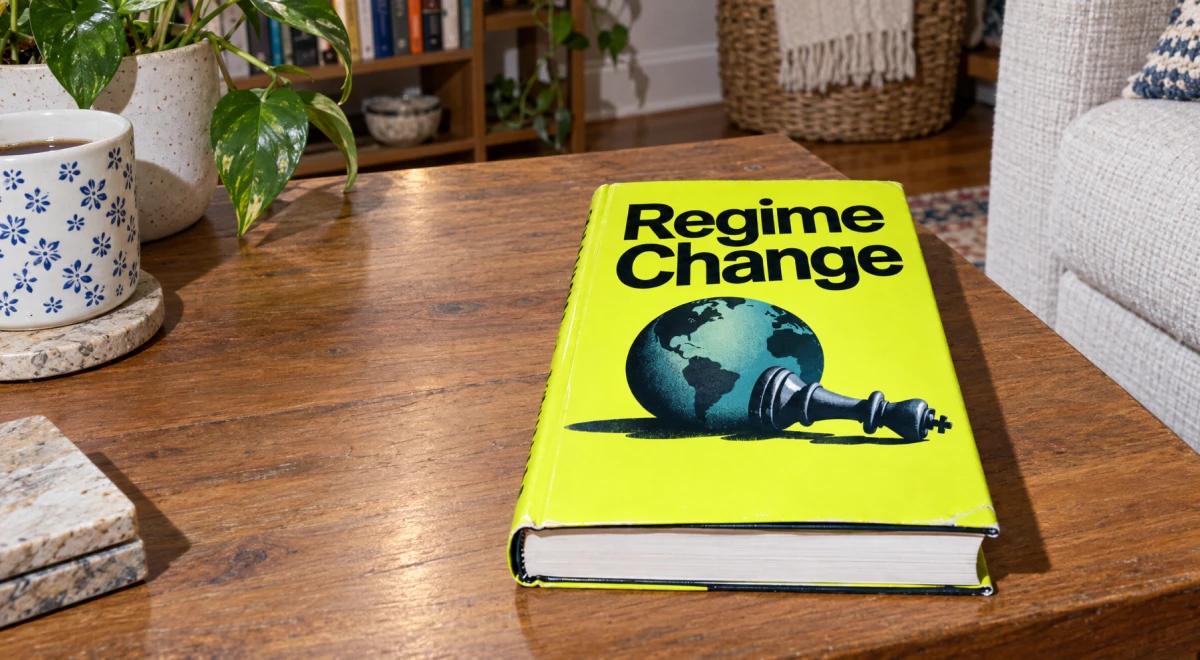

'Regime Change: Inside the Imperial Presidency of Donald Trump,' by Maggie Haberman and Jonathan Swan, came out on June 23, 2026. It became an instant #1 New York Times bestseller almost overnight.
Haberman, a White House correspondent for The New York Times, and Swan, who moved from Axios to the Times, spent close to two years and nearly 1,000 interviews building this book.
It picks up close to where Haberman's earlier works left off, tracking the first year of Trump's second term inside the Oval Office, the Situation Room, and the Justice Department.
This 'Regime Change' book review covers what the book reports, how critics and the president himself responded, and how it stacks up against classics on power like Niccolò Machiavelli's 'The Prince' and Bob Woodward and Carl Bernstein's 'All the President's Men.'
If books on leadership and power like this interest you, you can find similar nonfiction broken into 15-minute summaries on the Headway app.

Quick summary: What this book review covers
Here are 'Regime Change' book key takeaways and main points before we get into the details.
'Regime Change: Inside the Imperial Presidency of Donald Trump' is a 496-page account of the first year of Trump's second term, published by Simon & Schuster in June 2026.
Authors Maggie Haberman and Jonathan Swan conducted close to 1,000 interviews over roughly two years for the book.
The main points cover expanded executive power, including bypassed court orders, Situation Room meetings on the Epstein files, and a new war in the Middle East.
It debuted as an instant #1 New York Times bestseller and drew praise from The New Yorker's David Remnick, while Trump publicly rejected its contents on Truth Social.
This regime change book review also compares it to 'Confidence Man' and pairs its themes with classics on power such as 'The Prince' and 'The 48 Laws of Power.'
Keep reading for the full breakdown, including the anecdote everyone's talking about.
Who wrote Regime Change and why their access matters
Maggie Haberman has covered Donald Trump longer than almost any other reporter working today. A New York City native, she worked at the New York Post, the New York Daily News, and Politico before joining The New York Times in 2015.
She's covered six presidential elections and was part of a team that won a Pulitzer Prize in 2018 for reporting on Trump advisers' ties to Russia. In 2022, she published 'Confidence Man: The Making of Donald Trump and the Breaking of America,' tracing Trump's rise from the New York real estate world through his first presidency.
Jonathan Swan built his reputation at Axios with a direct, pointed interview style before joining the Times as Haberman's reporting partner on this book. Together, they spent roughly two years and close to 1,000 interviews reporting 'Regime Change,' talking to people inside the West Wing, the Justice Department, and the national security team, including Joint Chiefs of Staff chairman Dan Caine and Secretary of State Marco Rubio.
That kind of access is a big reason the book landed with so much weight the moment Simon & Schuster released it in hardcover, ebook, and audiobook formats.
For readers hunting a quick 'Regime Change' Maggie Haberman summary, or simply searching Maggie Haberman Trump book 2026, it comes down to this: two connected reporters, unprecedented access, and a portrait of a presidency operating without its old guardrails.
Inside the book: What 'Regime Change' covers
One year, six threads, and a presidency that looks nothing like the first. Here's what each part of the book actually gets into.
A presidency with fewer checks
The book's central argument is that Trump's second term runs with far fewer checks than his first. The generals who used to tell him no are gone. The lawyers who remain, the authors write, have learned to pick their battles carefully.
His administration has flouted court orders and claimed powers that Congress once held in check, all while global markets and foreign leaders absorb the shock of his decisions.
A new war in the Middle East
Some of the most detailed scenes happen inside the Situation Room and the Oval Office. Haberman and Swan describe deliberations that led to a new war in the Middle East, including tension over shipping through the Strait of Hormuz, and a plan that CIA director John Ratcliffe reportedly dismissed as unrealistic before Trump ultimately agreed to it anyway.
Secretary of Commerce Howard Lutnick and Treasury Secretary Scott Bessent, notably, were left out of the Iran decisions entirely, a detail the authors use to show how small Trump's real inner circle had become.
The home front: borders and the National Guard
On the home front, the book tracks National Guard troops surging into cities, a sealed border, and immigration agents clashing with protesters.
The Justice Department and the Epstein files
The Justice Department gets its own thread, too. The book documents an agency redirected toward the president's political opponents, alongside sourced accounts of tension inside the FBI and the DOJ.
A separate strand covers Situation Room meetings, led by Vice President J.D. Vance and Chief of Staff Susie Wiles, about how to handle fallout from the Epstein files, roughly ten days after a DOJ memo claimed there was no client list.
Agency cuts, Musk, and Venezuela
Elsewhere, 'Regime Change' tracks the shuttering of agencies like USAID, Elon Musk's early role trimming government spending, and decisions about Venezuela and Nicolas Maduro's government.
Convictions, survival, and a reshaped view of American power
The authors frame all of it against Trump's prior convictions and the assassination attempts he survived, arguing both experiences pushed him toward bigger risks and reshaped how the rest of the world reads American power.
8 standout moments from 'Regime Change'
A handful of scenes in the book stick with readers more than the rest. Here are eight worth knowing before you read the whole thing.
The tariff formula. The book walks through exactly how the administration set new tariff rates: take each country's 2024 trade deficit with the U.S., divide it by the value of goods that country exported to the U.S., then cut the result in half. That simple math produced sweeping new levies almost overnight.
The cost of the Iran war by day seventeen. Haberman and Swan lay out the toll in specific numbers: more than a dozen American service members killed, over 200 wounded, thousands of Iranian casualties, and more than $15 billion in Pentagon spending, with the Strait of Hormuz largely shut down and oil prices climbing as a result.
Susie Wiles' management style. The book credits the chief of staff with real skill for reading people, describing a staff that stayed intensely loyal to her personally and a notably calmer, quieter tone than past chiefs of staff were known for.
Doubts about Pete Hegseth. Several Republican senators privately questioned whether Hegseth, a former Fox News host and combat veteran, had the organizational experience to run the Pentagon, according to the authors' reporting.
Laura Loomer's Trojan horse cartoon. Not long after pushing for changes at the National Security Council, Loomer publicly objected to a 747-related decision by the administration, illustrating her point with a cartoon recasting the plane as a modern Trojan horse.
Governing as performance. The book uses Homeland Security Secretary Kristi Noem's approach to argue that for this administration, governing itself sometimes worked less like policy and more like a show of strength staged for one specific audience: the president himself.
Loose days at the Resolute Desk. By mid-year, the authors describe an Oval Office running on freewheeling sessions with a small core group of regulars, joined on any given day by lawmakers, business leaders, retired wrestlers, musicians, Gulf state royalty, crypto figures, or people seeking pardons for convicted friends.
The fallout after Charlie Kirk's death. The book reports that Treasury Secretary Scott Bessent compared the shock of Kirk's killing to September 11, and that Kirk himself had sensed, before his death, how much the perceived Epstein files cover-up was already cutting through with younger parts of the party's base.
📘 Untangle the politics of power on Headway!

Is the political bestseller worth reading?
Headway turns nonfiction books into 15-minute summaries.
Read political summariesThe document that became one of the book's most talked-about scenes
One scene from 'Regime Change' spread faster than almost anything else in the book. During an interview, Trump showed Haberman and Swan a two-page document ranking his power against historical figures, including Alexander the Great, Genghis Khan, Attila the Hun, Napoleon, Hitler, Mao, and Stalin.
The argument, as Trump laid it out, was that each of them held only regional power, while his reach was global. He told the authors these leaders maintained power through fear, then added,
"Who would ever do a thing like that? Right?"
He said the document had come from a historian.
When Haberman and Swan tried to trace it, they found the author wasn't a historian at all. It was Dave King, a South African businessman and longtime caddy and confidant of golf legend Gary Player, who had also served as chairman of Rangers Football Club. Trump aide Natalie Harp reportedly helped confirm King's identity to the authors after the fact.
Trump later posted the document on Truth Social anyway, describing its author as a "presidential historian." History has plenty of self-styled emperors who measured their reach this way, from Genghis Khan and Attila the Hun to Tamerlane and William the Conqueror.
How critics and the White House reacted to 'Regime Change'
Reviews of 'Regime Change' were largely strong. David Remnick, writing in The New Yorker, called it reporting of consequence.
Fintan O'Toole, reviewing it for The New York Times, argued that the book's granular detail works as a necessary counterweight to a presidency built on distortion. Journalist Tina Brown described it as "a flabbergasting feat of political reporting."
Not everyone welcomed it, though. Trump publicly rejected the book's contents, calling it fake news and criticizing Haberman by name. That kind of public pushback from the book's own subject became part of the story around its release, a pattern reviewers noted echoed what happened after Haberman's 'Confidence Man' came out in 2022.
Most book reviews landed positive even so, though some regime change book criticism has focused on 'Regime Change' book bias, given how close Haberman and Swan are to their subject after a decade of coverage.
The 'Regime Change' book controversy that followed had as much to do with who leaked to the authors as with the reporting itself. So the picture is a split one: acclaimed by critics and reviewers, disputed loudly by the president it's about.
Where Regime Change fits among other Trump-era White House books
'Regime Change' isn't the first of the best books about the Trump presidency to try to get inside this White House, and it won't be the last of the books about Trump's second term either. Here's how it stacks up against a few other books about Trump White House life that readers often compare it to.
| Book | Author(s) | Period covered | Reporting style |
|---|
'Regime Change' | Maggie Haberman, Jonathan Swan | First year, second term | Close to 1,000 interviews, real-time access |
'Confidence Man' | Maggie Haberman | Full career through first term | A decade of accumulated reporting |
'A Very Stable Genius' | Philip Rucker, Carol Leonnig | First term | Washington Post investigative reporting |
'Fire and Fury' | Michael Wolff | Early first term | Embedded, anecdote-driven |
Some reviewers wished for more depth on the Supreme Court's role in checking, or failing to check, the administration's moves. Others noted that unlike books written after Joe Biden left office and Trump returned to the White House, 'Regime Change' was reported and published in real time, which means some storylines were still unfolding as the authors wrote.
Is 'Regime Change' worth reading?
Is the 'Regime Change' book worth reading, or is it just the news you already saw with extra pages attached? The book's biggest strength is access. Haberman and Swan name their sources far more often than most White House reporting allows, and the level of detail, down to specific meetings and specific lines said in the Situation Room, is hard to match.
Its main limitation comes from the same place. This is a real-time account of a single administration, so a few threads, Venezuela policy and the Iran standoff among them, were still developing when the book went to print.
True to that real-time structure, the 'Regime Change' book ending saves the Iran standoff for its final chapters, capping off a year that started with quiet confidence and closed in open conflict.
Reader reception has been mixed on the details, even where critics agreed on the reporting. Anyone checking 'Regime Change' book rating on Goodreads will find a real split: some readers called it essential and hard to put down, while others felt it mostly recapped a year they'd already followed closely in the news.
For anyone running their own regime change book fact check, most of the sourcing lines up with reporting from Axios, CNN, and The New York Times' own excerpts published ahead of release.
'Regime Change' is available in hardcover, ebook, and audiobook formats, with Robert Petkoff narrating the book. If you're after a 'Regime Change' audiobook review specifically, Petkoff's narration keeps the long list of named officials easy to follow, even across 496 pages.
If the constant churn of political headlines already leaves you fried, our review of 'The Anxious Generation' digs into why nonstop news and social feeds affect attention in the first place.
📘 Get the key ideas without all 496 pages on Headway!
What Regime Change has in common with other books about power
Haberman and Swan aren't the first reporters whose access reshaped how the public understood a sitting president. 'All the President's Men' by Bob Woodward and Carl Bernstein did the same thing decades earlier, and readers drawn to 'Regime Change's' account of maneuvering inside the White House often end up back at older texts on strategy, like our breakdown of 'The Art of War'.
'The 48 Laws of Power' by Robert Greene and 'The Prince' by Niccolò Machiavelli both study the mechanics of holding and expanding power, themes that run through the book's account of a White House with fewer internal checks.
'Why Nations Fail,' by Daron Acemoglu and James A. Robinson, looks at what happens when institutions bend around one decision-maker, a useful lens for the book's account of court orders and Justice Department moves.
For a different angle on power, one person's courage against an entire institution rather than inside one, our piece on the Malala Yousafzai book pairs well with these themes. 'A Very Stable Genius' by Philip Rucker and Carol Leonnig also works as a first-term point of comparison for readers who want to track how the reporting has shifted over time.
Where to read next: Power, politics, and history with Headway
'Regime Change' is a long, detailed read, and that's the point for anyone who wants the full picture. But if you're working through a lot of nonfiction on power, leadership, and history at once, Headway gives you a way to sample ideas before committing to a full book.
If nonstop political nonfiction leaves you wanting a steadier daily reading habit instead of one dense sitting, our review of 'Atomic Habits' is the place most readers start. And if you need a lighter read after 496 pages of West Wing tension, our take on 'The Let Them Theory' is a good change of pace.



Where this book review leaves you with Headway
This 'Regime Change' book review gives readers a granular, sourced account of a presidency operating with fewer guardrails than before, built on close to two years of reporting from Maggie Haberman and Jonathan Swan.
If the book's themes of power, access, and institutions stuck with you, that curiosity doesn't have to stop at the last page.

Headway takes nonfiction like this and breaks it into 15-minute summaries you can read or listen to, with personalized recommendations pulled from your own interests and small gamified nudges, like streaks, that make daily reading feel less like a chore.
It's built for exactly the kind of person who finishes a 496-page book review and wants more, without another 496 pages standing in the way.
Download Headway and turn everything you just read about power, politics, and history into a daily habit of understanding it better, one 15-minute summary at a time.
FAQs about Regime Change book review
What is 'Regime Change: Inside the Imperial Presidency of Donald Trump' about?
If you're searching what is 'Regime Change' book is about in plain terms, it's a 496-page account by Maggie Haberman and Jonathan Swan covering Donald Trump's first year back in the White House. The 'Regime Change' book summary comes down to expanded executive power, Situation Room deliberations, a new war in the Middle East, and Justice Department decisions, based on close to 1,000 interviews.
What does the title 'Regime Change' mean?
The title plays on a phrase usually used for foreign politics. In one regime change book analysis, Axios, which broke news of the book ahead of release, framed it this way: after years spent covering how American journalists report on 'Regime Change' abroad, Haberman and Swan's reporting suggested they were documenting one happening at home, inside the country's own executive branch.
Did Donald Trump sit for interviews for this book?
Yes. Several of the book's most talked-about scenes, including the document ranking Trump's power against historical figures like Genghis Khan and Napoleon, came directly from interviews Trump gave to Haberman and Swan. Among the 'Regime Change' book revelations, this direct access is part of why the book carries so much sourced, on-the-record detail.
Is 'Confidence Man' required reading before 'Regime Change'?
No. 'Regime Change' works as a standalone account of Trump's second term, so you do not need the earlier book to follow it. That said, readers weighing 'Regime Change' vs other Trump books often get more context by reading 'Confidence Man' first, since it covers the decades that shaped how he governs now.
What did the internal polling memos in 'Regime Change' reveal about the Epstein files?
According to the authors, internal polling memos circulated among Trump's political team showed voters raising the Epstein files unprompted in focus groups. That detail is one of the more specific main points in the book, and it reportedly surprised officials who hadn't expected the story to break through with the public the way it did.
Should I read 'Regime Change' if I already follow political news closely?
If you're weighing should I read 'Regime Change' despite already following the news, it depends on how much detail you want. Regular readers may know the broad strokes, but the book's sourced meetings, direct quotes, and named officials offer a level of depth daily coverage rarely provides, which is why so many reviewers still recommend it over skimming a summary alone.