Self-growth
 Apps & Digital Tools
 Business & Career
 Success
 Growth Tools
 Psychology
 Communication
 Relationships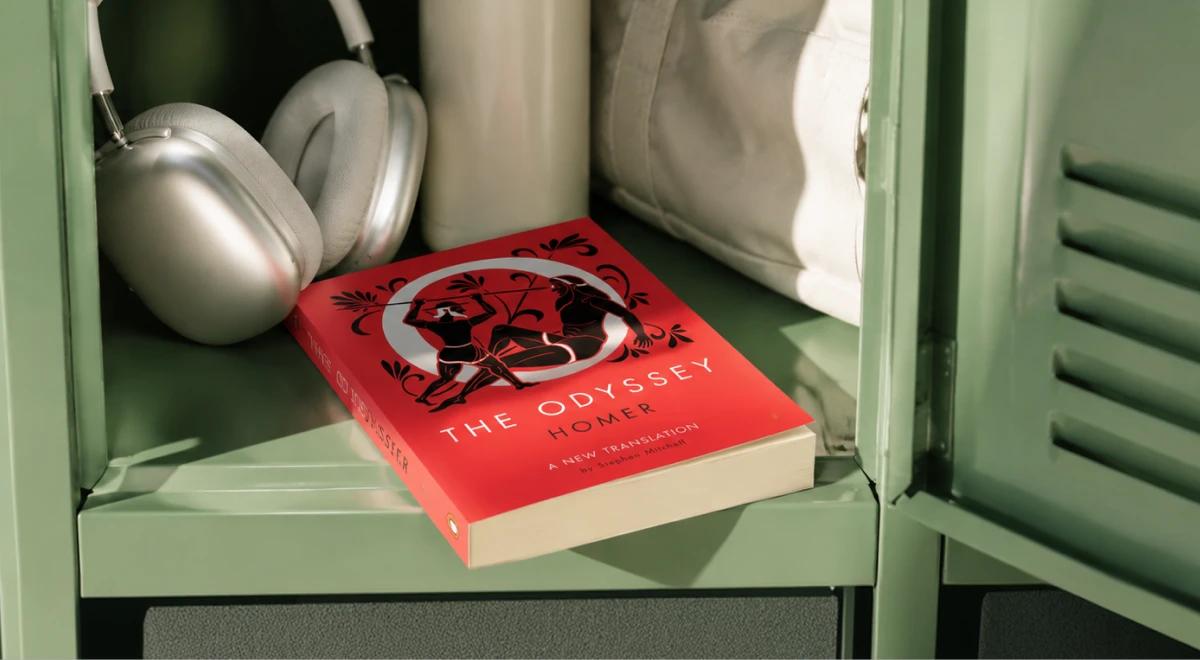

Christopher Nolan's The Odyssey, with Matt Damon, Anne Hathaway, Tom Holland, and Zendaya in lead roles, drew millions of people to a poem most had never opened. And 'The Odyssey' book has been doing exactly this for roughly 2,800 years.
It's one of the two texts considered foundational to all of Western literature, so embedded in ancient Greek culture that students were expected to know large stretches of it by heart. Here's a fact-based review of Homer's original — what the epic poem is, what happens across its 24 books, why its themes have proven near-impossible to kill, and how Nolan's adaptation compares to what Homer wrote.
If you want to go deeper on the ideas the poem raises, the Headway app has a 15-minute summary of 'The Odyssey' plus a growing library of other titles worth reading alongside the epic.
Download Headway and start with any of them today.
Quick summary: What you need to know about 'The Odyssey' before anything else
Here's the essential rundown, the kind you'd want before the film credits roll.
'The Odyssey' book is an ancient Greek epic poem attributed to Homer, composed around the 8th–7th century BCE, spanning 24 books and 12,109 lines.
It follows Odysseus, king of Ithaca, across a 10-year journey home after the 10-year Trojan War — meaning he was absent from home for 20 years total.
The poem's central themes are homecoming (nostos), loyalty, identity, cunning over brute force, and the obligations of hospitality (xenia) between guest and host.
Major characters include Odysseus, Penelope (his wife), Telemachus (his son), Athena (his divine protector), and Poseidon (his divine antagonist).
Emily Wilson's 2017 translation is the first by a woman and is widely praised for its clarity and accessibility for modern readers.
Keep reading for the full plot breakdown, character guide, themes, a comparison of the best translations, and a fact-checked look at what Nolan's film kept and changed.
What 'The Odyssey' book is: Genre, origin, and authorship
'The Odyssey' is an epic poem written in dactylic hexameter, the formal meter of ancient Greek verse, built from one long syllable followed by two short ones, repeated across 12,109 lines.
It was performed aloud before it was ever written down, part of a long oral tradition that predates literacy in ancient Greece.
The poem is attributed to Homer, though scholars have debated for centuries whether a single historical poet by that name actually existed. The prevailing academic view is that the poem emerged from generations of oral tradition before being committed to text, most likely in the 8th century BCE. The philosopher Aristotle wrote about Homer as a real person; modern scholars remain more cautious.
The poem's 24-book structure didn't come from Homer. Alexandrian scholars centuries later divided the text into 24 books — one for each letter of the Greek alphabet. The oldest complete manuscript dates to the 10th or 11th century CE.
Before that, the Athenian ruler Peisistratos established a committee in the 6th century BCE to compile and standardize the Homeric texts that were circulating orally across the Greek world.
'The Odyssey' is a sequel to 'The Iliad', which covers the siege of Troy. 'The Odyssey' begins after Troy has fallen and follows the consequences, specifically, what happens to one man trying to get home.
If you want to understand the full scope of Homeric epic, you'll eventually want both. 'The Iliad' covers kleos (glory through war); 'The Odyssey' is about nostos (homecoming) and what a person becomes in the process of surviving.
📘 Start exploring the ideas behind 'The Odyssey' with Headway!

The plot of 'The Odyssey' book: What happens across 24 books
The poem has a reputation for being dense and daunting. It doesn't have to be. Here's what happens.
The situation in Ithaca (Books 1–4: The Telemachy)
Odysseus has been missing for 20 years. Back in Ithaca, the suitors, dozens of men from surrounding islands, have moved into his palace, consuming his household's wealth and pressuring Penelope to choose a new husband.
His son Telemachus, now grown, sets out to find news of his father. He visits Menelaus in Sparta and Nestor in Pylos. At the start of the poem, the goddess Athena appears to Telemachus, disguised as a family friend named Mentes, and urges him to act. This section is often called the Telemachy — Telemachus's coming-of-age journey, running parallel to his father's.
Odysseus in exile (Books 5–8)
Odysseus is stranded on the island of Ogygia, kept there by the sea-nymph Calypso, who loves him and has offered him immortality. He's been there seven years. He wants to go home.
Athena convinces Zeus to intervene; Hermes is sent to Calypso with the order to release him. Odysseus builds a raft, is shipwrecked by a storm sent by Poseidon, and washes up on Scheria, the island of the Phaeacians, ruled by King Alcinous and his daughter Nausicaa, who find him on the shore.
Odysseus tells his story (Books 9–12)
At the Phaeacian court, Odysseus recounts his adventures since Troy, the entire narrative of monsters, gods, and disasters arrives here as a flashback. He encounters the Lotus-Eaters, whose food causes his men to forget home.
He blinds the Cyclops Polyphemus (son of Poseidon, which is why Poseidon spends the rest of the poem making his journey harder), naming himself "Nobody" so Polyphemus can't identify him — only to shout his real name as they sail away, an act of pride that costs him dearly.
The giant-cannibals, the Laestrygonians, destroy eleven of his twelve ships. The witch Circe turns his men into pigs until Odysseus, aided by Hermes and the protective herb moly, resists her and negotiates their release.
In Book 11, Odysseus descends to the underworld, the Nekyia, where he speaks with the dead: Tiresias the blind prophet, his own mother, the shade of Achilles, and Agamemnon, who warns him about treachery at home (Agamemnon was murdered by his wife Clytemnestra and her lover Aegisthus upon his return from Troy; his son Orestes later avenged him, a story the poem uses as a dark parallel to Odysseus's own homecoming).
He passes the Sirens (lashed to the mast so he can hear their song without being drawn into the sea), navigates between Scylla and Charybdis, and loses his remaining crew when they slaughter the Cattle of the Sun god Helios against his direct orders. He alone survives.
The return and reckoning (Books 13–24)
The Phaeacians sail Odysseus home to Ithaca in secret. He arrives disguised as a beggar and reunites with his loyal swineherd Eumaeus and, eventually, his son Telemachus, to whom he reveals himself. His father Laertes lives in retirement on a farm, broken by grief.
Penelope, still stalling the suitors, proposes an archery contest: whoever can string Odysseus's old bow and shoot an arrow through twelve axe-handle rings wins her hand. None of the suitors can string it. Odysseus, still disguised, does both. He then turns the bow on the suitors, killing them with Telemachus's help.
Penelope tests him carefully (she knows trickery), asking the nurse to move their bed. He corrects her: the bed can't be moved. He built it himself, around a living olive tree. She believes him. Athena later brokers peace with the families of the dead suitors.
📘 Get the hero's journey framework that maps every step of Odysseus's story with Headway!
The main characters in 'The Odyssey' book: Who they are and what they represent
'The Odyssey' characters list reads like a cast where nearly everyone represents something beyond themselves.
| Character | Role | What they represent |
|---|---|---|
Odysseus | King of Ithaca, the hero | Cunning, adaptability, the cost of hubris |
Penelope | Odysseus's wife, queen of Ithaca | Loyalty, patience, intelligence equal to her husband's |
Telemachus | Odysseus's son | Identity found in a father's absence; the coming-of-age arc |
Athena | Goddess of wisdom, Odysseus's protector | Strategic thinking as divine favor |
Poseidon | God of the sea, Odysseus's antagonist | The consequences of pride and the power of external forces |
Circe | Witch who transforms men into pigs | Temptation; the risk of losing one's shape and purpose |
Calypso | Sea-nymph who detains Odysseus on Ogygia | The seduction of comfort over meaning |
Antinous | Leader of the suitors | Hubris at its most reckless; abuse of hospitality |
Tiresias | Blind prophet in the underworld | The weight of self-knowledge and prophecy |
Nausicaa | Phaeacian princess | Proper hospitality; grace under unexpected circumstances |
So, what does Penelope represent in 'The Odyssey'? She's the poem's quiet center. While Odysseus is defined by cleverness in action, Penelope's intelligence is strategic patience.
She delays the suitors for years by weaving a burial shroud for Laertes and secretly unraveling it each night. She tests Odysseus more carefully than anyone else does. Her role in the poem challenges any reading that treats the role of women in 'The Odyssey' as passive; she's anything but.
The question of whether Odysseus is a good or bad leader is complicated. He's brilliant and brave. He also gets every one of his men killed. The poem doesn't resolve this cleanly, and that ambiguity is part of what keeps it interesting.
📘 Find out how ego shapes leaders, and destroys them, with Headway!
The themes of 'The Odyssey': What Homer was writing about
'The Odyssey' themes and symbols are the structural logic of the poem. Here's what Homer was working through.
Homecoming (nostos)
Everything in the poem is measured against one question: "Does this get Odysseus closer to Ithaca, or further away?" The shade of Achilles in the underworld tells him he'd rather be a living enslaved person than a dead king, a moment that quietly reframes the whole journey.
Cunning over force (metis)
Homer consistently rewards cleverness over brute strength. Odysseus escapes Polyphemus by naming himself "Nobody," blinding him, and hiding his men under sheep. He outwits Circe, strings the bow no one else can lift, and defeats the suitors through planning.
Hospitality (xenia)
In ancient Greek culture, hospitality was a moral and religious obligation, backed by Zeus himself. Every violation of xenia in the poem is punished. Polyphemus eats his guests. The suitors consume Odysseus's household for years. Both face catastrophic consequences.
Identity and disguise
The poem's hero spends most of it not being himself. He's "Nobody" in the Cyclops's cave. He's a beggar in his own home. He withholds his name from the Phaeacians until they've fed him. How does 'The Odyssey' explore identity? Through the question of what remains when everything external is stripped away.
Fate vs free will
Poseidon can delay Odysseus. He can't stop him. Athena can advise Telemachus. She can't force his crew to stop eating the Cattle of Helios. Fate vs free will in 'The Odyssey' sits in permanent tension: the gods set the conditions, humans make the choices, and the consequences fall on the humans.
📘 Start building the kind of resilience Odysseus needed; try Headway!
The best translations of 'The Odyssey' book compared
This is the most practical question for anyone new to the poem. 'The Odyssey' book summary you read will be shaped entirely by which English version you pick.
| Translator | Year | Style | Best for |
|---|---|---|---|
Samuel Butler | 1900 | Prose, formal | Public domain; free to read online |
Richmond Lattimore | 1965 | Close to the Greek meter, poetic | Readers who want formal verse |
Robert Fagles | 1996 | Contemporary, vigorous poetry | Most commonly assigned in university courses |
Emily Wilson | 2017 | Spare, accessible, line-for-line fidelity | First-time readers; most recommended recent translation |
Stephen Mitchell | 2013 | Clear, lyrical prose | Readers who prefer narrative flow without strict verse |
Emily Wilson's 2017 translation deserves its own note. It's the first English translation of 'The Odyssey' completed by a woman, and Wilson's stated aim was line-for-line fidelity to the Greek while using plain, contemporary English.
Her version made headlines partly because she translated Penelope's description of the suitors differently from her predecessors, restoring nuances the male-translated tradition had smoothed over.
For someone coming to 'The Odyssey' book for the first time, it's the most frequently recommended starting point among classics scholars today.
Nolan's film vs. 'The Odyssey' book: What the movie kept, cut, and changed
Millions of people came to Homer through Nolan's 2026 adaptation. Here's a fact-based comparison of where the film diverges from the poem. All details below reflect confirmed post-release reporting.
| Element | Homer's 'Odyssey' | Nolan's The Odyssey (2026) |
|---|---|---|
The Phaeacians and Nausicaa | Full episode in Books 6–8; Odysseus recounts his journey at their court | Cut entirely; Odysseus recounts memories to Calypso instead |
Hermes and the moly herb | Hermes appears and gives Odysseus a protective herb to counter Circe's magic | Cut; Odysseus works it out without divine assistance |
The Telemachy | Books 1–4 follow Telemachus on his own journey before Odysseus appears | Cut; film opens closer to the return |
The Laestrygonians | Man-eating giants hurl boulders, destroying ships | Reimagined as armored giants who also destroy ships |
The ending | Athena brokers peace after the suitor battle; brief epilogue with Laertes | Nolan replaces this with a more conclusive invented ending |
A bard's role | No specific casting note in the poem | Travis Scott plays a bard; Nolan drew a parallel to hip-hop and oral tradition |
The "Sea People" storyline | Not in Homer | Nolan adds a storyline referencing the real historical Sea Peoples of the Bronze Age |
Telemachus and Penelope | Telemachus commands Penelope to return to her chambers in Book 1 | Nolan softens this patriarchal element |
The adaptation is broadly faithful to Homer's structure. Every major island visit is included; the nested narrative of flashbacks survived; critics singled out the layered storytelling as the most Homeric thing about the film. The cuts were driven by the simple arithmetic of compressing 12,109 lines into 172 minutes. Something had to go.
📘 Get key insights for your learning journey in 15 minutes on Headway!
Why 'The Odyssey' book still matters: Its influence on everything that came after
Why is 'The Odyssey' still relevant today? Because it invented the template for almost every story told in the Western tradition since.
'The Iliad' and 'The Odyssey' are the earliest surviving works of Western literature, and 'The Odyssey's structure directly shaped what came after:
Virgil's 'The Aeneid' follows a Trojan survivor through a journey home. Dante's 'Divine Comedy' descends into an underworld.
James Joyce built 'Ulysses' (1922) chapter by chapter on Homer's episodes, mapping them onto a single day in Dublin.
Margaret Atwood's 'The Penelopiad' (2005) retells the whole story from Penelope's point of view.
Joseph Campbell's monomyth, the hero's journey framework he developed in 'The Hero With a Thousand Faces', was built substantially on the structure of 'The Odyssey'.
George Lucas used Campbell's framework explicitly as a blueprint for 'Star Wars'.
Check out other literary classics on the Headway blog, from the 'Small Things Like These' summary to a look at books like 'The Alchemist' for more epic journeys worth taking.

Top five book summaries to read after 'The Odyssey'
'The Odyssey' is 12,109 lines. Fully committing to it is a real undertaking. But the ideas it raises- about resilience through setback, the relationship between ego and disaster, and what makes a person worth following, keep showing up in the books serious readers return to again and again.
Headway carries 15-minute summaries of five books that put Homer's themes in direct conversation with modern thinking:
1. 'The Hero With a Thousand Faces' by Joseph Campbell
The definitive analysis of the monomyth that 'The Odyssey' helped create. Campbell maps the stages Odysseus moves through, the call, the trials, the return and shows why this structure appears in stories across every culture. It's the analytical key to the poem.
2. 'The Power of Myth' by Joseph Campbell and Bill Moyers
A recorded conversation about the role of myth in human life. Campbell discusses Homer directly and explains why these stories are maps for navigating real experience. Pairs well with reading the poem.
3. 'Meditations' by Marcus Aurelius
Written in the 2nd century CE, 'Meditations' represents the Stoic worldview that ancient Greek culture built on the same ethical foundations as Homer's epics. Endurance, inner discipline, and rejection of vanity, these are what Odysseus practices in his best moments and violates in his worst.
4. 'The Obstacle Is the Way' by Ryan Holiday
Draws directly from Stoic philosophy to argue that difficulty is the path through it. Odysseus loses his ships, his crew, and ten years of his life, and keeps going. Holiday's book examines the psychology behind that kind of persistence.
5. 'Ego Is the Enemy' by Ryan Holiday
Hubris, excessive pride that invites punishment, is one of the poem's central warnings. Odysseus taunts Polyphemus after blinding him, and that single act of arrogance costs him years. Holiday argues that ego is what makes capable people their own worst obstacles. It was true in 700 BCE. It's still true now.
If you're working through shorter books as stepping stones, the Headway blog's reading challenge list is a useful companion.
And if you want to explore how other great books hold up alongside Homer, check out our reviews of 'The Art of War', 'To Kill a Mockingbird', and 'The Great Alone'.
📘 Access all five of these summaries with Headway, no reading list required!



Start exploring 'The Odyssey' book summary on Headway
Homer's poem is still here, 2,800 years later, because the questions it asks don't expire. What does it cost to survive? What do you owe the people you left behind? What makes someone worth trusting, and what makes a person lose themselves along the way? Nolan spent millions making those questions loud again. The poem has been asking them quietly for millennia.
Headway won't replace reading Homer — nothing will. But if you want to get the core of what 'The Odyssey' is about before committing to 12,109 lines, the Headway book summary of the epic is the fastest honest route in.
Download Headway and start with whichever summary first pulls you in. Each takes about 15 minutes in text or audio — on your commute, at your desk, or the next time you're waiting for the film to start.
FAQs about 'The Odyssey' book
Who wrote 'The Odyssey' book and when was it written?
'The Odyssey' book is attributed to Homer, a poet whose historical existence has been debated by scholars for centuries. The prevailing view is that the poem emerged from a long Greek oral tradition before being written down around the 8th century BCE. There's no definitive proof that a single author named Homer composed both 'The Odyssey' and 'The Iliad', but the ancient world treated him as a real person, and the name has stuck.
Who is Odysseus and what is he trying to do in the poem?
Odysseus is the king of Ithaca and the poem's central character, known in Latin as Ulysses. After ten years fighting in the Trojan War, he spends another ten years trying to reach home. The gods, the sea, and his own pride conspire against him at various points.
What is the difference between 'The Odyssey' and 'The Iliad'?
'The Iliad' covers the siege of Troy — the war itself, the rage of Achilles, the death of Hector. 'The Odyssey' begins after Troy has fallen and follows the aftermath. 'The Odyssey' vs iliad difference comes down to subject: 'The Iliad' is about war and glory (kleos); 'The Odyssey' is about homecoming (nostos) and the internal cost of survival. They share characters and a world, but they're asking different questions.
How long is 'The Odyssey' book?
'The Odyssey' runs to 12,109 lines of dactylic hexameter arranged across 24 books. In a standard prose translation, that's roughly 400–500 pages depending on the edition. How long is 'The Odyssey' book to read? Most readers complete it in 10–20 hours, depending on translation style and reading pace. Emily Wilson's translation reads faster than older versions of the verse.
What is the best translation of 'The Odyssey' book for new readers?
'The Odyssey' book is most widely recommended for first-time readers. It was the first English translation completed by a woman, and Wilson prioritized line-for-line fidelity to the Greek with plain, contemporary English. Robert Fagles' 1996 version is also excellent and the most commonly assigned in university literature courses. For free access, Samuel Butler's 1900 prose translation is in the public domain.
What are the major themes of 'The Odyssey' book?
'The Odyssey' themes and symbols center on homecoming (nostos), the intelligence (metis) that outlasts brute force, the obligations of hospitality (xenia), identity and disguise, and the tension between fate and free will. The moral of 'The Odyssey' is multilayered, but one consistent thread is this: pride, particularly the kind that makes you announce your name to a blinded giant, costs more than you can afford.
Is 'The Odyssey' book difficult to read?
It depends entirely on the translation. In Emily Wilson's version or Robert Fagles', the poem reads as a gripping adventure story with some unfamiliar proper nouns. In older translations with archaic diction, it can feel more demanding. The narrative itself is clear and well-structured: each island episode is distinct, the characters are vivid, and the plot moves. First-time readers often find it more accessible than they expected.
How does Christopher Nolan's 2026 film differ from Homer's original?
The most significant structural change is the removal of the Phaeacians. In Homer's Odyssey, Odysseus recounts his entire adventure at King Alcinous's court in Books 9–12. Nolan replaces this with Odysseus recounting memories to Calypso. Hermes and the protective herb moly are cut; Nausicaa doesn't appear. The Laestrygonians are reimagined. Travis Scott plays a bard in a role Nolan explicitly connected to the hip-hop tradition and oral poetry. The ending is changed to be more conclusive. The film keeps all the major island episodes and the nested flashback structure, which critics noted as its most authentically Homeric quality.