Self-growth
 Apps & Digital Tools
 Business & Career
 Success
 Growth Tools
 Psychology
 Communication
 Relationships

Have you ever noticed how a six-year-old can memorize the names of ten different dinosaurs after a single game, while a teenager can recreate a viral TikTok dance after watching it just a few times? Most adults, meanwhile, would probably struggle to do either. And that's perfectly normal. At different stages of life, our attention, memory, motivation, and prior experience all work a little differently.
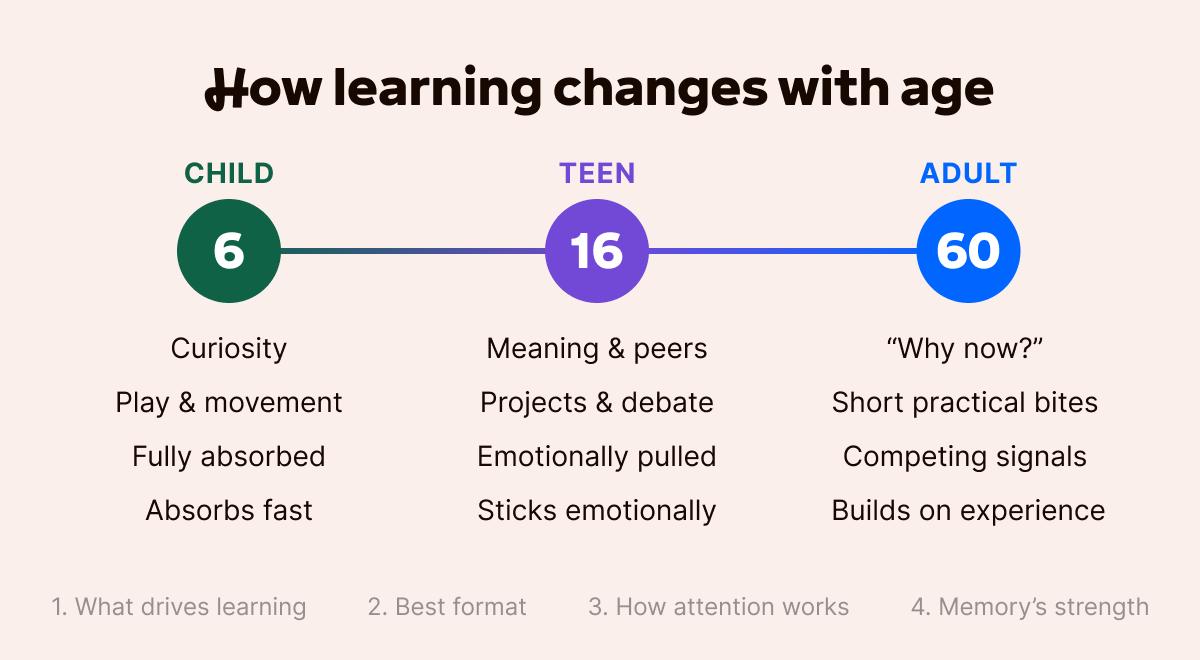
That's why there's no single learning method that works equally well for everyone. Young children learn best through movement and play. Teenagers engage more deeply when learning connects to real life, their peers, or their sense of identity. Adults, on the other hand, tend to learn most effectively when they understand why something matters to them right now.
Our brains never stop learning, not after school, and not after university. What changes with age isn't our ability to learn, but the kinds of learning experiences that work best. Some people thrive on play, others on discussion, and others on short learning sessions squeezed in between meetings. The real question isn't which learning format is "best." It's whether it matches the learner's age, experience, motivation, and everyday reality.
At 6, 16, and 60: How Learning Changes Across the Lifespan
The human brain starts learning at birth — and it never really stops. What does change over time is how it learns. As we grow older, our knowledge and life experience evolve, but so do the things that hold our attention, keep us motivated, and help new information stick.
For young children, learning is first and foremost a way of exploring the world. Jumping into a puddle isn't just play — it's an experiment. What happens if I jump? Why does the water splash? What's hiding at the bottom? Why does mud feel like that?
This is how children investigate almost everything around them. Play, movement, hands-on exploration, and direct experience don't just help them understand new ideas — they connect those ideas to their own actions. That's why most modern approaches to early childhood education emphasize active participation over passive listening.
Adolescence brings another shift. Neuroscientists often describe it as a "second window of opportunity" for brain development. Teenagers become especially responsive to emotion, social interaction, and subjects they genuinely care about.
When learning helps answer questions that matter to them — or gives them the chance to collaborate with friends — their motivation grows dramatically. There's a reason a teenager might forget a maths formula within minutes yet know every lyric to their favorite Taylor Swift song by heart. Project-based learning, debates, and real-world problem solving often resonate far more than traditional lectures during these years.
What Happens When We Grow Up?
There's a persistent myth that once you leave university, your brain gradually loses its ability to learn. Modern neuroscience tells a very different story. The adult brain remains neuroplastic — it can still form new neural connections and acquire new skills throughout life. What changes with age isn't our capacity to learn, but the way we learn best.
In our twenties, we often pick up new information quickly, but we're also more easily distracted and more likely to switch our attention from one thing to another. As we get older, processing speed may slow somewhat.
At the same time, accumulated experience becomes a powerful advantage. We get better at spotting patterns, connecting new ideas to things we already know, and making sense of complex concepts. In other words, younger brains tend to absorb new information faster, while older brains are often better at weaving it into an existing knowledge framework.
Motivation changes, too. Children often learn simply because they're curious. Adults, on the other hand, are much more likely to ask, Why do I need to know this? And that's not a flaw — it's a feature.
Think about the person who puts off taking a personal finance course for years, then finishes it over a single weekend after deciding to start a business. Research consistently shows that adults are more willing to invest time and attention in learning when they see a clear, practical payoff: improving at work, changing careers, solving a real problem, or reaching a personal goal.
That's one reason adult education increasingly relies on short, practical learning modules that can be put to use right away.
Attention works differently as well. Adults are less likely to have the luxury of uninterrupted learning. Work, family, message notifications, and endless to-do lists are all competing for the brain's limited cognitive resources. As a result, the challenge often isn't poorer memory — it's that the brain is trying to process too many competing signals at once.
Research on mind wandering — the tendency for our thoughts to drift away from the task at hand — offers another interesting insight. For years, researchers assumed that older adults were simply less prone to distraction because of age-related changes in the brain. More recent studies paint a more nuanced picture.
Motivation turns out to be a major part of the equation. When people see a learning task as personally meaningful, they stay focused for longer, regardless of age.
Adult learners also benefit from something children simply haven't had time to build: a rich store of experience. New knowledge rarely exists in isolation. The brain is constantly trying to attach it to something it already understands. Imagine a library. Early in life, the shelves are only partly filled, making it easy to find space for a new book. Over the years, the library has grown and become more organized.
Books are sorted by genre, author, and theme. The adult brain works in much the same way. New information doesn't land at random; it quickly finds a place alongside existing knowledge. That's why adults often grasp a difficult concept more easily through examples from work, travel, or everyday life than through abstract definitions alone. When new information fits into an existing mental framework, it's far more likely to stick.
This is where microlearning comes into its own. Its strength isn't just that lessons are short — it's that they fit naturally into adult life. Completing a quick lesson on the train, reviewing material during a lunch break, or revisiting a topic in the evening is often far more realistic than waiting for a free two-hour block that never arrives.
These short learning sessions make it easier to stay consistent, which is especially valuable when learning competes with countless other daily responsibilities. They work best, though, when they're paired with practice, spaced review, and opportunities to apply new knowledge in the real world.



Don't make your brain sit someone else's exam
Instead of trying to learn the way the internet tells you to, look for the approach that actually works for you — or for the child or teenager you're teaching. Age matters, and so does context.
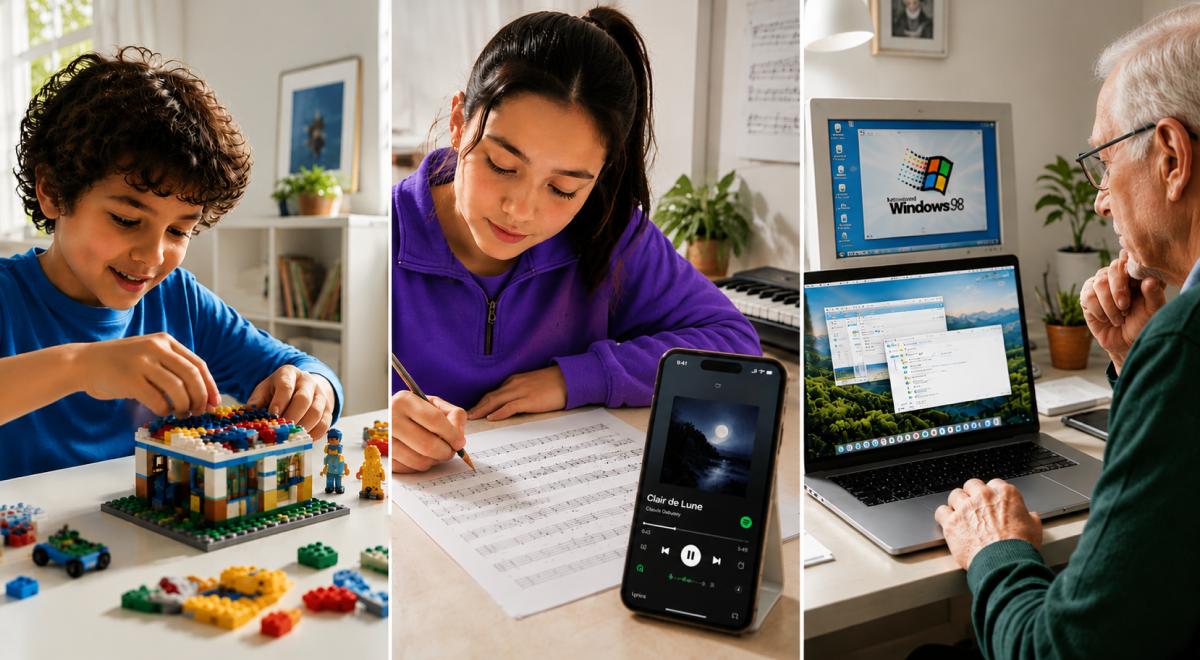
Teaching young children? Add more hands-on interaction.
Explaining fractions? Slice up a pizza. Learning about the planets? Build a solar system out of balls or LEGO bricks. The more children can interact with what they're learning, the more likely those lessons are to stick. For young children, doing isn't a break from learning — it's part of learning.
Teaching teenagers? Start with why.
Teenagers are rarely motivated by "because you have to." They're much more likely to engage when they see how a topic connects to their own lives and interests. Before introducing a new concept, show where it appears in the real world — from TikTok's recommendation algorithm to the technology behind video games.
Learning as an adult? Connect new ideas to what you already know.
New information is easier to remember when it has somewhere familiar to land. Learning about personal finance? Think about how you already manage your household budget. Getting to grips with new software? Compare it to a program you've used before. The brain likes building new knowledge on an existing foundation.
Fit learning into your life — not the other way around.
Not everyone has two uninterrupted hours to study. If your schedule is packed, a quick lesson on the commute or a few pages over your morning coffee will usually beat waiting weeks for the "perfect" moment. Research suggests that regular, bite-sized learning sessions can be just as effective as occasional marathon study sessions — especially when they're combined with practice and review.
Don't copy everyone else.
Your colleague might happily sit through two-hour lectures without losing focus, while you remember far more from several shorter sessions. And that's perfectly fine. Instead of searching for the best study method, experiment until you find the one that still leaves you remembering what you've learned a few days later.
Remember Blu, the macaw from Rio? He spent much of the film worrying that he couldn't fly because he kept comparing himself to everyone else. In the end, he took off only after he stopped trying to live up to other birds' expectations and found his own way.
Learning works much the same way. You don't have to study like your colleague, your friend, or your favorite YouTuber. If a particular approach helps you understand, remember, and come back for more, then you've found the one that works for your brain. And that's the only exam worth passing.