Self-growth
 Apps & Digital Tools
 Business & Career
 Success
 Growth Tools
 Psychology
 Communication
 Relationships

We all do. When chaos hits, your brain defaults to an unhelpful autopilot setting. Real habits of mind are the exact opposite of that knee-jerk reaction. They are the specific, reliable blueprints of behavior that dictate how you handle challenges, look at mistakes, and navigate real-world uncertainty.
Instead of just rushing ahead blindly, these tools give you the mental space to pause, lean into deep critical thinking, and make an intentional move.
Think of these patterns as foundational thinking skills that act like a gym routine for your brain. In the real world, they shape your career, your personal relationships, and your ability to keep growing long after your formal education is done.
But these traits aren't hardwired into your DNA. You can develop them with deliberate practice. That's exactly where an app like Headway steps in: you can unpack the psychology of better decision-making in just 15 minutes a day by digging into ultra-fast summaries of foundational personal growth books, like:
'Atomic Habits' by James Clear
'Frames of Mind' by Howard Gardner
'13 Things Mentally Strong People Don't Do' by Amy Morin
'Keep Moving' by Maggie Smith
'The Mental Toughness Handbook' by Damon Zahariades.
In this straightforward guide, I'll break down what these mental patterns actually are, why they matter outside a school environment, and how to use them every single day to stay sharp and sharp-witted.
📘 Build sharper habits of mind on your lunch break with the Headway app.

Habits of mind: Key takeaways (quick answer)
At their core, these frameworks are simply healthy thinking behaviors. They help you conquer problem-solving bottlenecks, avoid mental fatigue, and make smart, deliberate choices when you don't have all the answers.
Here is the quick layout of the 16 primary patterns:
Persisting: Sticking with a tough challenge until you find an answer.
Managing impulsivity: Forcing yourself to pause before you overreact.
Listening with understanding and empathy: Genuinely trying to see a situation from someone else's point of view.
Thinking flexibly: Changing your mind when new data proves you wrong.
Metacognition: Actively monitoring your own thinking habits.
Striving for accuracy and precision: Double-checking your work and caring about real craftsmanship.
Questioning and posing problems: Asking deep questions instead of accepting things at face value.
Applying past knowledge to new situations: Pulling lessons from past experiences to solve current dilemmas.
Thinking and communicating with clarity and precision: Speaking and writing without confusing fluff.
Gathering data through all senses: Using deep observation to see the full picture.
Creating, imagining, and innovating: Coming up with novel approaches to old blockages.
Responding with wonderment and awe: Staying deeply curious about the world.
Taking responsible risks: Stepping outside your comfort zone without being completely reckless.
Finding humor: Keeping things light-hearted to lower internal stress.
Thinking interdependently: Knowing how to collaborate with a team seamlessly.
Remaining open to continuous learning: Staying humble enough to know you don't know everything.
The real history behind these mindset tools
The whole framework was put together by two well-known researchers, Art Costa and Bena Kallick. They spent years studying how effective problem solvers handle complex issues. They quickly realized that the secret sauce wasn't just raw, unearned IQ scores.
The real differentiator was how intelligent people act when they run into a wall and don't know the answer.
Costa and Kallick realized these behaviors are standard across highly successful people in all walks of life. When their work was brought to light by the Association for Supervision and Curriculum Development, it flipped traditional education on its head.
It proved that real intelligence is about behavior, not just memorization. Think about icons like Albert Einstein — his genius wasn't just a math score; it was his relentless curiosity and willingness to challenge standard assumptions.
To keep things simple, let's look at how these three concepts actually separate:
Mindset: Your foundational belief system. For instance, knowing you can grow.
Habits: The automatic, routine actions you take every day.
Dispositions (habits of mind): The underlying thinking patterns that dictate how you choose to respond to a brand-new problem.
Put simply: your mindset shapes your beliefs, your habits shape your physical actions, and your habits of mind shape your underlying thoughts.
Navigating life's unexpected curves
These patterns are reliable, go-to thinking strategies you deploy whenever you hit an unexpected wall, a confusing project, or a massive life transition.
They help you slow down your racing mind, avoid simple blind spots, and run a better problem-solving strategy when everything feels completely up in the air.
Deep dive into the 16 habits of mind
When Arthur L. Costa and his research partner mapped out these 16 patterns, they gave us a clear window into how effective thinkers operate. Let's break down exactly how these traits show up when you're testing your own limits:

1. Better decision-making
This is your basic grit. It means you don't throw your hands up the second a task gets frustrating. You keep pushing forward, trying different angles until something finally clicks.
2. Stronger resilience
This is your basic self-control filter. Instead of snapping at a colleague or making a wild financial bet on a whim, you manage your impulsivity, breathe through the initial urge, and make a calculated move instead.
3. Better relationships
This means you actually shut up and listen to someone instead of just waiting for your turn to speak. You try to feel the weight of their situation and read between the lines.
4. Lifelong learning
When you are thinking flexibly, you don't stay wedded to an old idea just because it's comfortable. You shift your perspective when the facts change. It's like using associative learning or lateral thinking strategies popularized by theorists like De Bono to spot completely invisible options.
5. Personal growth
This is your brain running a background check on itself. You stop and analyze your own thoughts to see where your personal biases might be messing with your logic. It's the ultimate tool to protect your mental baseline. Also, taking a quick learning quiz can help you find out which strategies work best for your personal growth.
6. Striving for accuracy and precision
This means you actually take pride in what you build. You don't just rush to get a project off your plate. You review the fine details because real quality matters to you.
7. Questioning and posing problems
Instead of just swallowing whatever information is handed to you, you get comfortable posing problems and digging deeper. You ask, "How do we know this works?" to find the real truth.
8. Applying past knowledge to new situations
You treat your memory like a practical library. When you walk into completely new situations, you look back at your past knowledge to see what worked before, saving yourself from repeating old blunders.
📘 Stop overreacting to stress and start thinking smarter with Headway today.



9. Thinking and communicating with clarity and precision
You speak and write without hiding behind massive corporate buzzwords. You make your points cleanly, so there's zero room for misinterpretation.
10. Gathering data through all senses
You don't just skim the surface of a situation. You practice gathering data by listening closely, looking at visual cues, and paying attention to the real-world environment around you.

11. Creating, imagining, and innovating
You refuse to do things a certain way just because "that's how we've always done it." You play with concepts, sketch out wild ideas, and find unexpected shortcuts.
12. Responding with wonderment and awe
You keep that childhood spark alive. You look at complex systems, art, or technology with genuine wonderment and a desire to understand the hidden gears behind them.
13. Taking responsible risks
You accept that real growth requires some risk-taking. You step out of your safe bubble and take calculated, responsible risks because you know that playing it safe forever leads straight to stagnation.
14. Finding humor
You don't take yourself too seriously. When a project completely crashes, you find a way to laugh about the absurdity of the situation, which immediately breaks the stress cycle.
15. Thinking interdependently
You recognize that you aren't an island. You get comfortable thinking interdependently, checking your ego at the door, and pulling together with a group to build something bigger than yourself.
16. Remaining open to continuous learning
You accept that you are a permanent work in progress. You look at every single day as a chance for continuous learning, always staying hungry for new information.
The massive impact of rewiring your thinking
While these ideas get thrown around a lot in classroom lesson planning, their real value shows up when you are dealing with everyday adult chaos. They have massive positive effects on your career, your mental sanity, and your path to self-improvement.
When you intentionally build these patterns, you stop making messy, reactive choices. You develop the core emotional resilience needed to view a sudden career curveball as a series of fresh learning opportunities. You start learning continuously from your environment, meaning your brain never goes stagnant.
Our minds naturally try to protect us by taking shortcuts, but this often leads to cognitive glitches like deletions of important data, weird mental distortions, or sweeping overgeneralizations about our abilities.
If you catch yourself falling into a rut and blindly assume "I can never get this right," these 16 habits step in to correct the course. They force you to look at the cold data and say, "I can absolutely learn this framework if I change my approach."
📘 Get the ultimate blueprints for mental toughness in 15 minutes on Headway!
Seven actionable strategies for real-world growth
You don't need a lifestyle overhaul to build these patterns. Tiny, daily habits can completely rewire your brain over time.
Morning reflection: Pick one token habit to anchor your morning, like flexible thinking or deep listening.
Keep a quick challenge log: Jot down one messy situation from your day and look honestly at how you reacted to it.
Take intentional pauses: Forcing a simple five-second gap before responding to a stressful email fixes poor impulse control fast. Practice mindfulness more often.
Flip your questions: Swap out self-pitying thoughts for curious ones. Ask "What is this situation trying to teach me?"
Treat mistakes like data: Stop looking at a blunder as a personal failure. Treat it as cold feedback to adjust your strategy.
Run a weekly review: Take 10 minutes on Sunday to look at your behavioral trends. Ask yourself what worked and what went sideways.
Keep reading daily: Feed your brain a steady diet of new ideas to keep your curiosity alive and kicking.
Making this dynamic framework stick
Integrating these principles into a chaotic schedule is incredibly easy when you pair them with a quick microlearning routine.
The morning setup (10 Mins): Pop open the 'Atomic Habits' summary while you brew your coffee. James Clear explains how tiny daily routines compound into massive identity shifts. Pick one mental pattern to focus on before your inbox fills up.
The mid-day reset (5 Mins): During a quick lunch break, check out the summary for 'Frames of Mind.' Howard Gardner and his breakdown of multiple intelligences serve as an immediate reminder to practice thinking flexibly when dealing with stubborn clients or teammates.
The afternoon energy boost: When your focus hits a wall around 3 pm, spend a few minutes with '13 Things Mentally Strong People Don't Do' by Amy Morin. It delivers a brutal, helpful reality check that reinforces your determination and emotional control right when you want to check out.
The evening wrap-up (10 Mins): End your day by reflecting on your progress while listening to summaries of 'Keep Moving' by Maggie Smith or 'The Mental Toughness Handbook' by Damon Zahariades. Ask yourself what challenges you faced, which habits you deployed, and where you can tighten up your execution tomorrow.
Smart adjustments for better habits
Treating them like a checklist: These aren't chores to tick off your whiteboard. They are long-term mental pathways that require lifelong practice.
Trying to master all 16 at once: You will fry your brain. Pick one or two patterns to test out this week, build the muscle, and then layer on the rest.
Skipping the reflection part: If you don't actively look back at your behavior, you will never break your old patterns. Self-reflection is the actual engine of growth.
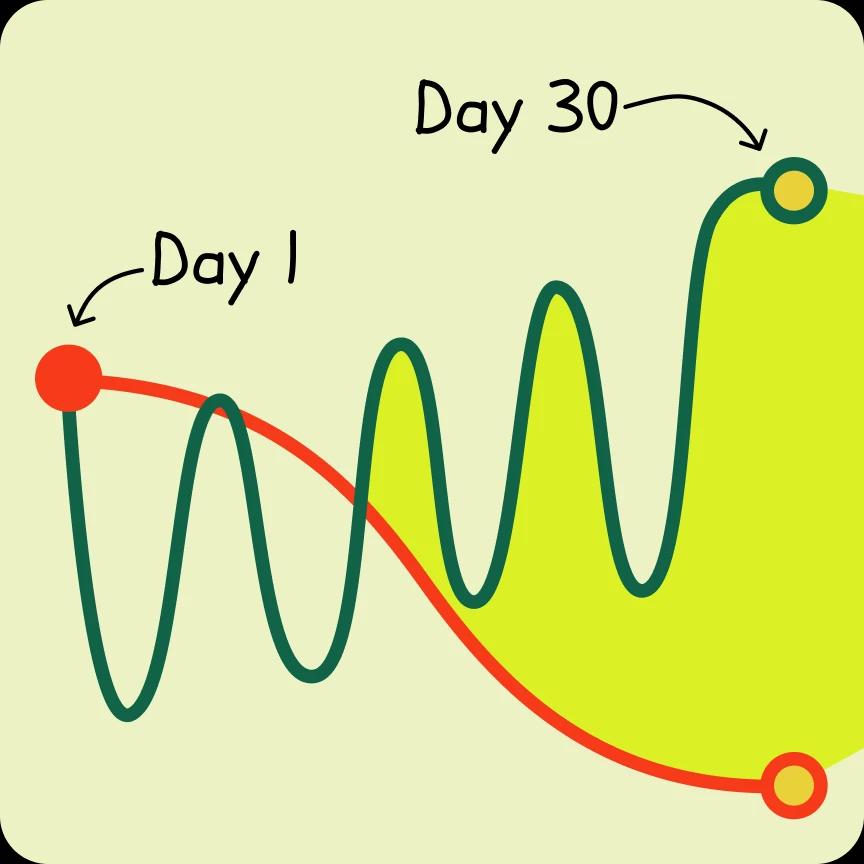
See how far consistent learning can take you.
Get actionable insights from your very first 15-minute summary.
Get the planUpgrade your brain and reclaim your mental edge today with Headway!
At the end of the day, your quality of life comes down to how you think when things get difficult. These 16 patterns aren't fixed personality traits: they are practical skills you can sharpen every single afternoon. By choosing curiosity over frustration and intent over impulse, you set yourself up to thrive no matter what the world throws at you.
If you want to speed up the process, Headway takes the heavy lifting out of personal growth. Summaries of world-class books give you the exact frameworks you need to make better decisions, protect your energy, and build a mind that works for you instead of against you.
📘 Build a smarter, sharper brain baseline by trying the Headway app today.
FAQs about the habits of mind
What are the habits of mind?
There are 16 different types of mental habits that we can use when dealing with new or difficult problems. The researchers Costa and Kallick created these habits not so much because they focus on memorizing things or memorizing tricks, but rather because they tell us how to behave, speak, or make decisions when we truly don't know what to do in a specific situation.
How do habits of mind help you succeed?
Because mental habits allow us to remain calm when things go wrong, they help us make better decisions about how to act. They help us avoid making emotional, rushed decisions under stress by teaching us to think analytically about our past mistakes and to cooperate with others. In the long run, using mental habits will help make better career and day-to-day decisions.
Can habits of mind be learned?
Absolutely! Mental habits or habits of mind are not magic; they are just ways of thinking that we can learn to strengthen through practice. By becoming aware of your blind spots, slowing down before acting on your initial reactions, and exposing your brain to personal growth books, you can totally change the way that you think over time.
What are 7 bad habits for your brain?
Reacting impulsively to situations without considering the possible consequences; being overly critical or negative when thinking about oneself; avoiding challenges that could provide you with an opportunity to learn; neglecting to consider feedback provided by others; attempting to perform multiple tasks simultaneously; not taking time each day to reflect upon experiences; and quitting projects immediately when they become difficult.
What are 7 healthy habits for the brain?
Remaining sincerely interested in everything; completing your work thoroughly and accurately before submitting it; demonstrating empathy for others when communicating with them; taking time to evaluate your thoughts and reasoning; exploring innovative methods of accomplishing tasks; taking calculated risks when pursuing goals; and making time daily to read summaries of books. These positive choices will help you maintain clarity of focus while continuing to expand your intellectual capacity.