Self-growth
 Business & Career
 Success
 Communication
 Healing
 Relationships
 Psychology
 Happiness
Why do so many relationships crumble when flowers start blooming? Relationship experts like Sue Johnson, author of 'Hold Me Tight,' and Esther Perel, who wrote 'Mating in Captivity,' have explored how seasonal shifts can strain even strong partnerships. March theory explains this spring breakup phenomenon and offers hope.
This article explores the foundation of the March theory, explains why romantic relationships often fall apart during this month, and offers practical tips from top love and relationship books summarized on the Headway app.
Try Headway as your practical guide to ensure your valued relationships last throughout the year!
Quick insights on March theory and spring breakups:
Understand why March triggers a relationship reboot
Learn how cuffing season transitions create a breakup pattern
Discover behaviors that lead to premature endings
Apply organizational learning concepts to romantic decisions
Keep reading for a more detailed trend overview (and its impact on your love life and sexual health)!

What is March theory? The TikTok phenomenon that explains spring breakups
March theory is the viral concept suggesting romantic relationships are most likely to end during the month of March. What started as a TikTok trend has resonated with millions because it reflects real patterns people observe in their love life and social circles.
The theory connects several seasonal and psychological factors. As winter's cuffing season ends and warmer weather arrives, people crave new beginnings and fresh starts. The longer daylight hours improve mood and spark desire for renewal in both households and relationships.
From viral trend to cultural reality: Why March theory resonates
Content creator Chiara King and countless others have shared their March breakup stories across social media, making the theory explode on For You Pages (FYP).
While it may seem like just another trend alongside astrology predictions or retrograde warnings, the pattern reflects deeper truths about human behavior.
So, it's essential that you discern whether a new relationship is based on genuine affection or is simply a case of being love-bombed by a player.
Shakespeare's warning to "Beware the Ides of March" and the old saying that "in spring, a young person's fancy turns to love" have long connected this month of the year to romantic turbulence.
Science supports this seasonal shift. Longer days, abundant sunshine, and the return of warm weather create biological changes that make us reevaluate our circumstances.
At this time, we feel energized to pursue a new life, find a new partner, or simply escape relationships that feel stagnant.
In fact, to understand the desire for new horizons and novel experiences better, read our summary of 'The Molecule of More' by Daniel Lieberman and Michael E. Long.
The post-Valentine's Day reality check
Valentine's Day creates artificial pressure to present perfect relationships on social media. When February 14th passes and March arrives, couples often face reality.
Long-term relationships that survived winter through comfort and routine suddenly feel confining as opportunities for new relationships and fresh experiences emerge.
The transition from cuffing season — when people couple up for winter warmth and companionship — to the month of March creates a natural checkpoint.
Partners who were "good enough" during cold, dark months may not feel right when spring promises renewal and possibility.
The psychology behind the March theory: Why spring triggers breakups
The March theory not only found life on TikTok and other social media sites, but also a March theory posited by James G. March as a framework for understanding how decision-making occurs in organizations and institutions.
It accounts for the messiness in the process and considers unique factors that are relevant to personal relationships, too.
Bounded rationality: Making breakup decisions with clouded judgment
Winter keeps people stuck inside with their partners and, over time, cute idiosyncrasies can become unbearable irritants.
And as winter ends, couples may assess their relationships based on these kinds of things rather than on perfect logic, leading to springtime breakups.
If you’re on the fence about giving in to the March theory prediction and ending a relationship, there might be some useful wisdom shared by Esther Perel in our summary of 'Mating in Captivity.'
Organizational learning: When March theory becomes self-fulfilling
Over time, people also engage in a form of organizational learning within their relationships.
Past relationship patterns, seasonal cues, and social narratives (like the March theory itself) inform future choices, and the March theory can become a self-fulfilling prophecy.
March has become a symbolic checkpoint, and people apply prior learning to make new decisions that can reflect the expectation that March signals a breakup.
Satisficing behavior: Settling for "good enough" endings
Satisficing behavior refers to the choices and actions we take to achieve a “good enough” outcome. Rather than acting with planning or intention, we just make a choice that seems okay or enough at the time.
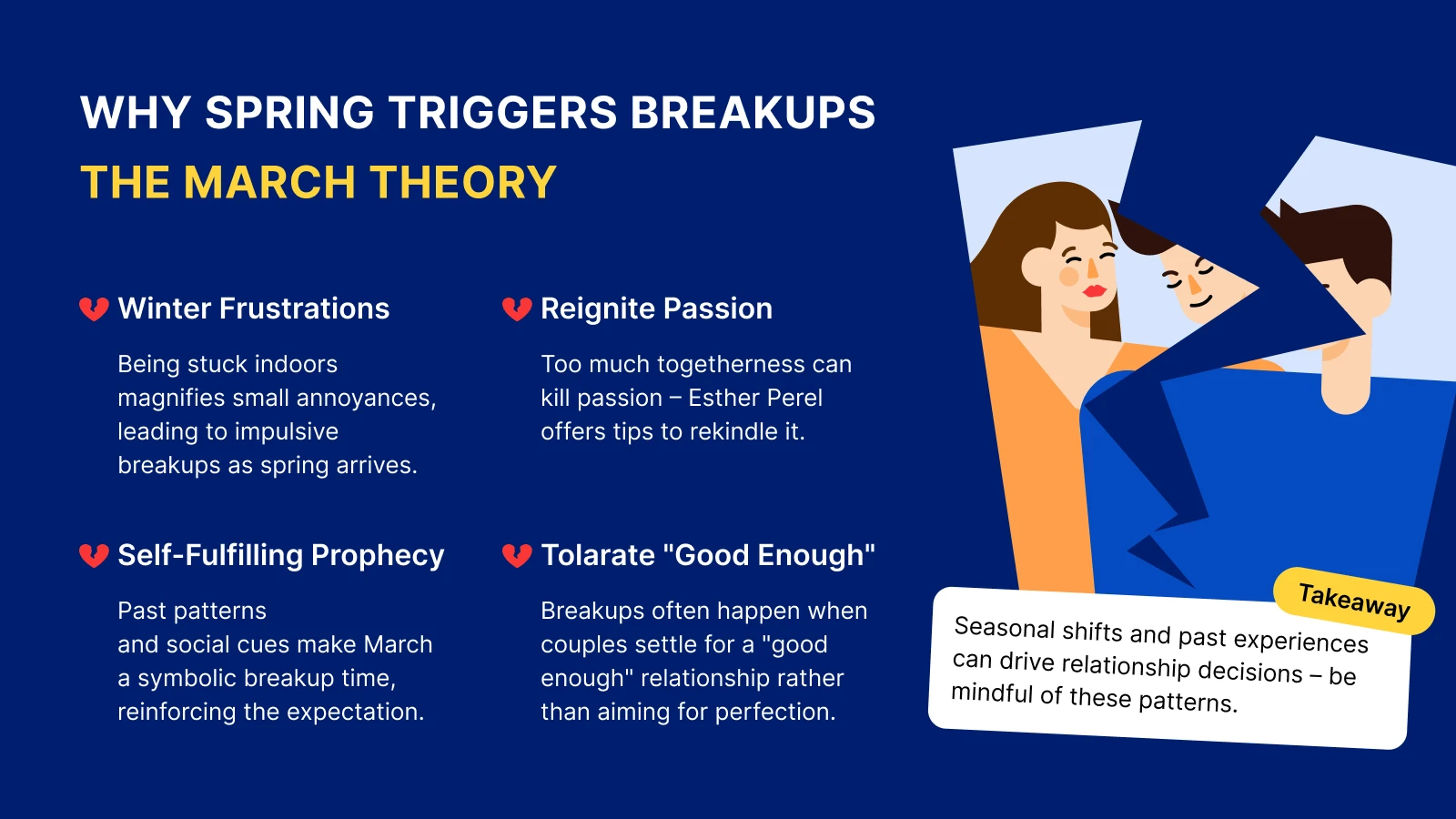
It explains the decision to end a less-than-perfect relationship even when the future is uncertain. A book summary that might help you avoid settling is 'How to Be an Adult in Relationships.'
Beyond romance: How March theory applies to all life transitions
March theory isn't just about breakups — it reflects broader patterns of reassessment and renewal that affect multiple life areas during early spring.
1. Career shake-up
You might be surprised to learn how March theory applies to more than just relationships. The themes of transition and reassessment are reflected in how organizations typically operate during early spring.
Just as couples are reassessing relationships, organizations may use this time to move on from outdated practices and embrace innovation, driven by both internal reflection and external pressures.
By making sure you and your partner are on the same page, you might be able to salvage your relationship if it’s worth saving.
Michael Todd wrote a great book, 'Relationships Goals,' that may be the blueprint you need to counteract relationship blues. After all, it’s easier to find relationship satisfaction when your relationship goals are the same. You can read the summary on the Headway app.
2. Personal development
While we make New Year’s resolutions at the end of the year, many of us see spring as a time when we’re ready for self-renewal, personal overhauls, and spring cleaning.
The month of March is very much a catalyst for personal growth and career shifts. The seasonal change brings renewed energy and clarity, and we feel ready to reevaluate our goals, habits, and relationships.
Why March theory isn't perfect: Key limitations
Even though March theory resonates emotionally and anecdotally, it's important to acknowledge its limitations and critiques.
The lack of empirical evidence
There is little scientific data that March is officially a breakup month. Besides, many critics question the role of the original theory — James G. March's Garbage Can Model in particular. It often sounds too broad and irrelevant to organizations and formal cultures of modern work.
Additionally, the model's random and ambiguous nature challenges its practical value as a decision-making tool.
Overgeneralization
At its core, March theory — both in romantic and organizational contexts — relies heavily on the concepts of bounded rationality and satisficing behavior. It means that people and institutions make decisions based on limited information and settle for "good enough" outcomes.
Although this may mirror real-world constraints, it also impacts the theory's capacity to address more intentional and strategic decision-making.
The theory also, in many ways, generalizes human actions across contexts, dismissing cultural, economic, and psychological variance in how and when you decide to alter your life.
Beating March theory: How to save your relationship in spring
If you can identify troubling behavior patterns in your current relationship, you’re not necessarily doomed. Furthermore, being able to recognize these patterns opens new ways for intentional action.

1. Communicate before you contemplate breaking up
When feelings of unrest emerge at winter’s end, that's a signal to do relationship work together — not necessarily to end things. Acknowledging dissatisfaction can lead to deepening connections rather than severing them.
Sue Johnson's 'Hold Me Tight' provides attachment-based strategies for couples facing disconnection. The book helps partners understand their emotional needs and communicate them effectively, even during transitional periods like spring. Dig deeper into our summary on the Headway app.
Make sure you and your partner are on the same page about goals, needs, and concerns. An honest conversation helps you decide whether March restlessness is a sign of incompatibility or simply the plea for attention and effort.
2. Practice agape love: Focus on partnership over self
Agape love is altruistic and unconditional love that encourages transparency and support while expecting nothing in return. From the perspective of March theory, it focuses on the needs of your partner and how you can serve them, along with choices that serve you.
This doesn't mean ignoring red flags or staying in unhealthy situations. It means approaching spring's renewal energy with curiosity about how you can grow together rather than assuming you need to grow apart.
Master your relationship timeline with Headway book summaries
March theory reminds us that change is natural. And sometimes, the season really does illuminate what your heart needs before you consciously recognize it. However, with the right tools and resources, you can easily dodge breakup fever and make your love flourish.

The Headway app is here to help you with exactly that. It offers concise summaries of books that go deeper into the mechanics of relationships and personal development. You can also learn how to improve your communication skills, speak confidently, and express your feelings without fear.
Download the Headway app today and turn big ideas into daily habits!
Frequently asked questions about the March theory
Why do breakups happen in March?
Breakups are more likely to happen in March for a couple of reasons. One is that we may believe that we’re supposed to break up with partners in March based on “folklore” or “TikTok truths.” Another reason stems from the urge for renewal and personal development in springtime when new growth appears all around us. We crave new beginnings and something novel rather than sticking with what we’ve grown used to.
Is the March theory true?
March theory can be a self-fulfilling prophecy. If we believe we’ll be breaking up with a partner in March, we may find ourselves doing that. However, the longer days, more abundant sunshine, and the return of warm weather also urge us to get outside and jump back into life. This can lead us to reevaluate our relationships.
How can the March theory be applied?
People often recognize that when the seasons are changing, our interests and motivations also change. If a person wants to maintain their relationship but feels stirrings of unrest as winter ends, it can be a sign that they might need to do some work together to prepare for the next stage of their relationship. Acknowledging feelings of dissatisfaction can lead them to deepen their relationship rather than ending it.
What is the March theory in psychology?
In psychology, March Theory refers to the concept that spring is a time of renewed desire for recommitment and self-growth. This can create substantial transitions in personal relationships, especially romantic ones, resulting in breakups. When used to describe organizational decision-making, it encompasses all of the unpredictable and uncontrollable factors that influence and constrain decision-making, including bounded rationality, satisficing, and organizational learning.
What is the April theory?
April Theory is essentially March Theory's sequel, suggesting that relationships surviving March's breakup season face another testing period in April. As spring fully arrives and social calendars fill with events, couples evaluate whether they want to bring their partner into their new life or continue solo. It's the "second wave" of spring’s relationship reassessment.
What is "agape" love?
Agape love is a selfless and unconditional love that encourages openness and support to others while expecting nothing in return. Seen through the lens of March theory, it encourages a person to focus on the needs of their partner, along with choices that serve both sides.