Self-growth
 Business & Career
 Success
 Communication
 Healing
 Relationships
 Psychology
 Happiness
Leila and Reza have been together for a decade. Although the honeymoon phase of their relationship has long passed, they have managed to deepen their connection over time by being intentional about the quality time they spend together despite their hectic schedules.
Like many other couples, their relationship has had its ups and downs, but one thing sets them apart from most couples who've been together this long. Leila and Reza have chosen to live apart together, and their relationship has never been stronger.
Living apart together (LAT) refers to two people in a committed relationship who choose to live in separate residences. While many couples still choose to live together, more are choosing to live apart together for a variety of reasons, including a desire for more independence, career mobility, financial considerations, and the need for adequate space for remote work.
If you enjoy exploring relationship ideas but don't always have time for long books, the Headway app can help you grow. It offers short, practical reviews of relationship and psychology books that help couples think through big decisions, like living apart, and have more honest and productive conversations about them.
📘 Explore modern relationship options — get Headway.
Quick summary: Living apart together – what it means for your marriage and family life
Living apart together describes a committed couple who choose to live in separate homes while remaining emotionally connected.
The arrangement appeals to some couples by offering more personal freedom, less friction over household responsibilities, and more energy to focus on the relationship.
Separate homes might not be the right choice for every couple due to the financial, logistical, and emotional challenges that may occur.
Like any important decision a couple makes together, LAT's success depends on both partners setting clear boundaries, cultivating intentional communication, and discussing whether their goals are aligned.
Couples with the most success often approach LAT as an intentional decision, rather than an attempt to avoid their problems. Those who reap the most benefits from separate homes prioritize strengthening their connection through shared rituals and spending meaningful quality time together.



What is living apart together?
Living apart together (LAT) describes a couple in a committed relationship who choose to live in separate homes. While some researchers define these relationships as "unmarried," others consider married couples who don't cohabitate as LAT.
Two homes, one home model
Some couples use a "two homes, one home" model, which involves living in a home that has two separate living units. But LAT couples maintain completely separate properties rather than shared space with divided units.
Long-distance couples
Although long-distance couples and those practicing living apart together may appear similar on the surface, the key difference is choice versus necessity. Long-distance couples often need to live farther apart due to circumstances beyond their control, such as work, school, or caring for family members in a different state. They're typically doing so out of necessity, not because they prefer living or working in a different state from their partner.
Additionally, long-distance couples usually have a timeline for when they can live together or get closer, while LAT couples choose the arrangement indefinitely unless they decide to change later.
Couples who choose separate homes typically base the decision on their shared relationship values and desired lifestyle. They may live close by or farther apart, but their reasons for making this decision often differ from those of long-distance couples.
Living apart together is relevant now more than ever, as modern relationships have shifted the narrative away from a "one size fits all" traditional relationship model, and more couples are opting for a different path. This growing trend represents a shift in how we view partnerships and what makes a romantic relationship work in today's world. Additionally, with the rise of remote and hybrid (in-office and remote) work, more couples are seeking living arrangements that provide adequate office space and privacy to focus on work.
📘 Redefine your relationship rules — download Headway.
Why more couples are choosing LAT
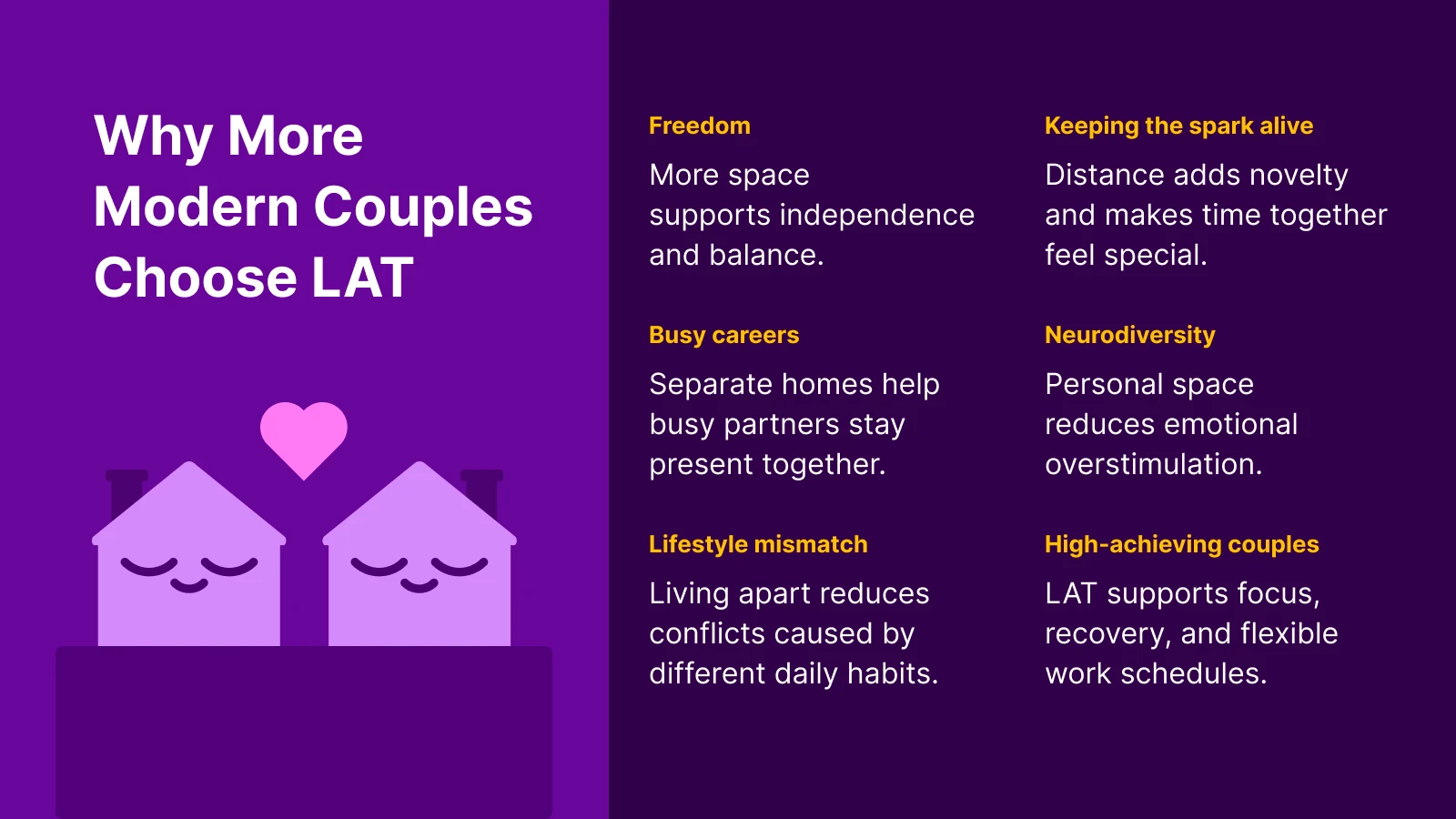
According to 2021 Census data, there are 3.89 million married couples living separately in the US alone. Research by relationship expert Vicki Larson, author of 'LATitude,' shows that this demographic spans young professionals to older people, with older women particularly embracing this type of relationship. Couples often choose LAT for a variety of reasons, including increased autonomy, busy careers, mismatched lifestyles, and a mutual desire to keep the spark alive.
Freedom
One potential benefit of living apart together is having more space and time to explore passions, interests, and hobbies outside the relationship. A healthy amount of space can help each partner maintain their own identity and provide a sense of balance that brings them closer together, rather than further apart.
For many in a LAT relationship, having their own space and own place means they get essential alone time to recharge.
Busy careers
Living apart together can be beneficial for couples with busy careers that require long hours or frequent travel, as the arrangement can help them feel more present when spending time together outside of work.
LAT also reduces friction for couples working remotely. After the pandemic, many companies switched to hybrid or full-time remote work. As a result, the shift created challenges for couples living in condos or homes without adequate office space for both partners to work and concentrate on their daily tasks.
Lifestyle mismatch
Living apart together can reduce stress and arguments that occur from mismatched lifestyles. Some couples are compatible in many areas, but they differ in how they approach daily tasks when living together. For example, a common argument that arises between cohabiting couples relates to the division of household chores and responsibilities. Other couples have mismatched sleep styles: one person stays up late while the other is a light sleeper who wants to go to bed early.
Keeping the spark alive
Some couples find that living apart together motivates them to be more intentional about their quality time together and strengthens intimacy as separate homes introduce a sense of novelty back into the relationship. Couples living apart may notice that they experience more excitement at the thought of seeing their partner, since it's not a daily occurrence, and subsequently have more energy for new activities and date nights together.

LAT particularly benefits neurodiverse and career-driven couples.
Neurodiversity
Living with another person who has a different schedule and habits may feel distracting and contribute to neurodiverse individuals feeling overstimulated.
Career-driven and high-performers
LAT supports career-driven couples who dedicate a lot of time and energy to work, or who travel frequently for work, so they can recharge in their own living space and spend quality time with their partner in a way that works for both of their schedules.
"Is it just avoiding problems?" myth-busting
A misconception about living apart together, which often occurs, is that couples choose to live apart just to avoid their problems and each other. While this can certainly happen, couples who live together can also engage in avoidance of their problems.
Avoidance of relationship problems isn't tied to a couple's living situation, but rather their communication styles. Couples who decide on LAT often reach the decision through intentional communication and in-depth conversations about their relationship goals and values, which is the opposite of avoidance and emotional suppression.
The benefits of living apart together
Work and lifestyle preference
Some couples reach an impasse if one partner wants to live close to work to avoid a long commute, while the other desires to stay in a different neighborhood. Other couples are drawn to various lifestyles, like one partner prefers the city while the other wants the suburbs.
In these cases, living apart together can work for the couple, as they can both get what they want, reducing resentment and preserving their energy to be present with one another when they spend time together. Some couples discover that shared living in one home means compromising on what each person needs from their living space.
Financial considerations
Some couples find that cohabiting and combining finances leads to frequent tension or arguments about each other's spending habits. Living apart together provides each partner with the opportunity to focus on their own spending habits and can reduce arguments about finances.
While moving in together may be a wise financial decision for some couples, for others, cohabitation might actually increase their cost of living, depending on the city and the current rental or mortgage cost for each partner. In some cases, moving into a larger space together may end up costing the couple more than separate residences would.
Fewer roommate arguments
When a couple moves in together and becomes comfortable with one another, they may fall into an overfunctioning or underfunctioning dynamic in which one partner naturally takes on the role of overfunctioning.
Overfunctioning in a relationship refers to taking on the bulk of household responsibilities and planning, while the other partner often defaults to taking on an underfunctioning role. The pattern amplifies tension and resentment for each partner as both become further entrenched in their respective roles.
Living apart together may help disrupt this pattern through each person living in their own residence and choosing the level of cleanliness and approach to daily tasks that works best for them.
When the pressure of navigating domestic tasks together lifts, resentment may wane and create space for the couple to spend intentional time together without worrying about or keeping track of who is doing the dishes, cleaning the kitchen, or taking out the trash.
Arguments about who left dishes in the living room or whose turn it is to clean can build ongoing tension. In traditional cohabitation, these daily friction points add up.
Living apart together also helps couples who have different sleeping styles and preferences. If one partner is a light sleeper and the other snores loudly or sleeps very late, the mismatch can be disruptive to the other partner and, over time, lead to resentment.
While there are potential solutions to this issue, if a couple finds that they've exhausted other options and cannot comfortably sleep in the same bed, living apart together may be a helpful solution to consider.
Keeping the spark alive
Our brains are hardwired to become adapted to exciting changes that occur over time, with research demonstrating that happiness levels usually revert to baseline after enough time has passed since the change occurred. What this means is that most of us are prone to taking pretty much everything in our lives for granted, including our relationships.
During the initial stages of a relationship, couples often have new experiences together, go on fun dates, and experience a heightened level of attraction to one another. As the relationship progresses and moves past the honeymoon phase, the initial excitement that often occurs early on begins to subside.
Living together can have many benefits, but one drawback is that couples can get caught up in their routines and begin to take each other for granted. Since our brains are hardwired to pay attention to novel stimuli, choosing to live apart together may help couples counteract the tendency to take their relationship for granted and bring some novelty back into their relationship by helping them become more intentional about the quality time they spend together, since they know they won't be seeing each other on a daily basis.
📘 Keep your spark alive intentionally — get Headway.
For busy professionals, neurodiverse, and high-mobility couples
Living apart together also appeals to busy professionals who have limited time due to long hours or travel often due to work, as the arrangement can help them feel a sense of renewed energy when they're together with their partner after having time to recharge or decompress on their own.
Neurodiverse individuals may find the experience of living with a partner who has a different routine distracting and disruptive to their focus and concentration. Living apart together benefits neurodiverse individuals who need limited distractions and want to maintain a routine that works for them in their individual living space.
What this looks like in practice
When Sam and Rachel lived together for a year, they often argued about whether to hire a cleaning service, and dividing up their chores was a frequent point of contention between them. Sam preferred to take care of chores daily, while Rachel preferred to take care of them in larger chunks of time spread out during the week. They both worked long hours during the week with opposing schedules in their respective fields, and as a result, often had limited energy at the end of their workday.
Now that they are living apart together, Sam and Rachel have decided how to approach their chores in a way that suits each of them in their own environment. Rachel decided to hire a weekly cleaning service, while Sam takes care of his chores a little bit each day in a way that fits his energy level and schedule.
Living apart together reduced the resentment that had been building between Sam and Rachel, and they've both noticed that when they spend time together, they argue less and feel closer to each other than before.

Can’t map out your relationship journey?
Discover more insights on relationships and get personalized tips to navigate it.
Define nowThe challenges and what to watch out for
Logistical and financial (two homes, scheduling, and travel)
For many couples, moving in together is a smart financial decision rather than separately paying rent or a mortgage. If a couple decides to live apart together, a potential challenge is the cost of each partner paying for housing separately, and, depending on where the two homes are located, travel time between them can also significantly impact finances over time.
Emotional and social: Risk of drift, jealousy, external pressure, and judgment
Although living apart together is a decision many couples have made over the years, there are still many people, including family members, friends, or even colleagues, who may judge this decision and, as a result, make inaccurate assumptions about the couple.
Without open and clear communication, jealousy and emotional distance may occur between a couple practicing to live apart together. The risk of drifting apart increases if a couple isn't prioritizing staying connected with their partner and spending quality time together. For LAT to succeed, both partners must be on the same page and engage in consistent communication, including check-ins on how the process is going.
Fit check: Who it's not suited for (lack of communication and strong desire for shared daily routines)
Living apart together may not suit couples who have children, as it may cause additional stress to navigate childcare activities separately and can also cause significant disruption to the children, depending on their developmental stage.
For couples who are struggling with emotional distance or are currently having communication difficulties, LAT may worsen these issues unless the relationship is on solid ground, since in-depth conversations about expectations and boundaries are needed for LAT to work.
Living apart together is unlikely to be a suitable choice for couples who want to spend time together daily and have a strong desire to share daily routines and responsibilities, as it may lead to resentment over time.
For couples already struggling with communication issues or those recovering from a near breakup, LAT requires the kind of solid foundation that makes any relationship work.
Is LAT right for you?
1. If you have children or pets, have you considered how this living arrangement would impact them, and have you considered alternative options?
For example, some couples with children or pets may choose to keep them in the same home, while each partner switches homes to maintain a stable environment.
When LAT isn't suitable, having two separate bedrooms may be an alternative that provides a space to sleep uninterrupted if sleeping styles are mismatched, work remotely with privacy, or focus on hobbies and interests outside of the relationship, depending on your motivation for wanting separate space.
Consider whether any of these alternative options would be suitable for your relationship moving forward.
2. What are some financial considerations to keep in mind if you make the decision to LAT?
Can both of you afford to live separately and be responsible for your own rent and mortgage costs? If not, how will you divide the bills?
3. Are you clear on your own intentions and motivation for living apart together?
4. Have you had an in-depth conversation with your partner about both of your intentions and reasons for choosing LAT, and which boundaries are needed?
Do you feel that both of you are on the same page or that one of you is hesitant about taking this step?
5. What are the potential benefits of choosing to live apart together for you and your partner?
6. What are the potential drawbacks of choosing to live apart together for you and your partner?
7. How will you know whether this relationship model is working for you and your partner?
8. How will you know whether this relationship model is not working for you and your partner?
📘 Make confident relationship decisions — download Headway.
How to make living apart together work — step-by-step
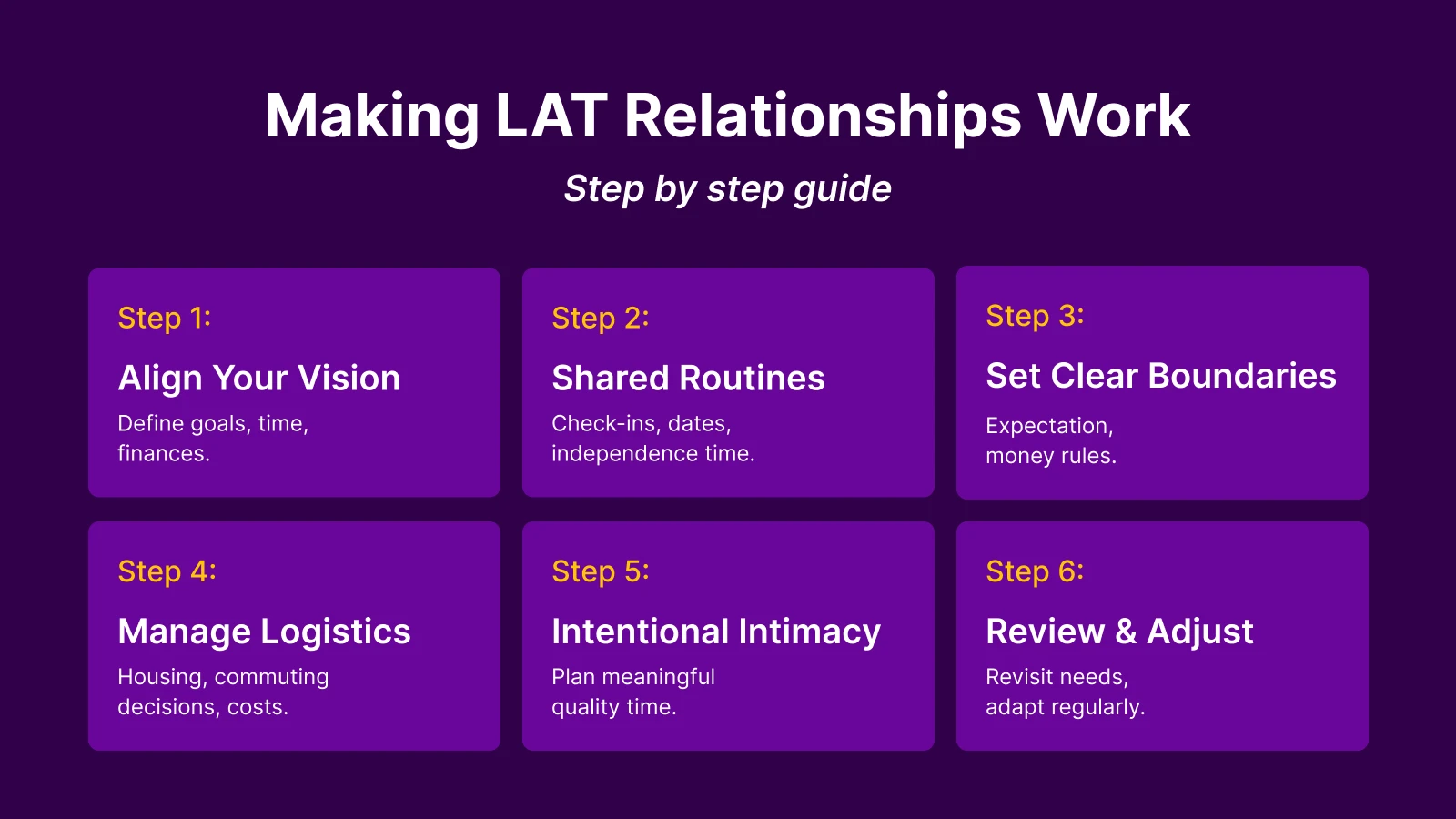
Step 1: Set the vision together — What does living apart together mean for both of you?
Consider what your relationship goals are and how often you would like to see each other during the week. Discuss financial considerations for living apart and whether you will combine or separate finances, or keep some finances combined while separating other finances. A successful live apart together relationship starts with both partners understanding what LAT couples do to stay connected despite separate places.
Step 2: Define routines and rituals — consistent check-ins, date nights, social time, and independence time.
For LAT to work, each couple must have trust and open communication, which includes consistent check-ins to evaluate how each partner feels about the arrangement, what's working, and what isn't. Discuss how you'd like to spend your date nights and quality time together. Consider how social time with mutual friends fits into quality time. Some LAT partners enjoy occasional sleepovers at each other's own homes to keep romance alive.
Step 3: Communication and boundaries — expectations, emergencies, finances, and house guest rules. Use tips from therapists.
It is important to discuss expectations around finances, communication, and boundaries before taking this step together as a couple.
Consider the following questions:
If you decided in step 1 how to divide your finances, now is the time to fine-tune the plan and consider whether any large purchases above a certain amount should be discussed together first.
What are each of your expectations for communication while living apart? The key to successfully living apart together and preserving your bond as a couple is having good communication, so it's important to get clear about what that will look like on a daily basis, whether it's texting, phone calls, or FaceTime.
Identify your boundaries and non-negotiables. Consider what your boundaries are when it comes to overnight guests, social activities, and substance use when not together with your partner.
Identify which boundaries are important to both of you.
Step 4: Manage logistics smartly — cost sharing, location decisions, home environments, and commuting.
Review your financial plan together. If one of you is moving out, where will the other live? How far of a commute is acceptable for both of you? How will you divide your costs, and will you combine your finances, keep them separate, or use a hybrid version of both?
Step 5: Build intimacy intentionally — because living apart requires more deliberate connection.
LAT will require more planning and effort to make time for one another. Consider how you can continue to build intimacy intentionally together so that you can feel closer rather than farther apart.
Step 6: Re-review periodically — the relationship needs change. The term "living apart together" doesn't mean "never revisit".
LAT is not a decision that is set in stone; the initial stages, in particular, may require quite a bit of trial-and-error to smooth out the kinks. Remember to continue checking in with one another and evaluate how this approach is going, expanding on what's working while discussing how to navigate or shift what isn't.
For your audience: include a mini-exercise at the end of this section that readers (or couples) can do to map their "LAT fit score".
What is your main motivation for choosing to LAT? Are your motivations aligned with your partner's motivations or in conflict with them?
Do you trust your partner?
Do you feel confident in your current level of communication with your partner?
What are the current issues you're struggling with as a couple? Would LAT potentially improve or worsen these issues?
What are the challenges you think could come up? Have you discussed how you might navigate these challenges together?
Are both of you on the same page about LAT, or did either of you choose LAT to appease the other?
Have you discussed any or all of these concerns with your partner?
If the answers to these questions reveal that you're not on the same page as your partner or that there are current challenges you're facing which could potentially be worsened by LAT, consider steps you can both take to address these challenges first and then re-evaluate whether it's the right time to try LAT once the relationship feels more stable.
Practical tips for living apart together — backed by key relationship books
Making LAT work requires attention to both your mental health and your intimate relationship. The following resources can help you build a strong, long-term relationship foundation.
Tip 1: Set your non-negotiables — protect desire and mystery
Inspired by: 'Mating in Captivity' by Esther Perel
Perel's book discusses how monogamous couples who live together may struggle to keep the spark alive due to the monotony of domestic chores and routine that builds over time. Couples choosing LAT may find the author's tips for maintaining desire, rekindling the spark, and infusing the relationship with novelty helpful as they embark on this new journey together.
Tip 2: Cultivate inner freedom — personal growth
Inspired by: 'Letting Go' by David R. Hawkins
Living apart together can help create space for each partner to intentionally work on growing and challenging themselves. Hawkins' book provides helpful tips for learning to acknowledge and regulate your emotions while cultivating inner peace.
Tip 3: Practice patience and intentionality — building connection over time
Inspired by: 'The Wait' by DeVon Franklin, Meagan Good, Tim Vandehey
For couples who are religious or practicing abstinence before marriage, this book can be particularly helpful in facilitating discussions about each partner's relationship values and provides guidance that can help strengthen your connection while living apart.
Tip 4: Balance passion and rest — nourish your bond
Inspired by: 'The Passion Paradox' by Brad Stulberg & Steve Magness
LAT can free up space for each partner to pursue passions that may have been on the back burner, whether related to their career, hobbies, or other projects of interest. For LAT to be sustainable, there needs to be a balance between pursuing your own passions and resting; otherwise, burnout is inevitable.
Tip 5: Speak each other's love language — stay connected
Inspired by: 'The 5 Love Languages' by Gary Chapman
Love languages provide a roadmap for how you feel most loved and supported by your partner in a romantic relationship. Learning what your partner's love language is can help you feel more connected and present together when practicing LAT.
Longitudinal review and check-in plan
3-month check
Objective: The goal of checking in at 3 months with your partner is to evaluate initial progress and emotional alignment.
Consider the following questions:
What is working so far about living apart together? How can we incorporate more of the factors working for us into our weekly schedule moving forward?
What are some challenges or things that are not working about living apart together? How might we navigate these challenges together moving forward?
Now that we've tried LAT for a few months, what are some ways each of us feels cared for and supported by each other?
6-month check
Objective: Reflect on personal growth and assess the living arrangement's effectiveness.
Consider the following questions:
What are the benefits of living apart that we've noticed so far?
What are the current challenges that are coming up (if any), and how can we overcome them together?
How connected do we feel during our quality time together, and does anything need to be adjusted?
12-month check
Objective: Revisit long-term goals and evaluate the future of the relationship.
Consider the following questions:
What are our long-term relationship goals?
Based on how LAT is going so far, would we like to continue or consider a different approach?
What are the improvements we've noticed so far? What are the drawbacks we've noticed so far?
📘 Build lasting relationship rituals — get Headway.
Intersection with life-stages: LAT in different phases of life
For couples with kids
Living apart together can provide space for each parent to recharge while still sharing responsibilities. Changing environments may negatively impact children, depending on their developmental stage, so consider how living apart together can be adapted to fit your current family situation and life stage.
For example, your kids may stay in the same home or apartment complex while each parent switches locations to maintain a sense of stability, or if that is not a feasible option, separate bedrooms or a separate room for each partner to decompress, work, or have uninterrupted sleep (depending on the motivation for wanting to LAT) may be suitable at this stage.
For blended families
Blended families need time to adjust and find their footing. LAT can allow flexibility for children's routines not to be disrupted so that their home environment can stay stable, while helping both partners adjust to new family dynamics.
For multi-city lifestyles
LAT may be beneficial for couples who travel or relocate frequently due to work or other reasons. Additionally, LAT might appeal to couples who prefer to live or work in different locations due to lifestyle preferences or their commute to work.
For young couples or newlyweds
Living apart together can be a strategic choice for couples building their lives together while preserving their individual freedom to pursue their hobbies, career goals, or interests outside of their relationship. For couples who are passionate about their personal growth, living apart together may seem like an alluring option that offers a balance between maintaining their own growth and building a strong relationship with their partner.
Want to find out if LAT is your format? Start with short relationship summaries in Headway
Living apart together can offer many potential benefits, and contrary to what some people may assume, it is a legitimate relationship approach that can work for many couples.
Living apart together might work best for couples who are busy professionals, neurodiverse, or have mismatched lifestyles or sleeping styles, as the arrangement supports their growth, intimacy, and freedom, but only when it is a thoughtful and intentional decision.
Curious if living apart together may work for you and your partner, but not sure which steps to take to ensure success and strengthen your connection through the process?
Check out Headway app's relationship book summaries to deepen your insight and gain useful tips on navigating important decisions as a couple and potential challenges that may arise with your partner during the process.
Regardless of the decision you make, having an in-depth discussion about relationship goals and whether LAT is right for you means that you are one step closer to developing a relationship that's aligned with both you and your partner's values and needs.
Frequently asked questions
Is living apart together the same as long-distance?
While living apart together and long-distance both involve couples living apart, they are not the same. If a couple chooses to live apart together, they may or may not be long-distance, and the choice is often based on lifestyle preferences and relationship values, while the choice to be a long-distance couple is usually due to external circumstances outside of the couple's control, such as school or work.
Does LAT mean you're not serious?
On the contrary, living apart together is a decision that requires in-depth discussions and thoughtful intentions to make it work. If both partners are on the same page and engage in consistent communication about what is and isn't working, LAT may actually strengthen their connection.
Will living apart affect marriage or kids?
Living apart together can help or harm a marriage, depending on intent. When chosen to support balance and reduce conflict, it may increase connection. If used to avoid issues, it can deepen the distance. For children, especially younger ones, LAT may be confusing and emotionally challenging. Talking with a therapist can help families decide if and when this approach fits.
How do finances work when you live separately?
Each couple choosing LAT needs to discuss how they will navigate their finances with this approach. Some couples may choose to handle their rent or mortgage separately while contributing to shared bills together. What works for one couple that is living apart together may not work for the next, which is why it is essential to consider different options.
Can LAT work if we want to live together eventually?
Yes, LAT doesn't have to be a decision that is set in stone. Living apart together can help you learn more about what you do and don't like, your non-negotiables, and your boundaries. It may also help you get more in touch with what is needed when you do eventually live together.