Self-growth
 Business & Career
 Success
 Communication
 Healing
 Relationships
 Psychology
 Happiness
Got a stack of books you've been meaning to read for months — maybe years? A lot of people have this massive list of books sitting there, and the best books everyone raves about? Still unread.
Why? Because free time doesn't exist anymore. You want to read, you keep adding titles to your reading list, but actually sitting down with a book? Doesn't happen. Work gets in the way, life gets messy, and before you know it, another month's gone by.
Reading more doesn't mean finding extra hours you don't have. It means using the time you've got differently.
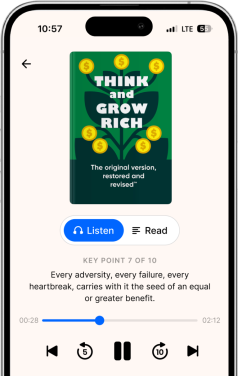
Headway gives you 15-minute summaries of the best books, so you're actually getting through your list of books instead of just staring at it. You learn what matters, you make real progress, and you stop feeling guilty about all that free time you think you're wasting.
📘 Download Headway and finally clear that list of books you've been ignoring.
Quick answer: 4 ways to read more books
Look at your schedule. You probably have more free time than you think — you're just not seeing it. Check your day and find those 15-30 minutes you're spending scrolling or doing nothing in particular.
Pick books you actually want to read. If a book bores you, drop it and find something you care about. Read about whatever you're into, doesn't matter if it's "important" or not.
Switch up the format. Carrying physical books everywhere is annoying. Grab an e-reader or listen to audiobooks while you're driving, cleaning, or at the gym.
Use Headway to save time. This is one of the best apps to build a daily reading habit. Full books take forever, but Headway breaks them into 15-minute summaries so you get the good stuff without the time commitment — you're learning without the guilt.
How to read more books: Proven tips to finish what you start

1. Make reading part of your routine
The first and most impactful thing you can do to read more is find ways to integrate a habit of reading into your existing routine. As referenced in the opening, today's modern, highly connected world no longer prioritizes books in the same way it used to. Everything is about instant gratification, jam-packed schedules, and places to go and be.
This makes it very hard to find the time to actually take a moment and enjoy more slow-burning activities like reading. But despite this pace you may be forced to live in, there are ways you can incorporate books into your life without compromising on other commitments.

2. Assess your schedule
You may have gotten used to saying the phrase, "I don't have time to read," but are you absolutely sure that's the case in your situation? Many of us get into the habit of thinking that we're busier than we really are, and as a result, we don't give ourselves enough credit for what we can actually accomplish in a day.
Begin by taking a thorough review of your schedule and identifying any gaps or downtime you may have. Do you have 30 minutes to spare? What about 15? In most cases, the answer is yes – we all have at least a few minutes here and there that we can use for reading.
It can be helpful to write out your schedule for a week or two, from morning to the end of the day, to get a better sense of how you're using your time. From there, you can start to look for patterns and places where you might be able to sneak in some reading time at home or your local library.

3. Create a reading-friendly environment
Sometimes, people don't read as much as they would like or should, due to external factors. If your home is cluttered or noisy, for instance, it can be very difficult to focus the few minutes you have to spare on reading.
Creating a reading-friendly environment can help alleviate these issues and make it easier to focus when you do have some time to read.
Think about the places where you feel most comfortable reading. Is it in your bed, curled up under the covers? In a comfy armchair with a cup of tea? Or a quiet campus or a public local library. Make a note of these places, and try to set aside some time to read in them on a regular basis.
In addition to finding the right setting, you'll also want to make sure you have everything you need to read nearby. Keep a stash of books in your bedroom, on a bookshelf, in a bag, or in your office, so that you can always grab one when you have a few free minutes. If you prefer digital reading, make sure your e-reader is fully charged and keep it within easy reach.

4. Set some reading goals
One of the best ways to ensure that you actually make time for reading is to set some specific goals. Trying to read more without any sort of plan is likely to result in frustration, as you'll only end up feeling like you're not making any progress and, thus, stop reading altogether.
For example, think about how many books you want to read this year or what genres to try reading next month.
Sit down and think realistically about how much time you want to spend reading each week. From there, you can break that down into smaller daily or monthly goals. For instance, if you want to read for two hours per week, that works out to about 20 minutes per day.
It can also be helpful to set goals for the number of books you want to read in a given time period. Whether that's one book per month or one book per week, having a specific target to achieve, such as a reading challenge consisting of a list of physical books or an audiobook playlist, will help motivate you to make your reading habit a regular one.

5. Supplement other pastimes with reading
If your schedule is absolutely swamped with other things to do, the next option you have to consider is reevaluating your existing pastimes. This is obviously less than ideal, as you don't want to give up activities you actually enjoy. However, in some cases, it may be necessary in order to make room for reading.
Take another look at your schedule and the activities on it. Are there any that you'd be comfortable swapping out? Are some things optional? Is there anything in there that you value less than reading? If so, then you may have found your solution.
Another way to approach this is to reduce the time you spend on your other pastimes, allowing you to have more time for reading. For instance, if you usually spend an hour watching TV every night, can you cut that back to 30 minutes? Doing so would afford you an extra three and a half hours of reading every week, which could amount to a lot of books in a short span of time.
You may also want to consider reducing your social media use, as it can be a significant time drain. If you find yourself scrolling aimlessly through Facebook or Instagram, try setting a timer for yourself and limit your time to 10-15 minutes on the site. This way, you can still stay connected without sacrificing too much of your precious reading time.
📘 Get Headway and start reading more without needing more time.

6. Find books that match your interests
One reason some people struggle with reading is that they're simply not interested in the books they're trying to read. If you find yourself struggling to make it through a new book, it may be because it's not something you're passionate about.
The solution to this problem is straightforward: find good books that align with your interests. Science junkie? Make a good science fiction book your next book. If you love the history of sports, look for books about notable sports figures from the past.
If you're interested in fashion, there are great books about the industry or famous designers. And if you're a fan of music, look for non-fiction books and biographies or memoirs from your favorite artists.
Check out book reviews if you're unsure of a title. There are tons of apps, book clubs, and online communities designed specifically for this purpose — give them a go and see what recommendations you can find.




7. Change your format
For some people, their main barrier to reading more is simply the fact that books can be a hassle to lug around. And that's a reasonable justification.
For instance, the Standard Edition of Harry Potter and the Goblet of Fire Illustrated Edition weighs a total of 4.68 lbs, while its Deluxe Edition weighs 10.5 lbs. Not exactly convenient for reading a lot of books on the go.
It isn't realistic to carry all of your favorite reads around, let alone worry about where you set them down or any risks of damage or theft. One way to address this issue is by switching to alternative formats, such as the following.

e-Readers
An e-Reader is a handheld electronic device that's designed specifically for reading books. The two most popular options on the market are the Amazon Kindle and the Barnes & Noble Nook.
These devices allow you to store thousands of different books on a single device, which is way more convenient than lugging around copies of physical books.
They're also usually significantly cheaper than buying print books, so that you can save some money in the long run. Plus, most e-Readers come with features like built-in dictionaries and adjustable font sizes, which can make the reading experience much more enjoyable.
Audiobooks
If you struggle with sitting down and reading, audiobooks may be a good solution. An audiobook is a recording of someone reading a book aloud, which you can listen to on your commute, while working out, or even while doing chores around the house.
They can be purchased for download online from sites like Audible and Amazon, and are especially great for people who are visual learners, as well as those with dyslexia or other reading disabilities.
8. Use the Headway app
If you find yourself challenged by the planning, costs, amount of time, or commitment of the aforementioned suggestions, downloading Headway may be your solution. Headway is an innovative app designed to make the process of learning quick and enjoyable.
The app reworks literary enrichment for the smartphone age through reading challenges, streaks, book summaries, and more, and is quickly becoming one of the most popular apps on the market. With features like progress tracking and flashcards, you can actually retain what you've just read.
Read Smarter, Not Longer — Try Headway

Reading more books doesn't mean turning your whole life upside down. Find some spare minutes here, pick stuff you're interested in, maybe switch to audiobooks — little things like that actually work.
However, if you're still short on time, consider Headway. You get a 15-minute summary of The New York Times bestsellers and other big titles, so you're learning what matters without sitting there for hours.
Want to improve your reading comprehension? Or read 50 books a year? Or, maybe, even write your own book? We can help with all of that.
Our daily microlearning app gives you book recommendations based on what you're into, has challenges and streaks to keep you going, and you can go at whatever pace works — knock out a whole summary in one go or just do a bit each day.
📘 Download Headway and get through more books without needing more time!
FAQs about how to read more books
How do I train myself to read more books?
Just read for 15 minutes every day — before bed, on your lunch break, whenever. Don't force yourself to do things that bore you. Keep a book next to your bed or in your bag so it's always available when you have a spare minute. Once it becomes automatic, you'll naturally read more.
Why does Gen Z not read?
They read tons — just not books. They're consuming articles, social media posts, podcasts, short stories, all that short-form stuff constantly. Their brains are wired for quick hits of information now, so sitting down with a 300-page novel feels painfully slow. Books can't compete with instant content.
What is the 50-page rule?
If you're not enjoying a book after 50 pages, consider quitting and finding something else. Why waste time forcing yourself through something you don't like? Some people stretch it to 100 pages for longer books, but the same concept — if it's not clicking, move on and don't feel guilty.
How to remember 80% of what you read?
Write stuff down while you're reading, highlight the important bits, and recap what you learned right after. Explaining it to someone else helps it stick way better. Headway uses spaced repetition and flashcards to aid in this process. Go over your notes the next day — that's when memory really sets in.
What are the 7 key reading strategies?
Skim the book first to see what's coming, ask yourself questions as you go, connect it to things you already know, picture what's happening in your mind, figure out what actually matters versus filler, recap each section, and then tie it all together at the end. You're interacting with it, rather than just staring at the words.