Self-growth
 Business & Career
 Success
 Communication
 Healing
 Relationships
 Psychology
 Happiness
A job offer came in lower than you wanted, and now you're panicking about what to say? You need more money, but asking for it over email feels like walking a tightrope: ask too much, and they pull the offer, ask too little, and you're stuck with less than you're worth.
The Salary Budget Planning Report by Willis Towers Watson says salary increases are sitting around 3.9% for 2025. That barely covers inflation, which means negotiating a salary increase with your recruiter isn't some power move — it's survival if you want to get anywhere.
Most people simply accept whatever number the recruiter presents, as they have no idea how to push back professionally. However, there are salary negotiation email templates that can help you secure a higher salary without jeopardizing the entire process. You just need to know what actually works when negotiating salary offers.
Books like 'Never Split the Difference' by Chris Voss and 'Getting to Yes' explain the tactics that work. Headway breaks them into 15-minute reads so you can learn tonight. Figure out how to write your salary negotiation email templates before you send something you'll regret.
📘 Download Headway and learn to negotiate like you've done this before.
Quick answer: Five ways to negotiate a salary offer via email
Research what people actually make and pick a number. Check Glassdoor or LinkedIn to see what similar jobs pay in your area. Asking for "more money" without a specific range makes you look unprepared.
Wait until they offer, but negotiate before you accept. Once they've officially offered you the job, that's when you negotiate. Not during the interview, not after you've already accepted — right in between.
Say thank you, then explain why you're worth more. Start by thanking them and expressing your enthusiasm about the role. Then, lay out what you bring and why your number matches up with what people in similar positions make.
Check in if you don't hear back. Send a friendly follow-up after 24 hours. Still nothing after a week? Try again. Two weeks of silence? One more email, then you know where you stand.
Negotiate the whole package, not just base salary. Stop focusing only on salary — bring up benefits, bonuses, remote work options, extra vacation days, whatever matters. Gives you way more leverage than just arguing over one number.
The importance of negotiating salary via email in today's job market
Negotiating salary via email has become a common practice in today's job market. Firstly, it's a great way to keep a clear record of the negotiation process, which can help prevent misunderstandings.
Secondly, it allows you to manage your time efficiently, as emails enable asynchronous communication, giving you the freedom to respond to potential employers' offers at your own pace and plan your next steps.
Thirdly, it offers added flexibility, as it gives you time to consider the response, reflect, and research, making you better prepared for any follow-up meetings or phone calls.
It's typical for employers to negotiate salary offers and sign-on bonuses with candidates due to budget constraints, exceptional qualifications, talent market conditions, geography, or the candidate's negotiation skills. This process enables both parties to establish the tone for further negotiations, thereby reducing the likelihood of miscommunication.
Basics of email negotiations for the proposed salary
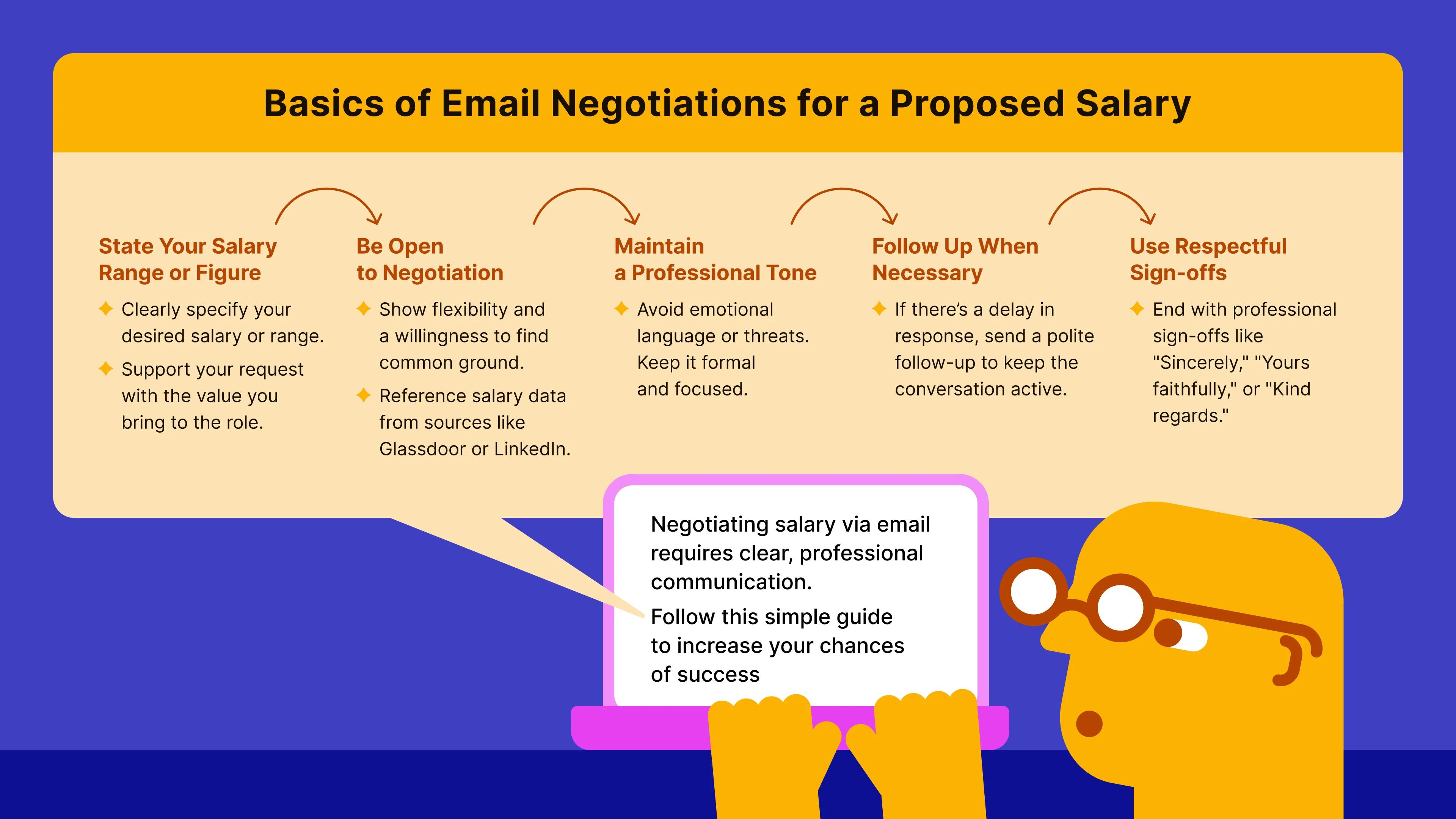
When negotiating your salary via email, it's essential to maintain a professional tone. Here is a simple guide to follow to raise the chances for a successful outcome:
Clearly state your desired salary range or a specific figure and elaborate on the value you would bring to justify your request.
Express your openness to a collaborative negotiation process, having a flexible range in mind, and showing a willingness to find a mutually agreed-upon number. Base your arguments on average salaries for similar roles in the same area by referencing Glassdoor or LinkedIn.
Maintain a professional tone, avoiding emotional language or threats.
If there's a delayed response, consider a timely follow-up email to keep the dialogue open.
Use respectful sign-offs such as Sincerely, Yours faithfully, or Kind regards.
When negotiating your salary via email, it's important to follow these guidelines to ensure you secure a compensation package that truly reflects your value and contributions, including paid vacation time.
If you decide to counteroffer a salary, there are several potential outcomes to consider:
The employer may accept or reject your counteroffer.
Ask for more information on the market value of similar roles.
Request more time to think about your counteroffer.
It's crucial to be prepared for these possibilities and to maintain a professional attitude throughout the entire negotiation process. Additionally, to ensure that your email is well-received, it's critical to express gratitude, be specific, maintain a positive tone, and emphasize the mutual benefit.
Negotiating a higher salary: When to say "no" before an offer
Negotiating a starting salary before receiving a formal job offer is pretty common, especially during the interview process. This is particularly suitable if you are confident in the demand for your qualifications in the job market. However, it's essential to be ready to say "no" and walk away if you discover the following:
It seems like there might be a misalignment in values between you and your potential employer.
Limited opportunities for professional development, an unfair compensation package without specific numbers, and no remote work or stock options.
A salary below the market rate with no signing bonus and an excessive workload.
Remember, diplomatically declining a job offer is not a failure. It's a decision that reflects your priorities and can help you find a more fulfilling position.
The right timing: How important it is in salary negotiations
When negotiating a higher salary, it's crucial to conduct thorough market research and gather facts on the average salaries in your area. The salary data and market average numbers will strengthen your negotiation. The timing of seeking a higher salary through negotiations is another vital matter. Here are some key factors to keep in mind:

Employer's performance:
Favorable financial rate: When the hiring company is on a positive profit-raising streak, it presents a suitable time for negotiations. Your role in driving the corporation's success becomes a leverage point.
Economic decline: When the economy is struggling, it's essential to approach salary negotiations with caution. While there may still be room for negotiation, staying flexible with your expectations and exploring alternative options may be necessary. Be prepared to emphasize the value you would bring with practical examples.
Your performance:
Recent achievements: If you've surpassed expectations or achieved meaningful milestones in your work, now is an excellent time to discuss potential opportunities to upgrade your position or receive increased compensation.
Consistent performance: A history of consistently strong performance reinforces your negotiation position.
Job market:
High demand for professional skills: Having sought-after skills provides you with a significant edge in discussions, as employers place great importance on your talents and are prepared to provide appealing compensation and benefits to secure your mastery.
Economic conditions: Employees tend to benefit from a robust job market, whereas a weak one might restrict their ability to negotiate effectively.
Company culture:
Open communication: A workplace environment that fosters sincere communication can be more helpful for productive negotiation processes.
Inflexible policies: Negotiating salary may be more difficult if your firm has "uncompromising" salary policies that exclude individual circumstances. These policies can make it more challenging to negotiate a pay increase.
Your relationship with your manager:
Having trust and mutual respect with your manager: A respectful relationship is essential for fostering a positive working environment that increases the likelihood of a beneficial negotiation outcome.
Open and respectful communication: A manager who is willing to listen to feedback, consider it, and engage in honest discussions about it is a positive indication of an environment that fosters open discussion about sensitive topics in the workplace.
Keep in mind that timing isn't the sole factor. Your enthusiasm for negotiations, skills in communicating with anyone, and the general job market have a substantial impact. By taking these factors into account and acting at the "right" moment, you can enhance your prospects of a raise.
📘 Try Headway to master negotiation before your next job offer.
Common fears and actionable solutions to the pay raise dilemma
The timing of a salary negotiation email is often a source of anxiety and confusion. It is commonly associated with moments such as receiving a new job offer or seeking a promotion or raise.
At those times, it's crucial to consider the company's culture in salary discussions, your relationship with the potential employer, and the stage of the hiring process. Ultimately, the most suitable time to send a salary negotiation email is when you feel self-assured and up to advocate for yourself.
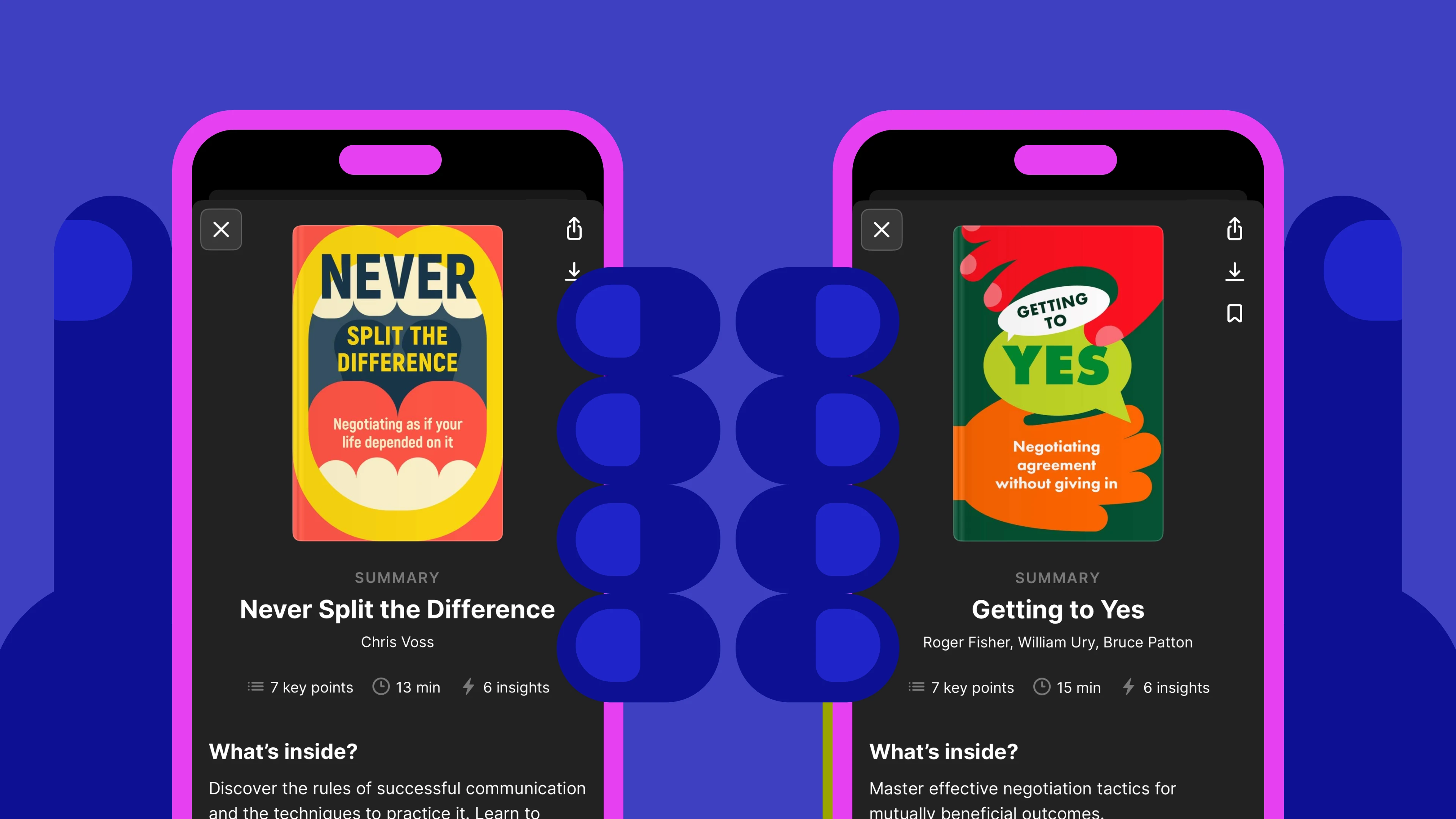
Both 'Never Split the Difference' by Chris Voss and 'Getting to Yes' by Roger Fisher, William Ury, and Bruce Patton provide valuable perspectives on negotiation tactics. Although they have some commonalities, they also present unique methods for overcoming typical fears that may impede negotiations:
1) Fear of rejection
'Never Split the Difference': Voss stresses the significance of establishing a connection and trust with the other party in order to lessen the fear of rejection:
"He who has learned to disagree without being disagreeable has discovered the most valuable secret of negotiation."
He recommends employing active listening and mirroring methods to boost connection and comprehension.



'Getting to Yes': Fisher, Ury, and Patton recommend that readers refer to a principled negotiation strategy that emphasizes interests over positions.
"People listen better if they feel that you have understood them. They tend to think that those who understand them are intelligent and sympathetic people whose own opinions may be worth listening to. So if you want the other side to appreciate your interests, begin by demonstrating that you appreciate theirs."
By understanding the basic needs and concerns of the other party, negotiators can alleviate the fear of rejection by identifying solutions that benefit all stakeholders.
2) Absence of personal connection
'Never Split the Difference': Voss emphasizes the significance of establishing a personal bond with the other party in order to foster a more cooperative negotiation atmosphere:
"Negotiate in their world. Persuasion is not about how bright or smooth or forceful you are. It's about the other party convincing themselves that the solution you want is their own idea. So don't beat them with logic or brute force. Ask them questions that open paths to your goals. It's not about you."
The author also recommends being empathic and providing undivided attention to comprehend the other individual's point of view.
'Getting to Yes': Fisher, Ury, and Patton stress the significance of developing connections, with an emphasis on fostering a cooperative environment through transparent ways of communication and a reciprocally respectful attitude:
"Pressure can take many forms: a bribe, a threat, a manipulative appeal to trust, or a simple refusal to budge. In all these cases, the principled response is the same: invite them to state their reasoning, suggest objective criteria you think apply, and refuse to budge except on this basis. Never yield to pressure, only to principle."
3) Room for misinterpretation
'Never Split the Difference': Voss emphasizes the significance of precise and transparent communication in order to prevent misinterpretations:
"Negotiation is not an act of battle; it's a process of discovery. The goal is to uncover as much information as possible."
The writer recommends using standard language and avoiding jargon.
'Getting to Yes': Fisher, Ury, and Patton stress the significance of engaging in active listening and asking for clarification to make sure that both sides comprehend each other's viewpoints well:
"The game of negotiation takes place at two levels. At one level, negotiation addresses the substance; at another, it focuses — usually implicitly — on the procedure for dealing with the substance."
They also recommend referring to objective criteria when assessing prospective solutions.
Both books offer valuable strategies for overcoming fears when negotiating salary or any other topic. The author of 'Never Split the Difference' places more emphasis on establishing a connection and comprehending the other person's viewpoint, while 'Getting to Yes' highlights a conscientious method that prioritizes interests over stances.
By integrating aspects from both books, you can develop a more effective and promising approach to facing fears and increase your chances of securing a fair compensation package.
📘 Get Headway and figure out how to ask for what you're worth!
Negotiation: A skill for long-term career success
Effective negotiation is a crucial skill that can profoundly impact your professional journey. It goes beyond simply securing a higher salary; it involves advocating for yourself, fostering strong relationships, and working towards achieving your career aspirations.

Psychological insights into negotiation anxiety
Negotiating is a complex task that can be intimidating. Understanding the psychology behind it is crucial to grow as a negotiator. Some people, in order to avoid confrontation, refer to playing "a peacekeeper."
In the book 'Never Split the Difference,' the author promotes the use of "tactical empathy," which involves comprehending the other party's viewpoint and leveraging that understanding to guide the negotiation.
Addressing the concerns of the other party reasonably and efficiently, negotiators can prevent disproportionate conflict and raise the possibility of a favorable result:
"Another simple rule is, when you are verbally assaulted, do not counterattack. Instead, disarm your counterpart by asking a calibrated question."
In 'Getting to Yes,' the writers stress the significance of separating individuals and the issue at hand:
"Increase your negotiation power is by improving your walk-away alternative. An attractive BATNA (Best Alternative to a Negotiated Agreement) is a strong argument with which to persuade the other side of the need to offer more."
By concentrating on specific matters rather than individual differences, the parties can avoid disagreement and pursue a mutually advantageous option.
Mastering negotiation: A 5-step guide
Drawing inspiration from the expertise of Chris Voss, Roger Fisher, William Ury, and Bruce Patton, the Headway Team put together a step-by-step manual for excelling in the negotiation of a job offer via email and ensuring a positive relationship with the hiring company:
Thorough preparation
Be fully equipped: Clearly define your goals and specify the terms that are not open to negotiation.
Research the other party: Collect information about their hobbies, preferences, needs, and how they tend to approach negotiations.
Develop a plan: When planning your strategy, be sure to consider different approaches, potential areas of compromise, and how to respond to counterproposals.
Building rapport and trust
Active listening: Ensure you listen carefully to what the other person is saying and demonstrate that you understand and value their perspective.
Mirroring: Utilize both verbal and nonverbal cues to mirror the behavior of the other party, building a connection based on mutual understanding and trust.
Create a positive atmosphere: Encourage a supportive and inclusive atmosphere that fosters teamwork and open communication.

Understanding interests, not positions
Investigate underlying needs: Delve into the core motivations behind the requests made by the other party.
Distinguish between individuals and the problem: Focus on addressing the specific issues rather than getting caught up in personal differences.
Generate potential solutions for mutual gain: Engage in a collaborative brainstorming process to develop creative and mutually advantageous outcomes that cater to the interests of all parties involved.
Utilizing tactical empathy and labeling
Understand the perspective of the other party: Take the time to fully grasp their point of view and demonstrate genuine empathy towards their position.
Recognize and acknowledge their emotions: Identify and label the emotions that the other party is experiencing, as this can help build trust and lead to better mutual understanding.
Use strategic empathy to guide the negotiation process: Employ empathy as a tool to influence the negotiation's direction, aiming to achieve a positive and mutually beneficial outcome.
Negotiating with BATNA and WATNA
Best Alternative To a Negotiated Agreement (BATNA): Recognize your most favorable alternative in case the negotiation doesn't succeed.
Worst Alternative To a Negotiated Agreement (WATNA): Assess the least favorable outcome if an agreement is not reached.
Employ BATNA and WATNA to determine your reservation value: Establish a minimum acceptable result based on your BATNA and WATNA.
By incorporating the strategies outlined in both 'Never Split the Difference' and 'Getting to Yes,' you can elevate your negotiation abilities and secure better outcomes in your negotiations.
Long-term benefits of negotiation
By gaining insight into the psychological factors that impact salary discussions, candidates can boost their confidence as negotiators. This can ultimately lead to greater success in their long-term careers:
Negotiation has the potential to open doors to greater financial security and increased job satisfaction.
It can foster stronger relationships with employers and colleagues while building up a person's assertiveness.
Mastering negotiation skills can pave the way for a smoother career progression.
Definition and key elements of a salary negotiation email
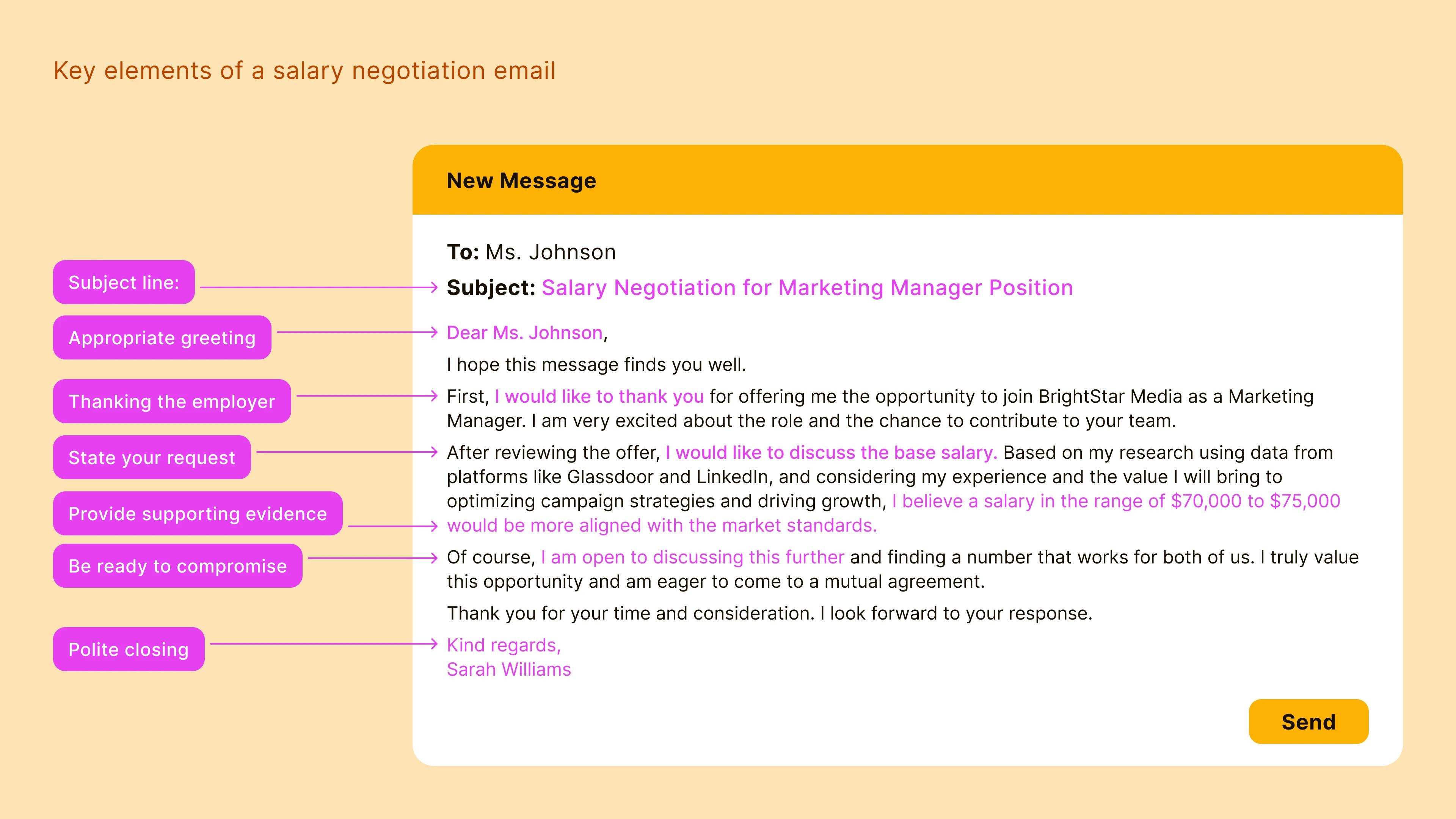
A salary negotiation email is a formal message to a potential or current employer discussing compensation. Standard components of such an email are as follows:
A simple subject line like "Salary Negotiation for [Job Title] Position."
Appropriate greeting by name and title.
Thanking the employer for a new opportunity or an acquired experience.
State your request: Clearly indicate your desired reward or compensation adjustment.
Provide supporting evidence: "Strengthen" your case with relevant data, such as market research or your accomplishments.
Be ready to compromise while negotiating.
Finish the email professionally with a polite closing.
These components can help you achieve success in negotiations with prospective employers.
The ideal time to send salary negotiation emails
Determining the perfect timing to send a salary negotiation email hinges on various factors. These include a unique corporate culture and specific guidelines for salary discussions. Generally, it is advisable to initiate salary negotiations after receiving a job offer but before formally accepting it. Personal comfort also plays a role; if you prefer face-to-face negotiations, it may be best to wait for an in-person meeting.
Upon receiving a job offer, it's paramount not to delay the negotiation process. It's also wise to avoid sending emails during peak hours when the hiring manager is likely preoccupied, especially early in the morning.
Additionally, if the receiver lives in a different time zone, it's vital to be considerate of their working hours. Ultimately, the most fitting time to send a salary negotiation email is when you are actually ready to engage in negotiations on the subject.
📘 Download Headway for expert negotiation strategies in 15-minute reads!
Salary negotiation email examples for different scenarios
The following email samples reflect various scenarios when you might need to raise a salary question proportional to your skillset:
1. Negotiating after a job offer & counteroffer
Subject: Follow-Up on Job Opportunity
Dear [Hiring Manager's Name],
I am reaching out to reaffirm my interest in the [Job Title] role at [Company Name]. Thank you for the chance to potentially join your team.
I am enthusiastic about the opportunity to contribute to [Company Name]'s achievements. Upon reviewing the [job description] and the proposed [salary offer], I would like to negotiate the possibility of a higher salary.
Drawing from my experience and research in similar positions, I am of the opinion that a salary range of [salary range] would be fitting and reflective of my qualifications and expertise. Currently, my salary stands at [current salary], and I have a proven track record of delivering [highlight your achievements].
I am confident that my [skills and certifications] are well-matched with the requirements of this role, and I am keen to bring my knowledge to your team. Additionally, I am open to discussing supplementary benefits and perks that could form part of the overall compensation package, such as [list potential perks].
I would welcome discussing my salary expectations further in a subsequent call or meeting. Thank you for your time and consideration.
Sincerely,
[Your Name]
[Your Contact Information]
2. Negotiating after a promotion or performance review
Subject: Request for Salary Adjustment Following Recent Promotion
Dear [Manager's Name],
I trust this email finds you in good health.
I am reaching out to formally seek a salary review in light of my recent appointment to the role of [New Position]. I am grateful for the opportunity to assume this new position and am eagerly anticipating the challenges and opportunities it will bring.
I am of the opinion that my expanded responsibilities and contributions to the team are in line with the standard salary range for this role. Through my research and conversations with colleagues in similar positions, I am of the belief that a salary adjustment of [amount] would be equitable and competitive.
Enclosed, you will find a comprehensive summary highlighting the significant achievements during my tenure in my previous role, as well as the valuable contributions I have made to the team following my promotion. I am eager to engage in a detailed discussion at your earliest convenience.
Thank you for dedicating your time and consideration to this matter.
Sincerely,
[Your Name]
[Your Position]
The art of follow-up: The effective strategies

Follow-up is a crucial element of the negotiation process. In 'Never Split the Difference' and 'Getting to Yes,' Voss, Fisher, Ury, and Patton stress the significance of follow-up to guarantee a favorable outcome in a negotiation. Here is a detailed breakdown of the optimal timing and strategies for crafting and sending effective follow-up emails (see templates below):
Post-negotiation follow-up can be beneficial in clearing up any misunderstandings or uncertainties that may have arisen. Additionally, it provides an opportunity to reaffirm and finalize the terms and conditions agreed upon during the negotiation process.
The follow-up shows your dedication to the process and can play a significant role in solidifying a positive relationship with the other party. This continued communication can help foster trust and understanding between both parties, ultimately strengthening the foundation of your professional relationship.
After the initial negotiation, it's essential to remain open to addressing any concerns or objections that may arise. The follow-up discussions provide an opportunity to carefully consider and resolve these issues, ultimately finding solutions that are acceptable to all parties involved.
In certain situations, it may be crucial to have additional discussions or meetings to iron out the details of the agreement and ensure that both parties are fully committed to the terms.
The writers emphasize that initiating follow-up actions should be done in a manner that excludes any indecisiveness about securing a higher base salary or a raise. Based on the authors' advice, try:
Immediate follow-up (within 24 hours)
Purpose: To emphasize your interest and acknowledge receipt of the initial offer.
Content: Show appreciation for the offer, summarize your main points, and ask about the next steps or a timeline for a decision politely.
The follow-up after a week
Purpose: To follow up and demonstrate ongoing interest if there has been no response.
Content: Kindly request an update on the status of the discussions and reaffirm your excitement about the opportunity.
The follow-up after two weeks
Purpose: If you haven't received a response after a week, give the process a little push.
Content: Demonstrate your ongoing enthusiasm and willingness to supply any extra information that could be beneficial.
The final follow-up:
Purpose: If you have not received a response regarding the status of the negotiation after several weeks, it would be appropriate to politely inquire about it.
Content: Express your ongoing interest while also being ready to acknowledge that the role may not ultimately align with your expectations.
1. Immediate follow-up (within 24 hours)
Dear [Hiring Manager's Name],
I appreciate the offer for the [Job Title] position at [Company Name]. I'm thrilled about this opportunity and value your time in considering my application.
As we discussed, I am confident that my skills and experience are a good fit for this role. I am eager to contribute meaningfully to the team and support [Company Name] in reaching its objectives.
I'd like to follow up on the salary range and compensation package you offered. Could you kindly provide more information regarding the base salary, extra perks, and bonuses to be expected?
Thank you for your time and thoughtful consideration.
Sincerely,
[Your Name]
[Your Contact Information]
2. The follow-up after a week
Dear [Hiring Manager's Name],
I trust this email finds you in good health.
I am reaching out to check in on our discussion about the [Job Title] role. I am highly enthusiastic about this opportunity and am still very keen to become a part of the team at [Company Name].
Please inform me if there is any additional information you require from me or if there are any updates on the hiring process, specifics of the compensation package, salary range, and its review timeline.
I appreciate your time and consideration.
Best regards,
[Your Name]
3. The follow-up after two weeks
Dear [Hiring Manager's Name],
I trust this email finds you in good health.
I'm writing to follow up on the status of our prior discussions concerning the [Job Title] role and its respective compensation package and expected salary range. I am enthusiastic about this opportunity and am confident that my expertise and experience would make a substantial contribution to your team.
Please do not hesitate to inform me if there are any additional requirements for me to fulfill in order to advance in the hiring process and remuneration negotiation.
Thank you for your time and consideration.
Sincerely,
[Your Name]
4. The final follow-up
Dear [Hiring Manager's Name],
I hope this email finds you well.
I am reaching out to revisit our prior conversations about the [Job Title] role, the compensation package, and the associated salary range. I remain highly enthusiastic about this opportunity and am confident that my professional skills and background align with the strategy of your team.
I realize that the hiring process can be time-consuming, and I wanted to follow up to inquire if there have been any developments regarding the status of my application and reward specifics.
Thank you for your time and consideration.
Sincerely, [Your Name]
When composing follow-up emails, it's essential to customize the content to fit the particular circumstances. It's also important to uphold a professional and respectful tone from start to finish.
Common errors in salary negotiation emails and how to avoid them
Crafting salary negotiation emails, whether for initial salary or periodic increases, can be challenging. Here are some mistakes to avoid and how to address them:
Being too vague or general
Avoid: Making generic requests for a "higher salary."
Do: Specify a precise salary range after doing research on market rates for identical or similar positions.
Focusing solely on salary
Avoid: Confining your negotiation solely to salary.
Provide a comprehensive overview of your expected reward, emphasizing the value you bring to the employer. It is essential to consider factors such as benefits, bonuses, and opportunities for career advancement.
Failing to prepare
Avoid: Entering a negotiation unprepared.
Do: Research market rates to estimate your precise worth. Consider the analytics of average salaries for the position you are applying for, your experience, and the company's financial state.
Overestimating your value
Avoid: Setting unrealistic expectations.
Do: Consider your value based on industry standards and your expertise, and be ready to discuss within a fair range.
Not being flexible
Avoid: Being inflexible in your requests. Stay open to finding a middle ground and take into account additional aspects beyond just the salary.
Do: Demonstrate a willingness to negotiate, considering alternative elements of the compensation package.
Using negative language
Avoid: Referring to negative language or a threatening tone.
Do: Communicate in a respectful and business-appropriate manner, highlighting the unique benefits and contributions you offer to the company.
Forgetting to follow up
Avoid: Neglecting a rule to follow up after sending your initial negotiation email.
Do: Craft a courteous follow-up email to express your continued interest in the opportunity and to provide further clarification on any remaining inquiries.
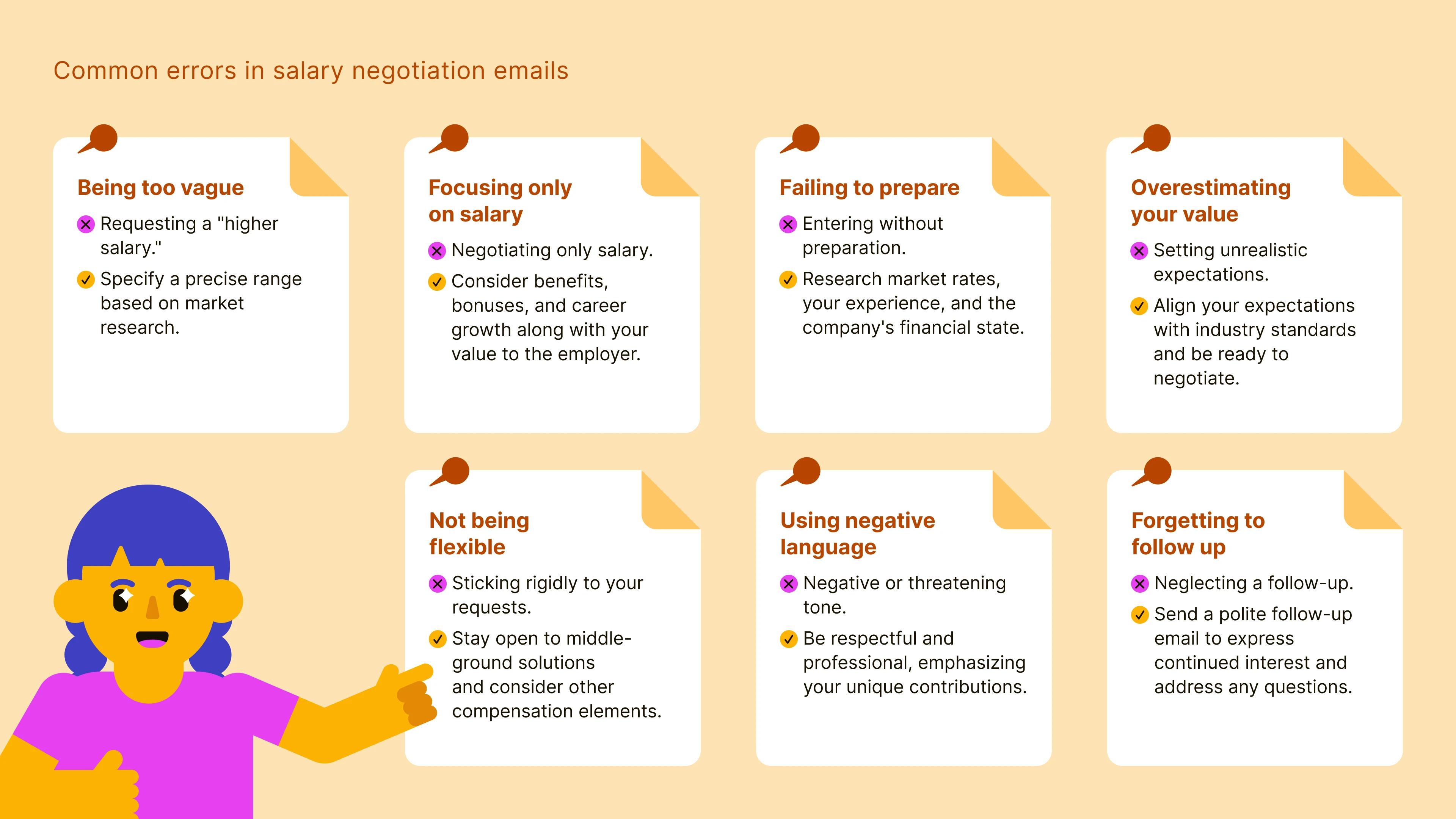
To increase your chances of negotiating a fair salary, avoid these common mistakes and follow the advice.
Learn to negotiate like a pro with Headway!
Learning how to negotiate a salary via email changes your whole job search, not just one job offer. When you know what you're doing, you get paid fairly, score better benefits and vacation time, and employers actually respect you more because you're not a pushover.
Headway's got book summaries on negotiation from Chris Voss, Roger Fisher, William Ury, and many others. You'll learn how to negotiate a salary via emails, handle their counteroffers, and make every job offer work better for you — 15-minute reads instead of slogging through entire books during your job search.
📘 Download Headway and stop fumbling through how to negotiate a salary via emails!
FAQs about how to negotiate a salary offer via email
How do you politely negotiate salary via email?
Thank them for the offer first, then tell them what you want, backed by real data from Glassdoor or LinkedIn. Say you're open to talking about the whole package, not just salary. Write like a professional, don't get emotional or threatening. If they don't respond in a day, check in again. Sign off with "Sincerely" or "Best regards."
How do you politely say the salary is too low?
Start by thanking them and saying you want the job. Then explain that similar roles in your area pay more based on what you found, and give them your actual number. Try something like "My research shows similar positions pay [X-Y], so I was hoping we could land somewhere in that range." Stick to the facts, don't whine about it.
What not to say when negotiating?
Don't threaten to bail or get dramatic with stuff like "I really need this" or "I deserve better." Saying you want "more money" without a specific number comes across as amateur. Stop obsessing over just salary when benefits and time off matter too. Avoid discussing coworkers or criticizing your current boss. Your personal money problems aren't their issue.
What are the three key rules to negotiate?
Do your homework, know what the job pays, and what your bottom line is. Figure out what both sides actually care about beyond the dollar amount. Have a backup plan (BATNA) so you know what you'll do if this falls through. That backup keeps you from negotiating out of panic.
How to respond to a low salary offer?
Thank them, then show them what you found about similar jobs paying more. Give them your number and explain why it makes sense for your experience and the market. Say you're down to talk about the whole package: benefits, bonuses, working from home, and extra vacation. Ask if there's wiggle room or if you can schedule a call to discuss it further.