Self-growth
 Business & Career
 Success
 Communication
 Healing
 Relationships
 Psychology
 Happiness

Are you letting self-doubt stop your progress? Then, you might want to learn how to develop a growth mindset to regain confidence and self-faith. Carol Dweck's decades of research at Stanford highlight that this approach changes your learning style and improves retention immensely.
So, if you're actively seeking a learning opportunity, key insights from Robin Sharma, Jordan Peterson, and psychologist Carol Dweck will give you excellent tools for self-improvement, self-awareness, and personal growth.
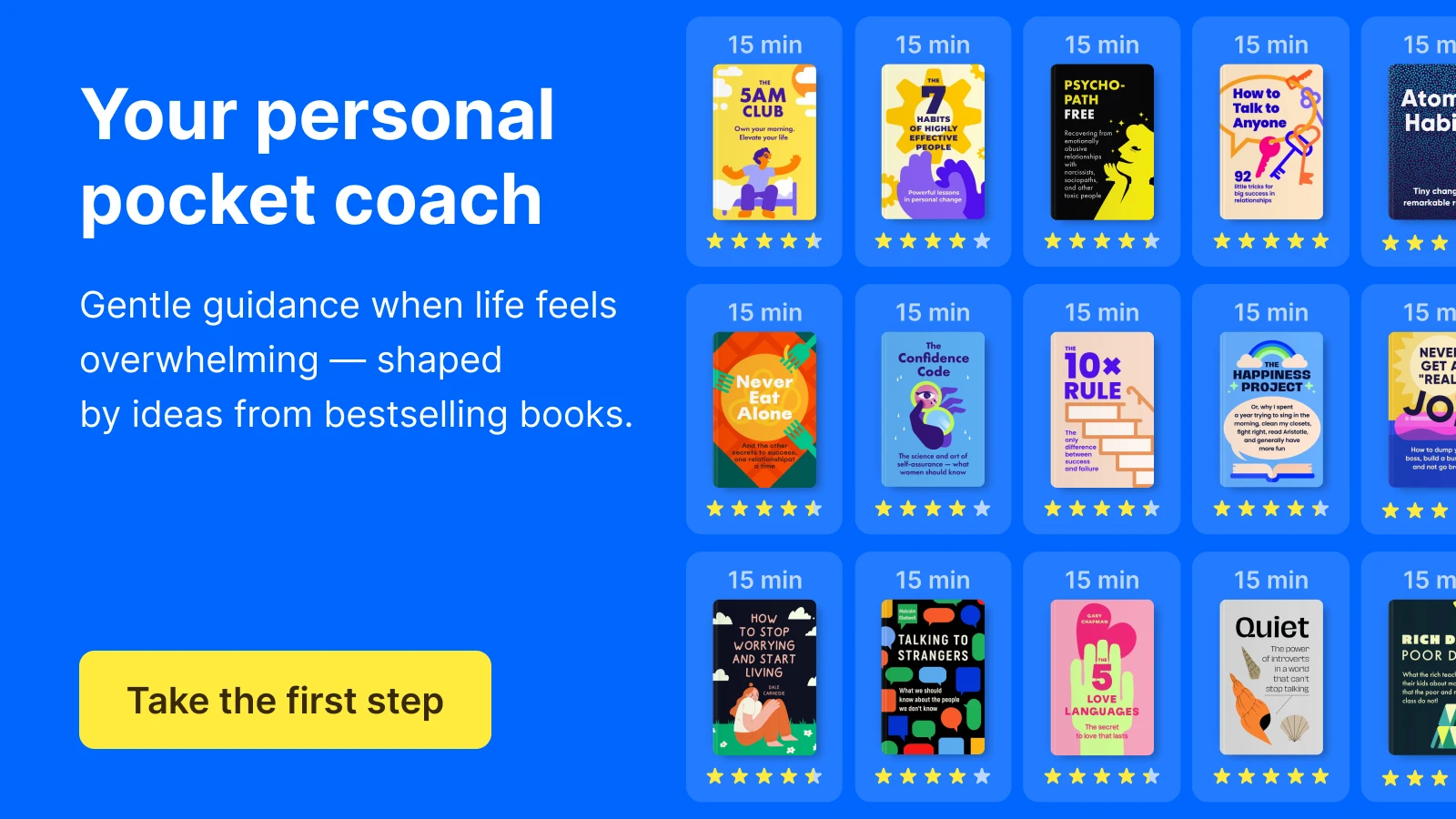
To gain that positive outlook, try the Headway app, where you can read or listen to book summaries and acquire new skills daily. This tool helps you build a growth-oriented routine and stay motivated during tough times.
Get the Headway app and shape your growth!
Quick summary: Growth mindset hacks that work
Here are the top tips on how to develop a growth mindset:
Practice lifelong education and reflection.
Change limiting beliefs with behavior change loops.
Cultivate belief and desire for success.
Build growth habits with a strict morning routine.
Strengthen discipline and personal meaning.
With these tips in mind, let's explore each one in full, along with practical mental health strategies you can start using today.
📘 Access all these books in one place with Headway!
Five tips to live a growth-oriented life
Changing your daily thinking patterns takes deliberate effort. Below are five strategies, each drawn from a key book. Read these summaries on Headway to accelerate your progress.
Tip 1: Practice lifelong learning and reflection
Adopting new ways of thinking is fundamental to long-term success. Psychologist Carol Dweck explains how shifting your beliefs can change everything.
Her research highlights the massive power of the word "yet." "I don't know this yet" signals that success is still ahead. Reflective journaling helps track this daily progress.
Write down your thoughts at the end of each day. Reviewing your actions helps you spot rigid thinking patterns quickly, and from there, you can correct them on the spot.
Tip 2: Change limiting beliefs with behavior change loops
Small habits build a strong behavioral foundation over time. Katy Milkman explains how to override static patterns effectively and permanently.
Setting up a daily trigger-action plan is simpler than it sounds. You drink a glass of water, then write down one goal. These small actions build real momentum over a few weeks.
Consistency matters more than intensity when changing your routines. Focus on small wins. Small wins stack up to create real, lasting change.
Tip 3: Cultivate belief and desire for success
Desire and persistence drive massive achievements in any field. Napoleon Hill outlines how strong belief shapes your daily reality.
Start by writing a personal success affirmation. Read it aloud every morning to reinforce your goals. With time, this kind of self-talk reshapes your inner dialogue.
Your subconscious mind absorbs these repeated affirmations over time. Once that happens, you start acting in alignment with what you say, and achieving your goals becomes much easier.
Tip 4: Build growth habits with a strict morning routine
Your morning routine sets the tone for the entire day. Robin Sharma shows how early hours support quiet reflection.
A good morning ritual includes physical exercise, daily planning, and reading. Starting proactively means that you respond to events rather than react to them. This structure supports daily self-improvement and sharp focus.
Waking up early gives you a quiet window before the day takes over, and that time is entirely yours to focus on what matters most. That consistency builds genuine mental resilience.
Tip 5: Strengthen discipline and personal meaning
Clear rules help you navigate difficult periods. Jordan Peterson provides firm guidelines for taking personal responsibility.
You can create a weekly checklist to review your actions against your core values. This practice builds character and mental toughness.
Taking responsibility for your actions removes the victim mentality. You stop blaming others for your current circumstances, and the path forward becomes yours to define.
📘 Practice lifelong learning daily with book summaries from Headway!
Top three exercises for better retention and focus
Daily practice is what turns these concepts into real habits. You need to apply these ideas consistently every single week. Here are three tools you can use right now.
Growth mindset reflection worksheet: Write down three difficult moments today. Describe exactly how you handled them.
Feedback journal: Record all constructive criticism you receive at work. Note exactly how you plan to use it.
Skill-stretch calendar: Schedule one challenging activity every single week. This routine forces you out of your comfort zone permanently.
You can also use Headway growth plans to organize your reading schedule effectively. A structured plan keeps you accountable and on track. Tracking your progress keeps motivation high.
Consistency remains the most important factor in this process. You'll see massive changes if you complete these exercises daily, as your brain will adapt to this new way of operating.
📘 Build your reflective practice with insights from Headway!
Why the growth mindset matters
Many people ask why cultivating a growth mindset matters and how it changes their daily outcomes. A flexible attitude builds true resilience in the face of setbacks, and you bounce back much faster when things go wrong.
A growth mindset also accelerates how quickly you pick up new skills. You'll read more books, ask better questions, and seek experienced mentors. You'll even regularly push past your comfort zone.
Your overall well-being improves when you remove the fear of failure entirely. You experience less stress during complex projects, and your daily life becomes much more fulfilling and enjoyable.

Professionals with flexible attitudes secure promotions faster than their rigid peers. They willingly take on new responsibilities, don't complain about the workload, and consistently focus on problem-solving.
Companies seek individuals who demonstrate high adaptability. A rigid employee struggles when the industry changes rapidly, while an adaptable worker thrives during organizational shifts.



The science behind the growth mindset concept
Psychological research shows that beliefs about intelligence directly affect human behavior. Carol Dweck spent decades studying students to develop and test this theory. She found that people hold fundamentally different beliefs about whether intelligence is fixed or can grow.
Individuals with flexible beliefs handle tough times with grace. Their brain activity actually shows more engagement when correcting mistakes. They process complex information differently from those with static beliefs.
This research forms the foundation of 'Mindset: The New Psychology of Success.' The brain can be trained to form new neural pathways, and consistent practice can genuinely reshape your thinking patterns over time.
Neurons that fire together wire together in the human brain. Constant complaining strengthens negative pathways, while practicing gratitude daily builds positive ones.
Science shows that neuroplasticity lasts throughout your entire adult life. So, you're never too old to change your daily habits. You can always rewire your brain for better outcomes.
📘 Track your progress and grow every day with Headway!
Growth mindset vs fixed mindset: Key differences at a glance
We need to define what a growth mindset means, so let's first look at its opposite. A fixed mindset assumes that human intelligence and innate talent are static traits. People with this view constantly avoid difficult tasks.
Conversely, the growth mindset concept suggests that people can develop abilities through dedication. Challenges become chances to improve, and the process matters more than the end result.
The table below clearly illustrates the differences between a growth mindset and a fixed mindset:
| Feature | Fixed mindset | Growth mindset |
|---|---|---|
Challenges | Avoids them entirely | Embraces challenges |
Effort | Sees effort as useless | Views effort as necessary |
Feedback | Ignores constructive feedback | Uses feedback to improve |
Success | Feels threatened by the success of others | Finds inspiration in others |
📘 Transform your mornings with reading and growth on Headway!
Real-life scenarios: How to overcome new challenges through growth
Many professionals face huge career hurdles on a daily basis. A manager might lose a major client unexpectedly due to market shifts. A rigid thinker would blame the market, the economy, or their team.
A flexible thinker reviews the lost deal for valuable learning experiences. They call the client and ask for brutally honest feedback, then carefully adjust their sales pitch for the next big meeting.
The same dynamic shows up when learning new skills later in life. Someone might struggle to play the piano during their first few lessons. They focus on daily practice rather than expecting immediate perfection.
We also frequently see this pattern in sports.
An athlete might lose a championship game after months of hard preparation. They review the game footage to spot their exact mistakes.
They bring in new coaches and completely overhaul their training regimen. They return the next season stronger and much more prepared. That resilience defines true champions in any field.
Check the facts and ignore the common myths
People often misunderstand what this psychological concept actually implies. Review this list to ensure you have the facts straight.
Myth: A growth mindset means you stay happy and smiling constantly.
Fact: A growth mindset helps you face negative thoughts and process them constructively.
Myth: Pure effort guarantees immediate and flawless success.
Fact: Hard work is required, yet the timeline for success always varies.
Myth: You either have this trait, or you don't.
Fact: Everyone possesses a mix of both mindsets depending on the exact situation.
Myth: Parents build massive confidence when they praise intelligence.
Fact: Parents build better resilience when they praise effort.
Myth: Flexibility requires ignoring your actual limitations completely.
Fact: A flexible attitude involves recognizing limits and finding creative ways to expand them.
📘 Wake up early, read smart, and grow fast with Headway!
Turn growth mindset into a lifelong habit with Headway book summaries
Now that you've learned the role of your daily habits on future success, you know exactly how to develop a growth mindset. Consistent effort, reading, and reflection will completely change your trajectory. You possess the tools to reframe negative thoughts and build a much better life.
The Headway app provides the perfect platform for this self-improvement journey. You gain immediate access to thousands of book summaries in text and audio formats. This tool saves you time while delivering world-class knowledge directly to your smartphone. You can listen on your daily commute, during your workout, or as part of your morning routine.

Take action right now and prioritize your personal development today.
Download the Headway app to increase your knowledge and track your progress daily. You'll build better habits, achieve your goals, and become the best version of yourself.
FAQs
What is a growth mindset?
A growth mindset is the belief that you can improve your abilities through dedication, study, and hard work. People with this view see failure as a chance to grow. They welcome new challenges and value continuous improvement. This approach builds long-term resilience and genuine confidence.
Can a growth mindset be learned later in life?
Yes, anyone can change their thinking patterns at any age. Neuroplasticity allows the brain to form new connections throughout life. You can build new habits, read informative books, and practice positive self-talk daily. Consistent effort slowly replaces old, rigid beliefs with time.
Does a growth mindset guarantee success?
It doesn't guarantee immediate wealth or flawless victories in life. It provides the psychological resilience needed to survive failures and harsh rejections. You still have to put in a lot of effort and make smart decisions. A flexible attitude simply removes the fear of failure and keeps you moving forward.
How do I handle constructive feedback?
You should view all feedback as a valuable tool for self-improvement. Try not to take professional criticism personally. Ask clarifying questions to understand where you need to focus. Apply the advice to your next project and track the results carefully. This habit accelerates your personal development.
Why do people stay in a fixed mindset?
Most people stay in a fixed mindset because it feels safe and comfortable. You face the possibility of failure and social embarrassment when you try new things. Society often praises innate talent over hard work, which reinforces static beliefs. Breaking out of it takes courage, self-awareness, and real commitment.