Self-growth
 Business & Career
 Success
 Communication
 Healing
 Relationships
 Psychology
 Happiness
A 2026 LinkedIn Talent survey found that 2 out of 3 recruiters find it hard to find skilled professionals.
Having said that, it's no surprise that marketing agencies and professionals struggle to find skilled copywriters. Meanwhile, freelance copywriters on Upwork charge anywhere from $50 to over $500 per hour. It means that the gap between demand and talent has never been wider.
So what's stopping you from filling that gap?
Most guides include overcomplicated marketing theory or give you basic advice that teaches you nothing. In this article, you learn the actual process, such as learning copywriting skills, landing your first freelance copywriting gigs, building a portfolio, and scaling into a full-time copywriting career.
By the end of this article, you'll know:
What copywriters do across different types of copywriting (emails, landing pages, social media posts, and ads)
How to develop writing skills without credentials
The exact steps to find potential clients and get paid
Real frameworks and tools that successful copywriters use daily
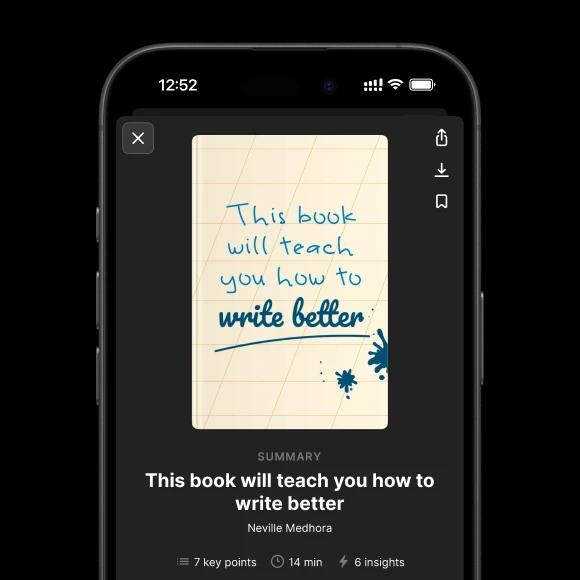
Curious to learn more? If you want to save tons of time on reading books about ways to write better, try the Headway app. You can find dozens of book summaries on writing techniques, strategies, and creativity. 15 minutes is enough to grasp the main takeaways and start using the insights in your first drafts!
Boost your career with Headway!
Beat other candidates by adding 20 times more books to your CV
Get a reading plan📘 Download Headway and start scaling your writing skills and creativity today!
Quick answer: How to become a copywriter in 2026
Here's a quick version of becoming a copywriter that comes down to three moves:
Learn how to write copy that sells: Pick up copywriting books from industry professionals. Even if you don't have time to read full books, Headway is the way out, as we offer book summaries in 15-minute text and audio formats.
Practice until it clicks: Write sample landing pages, email marketing campaigns, website copy. Your portfolio needs real work, even if your first projects are made-up clients.
Land your first copywriting jobs: Try Upwork for freelance work, send cold emails to small businesses, or check Facebook groups where startups hunt for copywriters. Early gigs won't pay much, but they prove you can do the work.
What does a copywriter do anyway?
A copywriter writes words in a form of content (articles, landing pages, newsletters, and case studies) that get people to do something: buy a product, sign up for a newsletter, click a button, or remember a brand.
Real-world examples:
Writing email marketing copies for a person who sells online courses
Creating landing pages for a tech startup
Scripting Facebook ads for a nonprofit
Rewriting or optimizing website copy for a small business
Social media posts for any possible brand
White papers or case studies that help sales teams close deals
Where you work changes everything:
Freelance copywriters have multiple clients, set their own pricing, and are able to move between different types of copywriting. You pick your projects and schedule, but you're also constantly looking for gigs and handling invoices.
Agency life means you're part of a creative team working on advertising copy and marketing campaigns for big brands. You get a steady paycheck and perks like health insurance, but expect late notifications and calls from clients who always need something ASAP.
In-house copywriters stay with one company full-time. You get stability and benefits, but you're writing for the same brand every single day, which can seem boring at times.
Day-to-day responsibilities:
Research your target audience and figure out what actually matters to them.
Write emails, ads, landing pages, and product descriptions.
Test different headlines and calls-to-action to see which ones convert.
Work with designers and marketers to bring campaigns to life.
Rewrite copy based on feedback (sometimes even 4 or 5 times).
Keep up with SEO practices, content, and digital marketing trends.
Copywriting definition: Copywriting means you write a persuasive text (called "copy") that motivates readers toward a specific action: buying a product or a service, joining an email list, or engaging with a brand.
A good copywriter doesn't just write well. They get marketing strategy, understand what makes people click, and know how to turn browsers into buyers. David Ogilvy, aka The Father of Advertising, called it "salesmanship in print." And it is still true to this day.
📘 A quick insight: Most copywriting pitches get ignored because they're too vague. Headway's summaries on marketing and writing show you how to write cold emails clients actually open — try the app before pitching your next client.
Is copywriting right for you?
Not everyone should become a copywriter, nor can everyone become one. Some people dislike writing to sell something, so if that's you, this probably isn't your path. But if you're still wondering whether a copywriting career makes sense for you, here's what actually separates people who make it from people who don't.
You might have what it takes if:
You have a constant curiosity about what makes people buy certain products or services
You can take a complex idea and explain it well in plain English
You don't let feedback like "no" or "rewrite this" bother you a lot
You see an ad and immediately think about why it worked (or why not)
Deadlines motivate you to be on track instead of freezing you up
You're fine with working alone for hours
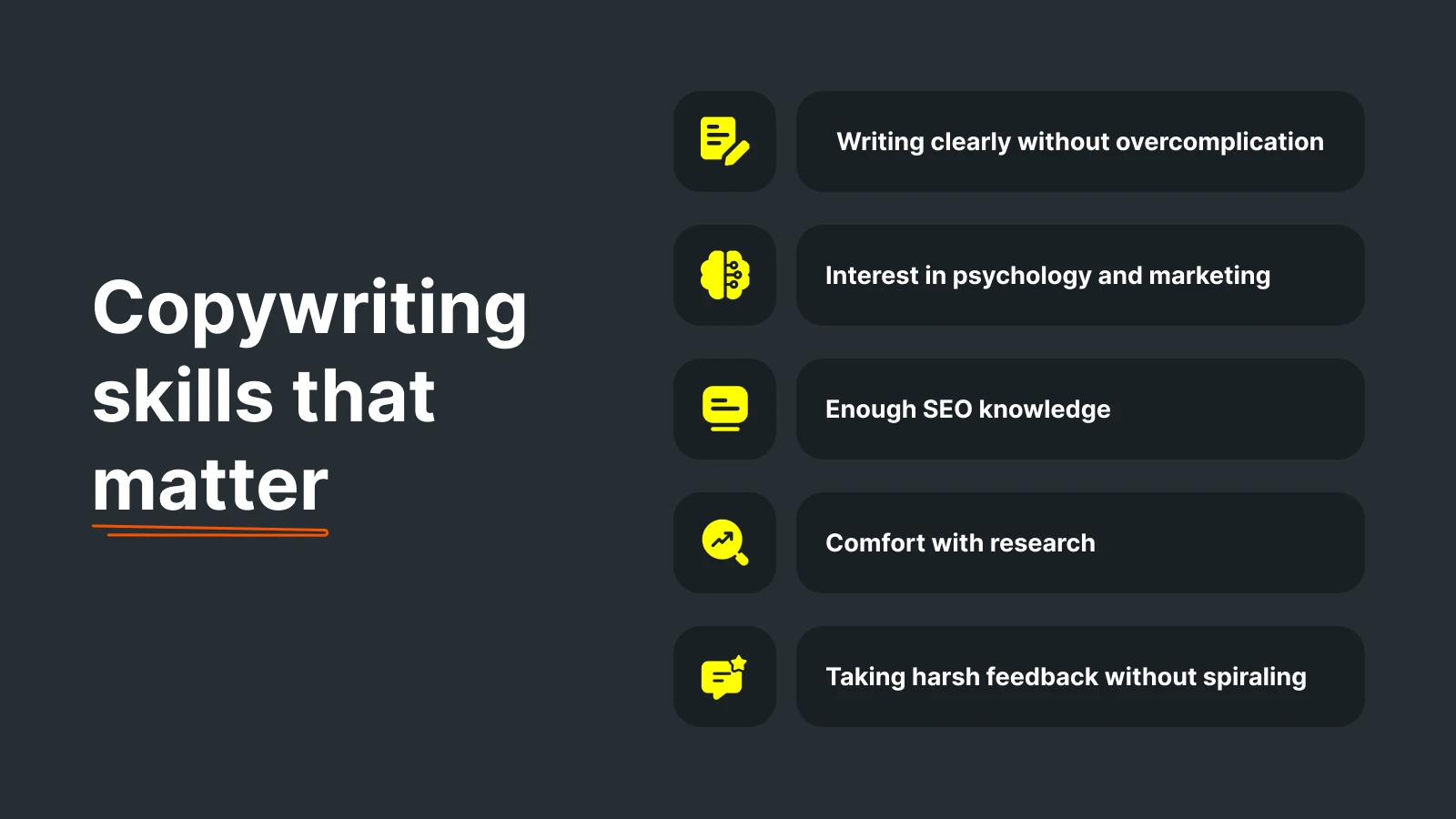
Copywriting skills that matter:
Writing clearly without overcomplication
Interest in people, psychology, and marketing overall
Enough SEO knowledge to make your copy easy to find in Google
Comfort with research (you'll write about industries you've never touched)
Ability to take harsh feedback without spiraling
Quick self-check:


What doesn't matter nearly as much:
A bachelor's degree in any specific or related field
Being a "creative type" (copywriting is closer to strategy than poetry)
A huge personal brand or LinkedIn following
Flawless grammar (you'll improve, and good copywriters hire editors)
Gary Halbert, the highest-paying copywriter in history, built a copywriting business without any fancy credentials. He studied what made people act, practiced it constantly, and wrote some of the best works in advertising history.
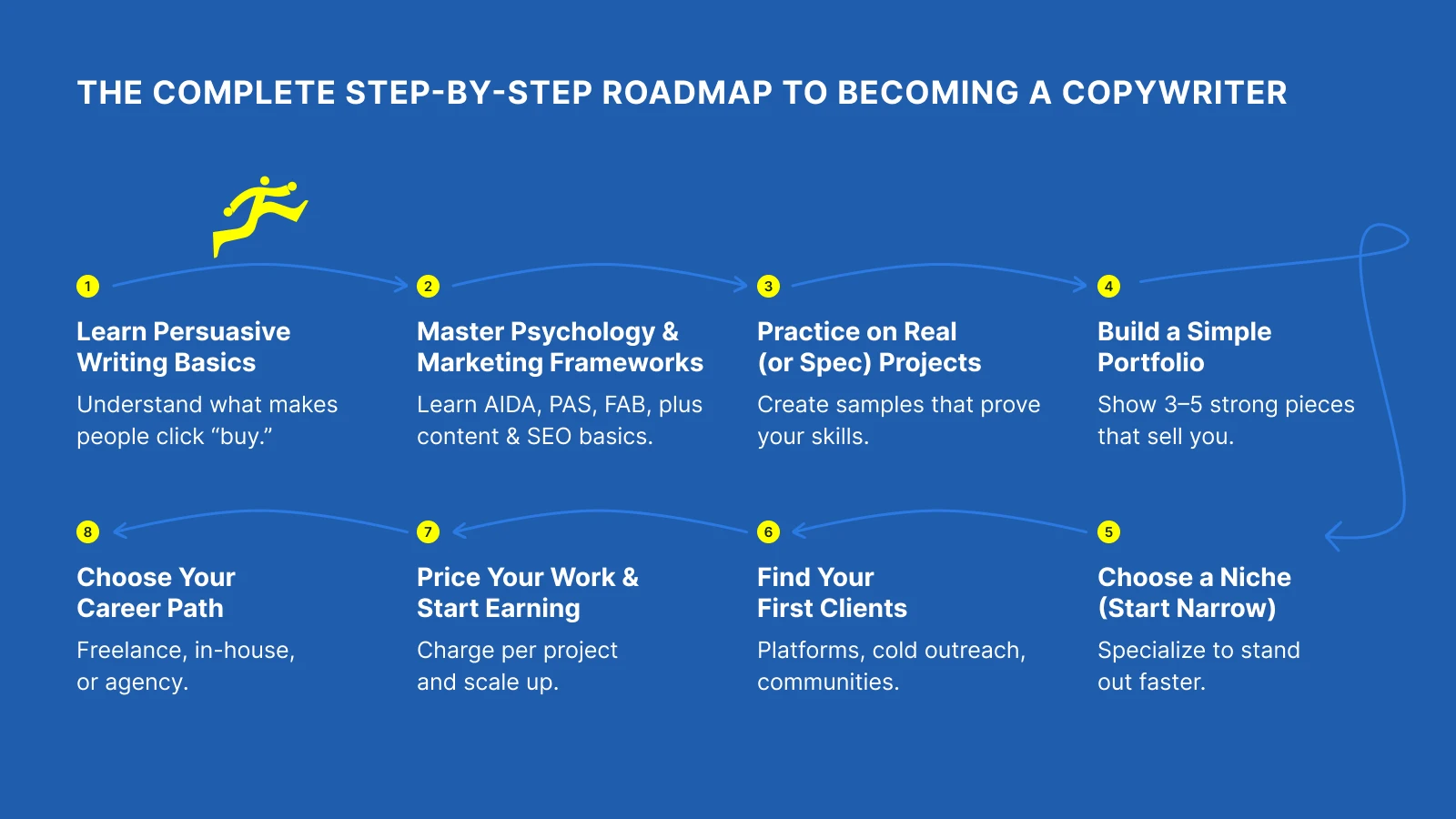
Step-by-step roadmap to becoming a copywriter
1. Learn the basics of persuasive writing
You can't write copy that sells without understanding what makes people click "buy." Start with copywriting books from legends who actually did this: David Ogilvy's 'Ogilvy on Advertising' and Gary Halbert's 'The Boron Letters.'
Skip expensive copywriting courses, at least for now. There are free resources everywhere: blogs, YouTube, LinkedIn posts, and newsletters. Save the courses for later when you know exactly what skill you're missing.
2. Master psychology and marketing principles
A great copy isn't the one with a rich vocabulary. It's the one about understanding your target audience better than they understand themselves. Learn these frameworks, as every successful copywriter uses them:
AIDA (Attention, Interest, Desire, Action)
PAS (Problem, Agitate, Solution)
FAB (Features, Advantages, Benefits)
Also, you should get comfortable with content marketing and SEO basics. There is no need to become an SEO wizard, but understanding search engine optimization makes your website copy and landing pages way more valuable to clients.
3. Practice with real projects (even fake ones)
Theory is great, but it won't land you copywriting jobs. Every beginner needs samples that prove their skills and that your copy works.
For instance, choose a small business you actually like: a coffee shop you visit, an online course you took, or a nonprofit you care about. Then, try rewriting their website copy and drafting three email marketing sequences. This way, you can practice and even offer to let them use your copy for free. You already have your first works published or used.
📘 A quick insight: Samples get rejected when they sound like they're written for everyone. Headway's summaries on storytelling and growth plans, like "Build a personal brand," teach you how to write for specific people — get the app and build a portfolio that clients want.
4. Build a portfolio that gets you hired
Potential clients want to spend money and get the services, but they also need proof that you're able to commit and have the skills for it. Use a simple template, something like a one-page site with your best samples. Show 3–5 pieces with variety: an email sequence, a landing page, social media posts, maybe some advertising copy (if any).
Also, you should add testimonials or feedback if anyone gives you one (even from practice clients or a friend's side project).
5. Pick a niche (or at least start narrow)
Generalists get lost in the noise, but specialists charge more and attract clients faster. It doesn't mean you must commit forever, but choosing one focus area builds expertise. Some high-paying options:
SaaS and tech startups
Health and wellness
E-commerce stores
B2B companies (they need white papers and case studies)
Financial services
Nonprofits running fundraising campaigns
6. Find your first clients
It sounds easier than it is, especially since this step freaks out most new professionals. Start on Upwork, yes, with lower rates at first because the competition is no joke. But it's the fastest way to get real freelance copywriting experience and testimonials, which you can use later to prove to other potential clients.
Also, consider sending cold emails to small businesses with a low-quality copy. Yes, most will ignore at first, but one or two will definitely give you a chance. It is a good idea to go through Facebook groups, LinkedIn, and online communities where startups and small business owners ask for help, too.
7. Price your work and start making money
Early on, charge per project rather than hourly, because pricing becomes clearer once you know how long things actually take you.
Rough rates for beginners are:
Email sequence (3–5 emails): $150–$400
Landing page: $250–$600
Social media posts (batch of 10): $100–$300
Website copy (5–7 pages): $500–$1,500
Raise your rates the moment you get better. Experienced freelance copywriters can charge $100–$300 per hour or $2,500–$15,000 per project, depending on the client's complexity and size.
8. Grow your copywriting career: freelance vs full-time vs agency
After landing a few gigs, it's time to decide which path you want to take:
Freelance copywriting gives you control because it depends solely on you: you pick your clients, set your pricing, and work from your couch. Keep in mind that income can bounce around, but good freelance copywriters can hit six figures without a boss.
Full-time in-house means greater predictability, as you work for one company and receive perks like health insurance and paid time off. But it also means less variety and versatility.
Agency work offers you structure and speed, as you'll handle bigger marketing campaigns and learn a lot. However, expect tighter deadlines and occasional late-night notifications.
Choose the one that best fits your values and lifestyle. Even if you won't like a chosen way of employment, you can easily go back and pick another one.
📘 A quick insight: Beginner copywriters leave thousands on the table because they guess at pricing. Headway's 15-minute summaries and growth plans like "Understand money psychology" cover what to charge and how to negotiate — stuff copywriting courses don't teach — download it now.
Tools, frameworks, and templates every copywriter needs in 2026
No, don't download fifty apps to write a great copy. Most successful copywriters use the same handful of frameworks and tools on repeat. Here are some of them:
Writing frameworks that work
These aren't theories you study once and forget — you'll use these on every project.
AIDA (Attention, Interest, Desire, Action): It basically means: hook readers with a headline, build interest by naming their problem, show what changes after they buy, and push for action with a button or link.
PAS (Problem, Agitate, Solution): Open with the problem your target audience has, then make it sting by showing what happens if they ignore it. Offer your solution as the fix.
FAB (Features, Advantages, Benefits): There is no point in just listing what a product does; explain why someone should care. "Sends daily reminders" (feature) becomes "You'll never skip a workout again" (benefit).
Tools copywriters actually use
Grammarly or Hemingway Editor: These platforms catch typos and flag too complex sentences.
Google Docs: Here is where the magic happens; it is free, shareable, and simple
ChatGPT or Jasper: You can use AI systems for brainstorming headline ideas or even generate outlines.
Ahrefs or SEMrush: Get great tools that show you what your target audience searches for when you're writing website copy involving SEO.
Canva: Mock up how your copy looks on a landing page (no need to ask a design friend for help).
Trello or Notion: Great organizational tools for tracking projects, deadlines, and revising notes.
CoSchedule Headline Analyzer: It scores your headlines before you choose one
Loom: record quick videos explaining revisions or walking potential clients through ideas.
Templates you can steal
Email marketing template:
Subject: [Hook with benefit or curiosity]
Opening: Name one pain point
Body: Make it worse, then show your fix
CTA: One clear action
P.S.: Add urgency or drop in social proof
Landing page template:
Headline: The big promise
Subheadline: Who does this help
Problem: What they're stuck on
Solution: How you can fix it
Proof: Testimonials or case studies
CTA: Button with action copy
FAQ: Answer objections early
Ad headline template (works for Facebook, LinkedIn, and other social media apps):
[Number] ways to [result] without [obstacle]
"Stop [pain]. Start [benefit]."
"What [audience] miss about [topic]."
Cold email template for landing clients:
Subject: Idea for [company name]
Hi [Name], saw [specific thing on their site]. Think [one improvement]. Helped [similar business] get [result]. Open to chatting about [project type]? [Name]
Pricing and rates for copywriters
Figuring out what to charge is one of the hardest parts early on. Most beginners either undercharge out of fear or pick a random number and cross their fingers. Here's how pricing actually works in the real world.
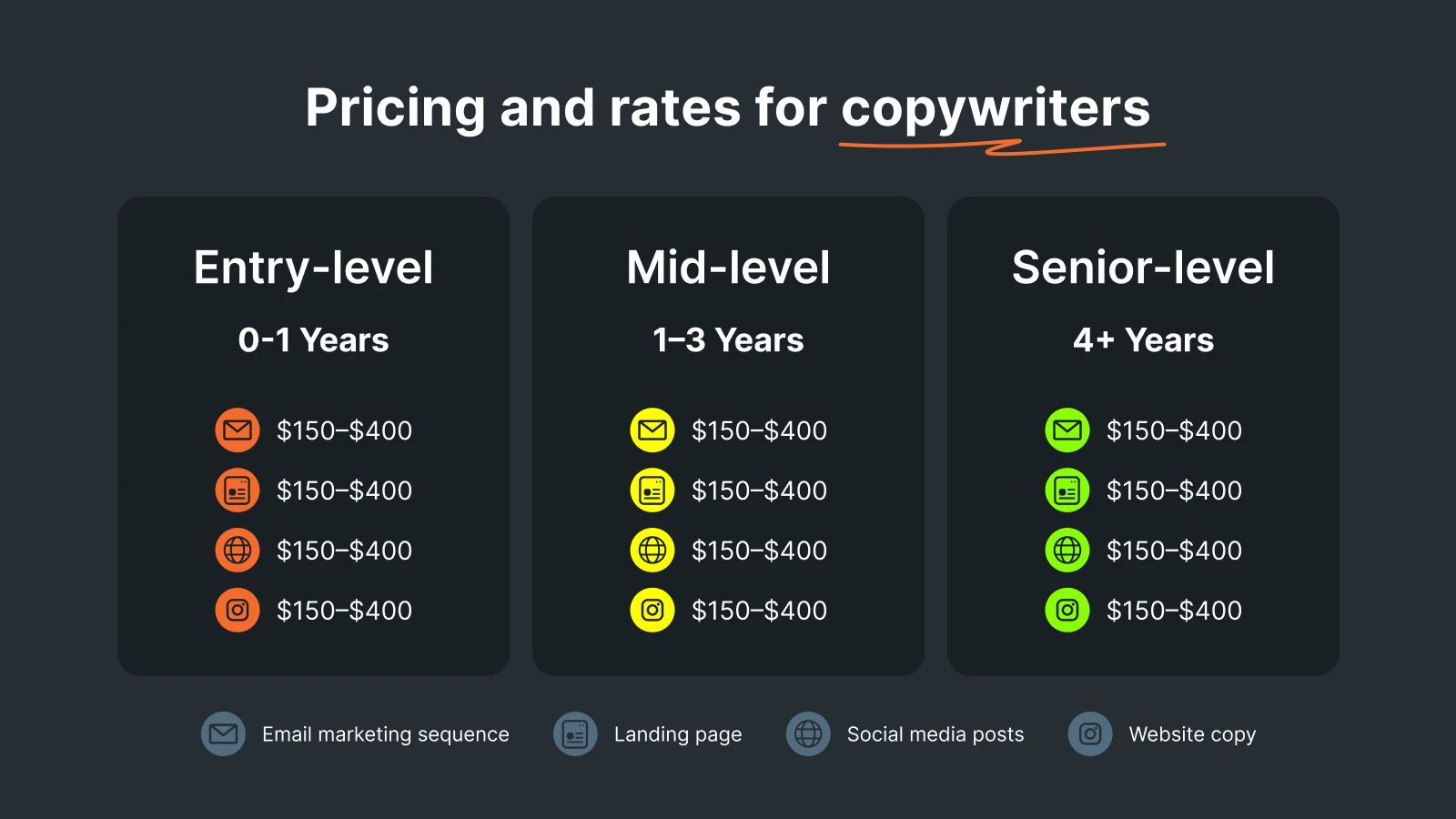
What copywriters charge (real numbers)
Your rates shift based on experience, specialization, and whether you're doing freelance work or sitting in an office.
Beginners (0–1 year):
Email marketing sequence (3–5 emails): $150–$400
Landing page: $250–$600
Social media posts (10-pack): $100–$300
Website copy (homepage plus 4 pages): $500–$1,200
Intermediate (1–3 years):
Email sequence: $500–$1,500
Landing page: $800–$2,500
Social media posts: $300–$800
Website copy: $1,500–$5,000
Experienced (over 4 years or strong specialization):
Email campaigns: $1,500–$5,000
Landing pages: $2,500–$10,000
Long-form sales pages: $5,000–$20,000+
Complete website: $8,000–$30,000+
Hourly rates for freelance copywriters run from $50 per hour (just starting) to $150–$400 per hour (specialists with proven results). But most clients want project pricing so they know costs upfront.
Quick pricing formula
Try using this formula: Take a guess at how many hours a project takes, then multiply that by your hourly rate, and tack on 20–30% for revisions. This is your quote.
Example: You calculated that writing 1 landing page takes around 6 hours, and your rate is $75 per hour. Base = $450; add a 25% cushion = $562, which you can round to $600. Once you get faster, you earn more per hour at the same price. Some successful copywriters charge $4,000 for articles that take them about 10 hours to write.
When to raise your rates
First of all, don't email everyone to announce a price change. You should raise rates for new potential clients and let existing clients keep their current rates (unless the workload is larger or more complex).
Change your pricing only when you have proven results, your calendar is packed, or clients keep saying yes without pushback. A good copywriter, the one who knows marketing and always hits deadlines, can charge even double the rate.
Also, don't lower your prices so they become "more affordable." Think about the value you create, not the hours you clock. Only this way can copywriting become a real profitable business, not an exhausting hustle.
📘 A quick insight: New freelance copywriters report tanking client relationships by taking feedback personally. Headway's growth plans, like "Communicate better at work" and "Develop your career," can help you with that — download the app now before your first paid project.
Case studies and examples: What makes copy actually work
Reading about copywriting is helpful. Seeing real before-and-after examples shows you what actually gets people to act.
Example 1: Email marketing that converts
Before (weak):
Subject: New Product AvailableHi, we launched a productivity app. It has lots of features, and we think you'll like it. Click here to learn more.
After (strong):
Subject: You're losing 2 hours a day (here's how to get them back)You planned to finish that project by noon. Now it's 4 pm, and you're drowning in your inbox. This app blocks distractions, batches tasks, and gives you those 2 hours back. Over 500 people are already using it. Try it free for 14 days — no card needed.
What changed: The second version hits a pain point your target audience feels every day, puts a number on it (2 hours), drops in social proof (over 500 users), and removes friction (no card).
Example 2: Landing page headline
Before: "The Best Project Management Software"
Every startup says they're "the best." Nobody cares.
After: "Stop losing tasks in Slack. See every project in one place."
This example names the exact frustration (tasks buried in Slack), promises a fix (one view), and speaks directly to teams drowning in messages.
Example 3: Social media posts for ads
Before: "Our course teaches copywriting. Enroll today!"
Generic. No reason to believe it works.
After: "Landed my first $2K client 6 weeks after this course. Now I'm booked through March." — Sarah T.
Leading with a testimonial builds trust instantly. Real results beat claims every time.
Career outlook and trends: The future of copywriting
Are you worried that AI will kill copywriting jobs? It won't, but it definitely changes the way you work.
What's happening right now
LinkedIn shows demand for copywriting skills jumped 35% in two years. Companies need writers who understand people, not just bots cranking out SEO keyword stuffing.
The US Bureau of Labor Statistics expects steady growth for writers through 2034. Digital marketing continues to grow, which means brands need more landing pages, email marketing, social media posts, and website copy.
AI shifts things, but doesn't replace you
ChatGPT can spit out rough drafts fast, which is useful for headline ideas or punching up weak sentences. But it can't interview your target audience, figure out what scares them at 2 am, or write copy that sounds like a real person.
Clients don't want robot text. They want a successful copywriter who gets their business, asks good questions, and creates messaging that actually works.
Where the work is
Some areas are hotter than others:
SaaS and tech startups need copywriters who understand product growth and can write landing pages that don't confuse people.
E-commerce wants email marketing, product pages, and ad copy that turn browsers into buyers.
B2B companies need white papers, case studies, and website copy that explain complex services without putting people to sleep.
Health and wellness are massive and heavily regulated, so copywriters who know the rules get paid well.
Nonprofits run fundraising campaigns constantly, and often have real budgets for solid writers.
What separates people who make it
Writing great copy is just the starting point, but what exactly pushes some copywriters ahead?
Range: Jumping between email marketing, ads, landing pages, and social media posts without your quality dropping
Speed: Startups especially want fast turnarounds
Strategy: Knowing how your copy plugs into bigger marketing campaigns and business goals
Reading data: Checking what's working, tweaking based on actual numbers
David Ogilvy built everything on testing. Gary Halbert studied people obsessively. Those fundamentals haven't moved. Platforms change, tools shift, but copywriting still comes down to understanding your target audience and making them act.
If you're ready to learn, adapt, and do the hard work, there's more opportunity in this copywriting career than before. Winning brands invest in real copywriters who will benefit their business goals.
Start your copywriting career with Headway!
You know what copywriters do now. How to build a portfolio, find clients, and price your work. The frameworks, the tools, all the steps to become a copywriter. What separates people who make it from people who don't? Actually starting.
Reading full copywriting books eats up a lot of time that most people don't have. Headway fixes that. Get the insights in 15 minutes. Learn persuasive writing and marketing psychology during your lunch break.
Boost your career with Headway!
Beat other candidates by adding 20 times more books to your CV
Get startedFreelance work means handling social situations with clients you've never met, maybe some public speaking when pitching projects, and figuring out your own way through an extroverted world that doesn't always make sense. Taking care of your mental health matters when you're building something from scratch.
Try these book summaries first:
'Unleash the Power of Storytelling' by Rob Biesenbach
'Scientific Advertising' by Claude C. Hopkins
'How Brands Grow' by Byron Sharp
'Thinking with Type' by Ellen Lupton
'Steal Like an Artist' by Austin Kleon
📘 Stop reading — download Headway and start writing!
FAQs about how to become a copywriter
How do I start being a copywriter?
You should start by identifying your strengths and weaknesses. This way, you'll know which skills of yours need to be improved. Then, try to create a portfolio (if you've done a few projects before); if not, practice on not-so-perfect copies you see from ads or social media posts of local brands. You might not get paid right away, but you're creating cases to show off to your potential clients later.
Can I make 5000$ a month with copywriting?
Yes, absolutely. It is possible to earn even more with copywriting jobs. However, the salary depends solely on a few factors: the type of employment (freelance, in-house, hybrid), experience (senior copywriters get paid much more than junior ones), and how well you can assess your expertise and skills.
What does a copywriter do exactly?
Copywriters craft texts that are gonna be used for many different reasons and purposes (slogans, scenarios, ads, social media posts, SEO articles, landing pages, white papers — the list goes on and on). They're professionals who know how to catch the reader's attention and push them toward the intent, whether it is to buy a product or service, raise brand awareness, or something else.
Is ChatGPT going to replace copywriting?
Not really. Think about it this way: people now are using the AI bots actively to create a few quick copies and don't really care about the quality of these texts. Readers are no fools; they can sense when something is not authentic. However, a great copywriter learns to leverage tools like these (for research, article outlines, and headline ideas).