Self-growth
 Apps & Digital Tools
 Business & Career
 Success
 Growth Tools
 Psychology
 Communication
 Relationships
You’ll learn
- Why big brands aren't better loved
- Who your most valuable customers really are
- When keeping customers is the wrong goal
- Why great ads still fail to sell
first KEY POINT
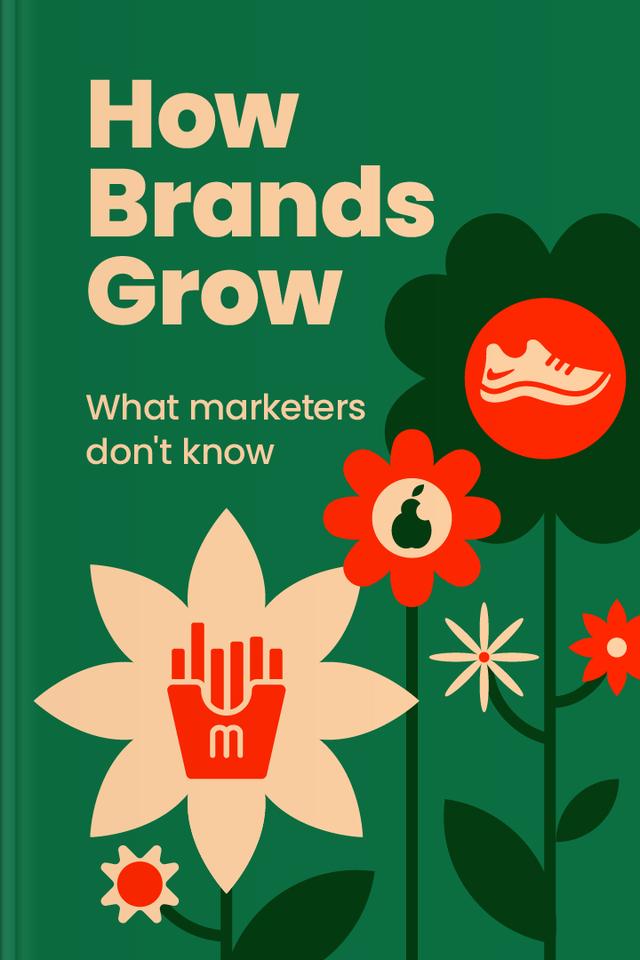
Some brands become household names. Others stay small even when customers like them, the product works, and the marketing looks perfectly sensible. You can probably name one of each. The usual explanations focus on what makes the winners special. They've got stronger loyalty, sharper positioning, a better-defined audience, or customers who feel attached to the brand.Byron Sharp starts somewhere else entirely, with what people actually buy. He drew on huge sets of purchasing data across categories, countries, and years. The same patterns kept showing up, often across brands that seem to have nothing else in common.Those patterns don't sit well with many familiar assumptions about loyalty, targeting, differentiation, and advertising. Some ideas that sound sophisticated turn out to matter far less than you'd expect. It's much simpler factors that do most of the work in deciding whether a brand stays small or grows.This summary follows Sharp's answer through the data, the marketing myths it unsettles, and the rules that emerge once those patterns become visible.
second KEY POINT
Every category has its giant, and everyone has a theory about how it got there. Usually, that theory involves loyalty. Somewhere behind a dominant market share, we assume, there's a devoted group of customers who keep choosing the same brand and rarely stray.Take two British laundry brands, Persil and Surf. One's a household name at home; one isn't. Persil was roughly a fifth of the laundry aisle, and Surf was a sliver of it. If Persil's lead came from stronger loyalty, its customers should have been buying it far more often. They weren't.Over a year, Persil buyers bought it 3.9 times on average, and Surf buyers bought it 3.4 times. That's barely a gap. The real difference was how many households bought at all. About 41% bought Persil, against 17% for Surf.Sharp's name for this pattern is the double jeopardy law. Smaller brands suffer in two ways: they have fewer buyers, and those buyers tend to purchase them slightly less often. Both matter, but it's the first one that does the damage. The same thing shows up in market after market, decade after decade.There's a tempting alternative here. If adding buyers is hard, why not get the ones you already have to buy more often? Marketers often point to Arm & Hammer, a baking soda brand, as proof that it's possible. In North America, baking soda sat in the cupboard for baking and not much else, so the company sold people on a second use: put an open box in the fridge to absorb odors.Sharp's answer is basically that the example was already old when he was studying marketing. And decades later, it's still the one everyone reaches for. If lifting purchase frequency were an easy route to growth, there'd be a lot more famous examples.The problem is that habits are stubborn. Even dentists can't reliably get people to brush twice a day. Associations are stubborn, too: a product mentally filed under "baking" doesn't easily become part of the "fridge deodorizer" category. And changing how millions of people use a product usually requires enormous marketing effort. Unilever once encouraged men to spray Axe over their bodies like perfume. Most continued using it under their arms.So, if sales come down to how many people buy and how often, you've got far more room to move the first number.
Continue reading with Headway app
Continue readingfirst KEY POINT
second KEY POINT
third KEY POINT
fourth KEY POINT
fifth KEY POINT
Related blog articles

Elevate the way you learn with Headway — the smart, streamlin...

Discover top apps that help you learn in just 10 minutes a da...

Curious about the Deepstash app? Find out if this app offers ...

The answer to the question "Is Blinkist worth it?" depends on...

Discover practical tips, expert insights, and book-powered to...