Self-growth
 Apps & Digital Tools
 Business & Career
 Success
 Growth Tools
 Psychology
 Communication
 Relationships

Do you freeze when meeting new people, then replay the conversation in your head for the rest of the week?
Here's how to talk to anyone: focus on making the other person comfortable instead of trying to sound impressive. Use open body language and a warm smile, greet them with a simple opener about the shared situation, ask an open-ended question, listen for one detail you can follow up on, and share enough about yourself to keep the exchange balanced. These habits carry you through everyday social situations, work events, and even video calls.
They're also the core skills behind 'How to Talk to Anyone' by American communication expert Leil Lowndes, plus classics like Dale Carnegie's 'How to Win Friends and Influence People.' This guide walks you through the method first, then points you to the books behind it.
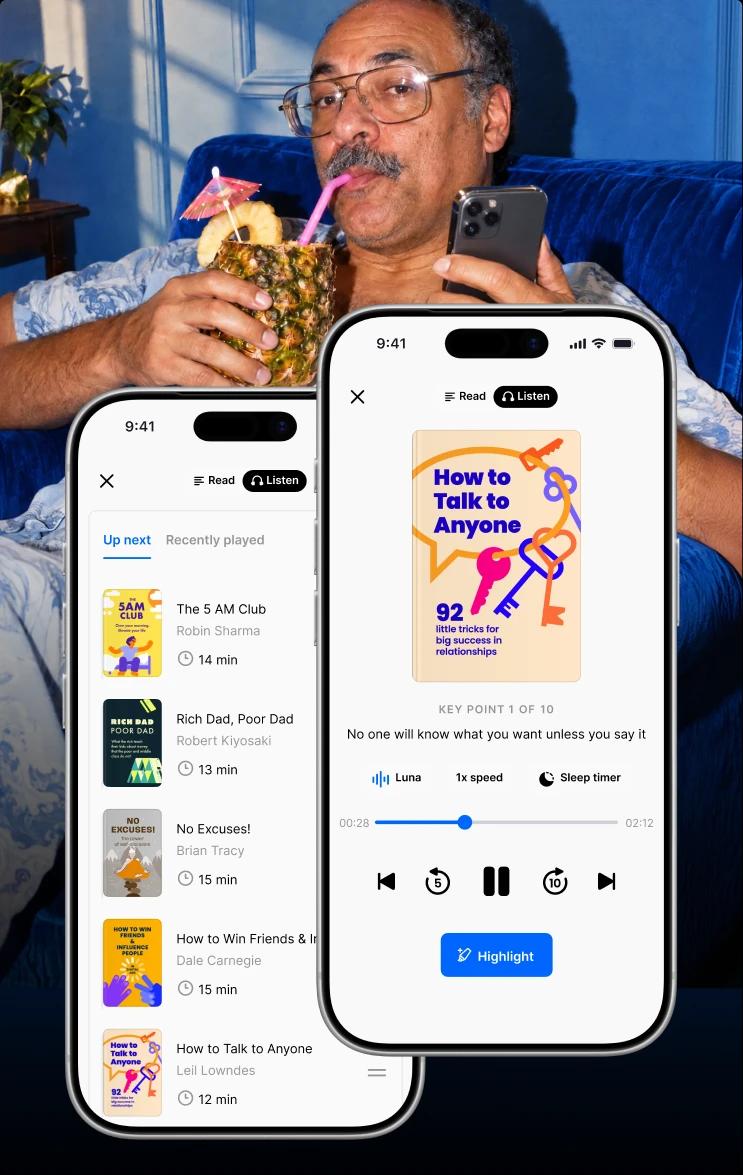
📘 Try the Headway app to learn techniques from the best communication books in 15-minute summaries — read or listen on any schedule.
Quick answer: How to talk to anyone (TL;DR)
Short on time? This seven-step loop works in almost any conversation:
| Step | What to do | Example |
|---|---|---|
1. Signal openness | Relax your posture, make natural eye contact, and smile. | "Hi — I don't think we've met yet. I'm Sam." |
2. Start with shared context | Comment on what's happening around you instead of hunting for a clever line. | "How do you know the host?" |
3. Ask an open-ended question | Use what/how questions that invite more than yes or no. | "What got you interested in this?" |
4. Listen for one detail | Give the other person your full attention and pick one thing to follow up on. | "You said you just moved — how are you finding it?" |
5. Build rapport | Use their name naturally, empathize, and look for common ground. | "I know what you mean — that first week can be a lot." |
6. Share, don't interrogate | Offer a short related detail about yourself, then hand the conversation back. | "I had the same problem when I started. What helped you?" |
7. Exit gracefully | End while the exchange still feels good. | "Great talking with you — I hope we catch up again." |
Quiz: What's your conversation style?
Discover your communication strengths and areas for growth!
Ready to improve your conversation skills?
No matter your current style, the Headway app offers practical, science-backed techniques from communication experts in just 15 minutes a day.
Melissa Sierra, an EVP at Media Integration, noticed the difference those daily summaries made in how she speaks and writes at work:
"I now ensure my words have meaning, and that I have an understanding of who is on the other side receiving my information."
— Melissa Sierra, EVP, Media Integration at USIM
📘 Get the proven techniques from the best communication books — summarized in 15 minutes — with the Headway app.

Why talking to people can feel so hard
If small talk drains you, nothing is wrong with you. A few common reasons explain why social interactions feel heavier than they should.
Overthinking is the big one. When you rehearse every sentence before you say it, you stop hearing your conversation partner and start performing. Negative past experiences pile on top — one awkward exchange in a meeting can convince you that every future one will go the same way.
Habits play a role, too. If most of your daily contact happens through social media, face-to-face conversation gets less practice than it used to, and any skill gets rusty without reps. The fix is not a personality transplant. It's a small set of repeatable moves, practiced in low-stakes moments.
How to talk to anyone: Seven skills that make conversations easier
Each skill below follows the same pattern: the principle, what to do, and the mistake to avoid. Together they form one loop — open, ask, listen, connect, share, exit.
1. Make a strong first impression with body language
People read your body language before they process a single word. Your posture, warm smile, eye contact, and tone of voice signal whether you're safe to approach — often within the first few seconds of an interaction.
What to do: uncross your arms, face the person, and hold natural eye contact — a few seconds at a time, not a stare. Keep your tone of voice relaxed and unhurried. When they speak, give them your undivided attention instead of scanning the room.
Leadership consultant Carol Kinsey Goman breaks these cues down further in her ten body language tips, but posture, smile, and eye contact cover most everyday situations.
The mistake to avoid: nervous movement. When you fidget with your phone, keys, or sleeve, you signal that you'd rather be somewhere else, even when you wouldn't.
2. Greet people and start small talk naturally
The best openers come from the situation you're both in, not from a memorized script. Small talk exists to signal friendliness, so a simple greeting plus one observation is enough.
At a work event, try "Mind if I join? I barely know anyone here." Waiting in line, try "Did we both pick the worst time to come?" Meeting someone for the first time at a party, "How do you know the host?" beats rehearsed icebreakers because it's grounded in shared context.
"Where are you from?" works too — just read the room, since a shared-situation question is often the safer first move. Save the personal questions for after the conversation warms up.
3. Ask open-ended questions
Closed questions get you one-word answers. Open-ended questions — the ones starting with "what" and "how" — hand your conversation partner an invitation to talk about something they care about.
Compare "Do you like your job?" with "What do you like most about what you do?" The second version starts a good conversation; the first one usually ends it. Ask one question, let them answer fully, then follow the thread instead of firing off the next question on your list.
One caution: space your questions out. Three rapid-fire questions in a row feels like an interview, not a conversation.
4. Practice active listening
Most people listen just enough to plan their reply. Active listening flips that: you give the speaker your full attention, then respond to what they actually said.
The loop is simple. Listen without rehearsing your response. Reflect back the key point ("So the move happened faster than you expected"). Clarify anything vague ("What made the timeline change?"). Then follow up on the detail that mattered most to them.
When you empathize out loud — "That sounds stressful" — you show the other person their words landed. That feeling of being heard is what turns strangers into friends, and it's the core of learning to communicate effectively anywhere. In 'Supercommunicators,' Charles Duhigg shows that the people others love talking to are usually the best listeners in the room, not the best talkers.
"There are two kinds of people in this life: Those who walk into a room and say, 'Well, here I am!' And those who walk in and say, 'Ahh, there you are.'" — Leil Lowndes, 'How to Talk to Anyone'
5. Build rapport without forcing it
Rapport grows from small signals of similarity. Use the person's name once or twice — it makes the exchange feel personal, though repeating it in every sentence has the opposite effect.
Lowndes recommends subtle mirroring, sometimes called parroting: loosely matching the other person's pace, volume, and energy. Keep it light. Literal copying of gestures feels unnatural fast, so match the vibe, not the choreography.
Sincere praise helps, too. A specific compliment — kudos for a presentation they gave, or a project they mentioned — builds warmth, while generic flattery reads as trying too hard. Ask about their well-being as you mean it, then listen to the answer. Common ground plus genuine interest is how meaningful conversations start.


6. Adapt to the social situation
One approach won't fit literally everyone, and that's the point: reading the context is a conversation skill of its own — one of several types of intelligence you can train. Here's how the same loop flexes across common situations:
| Situation | What changes | Try this |
|---|---|---|
Strangers | Keep stakes low; shared context first. | "That looks good — what'd you get?" |
Co-workers | Reference shared work, not gossip. | "How's the launch treating you?" |
An old friend | Lead with the gap, not guilt. | "It's been ages — what's changed since I saw you last?" |
Networking | Research attendees beforehand; ask about their work first. | "I read about your project — what's next for it?" |
Introverts (you or them) | Fewer, deeper exchanges over working the room. | "I'd rather have one real conversation than ten quick ones — what are you into lately?" |
Phone and video calls | Your tone of voice and their name do the work your posture usually does. | "Good to see you, Maria — how's your week going?" |
The same cues apply on video calls as in person — minus the handshake. Long before video, phone-first teams like sales reps and call center agents learned that a smile changes your tone of voice even when nobody can see it.
Whether you're talking with a client, a co-worker, or an educator at your kid's school, the loop holds: open, ask, listen, follow up. And if workplace conversations are your priority, our guide on how to speak like a CEO builds on the same foundation.
7. Keep the conversation balanced and exit well
A great conversationalist shares just enough. After the other person answers, offer a short, related detail about yourself, then pass the conversational ball back with another question. Talking only about yourself kills the exchange, but so does interrogating without ever revealing anything.
Silences will happen. Instead of panicking, loop back to something mentioned earlier or observe the moment out loud. And when the energy dips, end on a high note: "Great talking with you — I'm going to grab a drink, but I hope we catch up again." A graceful exit leaves the door open for the next conversation.
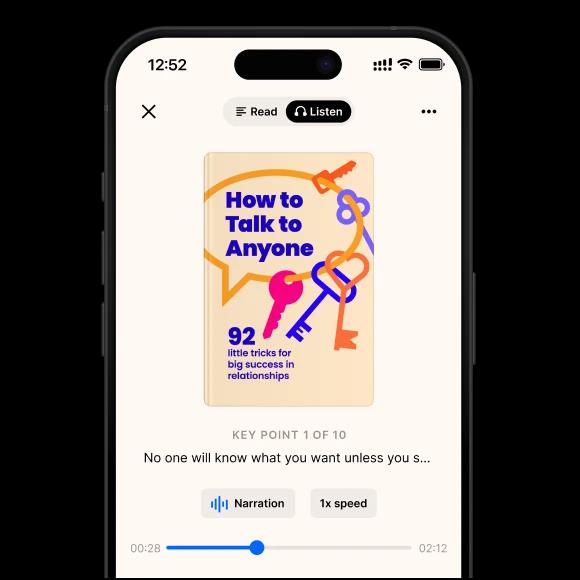
📘 Want all 92 techniques from Lowndes? Read or listen to the 15-minute summary of 'How to Talk to Anyone' on Headway and start using them today.
Conversation starters for any situation
Wondering how to start a conversation with a stranger without freezing mid-sentence? These conversation starters hand you the exact words for the most common settings.
| Setting | Opener | Easy follow-up |
|---|---|---|
Coffee shop | "That looks good — what'd you get?" | "Worth ordering again?" |
Work event | "Mind if I join? I barely know anyone here." | "How do you know the host?" |
Waiting in line | "Did we both pick the worst time to come?" | "Are you a regular?" |
Online | "Noticed you're into [hobby] too — how'd you start?" | "Any tips for a beginner?" |
Compliment | "Where's that jacket from? I love it." | "Do they make other colors?" |
New co-worker | "First week? How's it going so far?" | "What are you working on?" |
Reconnecting | "It's been forever — what's new with you?" | "Are you still into [old shared interest]?" |
Video call | "Before we start — how's your week been?" | "What's keeping you busy outside work?" |
Treat these as training wheels, not scripts. Once the other person responds, drop the list and follow their answer.
What not to do when talking to people
Most advice on how to talk to people covers what to do, but a few habits reliably sink conversations even when your intentions are good:
Staring. Eye contact should feel like checking in, not surveillance. Look away naturally as you think.
Overusing their name. Once or twice builds warmth; every sentence sounds like a sales call.
Forced mirroring. Copying gestures move-for-move reads as mockery. Match energy, not motion.
Flattery instead of praise. Vague compliments feel hollow. Specific ones land.
Turning the exchange negative. Complaining bonds people briefly, then drags the mood down. Keep early conversations light.
Performing vocabulary. You don't need a thesaurus to connect. If English isn't your first language, a simple question asked with genuine interest beats a sophisticated sentence every time.
Every one of these mistakes comes from the same root: focusing on how you're coming across instead of on the person in front of you. Redirect your attention outward, and most of them fix themselves.
Best books for communication skills
Books give you the theory; conversations give you the practice. These four cover the widest range of social skills — all available as short summaries on Headway.
'How to Talk to Anyone' by Leil Lowndes. Ninety-two specific techniques for first impressions, small talk, and rapport, from a communications coach who has trained Fortune 500 executives. Start here for tactics you can use today.
'How to Win Friends and Influence People' by Dale Carnegie. The self-help classic on making people feel valued. Nearly a century old and still the foundation most modern communication skills advice builds on.
'Never Split the Difference' by Chris Voss. A former FBI hostage negotiator on getting people to open up — useful far beyond negotiations, especially for tense or high-stakes talks.
'Influence: The Psychology of Persuasion' by Robert Cialdini. Explains why people say yes and how to apply those triggers ethically in everyday conversations and at work.
'The 48 Laws of Power' by Robert Greene. A guide to tricky social dynamics and workplace politics, drawn from history's most influential figures.
'Unleash the Power of Storytelling' by Rob Biesenbach. Turns ordinary exchanges into stories people remember — whether you're pitching an idea or chatting at a party.
📘 Explore summaries of the best books for communication skills on Headway — Lowndes, Carnegie, and hundreds more, in about 15 minutes each.
What do charismatic people do differently?
Top experts reveal the small shifts that change how everyone responds to you.
Get the insightLearn how to talk to anyone with Headway — one summary a day
Learning how to talk to anybody is a skill you build, not a gift you're born with — and the fastest way to build it is one technique at a time. Pick a single move from this guide, use it in a low-stakes conversation today, and let the repetition do the work.
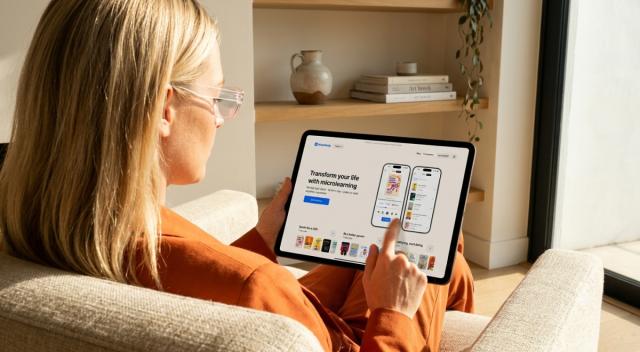
Headway makes the learning half easy. The app turns titles from its communication library — including 'How to Talk to Anyone' — into 15-minute text and audio summaries, so you can pick up a new technique on your commute and test it by lunch. Over 55 million users learn this way, and the app holds a 4.6 rating on both the App Store and Google Play.
📘 Pick one conversation skill and practice it today — then let Headway teach you the next one in a short daily summary.
Frequently asked question on how to talk to anyone
How do I become a better active listener in conversations?
Focus completely on the speaker and stop planning your reply while they talk. Reflect back their key point, ask one clarifying or follow-up question, and notice the emotion behind the facts. Brief verbal cues like "right" or "that makes sense" show engagement without interrupting. The goal is to make your conversation partner feel understood, not to prove you have a response ready.
How do I talk to people when I don't know what to say?
Start with the shared situation — the event, the line, the weather, whatever's in front of you both. Then ask one easy open-ended question and listen to the answer. You don't need a clever opener; a simple observation plus a follow-up carries most conversations. Most people are relieved someone else spoke first, so the bar is lower than your nerves suggest.
How to speak to anyone without sounding awkward?
Use simple language, a relaxed tone of voice, and natural eye contact, and put your attention on the other person instead of monitoring every word you say. Accept that some awkwardness is normal — pauses and fumbled sentences happen in good conversations, too. When you stop treating small stumbles as failures, they stop derailing you, and you come across as more at ease.
How can introverts learn how to talk with anyone?
Play to your strengths. Introverts usually prefer depth over volume, so aim for one real conversation instead of ten quick ones. Prepare two or three backup questions to reduce mental load, lean on active listening, and schedule recovery time after social events. Learning how to talk to anybody doesn't require becoming an extrovert — genuine curiosity matters more than high energy.
How to speak nicely to everyone, even people you disagree with?
Separate the person from the position. Ask questions to understand their view before responding, keep your tone of voice even, and acknowledge fair points out loud. There's no single formula for how to talk to everyone — one approach never fits all — but respect and curiosity keep almost any exchange civil. Disagreement handled well can even deepen a relationship rather than damage it.
Can I learn how to talk to everyone for free?
Yes. Practice one skill at a time in everyday low-stakes conversations — with baristas, neighbors, co-workers — and reflect on what worked afterward. Free microlearning apps, library copies of communication books, and interview podcasts all help; listening to how a good podcast host asks follow-up questions is a masterclass on its own. Paid apps add structure, but real conversations are the classroom.
Is there an app that can help me learn how to talk to anyone?
Yes — book-summary and self-improvement apps teach communication techniques in short lessons you can apply the same day. Headway includes 15-minute summaries of 'How to Talk to Anyone,' Dale Carnegie's classic, and other communication and self-help titles, in text and audio. The app supplies the techniques; your daily conversations supply the practice that makes them stick.
What are the best books for communication skills that can help me learn how to talk to anyone for free?
Start with 'How to Talk to Anyone' by Leil Lowndes for quick, practical tactics and 'How to Win Friends and Influence People' by Dale Carnegie for the relationship fundamentals. Add 'Supercommunicators' by Charles Duhigg if you want the research on what makes conversations click, and 'Never Split the Difference' by Chris Voss for high-stakes talks. All four are summarized on Headway.