Self-growth
 Apps & Digital Tools
 Business & Career
 Success
 Growth Tools
 Psychology
 Communication
 Relationships

That's the real question behind the Deepstash vs Blinkist debate. Both platforms compress big ideas from nonfiction books into minutes-long sessions, and both have earned massive audiences doing it. But they take opposite routes: Deepstash chops knowledge into swipeable idea cards, while Blinkist condenses whole books into 15-minute "blinks."
Here's how the two compare on library, format, audio, and pricing — and why the most useful answer to "Deepstash or Blinkist" might be a third app entirely.
📘 Spoiler ahead: Take Headway's quick quiz and get a personalized growth plan before you finish reading!
Deepstash vs Blinkist: Who wins? The quick answer
Blinkist wins on depth and library size. With 9,000+ titles, complete 15-minute book summaries in text and audio, expert Guides, and Blinkist AI for summarizing outside content, it's the stronger tool for structured learning.
Deepstash wins on price of entry and browsing. Its free plan offers unlimited browsing of 200,000+ idea cards drawn from 5,000+ books plus articles, podcasts, and videos — a genuinely fun doomscrolling alternative.
However, there's a catch. Both apps optimize for consuming content, not remembering it. If your goal is lasting personal growth, keep reading — the retention question changes the verdict.
All app features described in this article are accurate as of August 2026. Prices may vary depending on your region, current promotions, and seasonal offers.
Quick comparison: Blinkist vs Deepstash at a glance
Feature | Deepstash | Blinkist |
Core format | Short idea cards curated from books, articles, podcasts, and videos | 15-minute summaries ("blinks") of full books and podcasts |
Library | 5,000+ books, 200,000+ idea cards | 9,000+ book and podcast summaries |
Downloads | 10M+ | 43 million across platforms |
Ratings | Not published on its homepage | 4.7 stars average on iOS and Google Play |
Audio | Listening to ideas is a Pro feature | Text and audio on every summary |
Extras | Personalized growth plan, scan books, save ideas to "stashes" | Blinkist AI (Pro), expert Guides, Spaces, Shortcasts |
Free plan | Unlimited browsing with ads; saving, audio, and offline locked | One pre-selected book summary per day |
Offline access | Pro feature | Yes, for downloads |
Platforms | App Store, Google Play, web | iOS, Android, web, CarPlay, Android Auto |
Paid plans | Deepstash Pro subscription and a Lifetime Pro option | Premium and Pro, both billed for 12 months |
What is Deepstash? A quick look
Deepstash, built by Brainstash, Inc., is a platform where users read and curate bite-sized insights from across the web — books, articles, podcasts, and videos. It works like a knowledge feed: you scroll idea cards on topics like Productivity, Psychology, and Personal Development, then save the keepers to your personal collection.
Deepstash key features | App pros | App cons |
200,000+ idea cards from 5,000+ books | Free plan allows unlimited browsing | Ideas are fragments, not complete book summaries |
Sources span books, articles, podcasts, and videos | Playful, colorful user interface | Free plan shows ads |
Personalized growth plan | Lifetime Pro option for one-time-payment fans | Saving, listening, and offline access require Pro |
Scan books to pull ideas from physical copies | Available on the App Store, Google Play, and web | Primarily English-language content |
Any honest Deepstash review starts with the format. A Deepstash card takes seconds to read — perfect for a queue or an elevator ride. But a card from 'Atomic Habits' gives you James Clear's conclusion without the argument behind it. You collect the "what" and skip the "why."
What is Blinkist? A quick look
Blinkist has spent 10+ years as a book summary app, condensing nonfiction into 15-minute summaries and reaching 43 million downloads with a 4.7-star average rating on iOS and Google Play. Its pitch: key ideas from top books, podcasts, and experts in 15 minutes. For a deeper standalone verdict, see our full take on whether Blinkist is worth it.
Blinkist key features | App pros | App cons |
9,000+ book and podcast summaries | Largest library in this matchup | Only 12-month billing for individual plans |
Text and audio on every title | Professional audio narration, CarPlay and Android Auto support | Summaries can feel rushed for complex books |
Blinkist AI summarizes videos, podcasts, docs, and articles (Pro) | Expert Guides add interactive, step-by-step learning | AI features reserved for the pricier Pro tier |
Spaces for shared learning playlists | Free daily pick keeps casual users learning | Gift subscriptions temporarily unavailable |
Blinkist's newer features push beyond books: Guides put "an expert in your ear" with interactive tools, Spaces let you build learning playlists to share — you can finally start that book club — and Blinkist AI (on the Pro tier) creates video summaries, podcast recaps, and document digests from content you feed it.
The core experience, though, remains the same as a decade ago: pick a bestseller like 'The 5 AM Club' or 'Rich Dad, Poor Dad,' absorb the key ideas in 15 minutes, move on.
Deepstash vs Blinkist comparison: Four rounds to a verdict
Each round below pits the apps against a single question learners care about, from library size to what the subscription costs.
Content library: Idea volume or summary depth?
Deepstash counts its library in ideas — over 200,000 cards sourced from 5,000+ books plus articles, podcasts, and videos. The breadth of source types is unmatched in this pairing: a single scroll can hand you a stoic maxim, a startup lesson from 'Zero to One,' and a self-help insight from 'Mindset.'
Blinkist counts in titles: 9,000+ complete summaries spanning categories from Philosophy and Psychology to Politics, Parenting, and Money & Investments. Each one walks through a book's full argument, so context survives the compression.
The honest comparison: Deepstash gives you more moments of knowledge; Blinkist gives you more complete knowledge per session. Which one matters depends on whether you're browsing or studying.
Learning format: Swipes or structured sessions?
Deepstash behaves like a social feed with better content. You swipe, you save, you build stashes. The friction is nearly zero, which is exactly why it works as a doomscrolling replacement — and exactly why ideas can slide past without sticking.
Blinkist behaves like a curriculum of micro-lectures. A blink demands 15 minutes of actual attention, in return for a coherent walkthrough of the book. Guides add exercises and expert commentary for topics where reading alone isn't enough.
Neither app, notably, builds systematic review into the core loop. If you finish a Blink on Monday, nothing schedules that knowledge to resurface on Friday — a gap worth remembering for the final verdict. (It's also why some learners bolt on dedicated memory-training tools; our memoryOS review covers one popular option.)
Audio learning: Who serves your commute better?
Blinkist takes this round comfortably. Every summary comes in text and audio versions with professional narration, playback works with CarPlay and Android Auto, and downloads cover offline listening on flights or subway rides.
On Deepstash, listening to ideas is a Pro feature, and offline access sits behind the same paywall — the free experience is read-on-screen only.
If audio is your main learning channel, it's also worth comparing the summary approach against full-length listening: check whether Audible is worth it for eight-hour audiobooks, and be careful with free streaming sites — our Tokybook breakdown explains what those platforms really offer before you rely on one.
Pricing: What does each app cost?
Deepstash offers a free plan (unlimited browsing with ads), a Deepstash Pro subscription that adds saving, listening, ad removal, and offline access, plus a Lifetime Pro one-time purchase. Exact Pro pricing varies by region and promotion, so check the app's checkout screen.
Blinkist sells two individual tiers, both billed for 12 months: Premium at $79.99 as an intro price (then $99.99 per year) and Pro at $139.99 as an intro price (then $174.99 per year). Pro adds Blinkist AI, which summarizes outside videos, podcasts, documents, and articles. Teams can get a business plan from $480 per year for five users.
For context on what learning subscriptions cost across the category, our breakdown of Skillshare's cost shows how course platforms price against summary apps.
📘 Curious what better value looks like? See how Headway builds the learning plan for you!

The question this comparison skips: Will you remember any of it?
Here's the uncomfortable part of every Deepstash vs Blinkist review. Both apps measure success in consumption — ideas browsed, blinks finished. Neither one is built around what happens a week later, when most of that information has quietly evaporated.
Reading a summary is the start of learning, not the end of it. Without review, application, and a habit that survives busy weeks, a 15-minute blink and a 15-second idea card meet the same fate.
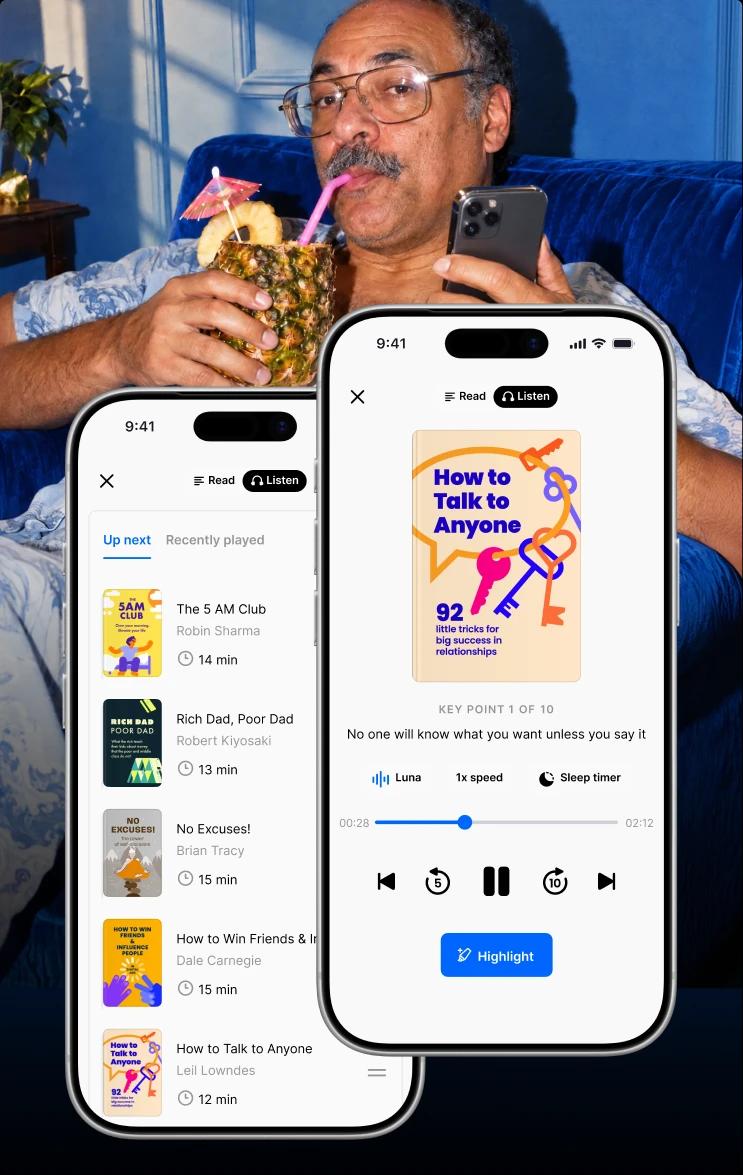
This is where the Headway microlearning app enters the picture. The head-to-head Headway vs Blinkist comparison breaks it down, and the difference comes down to design goals: Headway's 2,500+ nonfiction book summaries are wrapped in a retention system — spaced repetition flashcards that resurface key ideas over time, recaps after every summary, streaks that reward consistency, and interactive Shorts that let you rehearse real-life situations.
The starting point is a personalized growth plan: a short quiz about your goals builds a learning path from day one, then sharpens its personalized recommendations as you go. Summaries come in text and professional audio, work offline, support CarPlay and Android Auto, and are available in 11 languages.
The long-term effect is what users keep describing. Leadership advisor Herbert S. Burt has used Headway nearly every day for a year — he's missed just two days — and credits the app with letting him sample widely, then go deep only on the books that truly resonate. And writer Nicola Curtis tracked what six months of microlearning did to her life: sharper focus by month two after the 'Deep Work' summary, and better sleep by month five thanks to ideas from 'The Sleep Solution' that she still remembered weeks later.
📘 Want ideas that stick around? Get your personalized growth plan in a couple of minutes!



Which app matches your learning style?
Self-improvement tools only work when they match how you learn, so sort yourself honestly rather than aspirationally.
Choose Deepstash if you:
Want a free, entertaining doomscrolling alternative
Prefer tiny knowledge bursts over structured sessions
Enjoy curating and collecting ideas from many source types
Read on-screen and don't need audio or offline access
Choose Blinkist if you:
Want the largest possible library of complete book summaries
Learn by listening during commutes, with CarPlay or Android Auto
Will use Blinkist AI to summarize outside content
Are comfortable committing to a 12-month plan
Choose Headway if you:
Want summaries plus a system for retaining them
Respond well to streaks, goals, and visible progress tracking
Prefer a personalized plan over an open-ended library
Learn in one of 11 languages, or want flexible 4-week to 24-week plans
A few adjacent options, depending on how you learn best: visual learners should look at our Imprint app review for illustrated lessons, and if consistency is your real obstacle, pairing any app with a book buddy adds the accountability that solo reading lacks.

Skip the consumption trap: Build knowledge that lasts with Headway
The Deepstash vs Blinkist matchup has a fair winner for every category — Deepstash for free browsing, Blinkist for library depth and audio. But if you zoom out to the goal behind the goal, both apps leave the hardest part to you: turning information into lasting knowledge and behavior.
Headway was built for exactly that part. A personalized plan tells you what to learn next, 15-minute summaries deliver it in text or audio, and spaced repetition makes sure it's still there when you need it in a meeting, a negotiation, or a hard conversation.
As of August 2026, Headway's paid plans for US users come in 4-week ($19.99), 12-week ($39.99), and 24-week ($59.99) blocks — different locations may see different prices and discounts. The free plan includes one complete summary per day in text and audio.
📘 Start your Headway plan and turn 15 minutes a day into knowledge that compounds!
Frequently asked questions about Deepstash vs Blinkist
Which is better, Deepstash or Blinkist?
Blinkist is better for structured learning: 9,000+ complete book summaries in text and professional audio, plus Guides and Blinkist AI. Deepstash is better for free, casual browsing of 200,000+ short idea cards from books, articles, podcasts, and videos. If retention matters most, consider Headway, which pairs 15-minute summaries with spaced repetition and personalized growth plans.
What's the difference between Deepstash and Blinkist?
The format. Deepstash delivers standalone idea cards — single insights you can read in seconds and save to personal collections. Blinkist delivers complete 15-minute summaries that walk through a book's full argument, in text and audio. Deepstash suits feed-style browsing and idea collecting; Blinkist suits focused sessions where you want the whole picture of one title at a time.
Is Deepstash free?
Yes, with limits. Deepstash Free includes unlimited browsing of idea cards and personalized learning, supported by ads. Saving unlimited ideas, listening to ideas, removing ads, and offline access all require Deepstash Pro, which is also available as a Lifetime Pro one-time purchase. In short: reading on-screen is free, while keeping and replaying what you find is paid.
Does Deepstash have audio summaries like Blinkist?
Not on the free plan. Listening to ideas on Deepstash is a Pro feature, while Blinkist includes professional audio narration on every summary, plus CarPlay and Android Auto support for hands-free listening. If audio learning is your priority, Blinkist clearly leads this matchup — and Headway matches it with narrated 15-minute summaries, offline downloads, and in-car support.
How much does Blinkist cost compared to Deepstash?
Blinkist bills for 12 months: Premium starts at $79.99 (then $99.99 per year) and Pro starts at $139.99 (then $174.99 per year), with Pro adding Blinkist AI. Deepstash Pro pricing varies by region and promotion, with a Lifetime Pro one-time option available. Both apps show final prices at checkout, and seasonal offers can change what you see.
Can I use Deepstash or Blinkist offline?
Blinkist supports offline access on paid plans — download summaries to read or listen during flights and commutes. On Deepstash, offline access is one of the features reserved for Pro members, alongside audio and unlimited saving. Free users of both apps need an internet connection, so frequent travelers should factor a paid plan into the comparison.
Is there a better alternative to Deepstash and Blinkist?
For lasting results, yes — Headway. It combines 2,500+ nonfiction book summaries in text and audio with the retention tools both apps skip: spaced repetition flashcards, recaps, streaks, and interactive Shorts. A quiz builds your personalized growth plan from day one. As of August 2026, US plans come in 4-week ($19.99), 12-week ($39.99), and 24-week ($59.99) blocks.
Deepstash vs Blinkist vs Headway: Which should I pick?
Pick Deepstash for free idea browsing, Blinkist for the biggest library of complete summaries with audio, and the Headway app for turning summaries into a daily learning habit with measurable progress. Real users illustrate the Headway difference: one leadership advisor has missed only two days in a year, and one writer traced six months of steady focus and retention gains.