Self-growth
 Apps & Digital Tools
 Business & Career
 Success
 Growth Tools
 Psychology
 Communication
 Relationships


Deepstash sits in the US App Store under a one-word price label: Free.
Several reviewers describe signing up and meeting a trial prompt before they have finished a single card. Both things are true at the same time. You can read the app for months without paying, and the prompt will keep arriving.
So, is Deepstash free? Yes, for reading. Four things require Deepstash Pro: an ad-free feed, audio playback, offline downloads, and unlimited reading history. The Deepstash app is a microlearning tool that turns ideas from nonfiction books, articles, and podcasts into short cards you read in a feed, and the free version hands you that feed.
This article covers what a free account allows today, what Pro costs across every offer in circulation, and how to work out which side of the paywall you belong on.
The figures come from the US App Store listing, Deepstash's own pages, Google Play data, and published reviews, all checked on November 23, 2026. Nobody here ran a paid plan. Headway, this blog's own book summary app, appears near the end as one alternative for readers who want structure instead of a feed.
📘 Start with one free summary on Headway!
The Deepstash free tier in five lines
Deepstash is free to install and free to read, with ads in the feed.
Pro removes the ads and adds audio, offline downloads, and unlimited history.
Free users can save cards, but only up to a history limit.
Pro prices in circulation run from $12.99 monthly to $99.99 yearly.
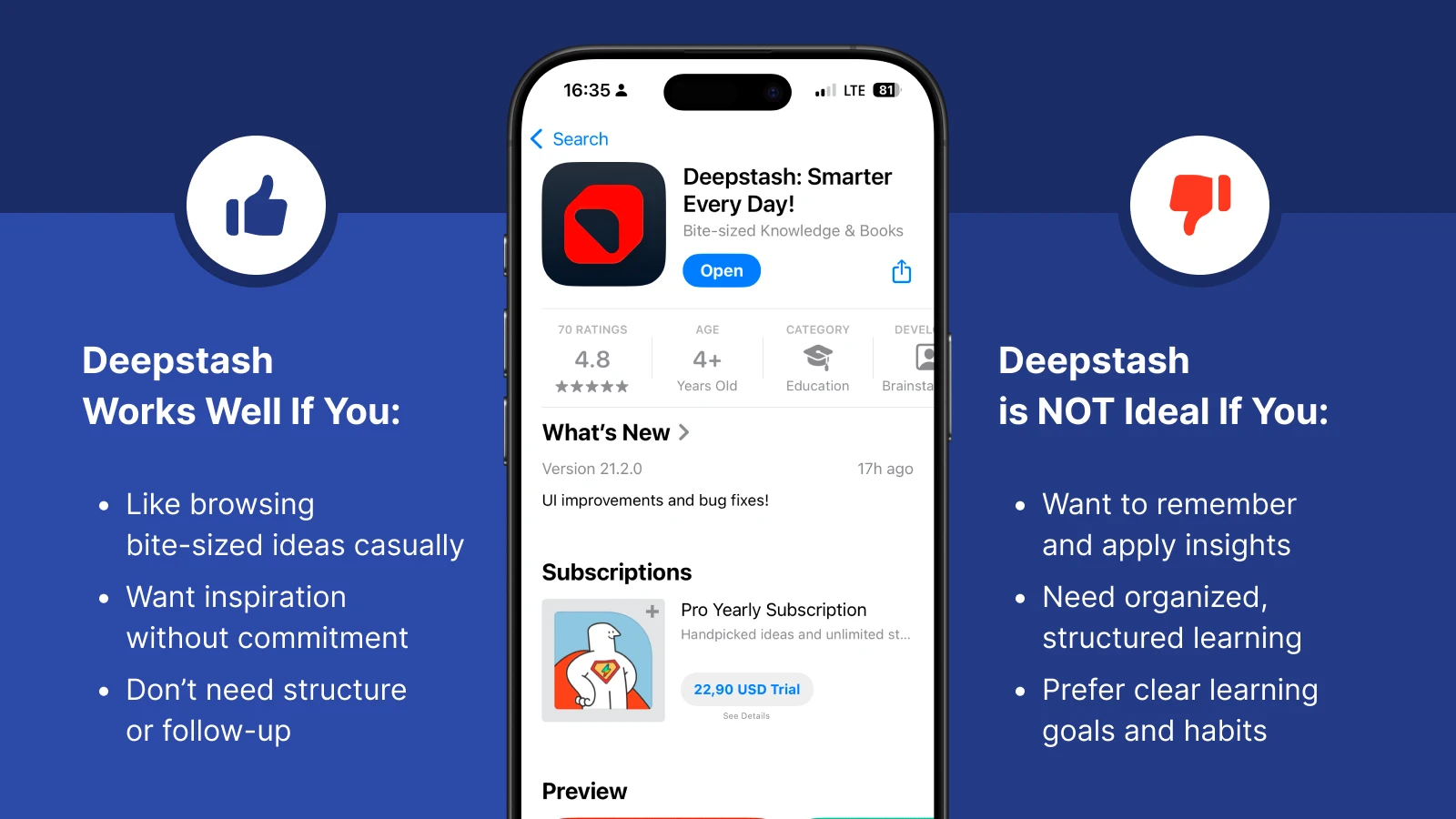
Free suits casual browsing, while paying suits readers who revisit what they keep.

What the App Store listing promises free users, word for word
The US App Store listing splits the app into Start Free and Upgrade to Deepstash Pro. On the free side, Apple's page describes access to 200,000+ ideas drawn from books, articles, podcasts, and videos, plus the option to "create and share your own ideas" at no cost. That second part gets lost in most coverage. Free access includes writing your own cards, not only reading other people's.
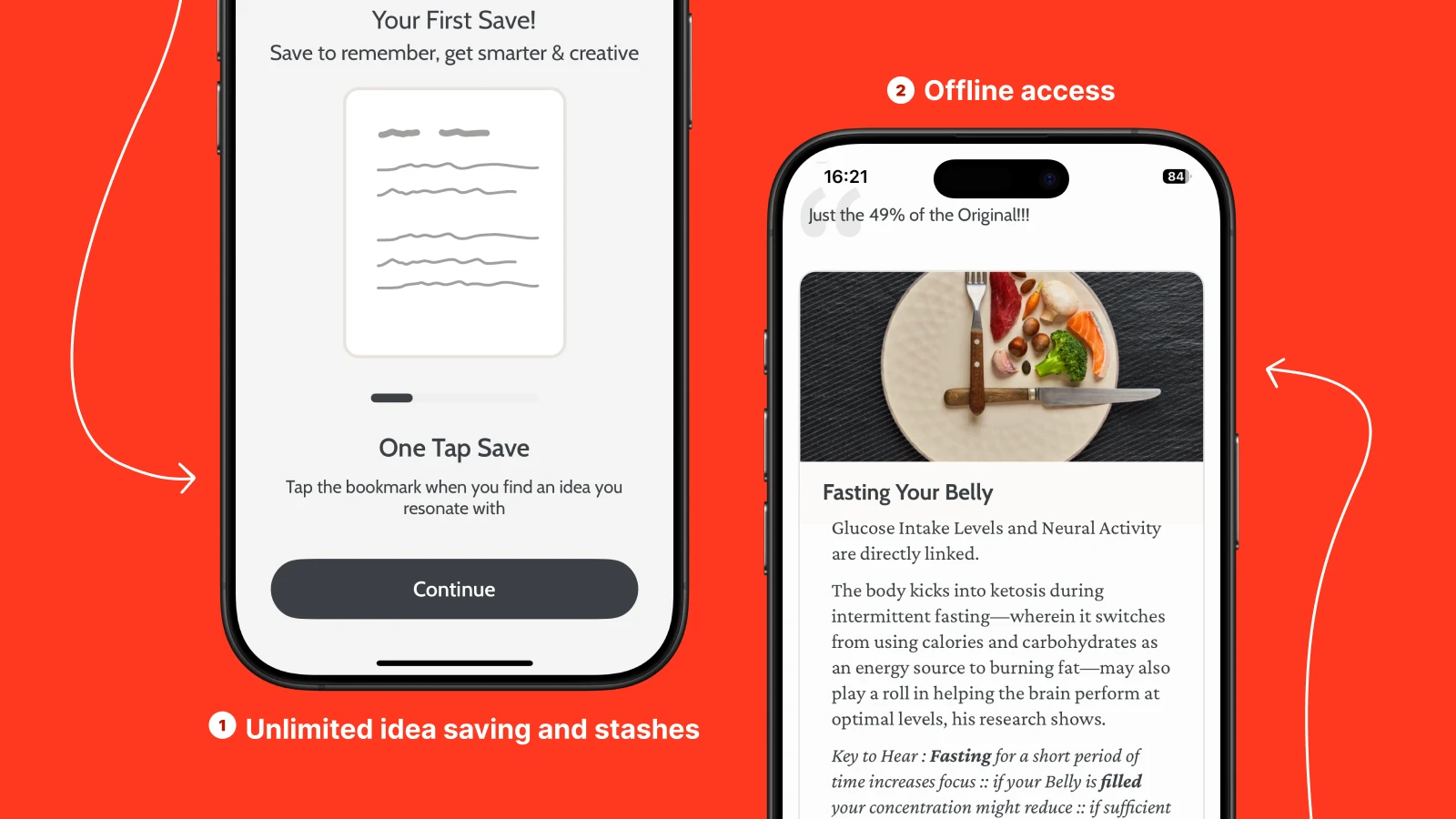
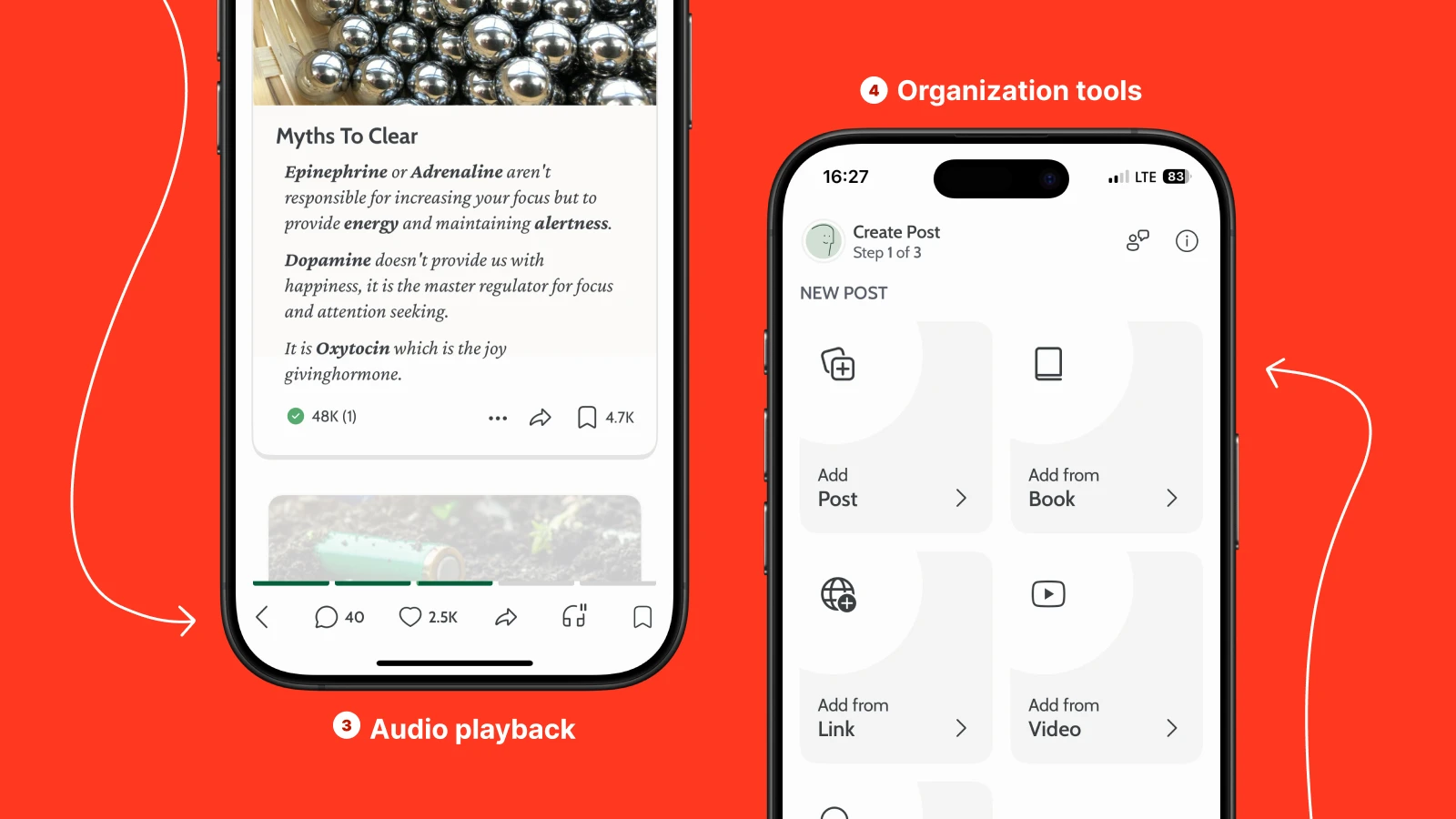
On the Pro side, the same page lists four additions: no ads, audio playback for all ideas, downloads for offline access, and unlimited history, described as going back to everything you have read, organized by day.
Read that last line closely. The listing sells the paid plan on history, which makes the free limit a limit on going back rather than a ban on keeping anything. The app works like a feed of bite-sized ideas: you pick topics such as productivity, psychology, or personal growth at signup, the feed adapts to what you open, and each card carries one idea and its key insight from a longer source.
Deepstash offers the whole library on that basis, so the core ideas of a book arrive one short idea at a time. Each card runs to roughly 200 words or fewer, which is under a minute of reading, and that length is the reason the app works for casual browsing in a queue or a lift. For a fuller look at how Deepstash works, the card format gets its own walkthrough on this blog.
What the free plan covers, according to the listing:
Unlimited reading across the full library of idea cards.
Personalized topic feeds that shift as you read.
Creating your own cards, plus the shared ideas other users post.
Saving cards, within the history limit Pro removes.
What Deepstash Pro adds:
An ad-free feed.
Audio playback on every card.
Offline downloads.
Unlimited history across everything you have read.
Where Deepstash free stops: Four walls and what each one blocks
Free users meet the same four walls, in roughly the same order. Ads arrive first. Audio and offline access only matter once you try to use the app away from a screen or away from a signal. The history limit takes the longest to notice, because it bites only when you go looking for something you read a month ago.
| Wall | What triggers it | What it blocks | What free users can still do |
|---|---|---|---|
Ads | Reading through the feed | Uninterrupted reading | Keep reading, with breaks you did not choose |
Audio | Tapping listen on a card | Hands-free use on a commute or a walk | Read the same card on screen |
Offline | Opening the app without a connection | Flights, subway rides, travel | Read ahead while you still have signal |
History and saving | Going back to older saved ideas | Rebuilding what you read last month | Save and reread recent cards, up to the limit |
None of the four has a workaround inside the app, though a notes app covers the saving gap for the handful of cards you want again.
Some reviewers describe a fifth limit: a daily cap on how many ideas the free feed serves before it stops refreshing. The App Store listing does not mention one, so treat it as a reported limit that may vary by account or version, not a published rule.
Why every Deepstash review quotes a different Deepstash cost
Look up the Deepstash cost, and you will find a different number on every page. Search the Deepstash Pro cost instead, and the spread gets wider, not narrower. One site says $29.99 a year, another says $89.99, a third says $99.99. None of them is lying. The US App Store in-app purchase list carries ten separate subscription products at once, and the price you see depends on which offer the app serves you, which billing period you pick, and where you are.
| Plan | Price (US) | Billing | Where it appears |
|---|---|---|---|
Pro Yearly (featured offer) | $49.99 | Yearly, with a trial | Subscriptions block, US App Store product page |
Pro Yearly | $69.99 | Yearly | In-app purchase list, US App Store |
Pro Yearly | $89.99 | Yearly | In-app purchase list, US App Store |
Pro Yearly | $99.99 | Yearly | In-app purchase list, US App Store |
Pro 3 Months | $19.99 | Quarterly | In-app purchase list, US App Store |
Pro 3 Months | $29.99 | Quarterly | In-app purchase list, US App Store |
Pro 3 Months | $59.99 | Quarterly | In-app purchase list, US App Store |
Pro Monthly | $12.99 | Monthly | In-app purchase list, US App Store |
Pro Monthly | $19.99 | Monthly | In-app purchase list, US App Store |
Google Play | Free to install, contains ads, in-app purchases | Varies | Google Play listing |
Every figure above comes from the US App Store on November 23, 2026. Prices move, and offers get retired, so read the number on your own checkout screen before agreeing to anything.
Watch the trial on the featured yearly offer. A trial nobody cancels rolls into the full charge at whatever price that offer holds.
No Lifetime Pro product appears in the current US in-app purchase list, even though lifetime deals turn up in older write-ups. Treat any lifetime offer as a promotion that may not come back.
For a plan-by-plan breakdown of Deepstash pricing, there is a dedicated piece here, and for market context, what Blinkist asks for a year puts the annual subscription in the same bracket.


What changed in 2026, and why older Deepstash reviews read differently
The version history explains much of the disagreement between reviews. Deepstash shipped updates almost weekly through 2026. Spanish arrived in September, French in August, onboarding was rebuilt in August, the home screen was reorganized into sections in October, and reading progress moved onto user profiles in September. Two more releases landed in the week this article was checked.
The bigger shift is harder to verify. In a long App Store review dated February 27, 2026, a user writing as Malcomxdidit described the app moving away from standalone quotes and loose ideas toward excerpts tied to full book summaries, and signed off with
"the magic is gone."
No company statement backs that up, and Deepstash replied to the review publicly. What the release notes do confirm is a steady march toward book-shaped content: book scanning, reading progress, quizzes, and a home screen built around what to read next.
If you landed here after a Deepstash review written in 2024, you are reading about a different app.
Where the Deepstash free plan earns its keep
Free tiers in this category tend to be a few sample lessons and a wall. Deepstash opens the full library instead, so the best ideas from a bestseller sit behind no payment at all, which is unusual enough to say plainly. Three situations where the free plan does real work:
You are trading a few minutes of feed-scrolling. The format sits close enough to a social feed that the swap costs no willpower, which is the whole argument behind apps people open instead of a feed. Mindless scrolling becomes passive reading, which is a modest win for anyone whose habit building starts by swapping one app for another.
You are sampling a book before committing. Short insights tied to a title give you the key ideas in a few minutes, which is enough to judge whether the full book deserves eight hours. For bite-sized knowledge at no cost, that is a fair trade.
You read on a commute with signal. Offline access is the wall most free users hit underground, so an above-ground commute sidesteps the one limit that would otherwise end the session.
Friction that shows up in the first week without Pro
The complaints below come from the store listings and published user reviews, in roughly the order you meet them.
Ads, early and often. The Google Play listing carries a Contains Ads label, and ad breaks in the feed are the first thing free users notice.
The upgrade prompt at signup. One App Store reviewer, otherwise enthusiastic, criticized being pushed into a seven-day trial immediately after downloading, before seeing what the app does.
Read once, lose it. Without unlimited saving and unlimited history, the cards you liked three weeks ago get hard to find. Several reviewers call the free tier heavily restricted for exactly this reason.
A card is a conclusion without an argument. Idea cards give you what an author decided, rarely why. For dense books, that gap matters, and it is the main reason people question whether the app is worth paying for.
Content quality varies by topic. A college student reviewing the app in 2024 found the personal growth, communication, and business material solid and everything outside those categories thin. The content mix still leans the same way, so consistent quality across every subject is not what users find once they stray from self-improvement.
Is Deepstash legit? Ratings, refunds, and what reviewers report
Store ratings and complaint sites measure different moments. The ratings measure reading. The complaints cluster at the payment.
| Source | Score | Reviews or ratings | Checked |
|---|---|---|---|
US App Store | 4.7 | About 95,000 ratings | November 23, 2026 |
Google Play (third-party tracker) | 4.5 | About 128,100 reviews | Listing snapshot March 11, 2026 |
Trustpilot | 4.5 | 2,191 reviews | November 23, 2026 |
Trustpilot is where it gets interesting. The score is high, 78% of reviews are five-star, and the page notes that the company invites customers to review and has replied to 96% of negative reviews. Under that sits a 12% one-star band, almost entirely about money: renewals charged without notice, trials rolling into annual plans, refunds requested and then refused or slow to land. Several of those reviewers add that the support team resolved the case in the end.
A five-star review from October 30, 2026, posted by a user named Renars, sums up the other side:
"You learn something, and it's much better than scrolling all day."
So, is Deepstash legit? Yes, in the plain sense. The app is published by Brainstash, Inc., sits at number 7 in the free Education chart on the US App Store, and the company answers complaints under its own name. What many users report is a billing surprise: a charge they forgot was coming, a renewal, a slow refund.
These are selected reviews, not the full rating. Current scores are available on Trustpilot/Google Play/App Store.
Three figures circulate widely in AI answers and roundups, and none of them matches a single source:
"Over 5 million users, rated 4.6" blends two different things. Google Play shows a 5 million-plus install band, Deepstash's own site claims 10 million-plus downloads, and the ratings are 4.7 on the US App Store and 4.5 on Google Play. Downloads are not users, and no 4.6 appears on either store.
"Annual plans from $49.99 to $119.99" overshoots at the top. The US in-app purchase list on November 23, 2026 ran from $49.99 to $99.99, with no $119.99 product in it.
"Free to use" and "paywalled on day one" are both repeated by review sites. Reading is free with ads, and the trial prompt arrives at signup, which is how both impressions survive.
Stashing an idea is not the same as keeping it
Researchers at Northumbria University interviewed 45 adults about the digital material they hold on to and heard the same three things repeatedly: it accumulates, deleting it feels hard, and the pile itself creates a low hum of anxiety. The study was qualitative, covered 45 people aged 20 to 52, and looked at personal and workplace files rather than learning apps, so it proves nothing about idea cards.
It does reframe the purchase. What Pro sells is unlimited saving and unlimited history, which is accumulation by design. So the purchase turns on one habit: whether you go back to anything you save. Price enters the decision only after that, which is also why so little of what we read survives the week.
Is Deepstash worth paying for? A seven-day test before you upgrade
Nobody outside your own reading habits can answer that, but you can gather the evidence yourself in a week, at no cost.
Use the free plan for a week without dismissing the ads.
Each time you try to save a card and meet the limit, note it.
On day seven, open what you saved and count how many you can explain without rereading.
Count how many you went back to on purpose.
If the second number is zero, Pro buys you a bigger archive of things you do not revisit.
If you hit the saving limit several times a week and you do reread what you keep, the annual plan is the cheaper option, so check which price the app offers you first.
Deepstash alternatives that stay free when Deepstash Pro isn't worth it
Deepstash alternatives split by what you want from them, and several stay at $0 permanently.
Khan Academy for structured courses with exercises, completely free, if you want a syllabus to work through.
Libby, with a library card, for full ebooks and audiobooks borrowed from your local library at no cost. Audible's catalog of full-length audiobooks is larger, reported above 800,000 titles, but it is a paid service.
Project Gutenberg and Standard Ebooks for public-domain titles you can download and keep.
Matter for unlimited article saving in a clean reading view, if the saving limit is your main complaint.
BeFreed for personalized audio lessons built around what you say you want to learn, the name that comes up most often when people ask for an audio-first alternative.
Paid options sit alongside these if the format matters more than the price. Blinkist built the same 15-minute summary idea into a library reported at 7,000 titles and up. For a wider set of other apps that work as a free option long term, the roundup of microlearning apps with real free plans covers what each free tier includes before you commit to any upgrade.
Deepstash idea cards next to Headway book summaries, row by row
One disclosure before the table: Headway is this blog's own app, so weigh this section accordingly. It publishes summaries of nonfiction books in text and audio, so it works as a different shape of learning tool and not a straight swap.
| Deepstash | Headway | |
|---|---|---|
Content format | Idea cards from books, articles, podcasts and videos | Book summaries of about 12 to 20 minutes, text and audio |
What the free plan includes | Unlimited reading with ads, limited history | One full summary a day, text and audio |
Price and trial | $12.99 monthly to $99.99 yearly across ten offers, trial on the featured yearly plan (US App Store, November 23, 2026) | $12.99 monthly, $29.99 per 3 months, $89.99 yearly, 7-day trial (US rates, November 2026) |
Platforms | iOS, iPad, Android, web | iOS, Android, web, Apple CarPlay, Android Auto |
Retention tools | Saved ideas and personal collections, with history limits on free | Spaced repetition cards, highlights, streaks, progress tracking |
Library | 200,000+ ideas drawn from thousands of sources | 2,500+ book summaries |
Main limitation | Cards give the conclusion without the argument, and the free tier limits going back | Smaller library, no community feed, no user-created content |
Which one fits depends on how you read. If you like a feed, want new ideas from podcasts and videos as well as books, and enjoy writing and sharing your own cards, Deepstash does that and Headway does not. If you want one book at a time, finished in a sitting, with cards that bring the key points back later, the summary format is closer to what you are after. Someone building good habits around a daily session will care more about the retention tools, and someone browsing at lunch will care more about the feed.

Start free and read a full book a day on Headway
Free Deepstash is a reading app. Pro is a keeping app. Great ideas reach you either way, and the difference is whether you can go back to them. That is the whole decision, and price matters less than which of those two you are.
If you read a few cards, enjoy them, and never think about them again, the free version is the entire product and Pro adds storage you will not open.
If you save constantly, reread what you saved, and get annoyed every time the history runs out, Pro is doing real work and the yearly subscription is the sensible way to buy it. Readers who want structure rather than a feed sometimes land on a book summary app like Headway instead, which is a different trade.
Spend the week. Count what you went back to. That number decides it.
📘 Get a daily nonfiction summary on Headway!
App prices, ratings, and features can change. Check the App Store, Google Play, Trustpilot, and the app's official site for the latest updates.
FAQs: Is Deepstash free?
Who is behind Deepstash?
Deepstash is published by Brainstash, Inc., the developer name shown on both store listings. The same team publishes several other learning apps, including Paladin for history, Empirio for business cases, Dilemmo for decision-making, and Protocol for health habits. Deepstash is the flagship by some distance, and the others share its card-based format on narrower subjects.
How much does Deepstash make?
No audited revenue figure is public, so treat any number you find as an estimate. The model has two legs: advertising shown to free users, and Pro subscriptions sold in monthly, quarterly, and yearly terms. On the funding side, trade press reported in October 2025 that PvX Partners provided Brainstash with $9 million in user-acquisition financing, following earlier seed rounds from European venture investors.
Do you have to pay a subscription for Deepstash?
No, though the app asks early. If you start the trial and change your mind, deleting the app does not stop the charge. Cancel through your store account: Settings, your name, Subscriptions on iPhone, or Payments and subscriptions in the Play Store on Android. Do it at least 24 hours before the renewal date.
What country is Deepstash from?
Deepstash grew out of Bucharest, Romania, where its founding team started building it in the late 2010s, and it operates through a US-registered entity, Brainstash, Inc., with an address in Newark, Delaware. That split is common for European consumer apps selling mainly to American users, and it explains why store listings show a Delaware address.
Is the Deepstash app safe?
The app is distributed only through the official App Store, Google Play, and its own website, which rules out the usual sideloading risks. It requires an account, serves ads on the free tier, and publishes an age rating and privacy labels on each store page. Read those labels if data collection matters to you.
What is the best app like Deepstash?
It depends on which part you like. For the card feed and community, nothing matches it closely. For book content with more context, summary apps cover the same ground at greater length. For saving articles you find yourself, read-later tools do it without limits. For subject-by-subject study, a course platform fits better than any feed.
How much does the Deepstash app cost?
Store prices exclude local sales tax and VAT, so the final figure at checkout often runs higher than the number listed. Prices outside the US follow local store tiers, so each country has its own set figure. And the charge lands on your statement from Apple or Google, not from Deepstash, which catches people searching their bank app for the name.
What is the best reading app for free?
Outside the idea-card category, library apps win on value. Libby connects to your local library card and lends full ebooks and audiobooks at no cost, with waiting lists on popular titles. Hoopla works similarly where libraries support it. For out-of-copyright classics, Project Gutenberg and Standard Ebooks offer free downloads with no account, no ads, and no borrowing period to worry about.
Is Deepstash or Blinkist better?
It depends on what you want from a microlearning app. Deepstash is built around bite-sized idea cards you can save and organize, while Blinkist offers more structured, full-book summaries with a clearer narrative flow. Blinkist costs $99 per year versus Deepstash Pro at $89.99, so pricing is similar. If you want a curated personal knowledge base, Deepstash has an edge; if you want complete book summaries with more depth, Blinkist wins. For retention tools like quizzes and spaced repetition, Headway is worth considering as a third option.
Does Deepstash use AI?
Deepstash uses a combination of human curation and algorithmic personalization to surface idea cards relevant to your interests. The feed adapts based on what you read, follow, and engage with, which gives it an AI-assisted feel. However, Deepstash is not primarily marketed as an AI-powered summarization tool — most of its content is curated by human contributors and editors. If AI-generated summaries are a priority for you, it is worth checking the app's current feature set directly, as the product continues to evolve.