Self-growth
 Business & Career
 Success
 Communication
 Healing
 Relationships
 Psychology
 Happiness
Leadership can become difficult when you don't know which type of leadership fits your situation. The wrong leadership style leads to team chaos, fear-based culture, burnout, and stalled innovation, especially in crisis situations. Of course, this also results in lower productivity and lower profitability. Developing self-awareness about your strengths and weaknesses is key to choosing the right approach.
While there are many types of leadership styles — including democratic leadership, transformational leadership, transactional leadership, servant leadership, and even laissez-faire leadership — this article compares two styles that often sit at opposite ends of the spectrum. This article breaks down charismatic vs autocratic leadership by examining the real problems leaders face today.
Charismatic leadership inspires through vision; autocratic leadership directs through authority.
Headway helps you explore leadership styles through short, practical summaries of influential books.

In the Headway app, you can dive into ideas from 'How to Win Friends and Influence People in the Digital Age,' 'Dare to Lead,' 'The Art of War,' and 'Leaders Eat Last' to see how transformational leaders, democratic leaders, and servant leaders think, decide, and act in real-world situations from everyday team management to high-pressure decisions.
Quick comparison: Charismatic vs autocratic leadership
Charismatic leadership
Leaders articulate a clear vision for the team
Communication style is collaborative and supports teamwork
Employee input is valued
Mistakes are seen as learning opportunities
Decision-making is shared
Goals are adapted to the skills of the team
Innovation is encouraged
Effective leadership approach for long-term growth and change
Often seen as an effective leadership style when motivation and engagement matter
High reliance on the leader's natural charisma
Requires exceptional communication and motivational skills.
Autocratic leadership
Leaders articulate specific desired outcomes with a focus on short-term goals
Communication style is directive
Obedience and rule enforcement are expected
Mistakes are discouraged; compliance is prioritized
Decision-making is centralized
Goals are adapted to the situation at hand
Innovation and creativity are not encouraged
Effective style during a crisis
Often creates a high-pressure environment that can affect team well-being
Risk of micromanagement
Can drain employee morale if maintained long-term
The real problems these styles cause in modern teams
Problems with charismatic leadership
Overdependence on the leader's energy:
The charismatic leadership style requires the leader to inspire and motivate the team by expressing their vision for the future. The effectiveness of this approach depends on the individual leader's personality and charm.
Unrealistic goals inspired by passion:
An elevated sense of purpose and commitment, inspired by the charismatic leader, might lead to excessively high expectations within the team. Under the pressure of high expectations and unrealistic goals, team members are at greater risk of burnout.
Team follows the person, not the plan:
A team focused on creating and innovating might lose sight of the stated goals of the work. They may be following the charismatic leader's broad vision, but not the desired plan.
Problems with autocratic leadership
Innovation slows down:
The focus on specific desired outcomes and rule enforcement might create a stifling environment that is unlikely to foster innovation and creativity.
Employees stop showing initiative:
In a micromanaged environment, there is less room for initiative. Outcomes and procedures are strictly defined.
Team morale drops:
Over time, morale declines as employees feel undervalued and untrusted to perform their jobs well.
High-pressure work environment:
The focus on short-term outcomes and centralized decision-making may foster a sense of powerlessness within the team. All of these factors contribute to a stressful workplace, where the leader exercises complete control.



The dangerous overlap: When charismatic leaders become autocratic
Why charismatic leaders often slide into control when under stress
When charismatic leaders shift their focus from inspiring others to maintaining their power, they become more autocratic. The same confidence that lends itself to charismatic leadership can also lead to overconfidence and a sense of superiority.
The charismatic leader who is highly stressed might start to believe that they have all the answers and don't need to take advice from others. They become overreliant on their personal judgment or intuition.
The slow shift from persuasion to pressure to demands
If left unchecked, the charismatic leader often becomes less tolerant of any dissent. They surround themselves only with people who agree with them or are willing to follow their wishes. Persuasion becomes less necessary to them; pressure becomes the basic strategy. When pressure fails, the autocrat makes demands.
How adoration turns into obedience
The followers of autocrats tend to favor structure and consistency over openness to new experiences. This need for stability makes them inclined to follow a strong leader to maintain traditional social structure.
Other followers may see the autocratic leader as being on the "winning side" and want to be on that same side in order to feel safe and in control.
When to use each style
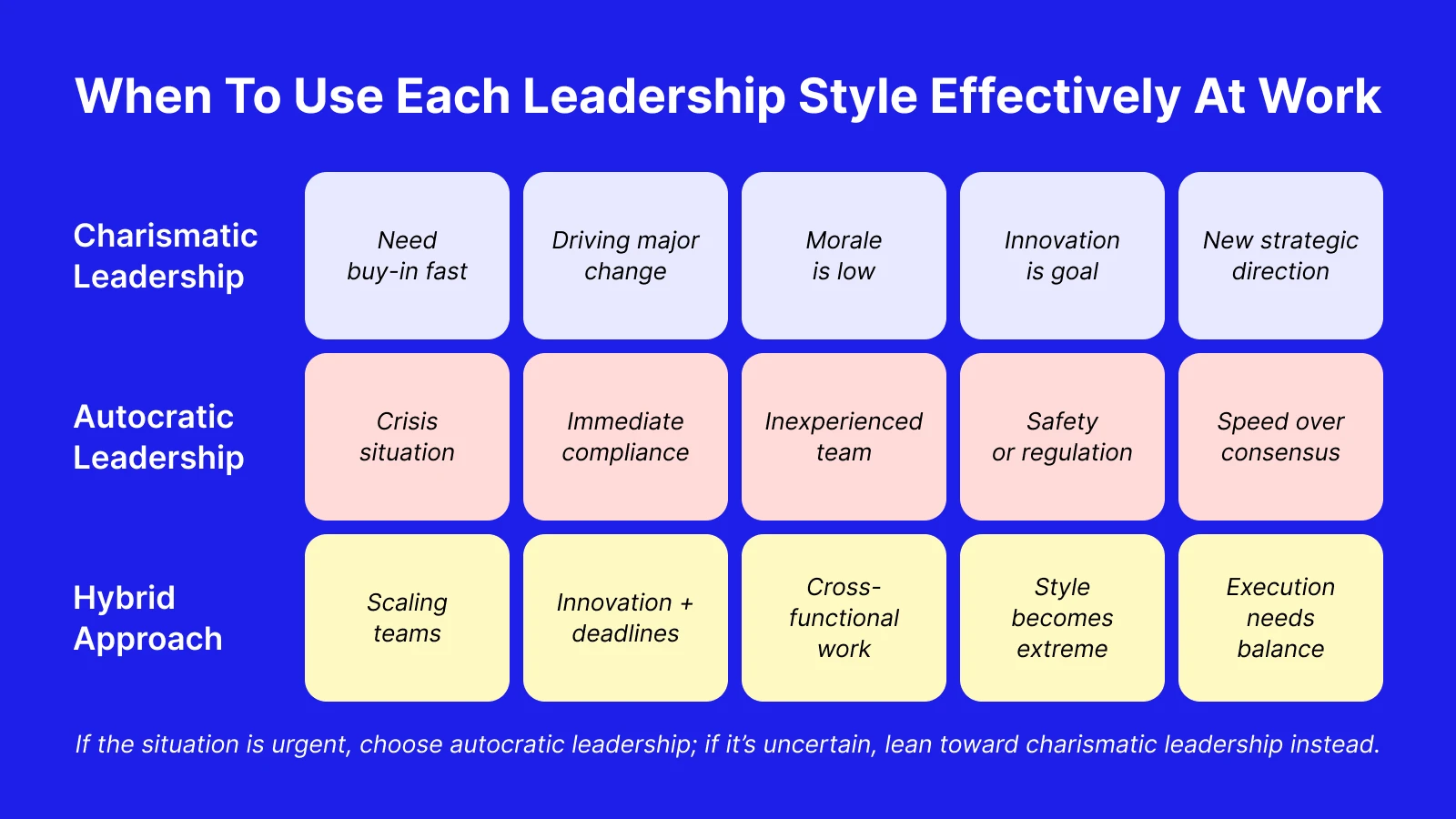
Use charismatic leadership when:
You need buy-in fast
A positive, inspiring approach that can capture others' attention. A charismatic leader might help the team stay resilient and hopeful during periods of change.
Inspired by 'How to Win Friends and Influence People in the Digital Age' by Dale Carnegie and Associates
You're driving a major change
Changes in policy, staff, or organizational structure might all be perceived as threats to teams. A charismatic communication style and a visionary approach provide an advantage.
Morale is low
A leader who is open to hearing team members' concerns and welcomes new ideas is more likely to boost morale.
Inspired by 'Dare to Lead' by Brené Brown, Phd
Innovation is the goal
The charismatic style values innovation and employee input. Mistakes are seen as learning opportunities.
You're inspiring a new strategic direction
A new strategic direction involves creativity and innovation, both of which are strengths of the charismatic style.
Inspired by 'Good to Great' Jim Collins
Use autocratic leadership when:
You're in a crisis
The autocratic style allows for quick decisions under pressure, clear instructions, and clear expectations.
Read 'The Art of War' by Sun Tzu
You need immediate compliance
The autocratic leader can create a circle of safety to protect employees from pressure and threats. Autocratic leaders favor obedience.
Read 'Leaders Eat Last' by Simon Sinek
Team lacks experience
An inexperienced team might require the clear instructions and clear expectations that characterize the autocratic leader.
Speed is more important than consensus
Top-down decision-making in autocratic leadership is more efficient than collaborative decision-making in charismatic leadership.
Safety or regulation is involved
Obedience and rule enforcement are consistent with the autocratic style.
When a hybrid model works best
Scaling teams
A business that maintains productivity as it expands must work efficiently and strategically.
Read more in 'Good to Great' Jim Collins
Balancing innovation with deadlines
Innovation requires charismatic leadership, while strict deadlines require some level of autocratic leadership.
Leading cross-functional groups
For example, leaders may use a servant-leadership mindset to support and develop people while applying autocratic clarity around deadlines or safety.
When too much charisma causes chaos
Leaders with too much charisma can lack the ability to execute the steps needed to finish projects. Their personal brand becomes prioritized over the success of the organization.
When too much control slows progress
An overly autocratic style can fail to allow for creativity and innovation, thereby slowing progress.
The quick decision rule:
If the situation is urgent, use autocratic leadership.
If the situation is uncertain, use charismatic leadership.
The psychology behind why people follow these leaders
Why people follow charismatic leaders
Freedom to be creative and innovative
Skilled workers often appreciate the freedom to create new solutions to problems or new ways to increase efficiency in their day-to-day work. People follow charismatic leaders because they feel empowered, heard, and trusted (a core benefit of democratic leadership and servant leadership).
This freedom is often supported by a light, intentional hands-off approach that gives teams space to experiment while staying aligned with organizational goals.
The enthusiasm and vision of the charismatic leader are motivating
Individuals and teams are inspired to work toward the goals set by the charismatic leader when the leader's motives appear aligned with their own. This kind of motivation positively shapes team dynamics, especially when leaders invest time in coaching and informal mentoring rather than control.
Ability to share in decision-making
Collaborative decision-making boosts morale and employee engagement.
Why people comply with autocratic leaders
Authority bias
When authority is highly valued within a team's culture, team members are inclined to follow a leader seen as strong and wise.
Desire for structure
Followers of autocrats tend to prefer structure and consistency to openness to new experiences. These followers want stability to maintain their current roles.
Relief from decision overload
There is less pressure to participate in decision-making when the decision-making is centralized with the autocratic leader.
Threat avoidance instincts
Fear of change and the uncertainty it brings can make individuals more likely to follow an autocrat who claims to keep them safe from perceived threats. (Link to Leaders Eat Last).
Impact on performance, innovation, and culture
Productivity
Autocratic = faster execution
Top-down decision-making, clear instructions, and specific outcomes all contribute to faster execution.
Charismatic = higher long-term motivation
Higher long-term motivation results from team involvement in decision-making and freedom to innovate. Longer-term productivity benefits from this leadership.
Innovation
Charismatic = risk-taking + new ideas
The view of mistakes as learning opportunities encourages experimentation and collaborative problem-solving, keeping teams flexible and creative.
Autocratic = reliable outcomes + low creativity
Innovation is neither encouraged nor rewarded in an autocratic system. Outcomes are more reliable and predictable.
Culture
Charismatic = energy + unity
The charismatic leader's vision of the future energizes and unites the team. Self-motivated people thrive in cultures that encourage creativity.
Autocratic = clarity + predictability
Specific goals and stability, as offered by the autocratic leader, create a culture of clarity and predictability. Teams that value structure and safety prefer the predictability of the autocratic leader's culture.
Quick self-assessment: Which leader are you?
Understanding where you fall among different leadership styles helps you see what kind of effective leader you are and where coaching, leadership, or mentoring might help you grow.
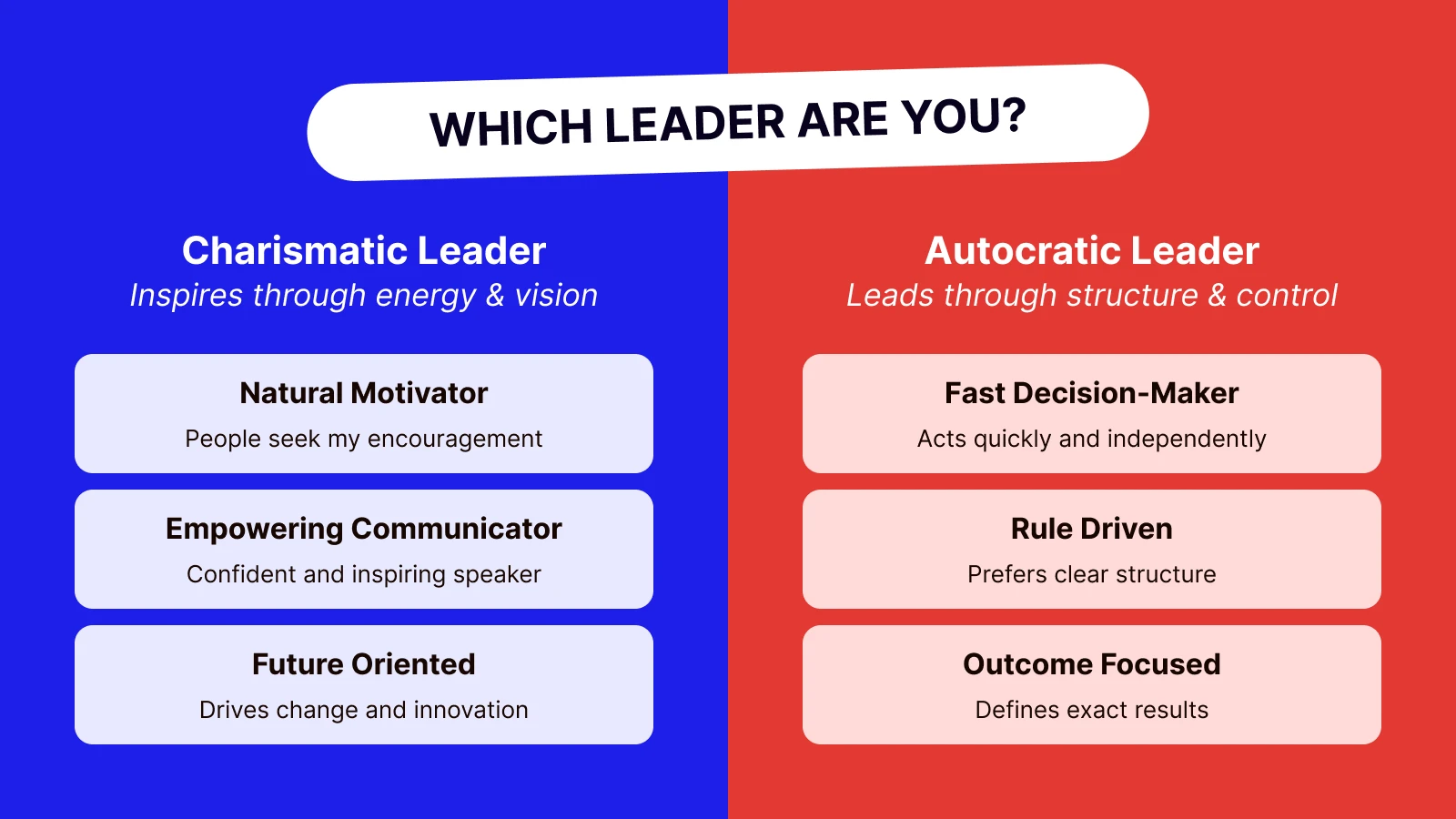
Traits of a charismatic leader:
People often come to me for motivation
I rely on emotional persuasion more than structure, focusing on empowering others
I communicate very effectively when speaking
I prefer collaborative decision-making that increases trust and job satisfaction
I value innovation and creativity
I prioritize long-term growth and change
Traits of an autocratic leader:
I prefer to make decisions alone when things get urgent, valuing quick decision-making
I'm uncomfortable when others challenge my decisions
I rely on clear rules and obedience
I usually state the specific desired outcome for the team
I prefer structure and long-term stability over innovation, which is typical of an autocratic leadership style
How to become a balanced, modern leader
Although most people naturally lean toward a particular type of leader, it's possible to learn to become a balanced leader. Balanced leaders strengthen emotional intelligence, improve their decision-making process, and learn when to step in and when to step back. They avoid extremes: neither entirely hands-off nor overly controlling.
Steps to include:
Learn structured decision frameworks
Structured decision frameworks allow teams to make better choices by limiting bias and emotional influences.
➡️ Check out our selection of podcasts about leadership.
2. Strengthen emotional intelligence
Emotional intelligence includes communication skills. Listening attentively, asking the right questions, and expressing yourself clearly are all traits of an effective leader and a coaching leader.
➡️ If you want to put these skills into practice, pay attention to two articles: How to Speak Like a CEO and How to Speak Like a Girlboss. Both will help you speak confidently without artificial roles and build real impact with your words.
3. Delegate with transparency
Transparency helps build trust and a sense of unity.
➡️ Read our article How to Be a Good Leader: Develop Trust, Vision, and Communication
4. Build psychological safety
Emotional safety requires an ability to understand and hone empathy.
5. Set clear processes so control doesn't depend on you
Effective planning, efficient resource use, and good timing characterize successful modern leaders.
6. Combine vision with accountability systems
The best companies have the best teams and the best environments. A shared vision combined with accountability measures encourages success.
📘 With Headway, you get fast access to proven leadership frameworks from top books, helping you grow without overwhelm.
Leadership without extremes: improve your modern style with Headway
Each style of leadership solves different problems. Both Charismatic and Autocratic leadership can become harmful when used mindlessly or exclusively. Modern leaders succeed by blending the inspiration and vision of the charismatic leader with the structure and predictability of the autocratic leader.
A real competitive advantage is gained by continuous learning. With Headway, you can explore proven frameworks from top leadership books and see how different leadership styles, like transactional leader and bureaucratic leader, actually work in practice.
To dive deeply into the world's top leadership books in minutes, explore the Headway app.
FAQ's
1. What is the difference between charismatic and autocratic leadership?
Charismatic leadership inspires through vision, makes decisions collaboratively, and encourages innovation for long-term growth. Autocratic leadership directs through authority, makes decisions centrally, and offers predictability. Urgent situations call for autocratic leadership, while uncertain situations call for charismatic leadership.
2. How do I identify my leadership style?
Try out the "Quick Self-Assessment" above and consider whether you mostly agree or disagree with the traits described. Keep in mind that your leadership style can be adjusted by learning about each style and taking steps to develop a more hybrid style. Reading books and listening to podcasts about leadership can be extremely helpful toward that goal.
3. What is Bill Gates' leadership style?
Bill Gates' leadership style changed over time. It began as autocratic, with strict control, central decision-making, and a focus on results. It gradually shifted to a charismatic style, with a vision for his company's future and an emphasis on innovation to create it. He became more willing to delegate and to allow his skilled teams to make decisions.
4. What is lazy leadership?
Lazy leadership is a misleading phrase that has taken on different meanings over time. The current meaning refers to leaders who delegate freely, attend fewer meetings, and focus their energy where it matters most. They do this by building teams that don't need them. While they don't appear to be busy, their teams tend to be very successful.
5. What is toxic leadership?
Toxic leadership is characterized by self-centeredness, abusive behavior, dishonesty, blaming, and manipulation. Personal power and status take priority over the organization's goals. Demands are placed on others through bullying and the threat of retribution. The toxic leader has a poor ability to self-regulate their emotions, causing instability and harmful uncertainty.