Self-growth
 Apps & Digital Tools
 Business & Career
 Success
 Growth Tools
 Psychology
 Communication
 Relationships


It's 3 a.m. You're wrecked — the kind of tired that sits behind your eyes — and your brain picks this exact moment to replay every email you didn't answer.
If that sounds familiar, you're caught in one of modern work life's cruelest pairings: burnout and insomnia. Chronic stress leaves you running on empty, yet the moment your head hits the pillow, your mind switches on. The two problems aren't separate. They feed each other, and the loop gets tighter the longer it runs.
The good news is that a loop has two sides you can work on. Once you understand why a stressed-out nervous system fights sleep, the fixes get a lot more specific than "just relax."
📘 Learn the fix from the people who wrote the book on it — start with Headway.

Quick answer: How burnout and insomnia keep you awake
If you're too exhausted to read through the science right now, start with this 30-second cheat sheet:
| What's happening | What actually helps |
|---|---|
Burnout keeps your stress response switched on, so it delays sleep onset and triggers those 3 a.m. wake-ups. | A real wind-down buffer and a worry offload before bed. |
Poor sleep then raises the next day's stress hormones, which deepens job burnout. | A steady wake time, morning light, and earlier exercise. |
Exhaustion that never lifts, no matter how long you're in bed, points to burnout — not only sleep loss. | Treat the daytime side: boundaries, recovery, workload. |
Sleep problems that drag on for several weeks, or come with low mood. | Talk to a doctor. |
Why chronic stress ties burnout and insomnia together
Burnout isn't ordinary tiredness. The World Health Organization describes job burnout as a syndrome tied to chronic workplace stress that hasn't been successfully managed — a mix of energy depletion, mental distance from your job, and a drop in how well you function. Insomnia symptoms often show up as one of the first signs, long before you'd ever call what you're feeling "burnout syndrome."
The pairing isn't just something people report anecdotally. In a cross-sectional survey of 1,300 financial-company employees — an open-access article distributed under a Creative Commons license — the workers who had insomnia were far more likely to meet the threshold for burnout, enough that the researchers singled out insomnia as one of its clearest clinical markers. The research reveals a tight link; a snapshot like this can't prove which comes first, but day to day, each side clearly feeds the other.
Here's the mechanism in plain terms. Chronic stress keeps your hypothalamic-pituitary-adrenal (HPA) axis — your body's main stress-response system — on high alert. An overactive stress response fragments sleep, and that sleep disruption pushes stress hormones higher the next day. Each side makes the other worse.
That's why you feel "tired but wired." Your body is physically drained, but your stress chemistry is still behaving as if a deadline is chasing you. Cortisol, which is supposed to taper off at night and rise in the morning, gets mistimed. So you crash at your desk at 3 p.m. and then lie there alert at midnight.
Tired but wired: Why you wake in the small hours
Plenty of people with stress-related insomnia fall asleep fine, then snap awake a few hours later with a racing mind. That middle-of-the-night waking is a hallmark of a hyperaroused nervous system, not a personal failing. Your sleep pressure has partly discharged, your stress system flickers back on, and suddenly every worry has your full attention — and you end up feeling stressed about being awake on top of everything else.
Daytime shows the cost too. When disrupted sleep stacks up over several weeks, you get the brain fog, short fuse, and mental exhaustion that make work harder — which generates more stress, which wrecks the next night. The loop doesn't care that you're trying your best.
Burnout syndrome or a sleep disorder? How to read your insomnia symptoms
Not all sleepless nights are the same, and the fix depends on which one you're dealing with. Here's a quick map before you decide what to do.
Acute insomnia: The short-term kind that clears on its own
Acute insomnia is short-term and usually has an obvious trigger — a brutal work sprint, a conflict with co-workers, a looming review, or a big life event. It often clears on its own once the stressor passes or your schedule settles. If your sleep went sideways during one rough stretch at work, this is the likely culprit, and the habits below are usually enough.
Chronic insomnia: When sleeplessness takes on a life of its own
Chronic insomnia means trouble falling or staying asleep at least three nights a week for three months or more. At this point, the sleep problem has taken on a life of its own — your brain has learned to associate the bed with being awake and anxious, and it starts to disrupt your daily life. Burnout can kick this off, but for individuals suffering from chronic insomnia, the problem often needs its own targeted approach, and sometimes professional support.
When it's burnout exhaustion, not insomnia
Here's a useful tell. Classic sleep deprivation improves when you finally get a long night. Burnout exhaustion often doesn't — you can sleep eight hours and still wake up flat, because the problem is a depleted stress system, not only sleep loss. If rest never seems to "take," you're likely looking at burnout driving the fatigue, and the daytime side of the loop needs attention first.
Curious where you land? A quick burnout quiz can help you gauge how far the stress has gone before you troubleshoot your nights.
Seven healthy sleep habits to break the burnout-and-insomnia loop
None of these require a prescription or a perfect life. They work because they calm an overactive stress system and rebuild your sleep signals — the two things burnout quietly dismantles.
Lock your wake-up time first. Your circadian rhythm is anchored by when you get up, not when you go to bed. Pick one wake time and hold it within about an hour, weekends included — the same principle sleep educators at Harvard Medical School teach. A steady morning cue does more for sleep onset at night than any bedtime ritual, because it tells your body when the day starts and, by extension, when it should wind down.
Chase morning light, then move. Daylight in the first hour after waking helps reset a mistimed cortisol curve, and regular exercise earlier in the day burns off stress chemistry so it isn't waiting for you at bedtime. A walk counts. This is also dead time you can reclaim — many people press play on a book summary while they move, turning a workout or a morning walk into something that steadies the mind instead of spinning it up.
Give yourself a real wind-down buffer. The "tired but wired" state needs a ramp, not a cliff. Protect the last 45 minutes before bed from work inputs and bright screens, and keep your sleep space dark, cool, and quiet. One of the easiest swaps is the one most of us resist: trade the late-night scroll for something lower-stakes.
Offload the worry before you lie down. A racing mind at 2 a.m. is usually unfinished thinking looking for a place to land. Give it one. Keep a notepad by the bed and spend five minutes writing down tomorrow's tasks and whatever negative thoughts are circling. Getting them out of your head and onto paper tells your brain the loop is closed for tonight.
Watch caffeine and the clock. Caffeine has a long tail — cut your caffeine intake by early afternoon so it isn't blocking sleep eight hours later. Alcohol is a false friend too; it helps you drop off but pushes you into lighter, broken sleep and strips out the deep sleep and REM sleep that actually restore you. Between caffeine, alcohol, and a few other factors, your schedule quietly decides how much restorative sleep you get, so keep your sleep duration roughly consistent and let your body know what to expect.
Stop trying so hard to sleep. Effort is the enemy of sleep — the harder you push, the more alert you get. If you're still awake after about 20 minutes, get out of bed, do something dull and dim, and return only when you're drowsy. It sounds backward, but breaking the bed-equals-struggle association is one of the most effective moves for stress-related insomnia, and it slowly rebuilds your sleep efficiency — the share of time in bed you actually spend asleep.
Treat the daytime burnout, not just the night. You can run a flawless wind-down routine and still lose if the workload that's draining you never changes. Protecting your sleep health means setting boundaries, building recovery into your work environment, and strengthening the coping skills and emotional resilience that keep stress from spilling into the night — the same burnout symptoms that, left alone, keep the loop spinning.
📘 Learn the daytime fixes in 15 minutes flat — get your plan.
When burnout and insomnia signal a bigger mental health concern
Habits handle a lot, but not everything. The Centers for Disease Control and Prevention calls insufficient sleep a public health problem, and over time it can significantly impact your physical and mental health. Loop in a doctor or a sleep medicine professional if your sleep problems last more than a few weeks, if you're sleep-deprived to the point it's unsafe to drive, or if the exhaustion comes with depression symptoms like persistent low mood or loss of interest.
A clinician might reach for proven methods — cognitive behavioral therapy for insomnia (CBT-I), including stimulus control and sleep restriction — rather than one more tweak to your routine.
Asking for support isn't giving up on the habits — it's making sure you're solving the right problem. Burnout, insomnia, and depression share a lot of ground, and personality traits like perfectionism or a hard time saying no can make the loop easier to fall into. Shift work, caregiving, and some mental health concerns all raise the stakes, and a professional can tell these apart faster than trial and error ever will.

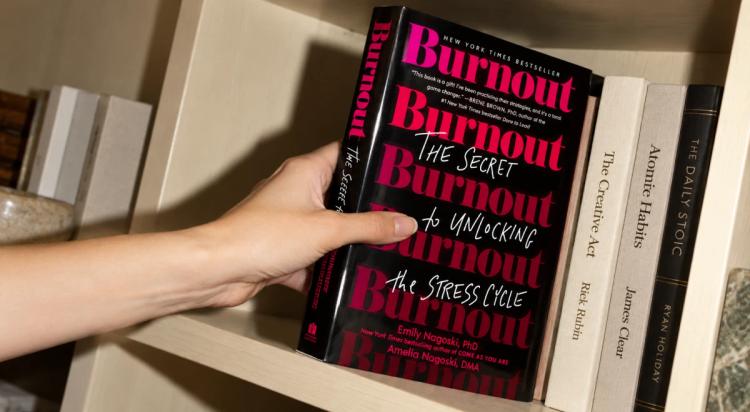
Learn your way out of the burnout-and-insomnia loop with Headway
Most of the fixes above come down to one thing: knowing what actually helps a stressed nervous system, then doing it consistently. That's a learning problem — and it's exactly where Headway earns its place.
Headway turns the best nonfiction on stress, sleep, and recovery into 15-minute summaries you can read or listen to. You can press play during your commute — in the car on CarPlay, or on the train — on a walk, at the gym, or with that first cup of coffee before the office fills up. Some people meditate in that quiet window, some pray, and some use it to learn one idea they can apply that day.
A quick quiz builds a plan around your goals, you keep a gentle streak going, and you can download summaries to listen offline. To be clear, Headway is a learning app, not a treatment — but the knowledge it hands you is the raw material for every change on this list.
📘 Press play on your first summary tonight — find your plan.

That's how it tends to work in practice. Headway's own Nicola Curtis found the summary of 'The Sleep Solution' by W. Chris Winter, MD and, within a few weeks of applying it, noticed real gains in her sleep quality — alongside feeling "calmer" and less stressed overall.
Cost control manager Abdelrahman Mohamed Soliman used a 20-minute morning habit to trade constant firefighting for a calmer, clearer head, starting his day with "clarity, not urgency." And between coding, triathlons, and three kids, Ivan Karačić fit over 120 book summaries into four months on early-morning audio walks — proof that even a packed, high-stress life has pockets you can reclaim.
If your reading pile is itself a source of guilt, leadership mentor Herbert S. Burt describes getting through more books in a year without the overwhelm.
A few summaries worth starting with when stress is eating your nights:
'The Sleep Solution' by W. Chris Winter, MD — why your sleep breaks and how to rebuild it.
'Deep Work' by Cal Newport — protect the focus that overwork and poor sleep erode.
'Atomic Habits' by James Clear — the mechanics of making a wind-down routine stick.
'Don't Overthink It' by Anne Bogel — practical help for the 2 a.m. racing mind.
Burnout and insomnia built the loop together, and they come apart the same way — a steadier day and a calmer night, reinforcing each other instead of tearing each other down. A good night's sleep isn't a lucky accident here; you rebuild it, one protected night at a time, until your work and personal life both feel the difference. You don't have to fix all of it this week. Pick one change, protect it, and let the loop start working in your favor.
Frequently asked questions about burnout and insomnia
Can burnout cause insomnia?
Yes, and it's one of the most common early signs. Chronic stress keeps your HPA axis — the body's stress-response system — switched on, which delays sleep onset and triggers night-time waking. Insomnia symptoms often appear before people recognize they're burned out. Because each problem worsens the other, treating the daytime stress and the night-time wind-down together works far better than tackling either one alone.
Can you fix your sleep without quitting your job?
Usually, yes. Most people rebuild their sleep by changing how they work, not by walking away from it — firmer boundaries, real recovery breaks, and a protected wind-down hour. Shrinking the chronic stress your work environment creates does more than any single bedtime trick, and it's often the fastest way to reduce burnout. If the job itself is genuinely unsustainable, that's worth facing, but better nights rarely require a resignation letter.
Do sleep aids fix stress-related insomnia?
They can mask it, not fix it. Over-the-counter or prescribed aids may help for a few nights, but they don't calm the overactive stress system underneath burnout insomnia, and some blunt the deep sleep and REM sleep that restore you. Building healthy sleep habits — a steady schedule, morning light, earlier caffeine — targets the cause instead. Talk to a doctor before leaning on any sleep medication long term.
Is burnout insomnia the same as depression?
No, though they overlap and can feed each other. Burnout is tied to chronic stress, usually from work; depression is a broader mood condition that colors everything, not just your job. Both can wreck sleep and drain your emotional resilience, and telling them apart matters because they need different help. If low mood, hopelessness, or loss of interest lingers for weeks, treat it as a mental health concern and speak to a professional.
How do shift workers cope with burnout and insomnia?
Shift work fights your circadian rhythm, so the usual advice needs adapting. Keep a consistent sleep window even on days off, use bright light during shifts and darkness after, and protect your sleep space with blackout curtains and a cool, quiet room. Watch your caffeine intake in the back half of a shift. If light sleep and exhaustion persist, a clinician may suggest structured methods like sleep restriction and stronger coping skills.
Can burnout and insomnia affect your physical health?
Yes. Ongoing sleep loss and chronic stress don't stay in your head — they can significantly impact your physical and mental health, from blood pressure and immune function to mood and concentration. Poor sleep quality is linked to lower overall quality of life and well-being over time. That's why the goal isn't just more hours in bed; it's calming the stress system so your days and nights stop draining each other.
How long does burnout insomnia last?
It depends on the trigger. Acute, stress-driven insomnia often clears within days or weeks once the pressure eases and your schedule steadies. If trouble sleeping continues at least three nights a week for three months, it's considered chronic insomnia and tends to persist on its own — even after the original stress fades. That's the point to seek tailored help rather than wait it out.
When should you see a doctor about burnout and insomnia?
Reach out if sleep problems last more than a few weeks, if daytime sleepiness makes driving or work unsafe, or if exhaustion comes with depression symptoms like persistent low mood. Insufficient sleep is a genuine mental health concern, not a willpower issue. Shift workers, caregivers, and anyone with an existing condition should have a lower threshold for help — a sleep medicine or mental health professional can sort out what's really going on.