Self-growth
 Apps & Digital Tools
 Business & Career
 Success
 Growth Tools
 Psychology
 Communication
 Relationships

Ever finished a book, nodded along the whole way, and realized a week later you couldn't explain a single idea in it?
That gap — between the knowledge you take in and what you can use — is a metacognition problem. Metacognition is thinking about thinking: noticing how your mind works, where it cuts corners, and how you learn. It's one of the quieter skills that still separates humans from the machines competing for the same work. The best books on metacognition don't hand you more facts to forget; they teach you to watch your own reasoning and make better sense of the world.
This isn't a generic list of twenty titles. Each of the five books below targets one specific way your thinking trips you up — overconfidence, hidden bias, shallow learning, mental autopilot, or forgetting what you read. Pair any of them with the personal growth reading you already do, and the ideas start to compound.
📘 Short on time? Get the key ideas on Headway in 15-minute summaries you can finish before your coffee cools.

Quick answer: the best books on metacognition at a glance
If you want to skip straight to the book that matches your problem, here's the short version.
'Think Again' by Adam Grant — for people who are too sure they're right.
'Thinking, Fast and Slow' by Daniel Kahneman — for people who trust their gut a little too much.
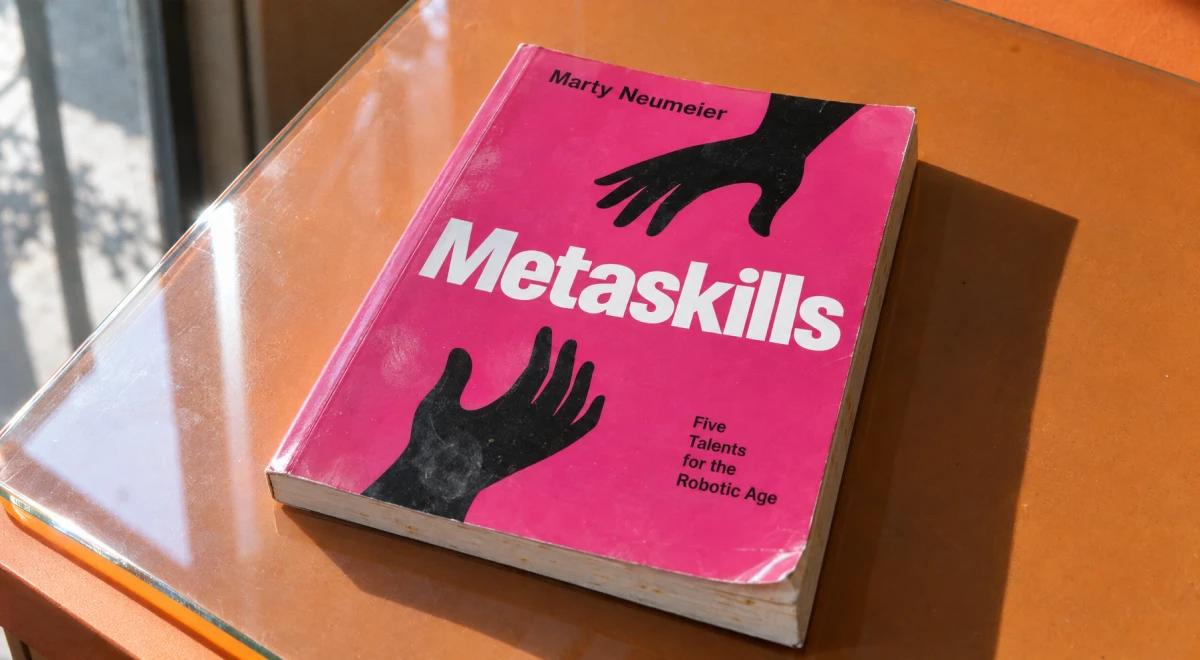
'Metaskills' by Marty Neumeier — for people who want to stay sharp as machines get smarter.
'The Art of Thinking Clearly' by Rolf Dobelli — for people who keep making the same mistakes.
'Learning How to Learn' by Barbara Oakley and Terrence Sejnowski — for people who study hard but forget fast.
Why cognitive biases make your brain bad at watching itself
Metacognition has a built-in problem: the tool you'd use to check your thinking is the same brain doing the flawed thinking. We're wired for confidence more than accuracy. In a much-cited 1981 study by psychologist Ola Svenson, 93% of US drivers rated their own skill as above average — mathematically impossible, since half of any group sits below the median.
That overconfidence isn't just a driving quirk. Decades of research show the same blind spots shape how you read the news, weigh an argument, or interpret a history book — the space between your perception and reality quietly widening. Strong metacognitive skills close the gap between how good your reasoning feels and how good it really is — and whether the right ideas land.
The five best metacognition books for understanding how you think
Each pick below solves one specific weak spot. Match the book to the habit that bugs you most, not to the one with the prettiest cover.
1. 'Think Again: The Power of Knowing What You Don't Know' by Adam Grant — for people who hate being wrong
Adam Grant's point is simple: the skill that matters most isn't how much you know; it's how willingly you rethink it. 'Think Again' digs into intellectual humility — treating your opinions as hypotheses instead of prized possessions. Grant shows how confident people get boxed in by "I'm right" thinking, while the best thinkers argue with themselves before anyone else can.
You'll learn to catch when you're defending an idea out of ego rather than evidence. If you dig in during disagreements, this one loosens the grip — a natural first step into metacognition.
2. 'Thinking, Fast and Slow' by Daniel Kahneman — for people who trust their gut a little too much
Nobel laureate Daniel Kahneman splits your mind into two characters. System 1 is fast and intuitive and jumps to conclusions; System 2 is slow, deliberate, and does the hard math. Most errors happen when we rely on System 1 for questions that need System 2 — trusting intuition where slow reasoning belongs.
'Thinking, Fast and Slow' is the definitive, chapter-by-chapter tour of cognitive biases — anchoring, loss aversion, the halo effect, and a dozen more traps you slip into without noticing. It's a dense but genuine must-read: once you can name a bias as it happens, you can slow down and correct it. New to the field? Our roundup of psychology books for beginners pairs well with this one.
📘 Want the big ideas faster? Read them on Headway in about 15 minutes each, in text or audio.
3. 'Metaskills: Five Talents for the Robotic Age' by Marty Neumeier — for people who want to stay valuable as AI grows
Marty Neumeier wrote 'Metaskills: Five Talents for the Robotic Age' around a simple worry: what stays valuable when machines handle the routine work? Neumeier frames it as professional survival. His answer is five higher-order talents — feeling, seeing, dreaming, making, and learning — that sit above any single skill and let you adapt when the ground shifts.
It's the most design-minded book here, and the least academic. Learning fast, connecting ideas across fields, and imagining what doesn't exist yet is exactly the work AI can't copy — and, he argues, where future success will come from. If you're thinking about the next decade of your career, this is metacognition applied to work.
4. 'The Art of Thinking Clearly' by Rolf Dobelli — for people who keep making the same mistakes
Rolf Dobelli's 'The Art of Thinking Clearly' is the practical companion to Kahneman's theory. Where 'Thinking, Fast and Slow' explains why your mind slips, Dobelli hands you the field guide: 99 short chapters, each naming one thinking error — survivorship bias, the sunk cost fallacy, confirmation bias, social proof — with a plain example and a one-line correction.
You can read it front to back or open a single chapter before a big decision. It reads less like philosophy and more like a pre-flight checklist for your brain — every entry ends with something you can do differently. Naming an error before you act on it is metacognitive regulation at its most usable, which makes this the most immediately practical pick on the list.
📘 Rather test a book first? Sample the summaries before you commit to 300 pages.
5. 'Learning How to Learn' by Barbara Oakley and Terrence Sejnowski — for people who study hard but forget fast
Barbara Oakley and neuroscientist Terrence Sejnowski built 'Learning How to Learn' around one question: how does the brain absorb hard material? Their answer leans on neuroscience — how your mind switches between focused mode (heads-down concentration) and diffuse mode (the loose wandering that cracks problems in the shower), and why cramming fails while spacing sticks.
You'll get concrete learning strategies: chunking, spaced repetition, and testing yourself instead of rereading. That advice is well supported: in a landmark 2013 research review, practice testing and spaced study earned the highest utility ratings of any technique studied, while rereading and highlighting ranked surprisingly low. It's the most hands-on pick for students and lifelong learners, and the one most likely to improve your results fast.
If you want to go further, Scott Young's 'Ultralearning' makes a natural companion read. If the material evaporates by exam day, start here — the techniques work whether you're 15 or 50.
Which metacognition book should you start with
Use this table to map each book to the thinking habit you most want to fix.
| Book | Best for | Core idea | Format |
|---|---|---|---|
'Think Again' | Being too attached to your opinions | Treat beliefs as hypotheses, not identity | Story-driven, easy read |
'Thinking, Fast and Slow' | Falling for cognitive biases | Two systems run your mind — know which is talking | Dense, rewarding |
'Metaskills' | Staying valuable as AI grows | Five durable talents above any single skill | Visual, design-minded |
'The Art of Thinking Clearly' | Repeating the same thinking errors | 99 named errors, each with a fix | Bite-sized, practical |
'Learning How to Learn' | Studying hard but forgetting fast | Focused vs. diffuse modes, spaced practice | Hands-on, beginner-friendly |


How real readers put metacognition to work
Learning about thinking is one thing; noticing your own is another. A few Headway users were generous enough to share how the shift played out — and each story lands on the same idea: quality of attention over quantity of books.
Executive coach Deyvis Bebicaci turned each summary into a reflection prompt:
After finishing a summary, I pause and ask: Where does this show up in real life?
That question — checking an idea against your own experience — is metacognition in a sentence. Copywriter Andrea Bagaglia caught the flip side first, the moment of noticing a gap:
I acquired a ton of cool principles along the way, but I didn't seem to remember anything.
He fixed it by testing himself instead of reading on autopilot. Others echo it: marketing manager Olena Khodos pre-reads summaries to test frameworks in real life, student Rahaf Sobh rethought how she approached reading and started remembering more, and freelance writer Israel López built learning plans around his weak spots.
Turn thinking about thinking into a daily habit with Headway
You can read every book on this list and still change nothing — the metacognition paradox in miniature. Insight without a system to apply it just becomes another thing you once knew.
Headway closes that gap. You get the core ideas from the best books on metacognition in 15-minute summaries, then quizzes and daily prompts nudge you to notice where each one fits your life and carry one idea forward. It's built for self-improvement that sticks, and it sits beside a wider self-improvement reading list. More than 60 million people downloaded it to keep exploring in the time they already have — a commute, a coffee break, the ten minutes before bed.
📘 Start with one summary today and see which idea you're still thinking about tomorrow.
Frequently asked questions about books on metacognition
What is metacognition, in simple terms?
Metacognition is thinking about your own thinking. It's the awareness of how you learn, reason, and remember — plus the ability to steer those processes on purpose. In practice, it looks like noticing when you're confused, questioning a snap judgment, or picking a study method that genuinely works for you. Researchers split it into two parts: knowing how your mind works, and regulating it as you go. The helpful shift is realizing you can direct your mind, not just ride it.
What's the difference between metacognition and critical thinking?
Critical thinking is how you evaluate information — weighing evidence, spotting faulty logic, judging a source. Metacognition turns that lens inward: it's how you judge your own thinking as you do it, and the two sharpen your problem-solving between them. Critical thinking asks whether an argument holds up; metacognition asks whether you're the right judge of it right now, or whether bias and fatigue are clouding your call.
Does metacognition improve problem solving and decision-making?
Yes. It improves problem solving by making you check your first answer before you commit to it — the usual source of avoidable mistakes. Research links stronger metacognitive skills to better decision-making, because you catch faulty assumptions early and adjust your actions in time. It won't hand you knowledge you don't have, but it helps you use what you already know far more reliably.
Is metacognition the same as intelligence?
No. Intelligence is roughly how fast you process and solve problems; metacognition is how well you manage that horsepower. Plenty of sharp people still trust a flawed intuition or wave away good evidence. Research suggests metacognition can be trained at any level of ability — good news if you're interested in thinking more clearly without magically raising your IQ.
Are book summaries as useful as reading the full metacognition book?
For grasping a framework, often yes. Metacognition books tend to carry a few core ideas stretched across 300 pages, so a good summary hands you the concept fast and lets you compare several before committing. The limit is application: reading about self-awareness does nothing unless you practice it — true whether you read the summary or the whole book.
Where can I find these metacognition books?
Every title in this article is widely available. You can find them on Amazon in print, Kindle, or audio — scan the author, the reader reviews, and current costs before you add anything to your cart, since prices and formats vary. If you'd rather test the ideas first, Headway carries key-idea summaries of many of these books, so you can see which one is worth buying or sharing with a friend.
How do you practice metacognitive skills day to day?
Start small and specific. Before a decision, ask what you might be missing. After you learn something, explain it in your own words and notice where you stumble — that's where your understanding is thin. Keep a short note on choices that surprised you later, so you can spot your patterns over time. Testing yourself beats rereading, and the goal isn't more thinking — it's clearer thinking.