Self-growth
 Apps & Digital Tools
 Business & Career
 Success
 Growth Tools
 Psychology
 Communication
 Relationships


The audiobook industry has judged narration as its own craft for a long time. Since 1996, the Audio Publishers Association has handed out Audie Awards for Best Female Narrator, Best Male Narrator, Multi-Voiced Performance, and Narration by the Author, separate from any award for the writing itself.
A great script and a great voice aren't the same thing.
This is the lens for this list of the best books on Audible. Instead of sorting by genre or bestseller rank, it picks books where the performance is part of the reason to listen. Some are full cast. Some are read by the author. A few are classics that mostly work because of the person reading them.
📘 Want quick audio insights? Headway has more than 2,500 summaries of popular nonfiction titles to listen to today.
*This review was prepared by the Headway editorial team and is current as of November, 2026. App prices, ratings, and features can change. Check the App Store, Google Play, Trustpilot, and the app's official site for the latest updates.

TL;DR: Best books on Audible to try right now
If you want one pick to try first, match it to the kind of listening you like:
'Daisy Jones & The Six': a full-cast production that sounds like a documentary.
'Greenlights': Matthew McConaughey reading his own memoir, with timing a page can't give.
'To Kill a Mockingbird': Sissy Spacek's reading of a classic.
'Project Hail Mary': sci-fi that's widely praised in audio form.
Where the narration does the heaviest lifting
Narration can lift the material of an audiobook well beyond what a standard reading gives you, and these are the titles where that shows most. The experience varies a lot with the performer, so a narrator's name is worth as much as a plot summary.
Start with 'Daisy Jones & The Six' by Taylor Jenkins Reid. It's a rockumentary told as interviews, loosely evoking the real history of bands like Fleetwood Mac, and the audiobook uses a full cast, so each band member sounds like a real person talking to a documentarian.
Narrator Julia Whelan, who has voiced books by Emily Henry, Kristin Hannah, and Reid herself, has called it the easiest way to get a first-time listener hooked because it feels like a podcast.
Full-cast productions are among the most immersive formats in audio, and this is a good example. Many of the books Whelan narrates, including Emily Henry's, regularly land on The New York Times bestseller list, so her name on a cover is a decent signal that the performance will be polished.
It also makes the full cast a gentle first step if you've never tried audio, since the voices keep you oriented without any effort.
Matthew McConaughey narrates his own memoir, 'Greenlights', and the humor lands in his voice in a way it wouldn't on the page. Authors reading their own work can give you a unique listening experience, since they know where a pause belongs. 'The Poet X' by Elizabeth Acevedo works for the same reason.
She wrote it in verse and reads it herself, so the rhythm arrives exactly as she meant it. If you're curious about how Audible's offering compares beyond narration, the full Audible review covers features and pricing.
Classics get a second life with the right voice. Stephen Fry's narration of 'Pygmalion' enhances the audio experience of a play that's already built on how people sound. Rosamund Pike reads 'Pride and Prejudice', which is highly recommended for the audio format because Austen's wit sits in the tone.
Sissy Spacek narrates the audiobook of 'To Kill a Mockingbird', often called the Great American Novel, and her voice suits a story told through a child's memory.
Sci-fi and fantasy audiobooks often have innovative storytelling and world-building that benefit from a narrator with range. Andy Weir's 'Project Hail Mary', read by Ray Porter, is highly praised for its audiobook format.
Part of the reason is the alien character Rocky, who communicates in musical tones, something a page can only describe and a performance can actually deliver.
Fantasy audio ranges from a gentle fairy tale retelling to a game-like series such as 'Dungeon Crawler Carl', and the best of it uses world-building to give the narrator something to play with.
'Dungeon Crawler Carl' is loud, funny, and packed with a game-like world that depends on the narrator's range to keep other characters distinct from one another.
Two more picks lean on production, not just a voice. 'The Night Swim' by Megan Goldin features a true crime podcaster as its main character, and its audiobook is designed to sound like a true crime podcast.
One content note: its plot involves a sexual assault trial. 'Remarkably Bright Creatures' by Shelby Van Pelt casts a separate voice actor for its octopus, Marcellus, an aging creature aware of his own mortality, which keeps him from blurring into the other characters.
As the title suggests, the book is about the creatures people overlook, and hearing a distinct voice for the octopus makes that point without a word of explanation.
Finally, 'The Goldfinch' by Donna Tartt is a case for commitment. It runs over 700 pages in print and over 32 hours on audio, so it's worth knowing the length before starting. It's a better fit for a long commute or a road trip than for a few spare minutes a day.
Of course, you can always pause it and come back, but a story this big works best when you can settle in.
How to sample a narration before you spend a credit
A good narrator can disappear into the story, and a perfect narrator makes you forget you're listening to a performance at all. You won't know which you've got from the cover. Here's a quick way to check before you spend a credit.
Start with the free sample on the listing. Five minutes is enough to tell whether the voice annoys you. Then look at the ratings, because Audible splits the score into Overall, Performance, and Story.
A great book can still come with a flat reading, and the Performance number is the one that tells you what you're getting. Excellent narration usually shows up there first.
Check whether the edition is unabridged, too. A few older editions trim the text, and a shorter runtime isn't always a better deal. Sleep timers and variable speed help too, so a slow narrator isn't a dealbreaker.
Then look at what else the narrator has read. If you loved one Julia Whelan book, several audiobooks of hers are probably worth trying, and the same goes for Stephen Fry or Richard Armitage. Narrators build followings for a reason.
If this is your first book, pick something under ten hours, and ideally a full cast production. They're easier to follow than a single voice reading 30 hours of dense prose. Listen at normal speed first and speed it up later. If you already love audiobooks, you probably know your own preferences, so lean on them.
One more habit worth building: when a performance wins you over, note the narrator, not just the title. It's the quickest way to build a shelf of favorite books you'll want to hear again, and it saves you from gambling a credit on an unknown voice.
📘 Try a quick nonfiction summary before you spend a credit on Headway!
Free classics and the Plus Catalog
Classic literature is where the Plus Catalog earns its keep. It's the rotating selection of audiobooks, podcasts, and originals included with an Audible Plus or Premium Plus membership at no extra cost per title.
It's a curated mix across genres, not a fixed library, and it includes a good number of popular fiction audiobooks. Several excellent narrations sit there and don't cost a credit. For a clear explanation of how credits and the catalog work together, see how Audible credits actually work.
Mary Shelley's 'Frankenstein' is an important ancestor of the horror and science fiction genres. One well-known Audible edition is narrated by Dan Stevens, an Audie finalist for that performance. Homer's 'The Odyssey' is literature's grandest evocation of every man's journey, and it suits being heard, since it began as an oral story.
'The Adventures of Huckleberry Finn' by Mark Twain is a classic American novel, and Huck, a boy running from his father toward a new life on the river, sounds more natural spoken than in dialect on the page.
Jane Austen's novels turn up in the catalog alongside others by Charles Dickens, Oscar Wilde, and Robert Louis Stevenson, including Dickens's 'A Tale of Two Cities' and Stevenson's 'Strange Case of Dr Jekyll and Mr Hyde', which Richard Armitage narrates in a special edition.
'Anne of Green Gables' and George Orwell's 'Animal Farm', written as World War II was ending, are in the same neighborhood, and so is 'A Clockwork Orange', whose invented slang is easier to absorb by ear. Stephen Fry has also narrated 'The Complete Sherlock Holmes' for Audible, and his retelling of Greek mythology, 'Mythos', is another good option when you want a long, warm listen.
If you like your classics dark, Audible's Monster Collection bundles 'Frankenstein', 'Dracula', and 'Dr Jekyll and Mr Hyde' in one 30-hour listen, narrated by Richard Armitage, Dan Stevens, Greg Wise, and others.
The standalone 'Dracula' edition uses several voices, including Alan Cumming and Tim Curry, which makes it feel closer to a radio play than a reading. These are excellent books to try on a dark evening, and they cost nothing extra if they're in the catalog that month.
Titles rotate in and out of the Plus Catalog, so check before you count on one.
The best books on Audible, book by book
The table pulls together every title covered above so you can scan the whole list. For the fuller picture of plans and pricing beyond this list, the dedicated "Is Audible worth it?" piece goes further.
| Book | Author | Narrator | Genre | Free with Plus? |
|---|---|---|---|---|
'Daisy Jones & The Six' | Taylor Jenkins Reid | Full cast | Fiction | No |
'Greenlights' | Matthew McConaughey | The author | Memoir | No |
'Pygmalion' | George Bernard Shaw | Stephen Fry | Classic drama | No |
'Pride and Prejudice' | Jane Austen | Rosamund Pike | Classic | Yes |
'To Kill a Mockingbird' | Harper Lee | Sissy Spacek | Classic fiction | No |
'The Poet X' | Elizabeth Acevedo | The author | Fiction/verse | No |
'Project Hail Mary' | Andy Weir | Ray Porter | Sci-Fi | No |
'Dungeon Crawler Carl' | Matt Dinniman | Jeff Hays | Fantasy/LitRPG | No |
'The Night Swim' | Megan Goldin | Podcast-style production | Thriller | No |
'Remarkably Bright Creatures' | Shelby Van Pelt | Multiple, incl. a voice for the octopus | Fiction | No |
'The Goldfinch' | Donna Tartt | Single narrator | Fiction | No |
'Frankenstein' | Mary Shelley | Varies by edition | Horror/Sci-Fi | Yes |
Genres on Audible run from Sci-Fi, Fantasy, Thriller, and Mystery to Romance, Memoir, and nonfiction audiobooks, so the list above only samples the catalog. The "Free with Plus?" column reflects the catalog at the time of writing and can change.
📘 Test a short audio summary on your commute with Headway!
What the ear rewards, genre by genre
Different genres ask different things of a narrator, and knowing that helps you find books you'll actually finish.
Thrillers and mysteries reward pace. A slow, even voice can drain the tension from a twist, so the production around a thriller matters, which is why a podcast-style recording like the one for 'The Night Swim' works so well.
Classic mysteries are different. Stephen Fry's reading of 'The Complete Sherlock Holmes' keeps the dry humor of the stories intact, and it's a fun way to cover Conan Doyle's whole run without picking up a physical book.
Romance and book-club fiction reward warmth and timing. This is the territory of Julia Whelan, who narrates Emily Henry's novels, Taylor Jenkins Reid's, and Kristin Hannah's historical fiction. Her reading of Hannah's 'The Women' won the Audie for Best Fiction Narrator in 2025, which tells you how seriously the industry takes the craft.
Memoir rewards the author's own voice. Matthew McConaughey's 'Greenlights' is one example. Tara Westover's 'Educated' is another, though it's read by Whelan, and it shows that a skilled outside narrator can carry a personal story too. Either route can work as long as the voice stays out of the way.
Nonfiction and personal growth listening reward clarity. A narrator who sets a steady pace and doesn't oversell can make a dense idea easier to retain than the page does. That's one reason many people save audio for their commute and keep the harder books for their desk.
Sci-fi and fantasy reward range. These books often have innovative storytelling, odd names, and invented languages, so a narrator who can keep a dozen voices apart is worth a lot.
This is where 'Project Hail Mary' and 'Dungeon Crawler Carl' earn their place on this list, along with 'The Martian', narrated by Wil Wheaton, which is exclusive to Audible.
Classics reward patience. A narrator can turn a book that felt like homework into something you can hear, and the result often feels more like a movie for your ears than a reading assignment.
It's why a long Dickens novel can suddenly feel doable on a walk. The same goes for 'A Tale of Two Cities', which many people never finish in print but sail through when someone else does the reading.
Choose by narrator, not just by title
When listening to audiobooks, the voice in your headphones matters just as much as the author's words. You can have a brilliant story ruined by a flat performance, or a mediocre story elevated by a master voice actor.
For instance, when J.K. Rowling released 'Harry Potter and the Sorcerer's Stone', the legendary narration by Jim Dale and Stephen Fry proved exactly how much a narrator defines a beloved universe.
Ray Porter is practically a guaranteed purchase for sci-fi fans. January LaVoy brings incredible warmth and depth to historical fiction.
Finally, Julia Whelan remains one of the platform's most prolific and acclaimed narrators across contemporary fiction and memoir, making any new releases she voices an automatic download for seasoned listeners.


Pros: what Audible's narration earns
The strongest case for Audible is the pool of narrators. Listeners name the same favorite narrators again and again, including Ray Porter, Julia Whelan, Stephen Fry, Tim Curry, Alan Cumming, Dan Stevens, and Richard Armitage.
Whelan in particular is a popular narrator for many authors, and her fans follow her from book to book. That kind of loyalty is rare in print, where few readers choose a book because of its typesetter.
The second advantage is production. Full-cast and dramatized recordings can do things a text-only release can't, and engaging narration and production quality can enhance storytelling in ways that surprise people who think audio is just reading out loud. It also helps with nonfiction and personal growth listening, where an effective narrator can make dry material easier to stay with.
The third is exclusive content. Audible offers a curated selection across genres and some audiobooks you can't get elsewhere. 'The Martian', narrated by Wil Wheaton, is exclusive to Audible and often cited as a case where narration lifts a story.
If you're weighing Audible against other apps, the Audible vs. Spotify audiobooks comparison shows how Spotify's growing catalog stacks up.
Cons: where the narration premium doesn't pay off
Quality isn't uniform. A credit costs the same whether the reader is excellent or merely adequate, and the audiobook experience can change a lot with a single performance.
A narrator you find grating can sink a book you'd otherwise enjoy, so sample before you commit. It's the same story in a different voice, and the voice is most of what you're paying for.
Length is the second catch. 'The Goldfinch' at 32 hours is more than four times the length of many single-narrator novels, and a long listen, like one of Stephen King's big novels, can take weeks. Think about whether you'll actually finish before you spend a credit on it. Credits are meant to be used, too.
Third-party sources report that unused credits roll over for up to a year while your membership is active and vanish if you cancel, so a pile of unspent credits is a quiet cost. A credit spent on a book you abandon at hour four is a credit gone, and that's the main way listeners feel they've wasted money.
Third, several of the free classics above, including 'Frankenstein', 'The Odyssey', and 'The Adventures of Huckleberry Finn', are also available free elsewhere with no subscription at all, often through a library.
That's worth knowing before paying for access. Free options won't have the same narrators, though, so the real question is whether a particular performance is worth paying for, and for a few of the titles above, it is.
There are also other ways to buy audiobooks. Libro.fm supports independent bookstores through its subscriptions, and its credits don't expire. Amazon Music has begun including audiobook credits with some music memberships, at no extra cost beyond the membership. If Audible's credit pricing doesn't match how much you listen, the list of Audible alternatives is a good place to start.
📘 Pick up a nonfiction summary between long listens on Headway!
When a physical book is still the better choice
Audio isn't the right format for everything, and it helps to say so. Books with charts, footnotes, or a long cast of names tend to work better on the page. A physical book also lets you flip back, underline, and skim, none of which an audiobook handles well. Reference books and anything you'll want to consult again are usually easier in print.
If you want both, the formats can run side by side. When you own the Kindle edition, Amazon's Whispersync feature can keep the audiobook and the text on the same page, so you can switch between listening and reading without losing your place. It only works for titles that have both editions, so check the listing.
Attention is the other thing to weigh. Audio is easy to pair with a commute, a workout, or the dishes, and that's a big part of its appeal. But a dense argument, or a mystery where one small clue matters, can slip past you when your mind is half somewhere else. If you notice you've lost the thread, rewind a few minutes instead of pushing on. Fiction with a strong voice forgives distraction more than a book of ideas does.
Re-listening is another trade-off. Some people play a favorite performance multiple times and notice something new each pass, which is one of the real pleasures of audio. But a novel with a complicated plot is harder to revisit by ear than by eye, because you can't glance back for a name.
Most libraries lend audiobooks for free through apps, which makes them a low-risk way to test a narrator before you commit money to one. Plenty of listeners borrow first and buy only the performances they know they'll replay. And for non-fiction audiobooks, many listeners keep a few notes or highlights, because retention from listening alone tends to fade. That's a gap shorter formats try to fill.
Try a different way to spend your listening time — Headway!
Not every book needs a ten-hour performance to be worth your time, and not every title you want to absorb is fiction that's best heard as a full production.
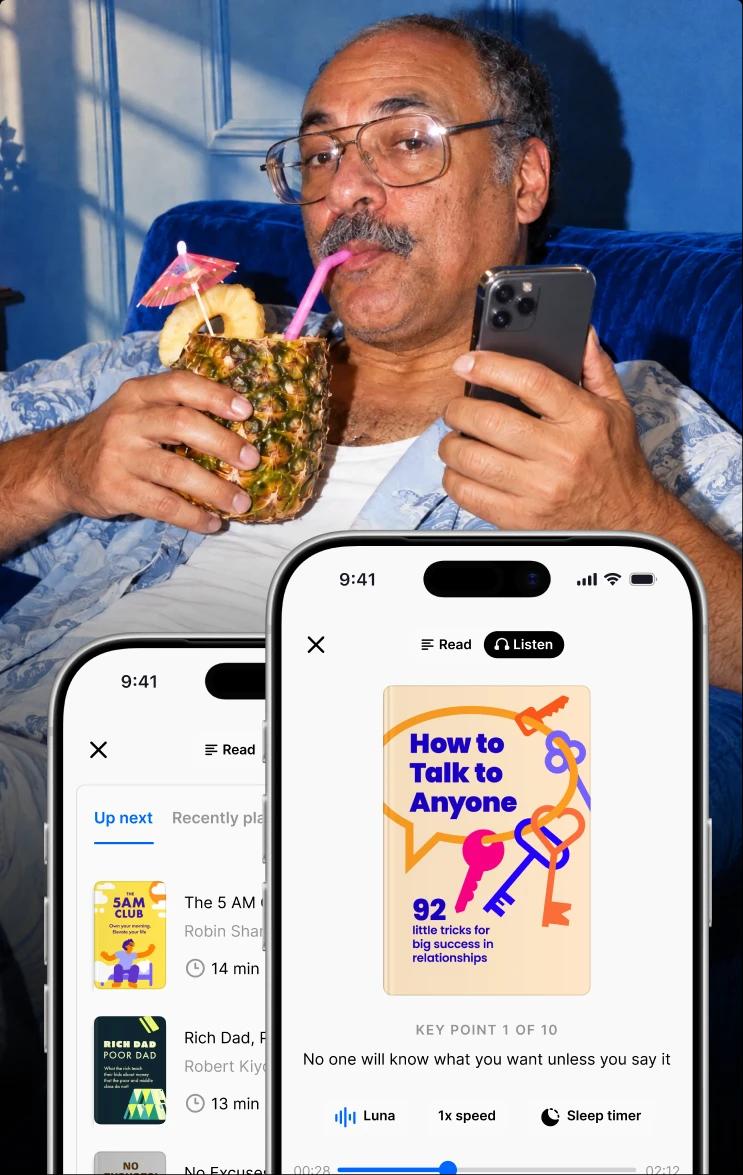
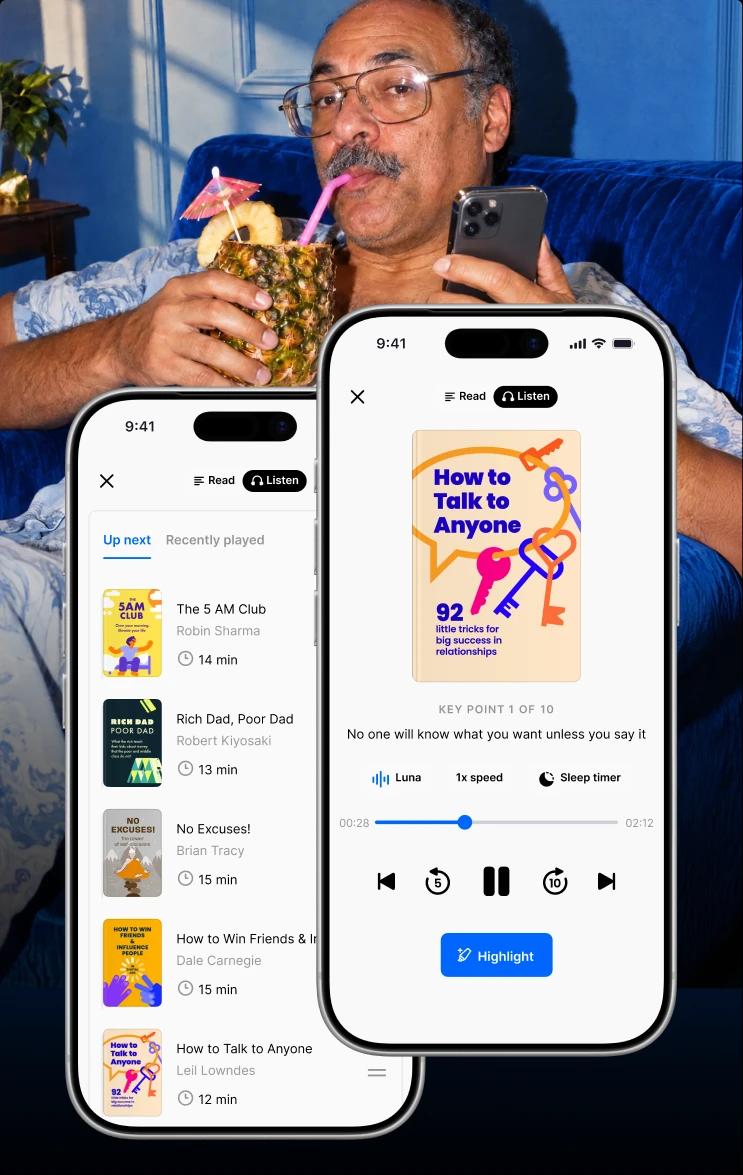
Headway serves a different need than anything above: 15-minute summaries of nonfiction books, in text and audio, for people who want the core ideas fast.
Audiobooks can also transform personal growth and self-improvement learning when a narrator makes dry material easy to follow, and short audio summaries build on the same idea. It works as a complement to audiobook listening, not a replacement for it. The table compares the two on plain facts.
| Audible | Headway | |
|---|---|---|
Content format | Full audiobooks, including full-cast productions | 15-minute nonfiction summaries in text and audio |
Price and trial (US, November 2026) | Plus $7.95/month, no credits; Premium Plus $14.95/month with one credit, 30-day trial | Free plan with one summary a day; $12.99/month, $29.99 for 3 months, $89.99/year, 7-day free trial |
Platforms | iOS, Android, and web | iOS, Android, web, Apple CarPlay, and Android Auto |
Library | More than a million titles | 2,500+ nonfiction summaries |
Offline listening | Yes | |
Best for | Long-form fiction, memoirs, and narrated classics | Quick takeaways from nonfiction |
Main limitation | Credits and the Plus Catalog have limits, and long listens take time | Leans nonfiction, and summaries are shorter than full books |
If you want a nonfiction book's main ideas in 15 minutes before deciding whether to listen to the full thing, a summary can help. For readers comparing summary apps, how Headway compares to Blinkist covers that category.
📘 Preview a nonfiction summary on Headway!
FAQs about the best books on Audible
What is the highest-rated audiobook on Audible?
Audible's ratings shift constantly, so no single title holds the top spot for long, and a current answer needs a look at the live site. A more useful question is which performance suits you. Check the "Performance" score, not just the overall stars, because a great story can hide a flat reading. Then read a few recent reviews.
What are the top 10 audiobooks of all time?
There's no official list, and sales, ratings, and listener polls give different answers. A fair shortlist from this article would be 'Daisy Jones & The Six', 'Greenlights', 'To Kill a Mockingbird', 'Project Hail Mary', and 'Pride and Prejudice', then the free classics. Check a current source before quoting a ranking.
What are the best books only on Audible?
That means exclusives, mainly Audible Originals and Audible-only productions. 'The Martian', narrated by Wil Wheaton, is exclusive to Audible. Many other recommended titles, like 'Daisy Jones & The Six', are sold on several platforms, so don't confuse "great on Audible" with "only on Audible." Check the listing to confirm exclusivity, since platform deals change over time.
What is the hottest book on Audible?
"Hottest" means trending this week, which differs from highest-rated of all time. Trending lists change often and follow new releases and social media buzz, so a current title may not be a lasting one. The Audible home page and bestseller charts show what's moving now, and older picks like 'Project Hail Mary' tend to keep returning. Treat trending as a cue to sample.
What is the most listened-to audiobook?
Audible doesn't publish one public all-time listens figure, so any claim you see online is an estimate. Listens, sales, and ratings measure different things. For popularity data, check library apps and Audible's own charts, and be wary of numbers that don't name a source or a date. A confident number with no source usually isn't one.
Do I own my Audible books forever?
Mostly yes. Titles you buy with a credit stay in your library as long as your account exists, even after you cancel a membership. Titles you stream from the Plus Catalog don't, and they disappear if you cancel or when they rotate out. So the credit books are yours to keep, and the Plus ones are on loan.
What's the best order to listen to the Dungeon Crawler Carl books in?
You must listen to them in exact chronological publication order: start with 'Dungeon Crawler Carl', then proceed to 'Carl's Doomsday Scenario', 'The Dungeon Anarchist's Cookbook', 'The Gate of the Feral Gods', 'The Butcher's Masquerade', 'The Eye of the Bedlam Bride', 'This Inevitable Ruin', and finally 'A Parade of Horribles'.
Can Audible credits roll over if you don't use them every month?
Yes, your unused Audible credits will automatically roll over to the next month, allowing you to save them up for massive book releases. However, depending on your specific subscription plan, there is a hard cap on how many total credits you can hoard before they begin to expire.