Self-growth
 Apps & Digital Tools
 Business & Career
 Success
 Growth Tools
 Psychology
 Communication
 Relationships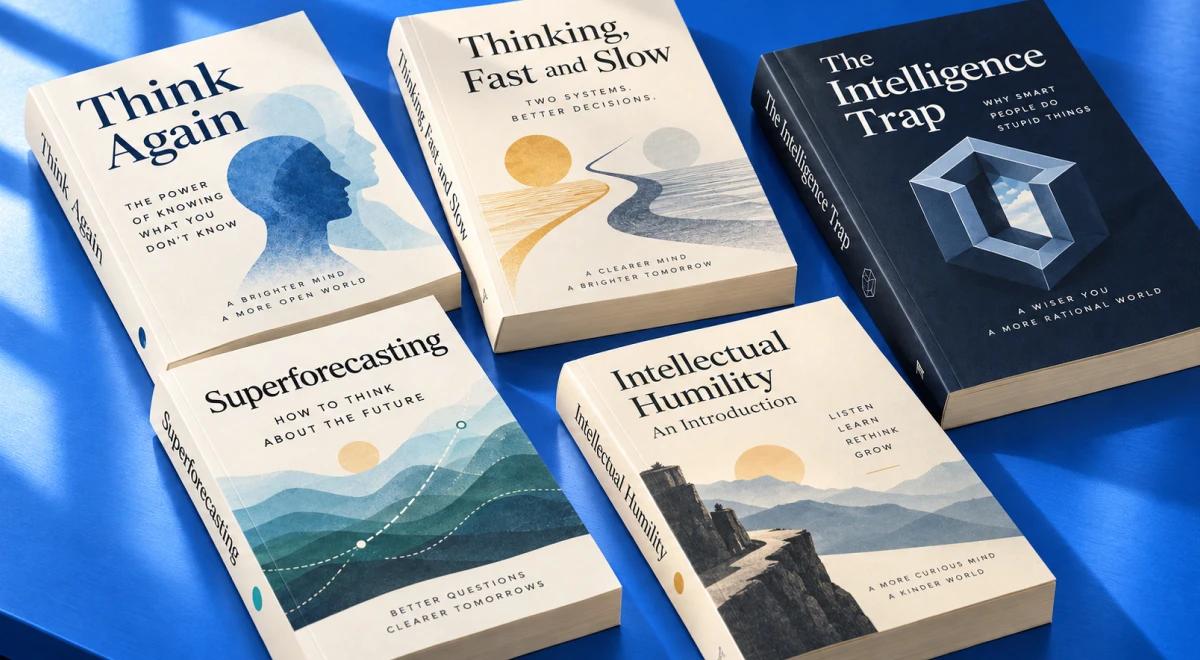

Think about the last time you were dead certain about something, and it turned out you weren't. Did you notice the exact moment your mind changed — or did you quietly rewrite the story so you'd been right all along?
That gap between how much we know and how much we think we know has a name: intellectual humility. It's the willingness to admit your own beliefs might be mistaken, and it's one of the most useful intellectual virtues you can build. The best books on intellectual humility don't just define the idea. They hand you the mental tools to question your assumptions, handle disagreement, and change your mind without feeling like you lost.
Most of these ideas sit inside dense books you keep swearing you'll finish someday. Headway pulls the core insights from 2,500+ nonfiction titles into 15-minute reads and audio, so you can put them to work instead of adding to the pile. Consider this your short, practical reading list for thinking more honestly.
➡️ New to this kind of reading? Ease in with our psychology books for beginners.
📘 Build a reading plan around the way you actually think — answer a few quick questions on Headway.
Quick answer: What are the best books on intellectual humility?
If you want the fast version, these five books on intellectual humility cover the idea from different angles — psychology, philosophy, and real-world decision-making. Use the table below to find the one that fits what you want to work on.
'Think Again' by Adam Grant — the modern classic on rethinking, unlearning, and finding the upside of being wrong.
'Thinking, Fast and Slow' by Daniel Kahneman — the definitive tour of human cognition and the biases that quietly run your judgment.
'The Intelligence Trap' by David Robson — why intelligent people fall for their own reasoning, and how intellectual modesty leads to wiser decisions.
'Superforecasting' by Philip E. Tetlock and Dan Gardner — how the world's best forecasters use open-mindedness and constant self-correction to predict complex events.
'Intellectual Humility: An Introduction' by Ian M. Church and Peter L. Samuelson — the scholarly guide to the philosophy and science behind the virtue.
📘 Meet these ideas in 15 minutes, not 15 hours — get your personal reading plan on Headway.

Understanding intellectual humility: The virtue behind clearer thinking
Intellectual humility isn't shyness, and it isn't low confidence. Psychologists who study it, like Mark Leary and his colleagues, describe it as the degree to which people recognize that their beliefs might be wrong. It's an intellectual virtue — a learned habit of mind rather than a personality flaw — and the nature of intellectual virtues is a topic of ancient interest, going back to Socrates admitting how little he actually knew.
The study of intellectual humility: What philosophy and positive psychology reveal
Once a niche concept, intellectual humility has become one of the most important intellectual topics in modern thought. Over the past few decades, contemporary philosophy has experienced unparalleled energy and concern for one particular virtue above the rest, and it now sits right at the crossroads of philosophy and science.
Researchers in positive psychology have broken it into measurable traits like open-mindedness and intellectual modesty — a more nuanced approach than the vague "just stay humble" advice you usually hear — while philosophers argue over how emotions affect our ability to think clearly. There's even a genuinely interdisciplinary treatment of the whole field, thanks to Ian M. Church and Peter L. Samuelson's 'Intellectual Humility: An Introduction', which maps what the virtue is and where it can be applied.
The stakes are higher than they sound. In a 2015 study, Yale University researchers found that people who looked up answers online rated their own knowledge higher afterward — even on topics they never searched. That's intellectual overconfidence in miniature: the more information we can reach, the more we mistake access for understanding. Recognizing the limits of human knowledge, your own included, is what keeps that trap from closing on you.
📘 See where your own thinking gets stuck — start with a plan matched to your goals on Headway.
Books to catch your own blind spots
These two books on intellectual humility train the same core skill: noticing when your own mind is fooling you, before it costs you anything.
1. 'Think Again: The Power of Knowing What You Don't Know' by Adam Grant
Adam Grant, an organizational psychologist at Wharton, argues that we spend far too much time thinking like preachers defending our beliefs, prosecutors attacking everyone else's, and politicians chasing approval. What we rarely do is think like scientists who treat their opinions as hypotheses to test. The result is a book about the underrated skill of rethinking — updating your views, unlearning what no longer holds, and finding something close to relief in discovering you were wrong.
Grant's central idea is "confident humility": believing in your ability to figure things out while doubting whether your current answer is the right one. He shows how to argue like you're trying to learn instead of win, how to ask the kind of questions that change minds (including your own), and why the most persuasive people concede good points rather than steamroll them.
It's the clearest place to start on this list if you want intellectual humility you can use by Friday, and the Headway summary gets you the framework in about 15 minutes.
➡️ Rethinking old assumptions is also where fresh ideas come from — if that's your angle, our best books for creativity pick up the thread.
2. 'Thinking, Fast and Slow' by Daniel Kahneman
Daniel Kahneman won a Nobel Prize for showing just how unreliable our snap judgments can be. His framework splits the mind into two systems: System 1, the fast, intuitive, emotional autopilot that runs most of your day, and System 2, the slow, effortful, logical mode you'd like to believe is in charge. Most errors, he explains, come from letting System 1 answer questions that really needed System 2.
The book is a field guide to human cognition and the cognitive biases baked into it — anchoring, availability, overconfidence, and the quiet conviction that what you see is all there is.
Reading it is humbling in the best sense, because you start catching your own mind taking shortcuts in real time. Kahneman was also famous for changing his mind in public, which tells you he practiced what he wrote. The Headway summary is a fast way to meet the key biases without the 500 pages.
📘 Catch your biases before they cost you — find your next read on Headway.
Books for wiser decisions under uncertainty
Intellectual humility isn't only self-awareness — it's a decision-making edge. The next two books show what happens when you treat your own conclusions as works in progress.
3. 'The Intelligence Trap: Why Smart People Do Stupid Things and How to Make Wiser Decisions' by David Robson
Science writer David Robson tackles an uncomfortable paradox: intelligence and education don't protect you from your own intellectual weaknesses — and sometimes they make them worse. Smart people are better at building airtight arguments for conclusions they reached for bad reasons, a pattern researchers call motivated reasoning. Expertise can harden into a blind spot, and a high IQ can come with an equally high talent for rationalizing.
The fix Robson lays out is intellectual humility by another name: curiosity, actively open-minded thinking, and the modesty to check your own reasoning before you trust it. Drawing on research into wisdom and rationality, he shows how intellectual modesty leads to wiser decisions, especially when the stakes and the pressure are high. If you've ever watched a brilliant person make an obvious mistake — or done it yourself — this one lands hard.
➡️ For more in this vein, our best books for decision-making go further.
4. 'Superforecasting: The Art and Science of Prediction' by Philip E. Tetlock and Dan Gardner
Philip Tetlock spent decades studying whether anyone can genuinely predict world events, and found that a small group of ordinary people — his "superforecasters" — consistently beat expert teams and even intelligence analysts who had access to classified information, by margins of 30% and up. Their edge wasn't raw brainpower or insider access. It was a way of thinking built almost entirely on intellectual humility.
Superforecasters treat every belief as a probability that can move, update in small increments as new evidence lands, and stay in what Tetlock calls "perpetual beta" — always revising, never finished. They break big questions into smaller ones, actively seek out views that contradict their own, and score their track record honestly.
This is open-mindedness and self-correction turned into a measurable skill, and it's the strongest proof on this list that being willing to be wrong makes you more accurate, not less.
📘 Turn "I might be wrong" into sharper calls — get a reading plan on Headway.
The scholarly foundation: An interdisciplinary take on intellectual humility
If the four titles above are the practical toolkit, this last one is the manual behind them — for readers who want the ideas at full depth, not just the takeaways.
5. 'Intellectual Humility: An Introduction to the Philosophy and Science' by Ian M. Church and Peter L. Samuelson
Ian M. Church, a philosopher at Hillsdale College, and Peter L. Samuelson wrote the scholarly reference on the subject. Built around ten big questions and covering themes from philosophy, psychology, education, social science, and even divinity, it asks what an intellectual virtue really is and how we would ever know who is intellectually humble.
It addresses issues the other books skip: whether these traits are innate or learned habits, how emotions affect our ability to stay humble, the best way to handle disagreement, and what intellectual humility means for religion — and for religious scholars weighing their own theological commitments.
The whole book is aimed at encouraging people to care about the virtue and recognize it in themselves and others. Fair warning — it's a 368-page academic text written for the University of Edinburgh's online course, not a quick read, and it isn't on Headway. But if the idea has its hooks in you, this is where the philosophy and science live.

What intellectual humility looks like in real life
The idea gets real when you see it in someone's ordinary day. These Headway readers each describe a version of the same shift: catching a reaction, questioning a habit, staying open when digging in would have been easier.
Abdelrahman Mohamed Soliman, a corporate cost control manager, describes almost reacting defensively in a tense budget meeting — then pausing, reframing the problem, and asking better questions instead. A colleague later told him, "You don't rush decisions anymore, you frame them." Read how 20 minutes a day moved him from reactive manager to strategic leader.
Deyvis Bebicaci, an executive coach with 30 years of experience, reads one summary each morning and asks a single question: where does this show up in real life? That habit turns insight into the kind of question that helps his clients notice their own patterns. See how daily micro-learning reshaped his coaching practice.
Olena Khodos, a content marketing manager, realized she'd been approaching learning the same way for years and it had stopped working — so she rebuilt her method around testing ideas rather than hoarding them. See how she read 20 business books in 3 months.
Israel Erick López Andrade, a freelance writer of 20-plus years, swapped hours of half-useful courses for short, deliberate reads on personal development and resilience. Here's his honest review.
Rahaf Sobh, a university student, says a small, nagging discomfort about unfinished books is what pushed her to rethink how she reads entirely. Read what changed after two months.


Make intellectual humility a daily habit with Headway
Reading about intellectual humility is the easy part. Practicing it — catching a bias mid-thought, sitting with "I might be wrong," updating a belief you're attached to — takes repetition, and that's the part a stack of unread books can't give you.
Headway turns the ideas in these books on intellectual humility into 15-minute reads and audio you can return to daily, with a plan matched to what you actually want to work on. Pick one title, absorb one idea, and notice where it shows up before your next big decision.
Want to keep the momentum going? Pair a title like 'Think Again' with our best books for self-improvement or best books for productivity.
📘 Start with one idea and make it stick — get your personalized reading plan on Headway.
Frequently asked questions about books on intellectual humility
What is intellectual humility, in simple terms?
Intellectual humility means recognizing that your beliefs and knowledge have limits, and that some of what you're certain about could be wrong. It isn't doubting everything or lacking confidence. It's holding your views firmly enough to act on them while staying open to evidence that you should revise them — plain intellectual honesty about the edges of what you actually know.
What's the difference between intellectual humility and general humility?
General humility is about how you rank yourself against others — modesty about status, talent, or achievements. Intellectual humility is narrower and aimed at your ideas: the willingness to admit your reasoning might be flawed and your conclusions incomplete. Psychologists sometimes label this trait intellectual modesty. You can score high on it while staying self-assured and ambitious in every other part of life.
Is intellectual humility a sign of weakness or low confidence?
Just the opposite. It takes more confidence to say "I might be wrong" than to bluff certainty, and the alternative — intellectual arrogance — is what feeds intellectual overconfidence and avoidable mistakes. Adam Grant calls the sweet spot "confident humility." It's also why the best books about changing your mind treat updating a belief as a route to wiser decisions, not a defeat.
How do you know if someone is intellectually humble?
Watch how they handle being challenged. Intellectually humble people ask questions instead of getting defensive, credit the good points on the other side, say "I don't know" without flinching, and shift position when the evidence changes. It shows up less in how they talk and more in how they handle disagreement once they're proven wrong. Church and Samuelson treat this as one of their ten big questions.
Are there books about epistemic humility specifically?
Yes — "epistemic humility" and "intellectual humility" get used almost interchangeably, both pointing to an honest grip on the limits of what you know. If you want books about epistemic humility from the academic side, Church and Samuelson's 'Intellectual Humility: An Introduction' digs into the underlying epistemology. For books on epistemic humility you can actually apply, 'Think Again' and 'The Intelligence Trap' cover the same ground without the jargon.
Can intellectual humility be learned, or are you born with it?
It can be learned. Researchers treat it partly as a stable disposition and partly as a set of learned habits you can strengthen — questioning your assumptions, seeking out disagreement, and building the cognitive flexibility to update a belief when evidence shifts. Like most intellectual virtues, it grows with self-reflection and repetition, which is exactly why steady, deliberate reading helps it stick.
How is intellectual humility connected to critical thinking and open-mindedness?
They reinforce each other. Intellectual humility is what makes you willing to catch your own cognitive biases — confirmation bias above all — while open-mindedness is the habit of taking opposing evidence seriously. Together they form the backbone of critical thinking. That overlap is why books on intellectual humility and critical thinking, books on intellectual humility and open-mindedness, and books on critical thinking and open-mindedness keep pointing to the same handful of titles.
Do I need a philosophy background to read these books?
Not for four of the five. 'Think Again', 'Thinking, Fast and Slow', 'The Intelligence Trap', and 'Superforecasting' are written for general readers, with the research folded into plain language and real examples. Among these books about intellectual humility, only Church and Samuelson's 'Intellectual Humility: An Introduction' reads like a textbook.
For the best books on intellectual humility without the academic weight, the Headway summaries hand you the core ideas fast.