Self-growth
 Business & Career
 Success
 Communication
 Healing
 Relationships
 Psychology
 Happiness
Most online learning courses get abandoned before the first module is even finished. The old model of sitting through hour-long lectures just doesn't match our busy schedules anymore. We need something that respects our time while actually helping us grow. Bite-sized learning offers a solution.
Real-world microlearning examples show you don't need half a day to gain new skills. Microlearning fits education into your actual life, not the other way around. Instead of fighting for time, you work with the small pockets of time you already have. You turn waiting for coffee into a moment of growth.

Turn spare moments into personal breakthroughs.
Choose from 2K+ titles and feed your hunger to grow.
Try nowIn this article, you'll discover real-world microlearning examples that save time and boost knowledge retention. We'll cover everything from short videos and quizzes to mobile apps that turn your morning commute into a personal classroom. By the end, you'll know exactly which formats work best for your specific goals.
Stop letting your potential sit on a shelf. Download the Headway app to experience microlearning firsthand.
➡️ What is Headway and how does it work?
Quick answer: What is microlearning?
What is microlearning exactly? It's a teaching method that provides information in short, focused bursts. These sessions usually last between two and fifteen minutes. Instead of throwing a whole textbook at learners, it breaks complex topics into small modules. Each part has one clear goal, making the content easy to handle.
Effective microlearning content shares a few key traits that make it work:
Short duration: Every session lasts fifteen minutes or less.
Mobile learning: It's accessible on your phone whenever you need it.
Single focus: Each module covers one specific idea or skill.
Own pace: You decide when to start and when to stop.
Just-in-time: You can use what you learn right away.
Microlearning works because it doesn't fight against your brain's limits. It works with them. When you focus on one small thing, you're much more likely to remember it a week later. It turns a massive mountain of information into a series of small, manageable steps.
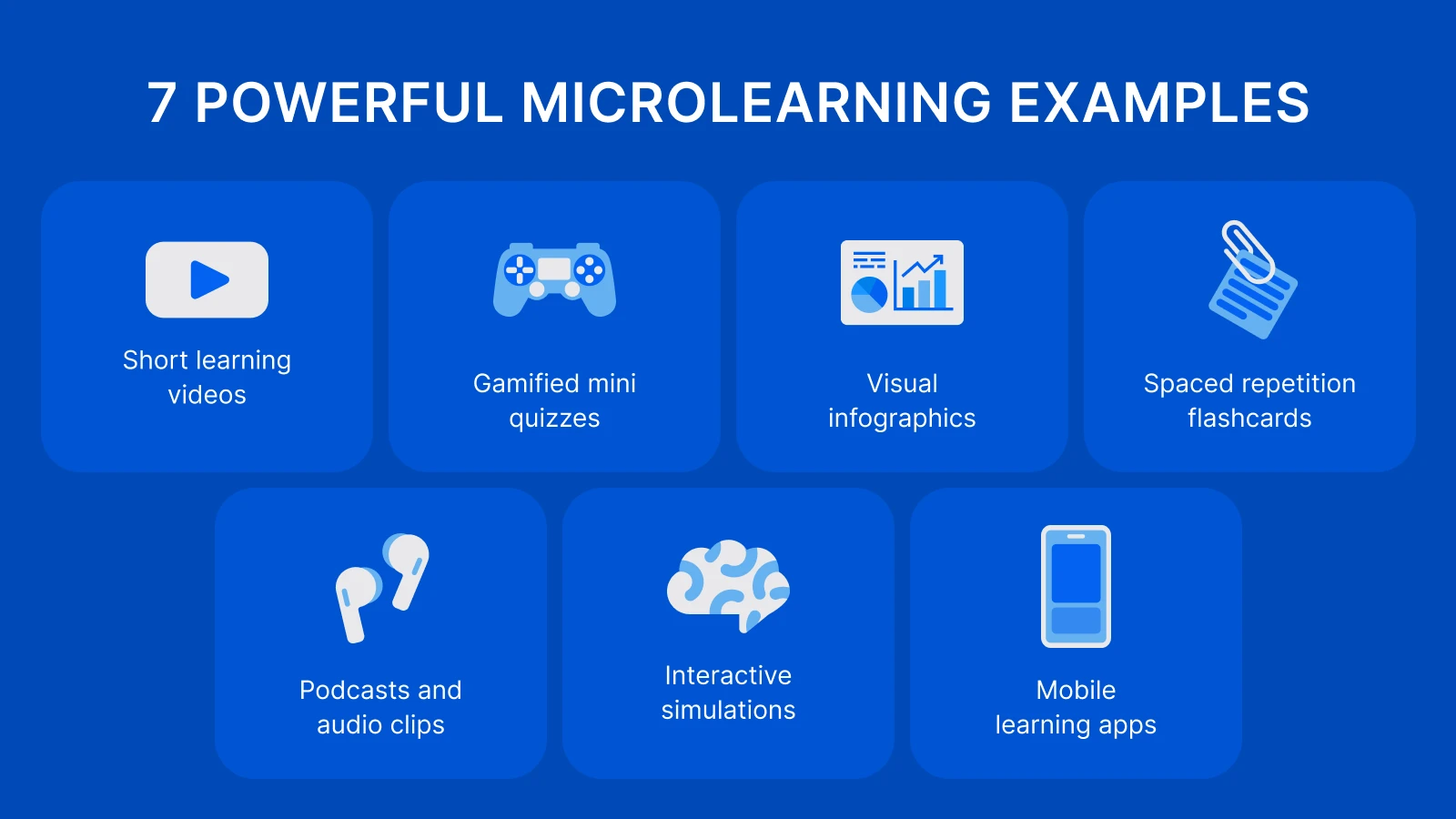
Seven powerful microlearning examples you can use today
Different types of microlearning work best for various situations. If you want to master a new tool, you might need a video. If you want to remember facts, you might use flashcards. These are the most effective formats we're seeing in 2026.
1. Short videos
Microlearning videos are one of the most popular ways to learn today. They combine what you see with what you hear to create a rich learning experience. Think of a YouTube tutorial, but even shorter and more focused. A ninety-second video explaining a specific hack can stick with you better than reading a long manual for ten minutes.
These short videos work because your brain processes pictures much faster than text. When you see someone perform a task while they explain it, you create multiple paths in your memory. That's why microlearning videos are a go-to for employee training and quick DIY fixes. They give you the "how-to" without any fluff.
2. Gamified quizzes
Gamification turns the act of learning into a fun challenge. Interactive quizzes give you instant feedback, so you know right away if you understood the material. Points, badges, and streaks tap into your natural desire to win and improve. It makes the learning experience feel like a game rather than a chore.
When you use gamified elements, your brain releases a tiny bit of dopamine every time you get a correct answer. That feedback makes you want to keep going. It's a powerful tool for learner engagement because it keeps you coming back to beat your own high score. You're learning, but it feels like playing.
📘 Want to test your knowledge? Try Headway's interactive quizzes with answers to life's questions to help you stay sharp and motivated.
3. Infographics
Infographics are visual summaries that present a lot of information in a single image. They're great for showing a step-by-step process or comparing two different ideas. Instead of a five-page report, you get a clear map of the most essential points. You can absorb the key takeaways in just a few seconds.
These work well as a reference you can look at later. If you're learning a new workflow at work, having a quick infographic on your desk is better than searching through a long e-learning course. It provides a visual anchor for your memory, helping with knowledge retention long after you first saw it.
4. Spaced repetition flashcards
Digital flashcards that use spaced repetition are a secret weapon for memory. These systems show you information just as you're about to forget it. If you get a card right, you see it less often. If you get it wrong, you see it more. It forces your brain to work just hard enough to make the memory stick.
Spaced repetition is the best way to fight the "forgetting curve." Instead of cramming for hours and forgetting everything the next day, you spend five minutes a day reviewing. It's the most efficient way to build long-term knowledge. It's a key part of many successful microlearning courses for everything from medical terms to coding.
5. Podcasts and audio clips
Audio learning is perfect for those times when your eyes are busy, but your mind is free. You can listen to short podcasts or audio summaries while you drive, exercise, or wash the dishes. It turns "dead time" into a productive learning experience without requiring you to stare at another screen.
Many learners prefer this format because it feels like a conversation. Short audio modules are easy to consume and can be very persuasive. You can catch up on the latest trends in your field or listen to a bestselling book summary while you walk the dog. It makes growth feel effortless and natural.
📘 Eyes busy? Turn your commute into a classroom. Listen to Headway's audio summaries and focus sounds to grow while you move.
6. Interactive simulations
Sometimes you need to learn by doing. Simulations let you practice real-world scenarios in a safe place. You might practice a difficult conversation with a customer or learn how to use a new piece of software. It allows you to make mistakes without any real consequences.
Hands-on practice builds true confidence. It's a common feature in high-quality e-learning courses because it moves you from "knowing" to "doing." When you choose a simulation, you're training your brain to respond correctly in real life. It's the bridge between theory and practice.
7. Mobile apps
Mobile apps are the ultimate home for bite-sized learning. They live in your pocket, send you helpful reminders, and track your progress over time. They're designed for on-demand access, so you can learn exactly what you need, when you need it. Mobile learning apps are the most accessible form of learning today.
Apps like LinkedIn Learning or Duolingo have shown how powerful this can be. They use onboarding sequences that get you started in seconds. Because you always have your phone, you can always squeeze in a quick session. It removes the friction of having to sit down at a computer and log in to an LMS.
Real-world microlearning examples in action
Knowing the formats is one thing, but seeing them in action is another. Organizations and people are using these tools to change how they grow. Here are a few case studies of microlearning in the wild:
Corporate training and onboarding
Companies are ditching the all-day workshops for microlearning modules. That shift has changed the way corporate training works. Instead of overwhelming new hires with a mountain of paperwork, companies use a series of short videos for onboarding. Short videos let people learn while they get started in their jobs.
Compliance training is another area where microlearning works well. Instead of a boring three-hour lecture once a year, employees get five-minute modules throughout the month. Regular refreshers keep the rules fresh in their minds. It's much more effective for safety training because it provides just-in-time reminders before a dangerous task is performed.
In learning and development, the goal is to keep team members growing without burning them out. By offering on-demand microlearning content, companies empower their people to learn what they need when they need it. On-demand access increases learner engagement and makes the training sessions feel valuable rather than like a waste of time.
📕 Train teams effectively with Headway for Business.


Health and safety training
In high-risk jobs, health and safety are everything. Microlearning courses help keep workers safe by providing quick refreshers on demand. A construction worker might watch a two-minute video on their phone about how to properly secure a harness before they climb. That's the ultimate example of just-in-time learning.
By breaking down safety training into small, easy-to-remember parts, companies reduce accidents. It's much easier to remember three key safety steps from a short video than fifty steps from a long manual. These microlearning examples show that better instructional design can literally save lives. It makes safety a daily habit rather than a yearly chore.
Soft skills development
Soft skills like leadership and communication are hard to teach in a classroom. They require regular practice and reflection. Microlearning videos and quizzes are perfect for this. You might watch a short clip on giving better feedback, then try it out in your next meeting.
Because these skills are about behavior, spaced repetition is key. You need to be reminded of the principles over and over until they become natural. Microlearning content provides these gentle nudges throughout your week. It turns the complex task of "becoming a better leader" into a series of small, manageable actions.
Headway: The ultimate example of microlearning for personal growth
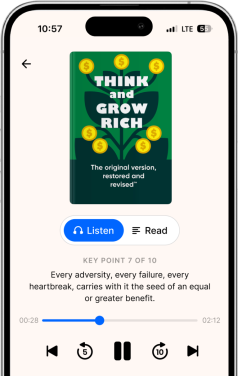
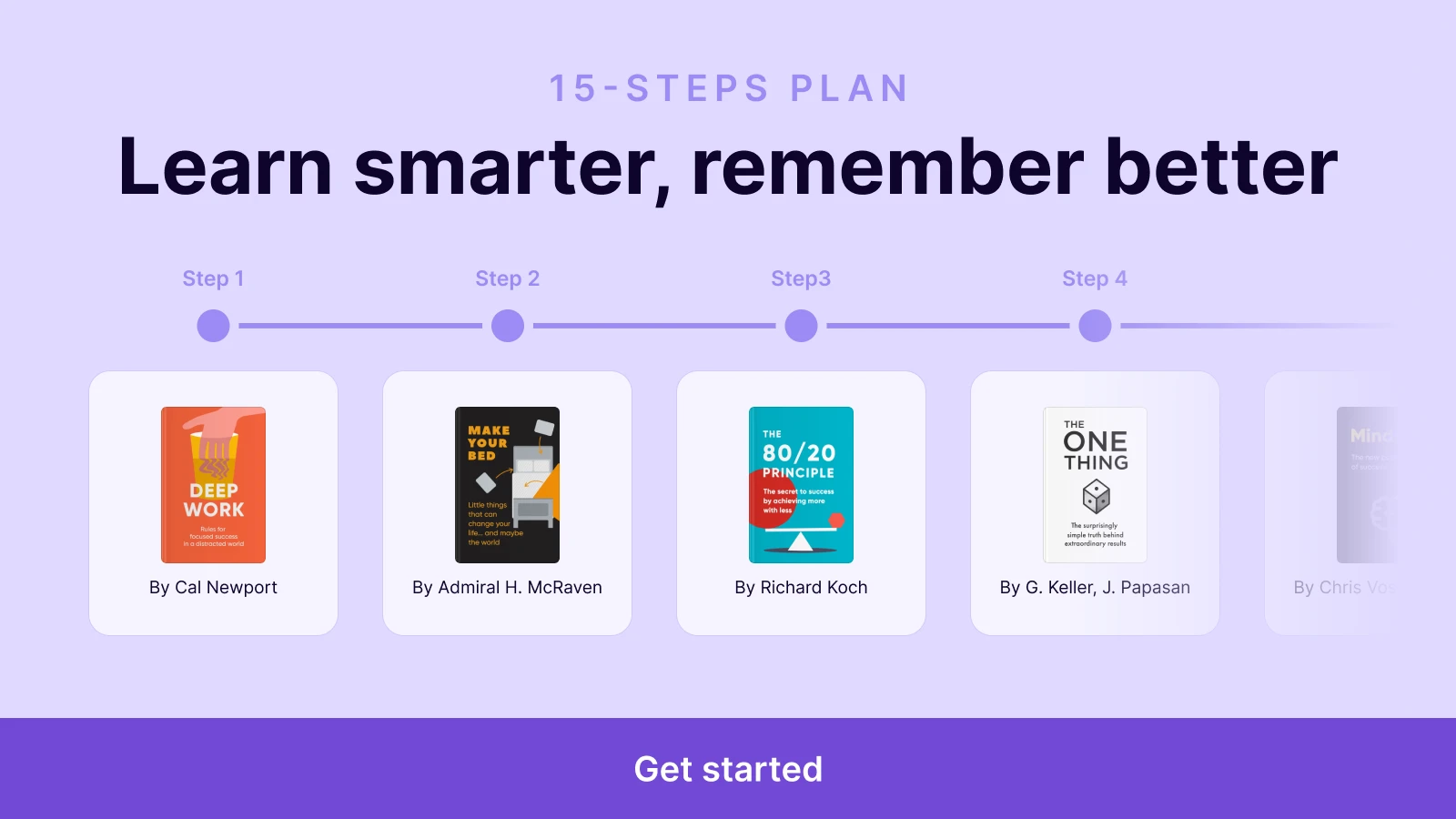
If you're serious about fitting learning into your life, Headway is the best example of this approach in action. The app works for people who want to grow but don't have hours to spare. It takes the world's best nonfiction books and turns them into fifteen-minute experiences.
Daily microlearning sessions
The app gives you bite-sized learning that fits into your workflow. You don't have to find extra time in your day. You just use the time you already have. You can read a summary during your morning coffee or listen to one while you're at the gym. It's the perfect solution for busy schedules.
The content is designed to be consumed on demand. If you are about to have a tough conversation, you can find a summary on communication. If you are feeling low on energy, you can find motivation. It gives you the new skills you need precisely when they are most useful.
Gamification for long-term habits
Headway uses gamification to keep you coming back. Streaks, achievements, and progress bars make learning feel like a win. You'll find yourself opening the app just to keep your learning streak alive. That consistency is what leads to real, lasting change over time.
These gamified elements help build a growth habit. You're not just reading; you're building a record of your own development. It makes the learning experience rewarding and addictive in a healthy way. It turns the "I should read more" guilt into a daily sense of accomplishment.
📘 Stop feeling guilty about unfinished books. Join the Headway community and start your learning streak today with quick summaries you can read or listen to on the go.
Multimedia and memory tools
You get to choose how you want to learn. You can read the text when you have a quiet moment, or you can use the audiobooks feature when you're on the move. The app even offers bedtime mode and focus sounds to help you get into the right headspace for learning or resting.
To help with knowledge retention, Headway uses spaced repetition flashcards. The app tracks which ideas you've seen and reminds you of them at the right time. It also features short videos and quizzes to help reinforce what you've learned. You don't just consume information; you actually keep it.
The science: Why microlearning works for your brain
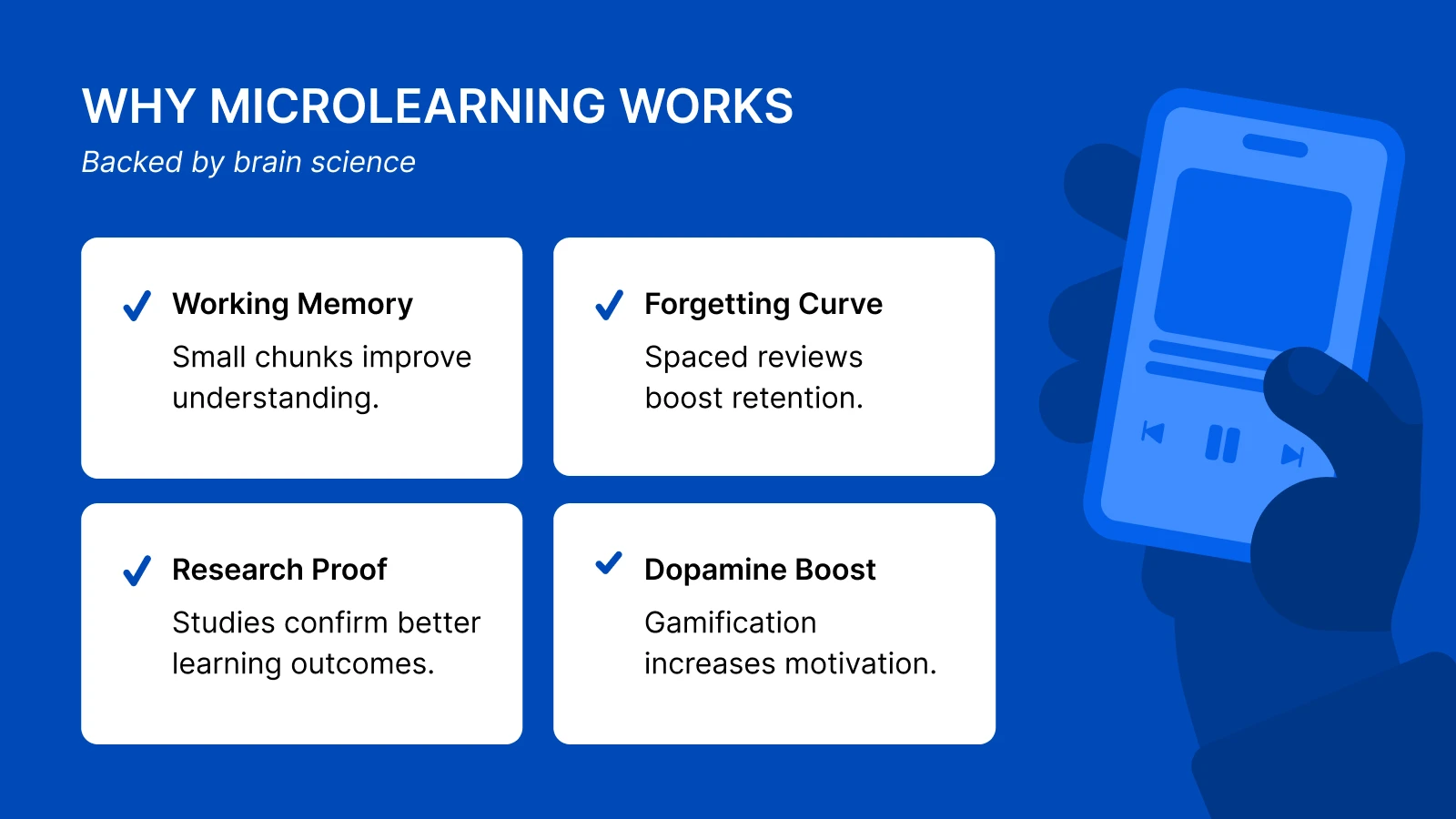
There's real science behind why bite-sized learning is better for you. It all comes down to how our brains handle information. When we understand the science, we can design better e-learning courses and habits.
Cognitive load and attention spans
Our attention spans are shorter than they used to be, but that's only part of the story. Instructional design experts talk about "cognitive load." That's the amount of effort it takes for your brain to process new information. If you try to learn too much at once, your brain gets overwhelmed and shuts down.
Microlearning modules respect this limit. By focusing on a single small part of a topic, they keep cognitive load low. This practice allows you to focus all your mental energy on understanding that one thing. It's much more effective than trying to juggle ten different concepts at once.
The forgetting curve and retention
As we mentioned before, we forget most of what we learn very quickly. But spaced repetition fixes this. By reviewing small bits of information at increasing intervals, you "reset" the forgetting curve. Each review strengthens the memory and makes it harder to lose.
Research shows that knowledge retention can be up to 60% higher with microlearning compared to traditional methods. The short format enables regular review. You probably won't re-watch a two-hour lecture, but you'll happily spend two minutes looking at a flashcard or a summary.
The dopamine reward system
Your brain loves rewards. When you finish a small task, like a five-minute microlearning video or a quick quiz, your brain releases dopamine. That's the "feel-good" chemical that makes you want to repeat the behavior. It's the same system that makes social media so addictive, but here it's used for your benefit.
By breaking a large learning objective into small wins, you keep your motivation high. Instead of feeling like you're failing at a huge goal, you feel like you're winning at a series of small ones. That positive cycle is what keeps learners engaged and helps them reach their long-term goals.
📘 Give your brain the reward it craves. Use Headway's shorts to get a quick win while learning something life-changing.
How to build your own microlearning habit
Ready to start? You do not need a complex plan. You just need to make a few minor changes to how you use your time. Here is a step-by-step guide to making it stick.
Swap scrolling for growing
We all have moments where we reach for our phones out of boredom. Instead of opening social media, open a learning app. You'll spend the same five minutes, but you'll walk away feeling better. The secret is to make the learning app just as easy to reach as the distraction.
Try moving your online learning apps to your home screen and moving your social apps to a folder. That small change makes you pause for a second. In that second, you can choose to learn something new. It turns a bad habit into a powerful one without requiring any extra willpower.
Use your "dead time" wisely
Think about all the moments in your day when you're just waiting. Whether you're waiting for the bus, waiting in line, or waiting for a meeting to start. These are perfect opportunities for bite-sized learning. Even ten minutes a day adds up to over sixty hours of learning per year.
That's more than enough time to master a new skill or absorb the main ideas from fifty books. If you have your on-demand learning tools ready on your phone, you never have to waste a moment. You can turn a boring commute into a deep dive into a new topic.
Set a clear learning objective
Don't just consume random information. Decide what you want to achieve. Maybe you want to improve your soft skills, learn about health and safety, or understand a new trend in corporate training. When you have a clear learning objective, you can find the right microlearning courses to match.
Purpose is what drives consistency. When you know why you're learning, you're much more likely to show up every day. Check in on your goal once a week. Are you getting closer? Does the goal still matter to you? Adjust your path as needed, but keep moving forward.
Start smaller than you think
If fifteen minutes feels like too much, start with five. Or even three. The goal is to build the habit of showing up. Once the habit is there, you can slowly increase the time. Many people find that once they start a fifteen-minute summary, they actually want to finish it because it's so engaging.
The most important thing is not to let the "perfect" get in the way of the "good." Doing a three-minute session is much better than doing nothing at all. Consistency beats intensity every single time. Small daily actions are what create a lifetime of growth.
📘 Start small today. Download Headway and listen to one quick summary. It is the easiest way to begin your daily growth habit.
Make consistency your superpower with Headway
The best microlearning examples all share one truth: Small steps lead to huge results. You do not need to find hours of free time. You just need to show up for a few minutes each day. Whether you use short videos, quizzes, or book summaries, the format matters less than the habit.
One year from now, you could look back and realize you have the equivalent knowledge of fifty books. Or you could look back and wish you had started today. The choice is yours, and it only takes fifteen minutes.
Ready to join 55 million people who are already crushing their goals? Download the Headway app today and start your journey toward becoming the best version of yourself. Your future self will thank you for the small steps you take right now.
Frequently asked questions about microlearning examples
What are the examples of microlearning?
Common microlearning examples include short videos, gamified quizzes, infographics, and flashcards. Other formats are podcasts, interactive simulations, and mobile apps. Book summary apps like Headway are great examples too, as they turn long books into focused fifteen-minute sessions you can finish anywhere.
What are the benefits of microlearning?
The main benefits of microlearning are better knowledge retention and higher learner engagement. It works because it doesn't overwhelm your brain with too much at once. Research shows it can improve retention by 25% to 60% compared to traditional courses. Plus, it fits easily into busy schedules.
Is microlearning effective for soft skills?
Yes, it's very effective. Skills like leadership and communication need regular practice. Microlearning content, like videos and quizzes, allows you to learn a technique quickly and then try it out in your real-life work. That constant cycle of learning and doing is the fastest way to improve.
Can microlearning replace traditional courses?
Not always, but it's a powerful partner. It's great for reinforcing ideas and providing quick refreshers. Complex topics might still require longer foundation training sessions. Think of microlearning for daily growth and long courses for deep, technical knowledge. Together, they create a complete way to learn.
What exactly is microlearning?
It's an approach that breaks big topics into small, focused pieces. Each lesson usually lasts two to fifteen minutes and covers a single idea. It's designed to match how our brains naturally work, avoiding information overload and making learning more efficient and fun.
How can I start microlearning?
Pick one topic you want to learn and find an app that helps you. Headway is excellent for personal growth through book summaries. Duolingo is the leader in languages. Start with just five minutes a day. The best time to start is the next time you have a few free minutes and reach for your phone.
What are the best microlearning platforms?
It depends on what you want to learn. LinkedIn Learning is excellent for professional skills. Duolingo is the best for languages. For self-improvement and leadership, Headway is the top choice because it distills bestselling books into bite-sized learning that you can actually finish.