Self-growth
 Apps & Digital Tools
 Business & Career
 Success
 Growth Tools
 Psychology
 Communication
 Relationships
You’ll learn
- The functions of thinking hats
- When and how to use them
- Restrictions and rules of each hat
- The importance of discipline in the thinking process
first KEY POINT
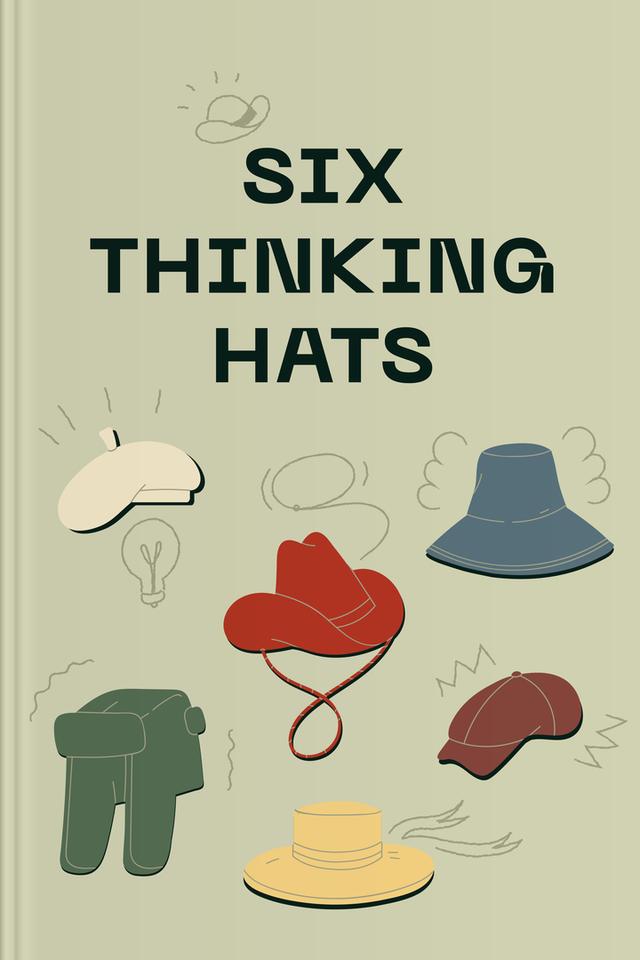
Edward de Bono revolutionized the way we think by introducing the concept of the Six Hats method. Researchers from IMB laboratories, teachers, jurors, and world-famous companies (such as Siemens) utilize the technique in the working process. All claim that six hats make whatever they are doing astonishingly efficient. The meetings take less time, and the decision-making has become more manageable.
Thinking is a skill, and we can’t master it completely. There’s no limit to learning. While improving and utilizing this skill, however, we encounter a big issue: confusion. Thinking comes in different colors. Logic, emotions, creativity, and facts influence it. The vibrancy can feel overwhelming, and here’s where the six hats come into play. This method makes your thoughts more organized by dividing them into six types.Typical Western thinking mainly relies on three things:• Argument
• Categorization
• Searching for the ultimate truthEdward de Bono proposes parallel sensitization that accounts for various possible truths. This method focuses on what can be, not only what is. Thinking based on the argument is not sufficient for an ever-changing world. Parallel thinking presupposes looking at a given subject from all possible perspectives. While disagreements dictate that only one opinion can be right, six hats allow various correct viewpoints.The directions parallel thinking can take are defined by different hats, each with unique characteristics. There are various ways to use hats. Single-use is helpful when we want to engage in a particular thinking style. We can also use hats in sequence, either an evolving one or a pre-set one.
second KEY POINT
The white hat deals with information stripped of any interpretation or opinion. While wearing this hat, we don’t use the information to prove a point or convince someone that we’re right. If some pieces of information contradict each other, we view them congruently. We choose one of them only if necessary. During the white hat stage, we also determine which information we lack and establish means of obtaining it.
Continue reading with Headway app
Continue readingfirst KEY POINT
second KEY POINT
third KEY POINT
fourth KEY POINT
fifth KEY POINT
sixth KEY POINT
Related blog articles

Elevate the way you learn with Headway — the smart, streamlin...

Discover top apps that help you learn in just 10 minutes a da...

Curious about the Deepstash app? Find out if this app offers ...

The answer to the question "Is Blinkist worth it?" depends on...

Discover practical tips, expert insights, and book-powered to...