Self-growth
 Business & Career
 Success
 Communication
 Healing
 Relationships
 Psychology
 Happiness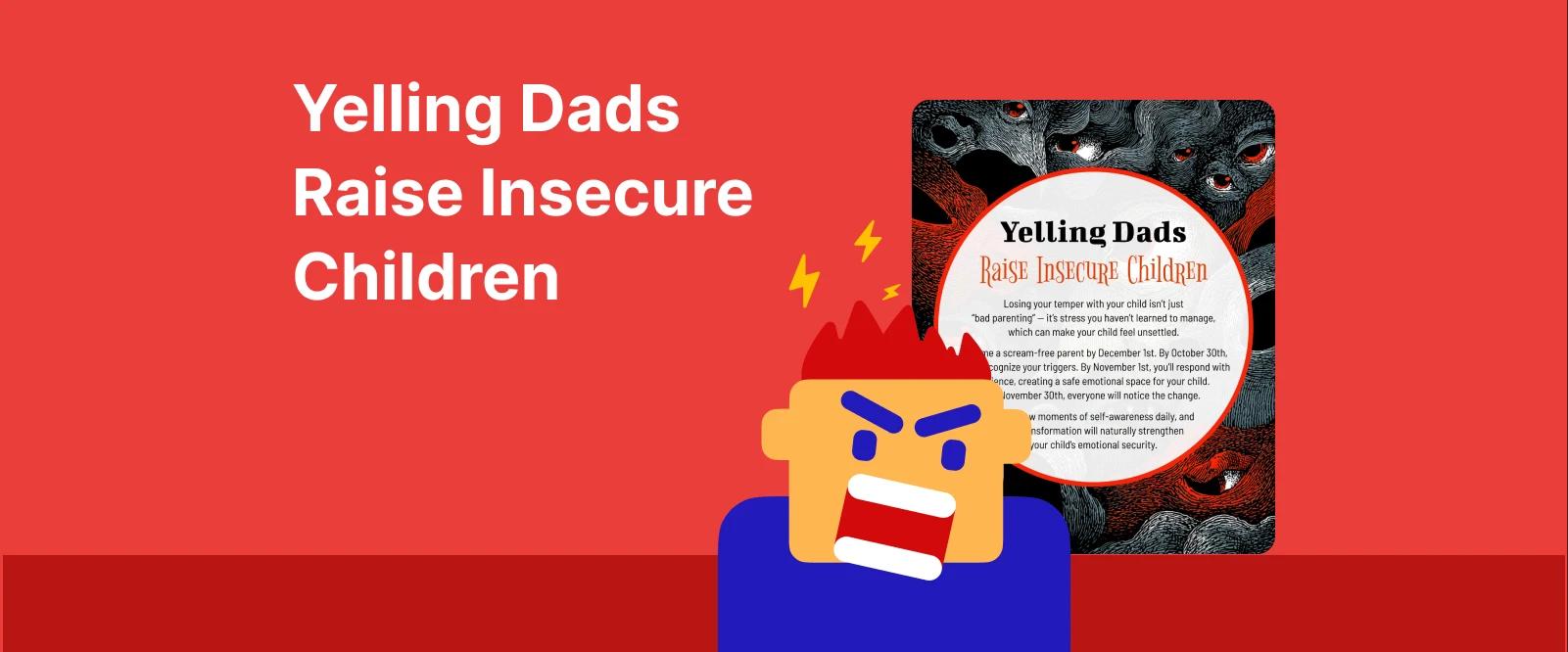
Research confirms that yelling dads raise insecure children — not because they don't love their kids, but because fear blocks connection and healthy problem-solving. When the volume goes up, the learning shuts down.
This article isn't intended to make you feel guilty. We've compiled expert advice to help you grow. If you are reading this, you are already doing the work to be better, and now you have a roadmap to regain your authority without raising your voice.
You'll explore the neuroscience of the yelling brain, the link between a father's anger and a child's self-esteem, and practical steps to change your parenting approach today.
Want to fast-track your journey to calmer parenting and better mental health for the whole family? Join over 55 million people on the Headway app.
We summarize the world's best parenting books — like 'The Whole-Brain Child,' 'Nonviolent Communication,' and 'Emotional Intelligence' — into bite-sized, 15-minute reads so you can grow into the dad you want to be.
Does yelling damage a child's brain?
To understand why yelling backfires, you have to look under the hood of your child's nervous system. You might think a raised voice commands attention, but biology disagrees.
The "reptilian" response
When a child is confronted with a loud, angry voice — especially the booming baritone of a father — their brain senses a threat. This threat instantly triggers the amygdala, the brain's "smoke detector," sending your little one into fight, flight, or freeze mode.
Being frequently yelled at changes the mind, brain, and body by increasing activity in this emotional part of the brain, boosting stress hormones, and tightening muscles. Over time, that pattern wires in. Your child's nervous system starts to expect danger, even on quiet days.
In this state, the logic center of the brain — the prefrontal cortex — goes offline. Your child literally cannot process the lesson you are trying to teach, because their body is prioritizing survival over learning. For young children and kids with ADHD or other attention challenges, this shutdown happens even faster.
Cortisol and connection
This fear response releases a flood of stress hormones, including cortisol, into the bloodstream. Chronic exposure to this stress can change how a child thinks and feels about themselves, even into adulthood, with long-term effects on mental health, self-esteem, and overall well-being.
Therapist Hilary Jacobs Hendel describes adults who grew up with constant yelling and verbal abuse as carrying "scars no one can see." They often struggle with depression, anxiety, and a harsh inner critic that sounds like their parents' voice.
As Dr. Daniel J. Siegel notes in 'The Whole-Brain Child':
"Too often we forget that discipline really means to teach, not to punish. A disciple is a student, not a recipient of behavioural consequences."
If the goal of discipline is teaching, yelling is counterproductive because it shuts down the classroom in your child's mind.
Understanding the brain is the first step to mastering parenting. The summary of 'The Whole-Brain Child' turns this science into quick, practical tools you can use every day.
Why yelling dads raise insecure children
We know yelling creates stress. But why do yelling dads raise insecure children in particular? The answer lies in attachment and the stories children tell themselves.
Attachment theory simplified
Children are hard-wired to look to their parents as a safe harbor. They venture out to explore the world and retreat to you for safety when they feel scared. But when the parent — the source of safety — becomes the source of fear, the child's attachment system goes into crisis.
Studies show that humans do better when they feel safe and consistently loved. When fear is repeatedly triggered by a harsh environment, like one with frequent yelling or emotional abuse, it creates traumatic stress, even if parents never use spanking. The child has nowhere to go. They can't run from you, but they can't relax with you either.
A 2024 meta-analysis of 17 studies found that when parents share verbal threat information — comments like "That dog will bite you," "People are dangerous," or threats shouted in anger — children's fear of new situations increases sharply, regardless of age. The effect was large and clear: What parents say shapes how anxious and insecure kids feel about the world.
The "Am I bad?" narrative
Children are egocentric by nature. They don't think, "Dad is having a hard time at work and lacks emotional regulation." They think, "Dad is mad, so I must be bad."
As relationship expert Sue Johnson writes in 'Hold Me Tight':
"When love doesn't work, we hurt... brain imaging studies show that rejection and exclusion trigger the same circuits in the same part of the brain, the anterior cingulate, as physical pain."
Yelling is not just noise. To a child, it feels like emotional pain and rejection from the person they love most.
Over time, this "Am I bad?" story seeps into a child's sense of self. It can shape their parenting styles later, their adult romantic life, and the quality of their parent-child relationships with the next generation.



The "dad" factor: why we yell (and why it is hard to stop)
If you know yelling hurts your child's self-esteem, why do you still do it? For many dads, the cards are stacked against them when it comes to calm parenting.
The authority trap
Many men were raised to believe that being "head of the household" means being the loudest voice in the room. Maybe your own parents yelled, spanked, or used sarcasm to shut down "bad behavior." You may have learned that tough love, raised voices, or even verbal abuse are normal parts of discipline.
It's easy to confuse fear with respect. You might worry that if you don't yell, your child will walk all over you, talk back, or ignore you. But true authority is quiet. A confident leader doesn't need to shout to be followed.
Societal pressure and hidden triggers
Men are often taught to express distress through anger instead of vulnerability. When you feel disrespected, ignored, or overwhelmed by money pressures and work stress, it often comes out as a bark.
Common triggers include:
Defiance: When your child talks back, it feels like a challenge to your status.
Repetition: Asking the same thing five times triggers a sense of powerlessness.
Exhaustion: A tired nervous system has no brakes and reacts faster.
Public pressure: When your child has tantrums in a store, you fear being judged for "weak" parenting.
Noticing your triggers is the first step toward emotional regulation for you and better mental health for your child.
You might also be parenting without a guide. Maybe no one ever taught you alternatives to yelling. That's where parent coaching, books, and even a good parenting podcast can help you build a new toolkit.
Signs your child is struggling with yelling
How do you know if yelling is taking a toll? The damage isn't always visible, but your child's behavior tells a story. Look for these signs in young children and older kids:
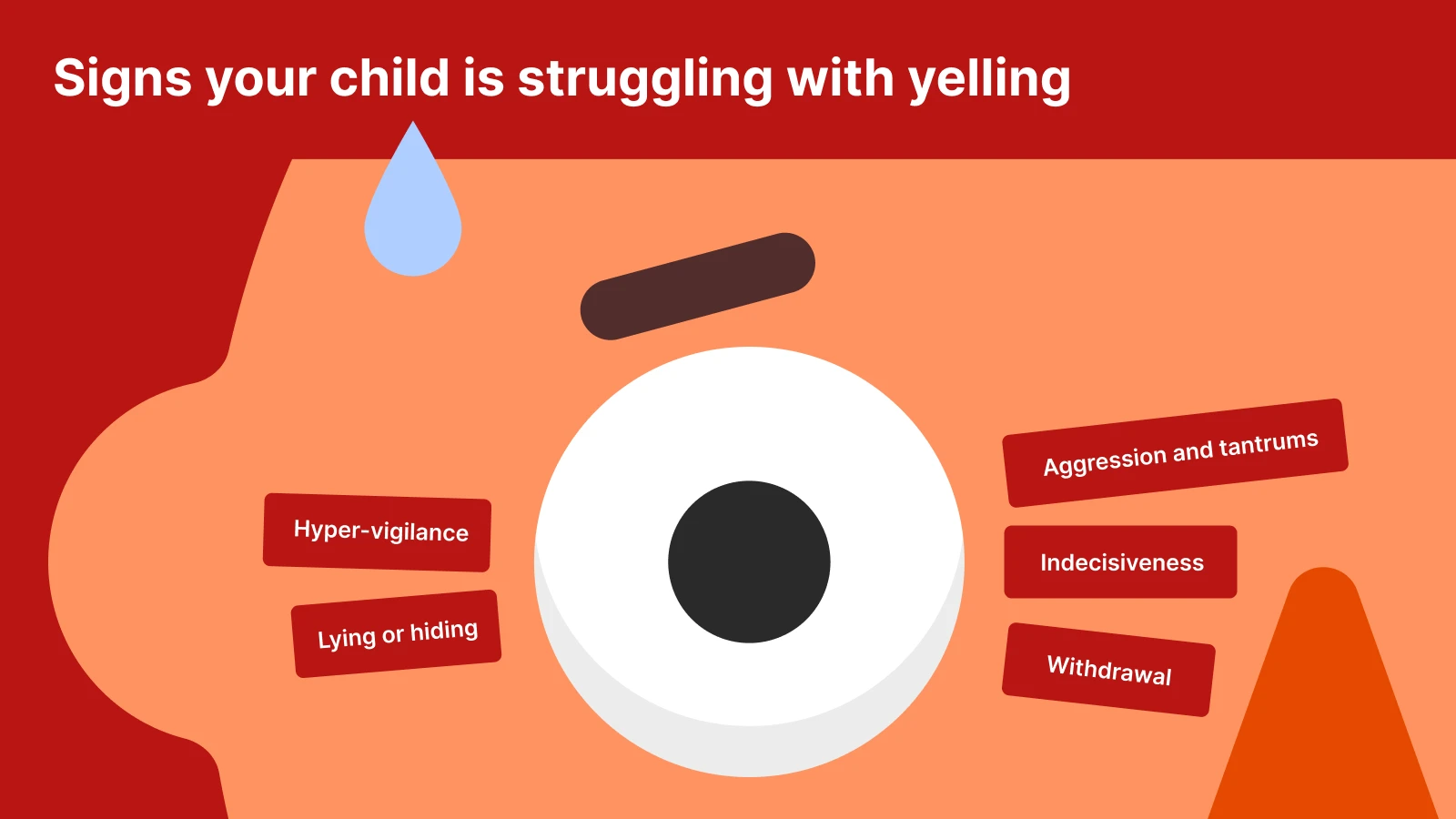
Hyper-vigilance: Your child flinches when you move quickly or scan your face to read your mood. Their amygdala is stuck on "high alert."
Lying or hiding: When parents yell a lot, lying becomes a survival strategy to avoid explosions, even around small mistakes.
Aggression and tantrums: Children mirror what they see. If dad solves problems with volume, children's behavior may include hitting, yelling at siblings, or using verbal abuse with peers.
Indecisiveness: An insecure child is terrified of making the "wrong" choice, which could trigger another lecture or punishment.
Withdrawal: Your child shuts down, avoids eye contact, or stays in their room. The "I don't care" act often hides a child who cares deeply but feels unsafe.
These patterns aren't proof that you're a bad parent. They're signals from your child's nervous system that something in the environment feels too intense.
How to stop yelling in the moment
Changing a habit is hard, especially when you're tired, and your child's bad behavior is pushing every button you have. But you can shift from being a yelling dad to being a calm guide with simple tools that protect both your authority and the relationship.
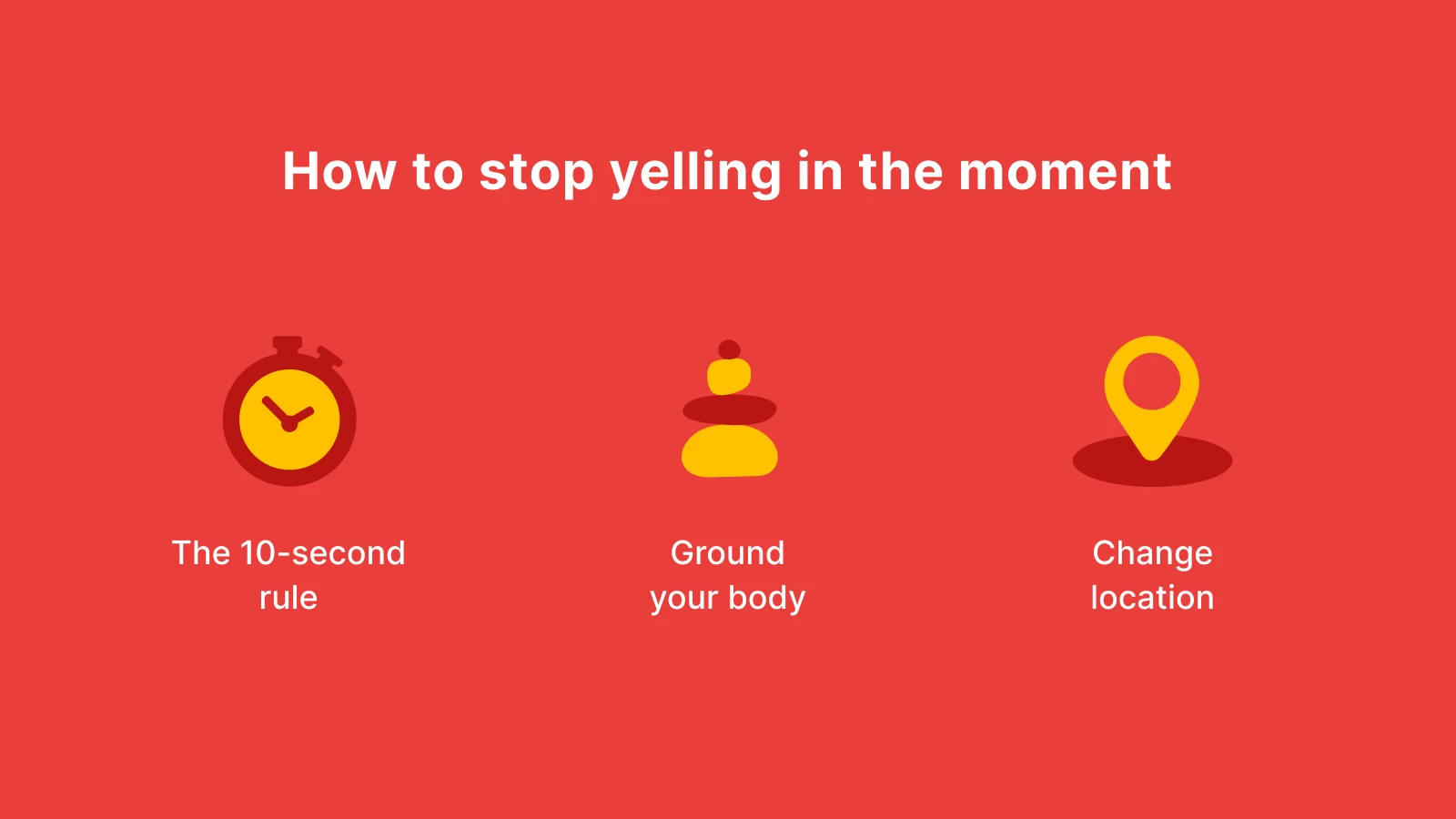
The pattern interrupt
The moment you feel heat rising in your chest, you need a circuit breaker.
The 10-second rule: Force yourself to count to 10 before speaking. It gives your prefrontal cortex time to come back online.
Ground your body: Unclench your jaw, drop your shoulders, and feel your feet on the floor. This action tells your nervous system there's no physical danger.
Change location: Step into another room, drink a glass of water, or splash your face. You cannot parent effectively when your body is in fight or flight.
The low and slow technique
Counterintuitively, a low, slow voice is more powerful than a shout. When you lower your voice, your child has to lean in to hear you. It signals that you are in control of yourself.
You might say, "I am having a hard time staying calm, so we are going to pause and talk in two minutes." This approach models emotional regulation and problem-solving skills in real time.
Daniel Siegel reminds us of the power of our own development:
"As parents become more aware and emotionally healthy, their children reap the rewards and move toward health as well."
Learning to manage your own triggers is key. The summary of 'Emotional Intelligence' on Headway offers quick, science-backed tools for staying steady when your child pushes your limits.
How to repair the relationship after you yell
You'll mess up. You'll yell again. The difference between a toxic environment and a healthy one isn't perfection—it's repair.
Researchers emphasize that when a break in the relationship happens, repairing the emotional connection as soon as possible protects children's development and long-term well-being. It also shows them that healthy relationships can survive conflict.
The R.E.P.A.I.R. method
Here's a simple script you can use with your child after you yell:
| Step | What it means | Example |
|---|
R — Recognize | Admit what happened. | "I yelled, and that was not okay." |
E — Explain | Name your feelings without blaming. | "I was frustrated and tired," not "You made me mad." |
P — Apologize | Offer a sincere apology. | "I am sorry I yelled." |
A — Affirm | Reassure safety and love. | "I love you, and you're safe with me." |
I — Invite | Propose a do-over or collaboration. | "Can we try that again in a different way?" |
R — Reconnect | Use warmth or a gentle touch to close the loop. | A hug, a gentle touch, or a shared joke if your child is open to it. |
Why apologizing increases respect
Some dads fear that apologizing makes them look weak. The opposite is true. Owning your mistakes models accountability, emotional regulation, and empathy. It shows your child that even Dad is working on himself.
Repairing relationships is a skill. 'Nonviolent Communication' is a game-changer for parents who want fewer power struggles and more cooperation — and you can get the core tools in 15 minutes on Headway.
Transform from yelling dad to calm guide with Headway
The phrase "Yelling Dads Raise Insecure Children" is a heavy warning, but it's not a life sentence. The brain is plastic. With practice, your nervous system and your child's can learn new patterns.
By understanding the science of child development and the impact of raised voices, you can choose connection over intimidation. You can build healthy relationships at home where children's behavior is guided by respect, not fear. You're teaching your child that mistakes happen, but love is constant. You're showing them that strength doesn't roar — it listens.
Join over 55 million people on Headway and start your journey to becoming the calm, confident father your children need.
Whether you're struggling with behavioral problems, dealing with young children who talk back, facing questions about spanking, or building a more loving relationship with your kids, Headway gives you trusted ideas from the world's best books to support your parenting approach every day.
Frequently asked questions about yelling dads raise insecure children
Am I damaging my child by yelling?
Yelling doesn't automatically make you a bad parent, but it can affect your child's sense of safety and self-esteem. Frequently raised voices activate their stress response, making them anxious, guarded, or overly cautious around you. Repairing after conflicts and practicing calmer communication support healthier, long-term emotional development.
How does an angry father affect a child?
When a father reacts with anger, children often interpret it as a sign that they're unsafe or "bad." This interpretation can create fear of making mistakes or difficulty trusting others. Repeated exposure to anger may influence their confidence, relationships, and emotional regulation skills.
What happens to a child's brain when they are yelled at?
A raised voice activates the amygdala — the brain's alarm system — triggering the fight-or-flight response. In this state, the thinking part of the brain shuts down, making learning nearly impossible. And if yelling happens often, the child's nervous system becomes overly reactive, increasing stress hormones and long-term anxiety.
How do I repair our bond after yelling at my kids?
Repair starts with honesty. Acknowledge the yelling, briefly explain your feelings, and offer an apology. Reassure your child that they are loved and safe. Invite a do-over and reconnect with touch or closeness if they are open to it.
Is yelling effective parenting?
Yelling may stop behavior in the moment, but it doesn't build respect or problem-solving skills. In fact, it often triggers fear rather than cooperation. Children learn best when they feel safe and connected. Calm, clear communication builds true authority and strengthens your relationship.
How do I know if my child has behavioral issues?
Behavioral challenges usually show up as frequent aggression, tantrums, withdrawal, lying, or extreme fearfulness. But these can also be stress responses — not signs of a "bad child." If patterns persist or significantly impact daily life, consider consulting a pediatrician. Observing behavior with curiosity, not judgment, is the best first step.