Self-growth
 Business & Career
 Success
 Communication
 Healing
 Relationships
 Psychology
 Happiness
What is personal leadership? It's leading yourself first: knowing your core values, making deliberate choices, and taking responsibility for your own life before trying to guide anyone else. Think of it as being the CEO of yourself.
Here's what most people miss: you don't need a corner office to practice leadership skills. Personal leadership starts with how you spend your Tuesday morning, the decisions you make when nobody's watching, whether you hit snooze or get up for that workout.
And this isn't just personal development talk. There's real data behind it.
Gallup surveyed people in 52 countries, and the strongest signal they got was not about competence or status, but about what people expect from leaders. And the keyword here is hope.
That insight changes how we think about effective leadership. If people look to leaders for hope, trust, and stability, then personal leadership starts long before you manage a team. It begins with how well you manage yourself — your mindset, your energy, your values, and your daily choices.
You can build these skills daily with Headway. Fifteen-minute book summaries from books like 'Good to Great' and 'Dare to Lead' give you core ideas during your coffee break, so you can use them that same day.
Quick summary: Personal leadership in practice (not theory)
Self-leadership first: Managing your thoughts, emotions, and actions before leading others.
Key traits: Self-awareness, emotional intelligence, decision-making, and self-discipline.
How to develop it: Daily self-reflection, aligning with your personal values, setting goals, and learning from mentors.
The payoff: Better well-being, stronger relationships, career and personal growth, and confidence.
What is personal leadership?
Personal leadership is about directing your own life with intention. It's not waiting for someone else to tell you what to do or who to be. Brené Brown puts it perfectly in 'Dare to Lead':
"You either walk inside your story and own it, or you stand outside your story and hustle for your worthiness."
Here's how it differs from traditional leadership:
Traditional leadership: You guide team members toward a shared goal. You manage people, deadlines, and outcomes.
Personal leadership: You guide yourself. You manage your time, energy, and growth. No team required.
Personal leadership means you're the one setting the direction. You decide what success looks like in your personal life and career. You build trust with yourself by actually following through on what you say you'll do.
Think about it this way: if you can't lead yourself out of bed in the morning or manage your own emotions during a tough conversation, how are you going to lead anyone else? Good leaders know this. They start with self-leadership.


Core traits of personal leaders
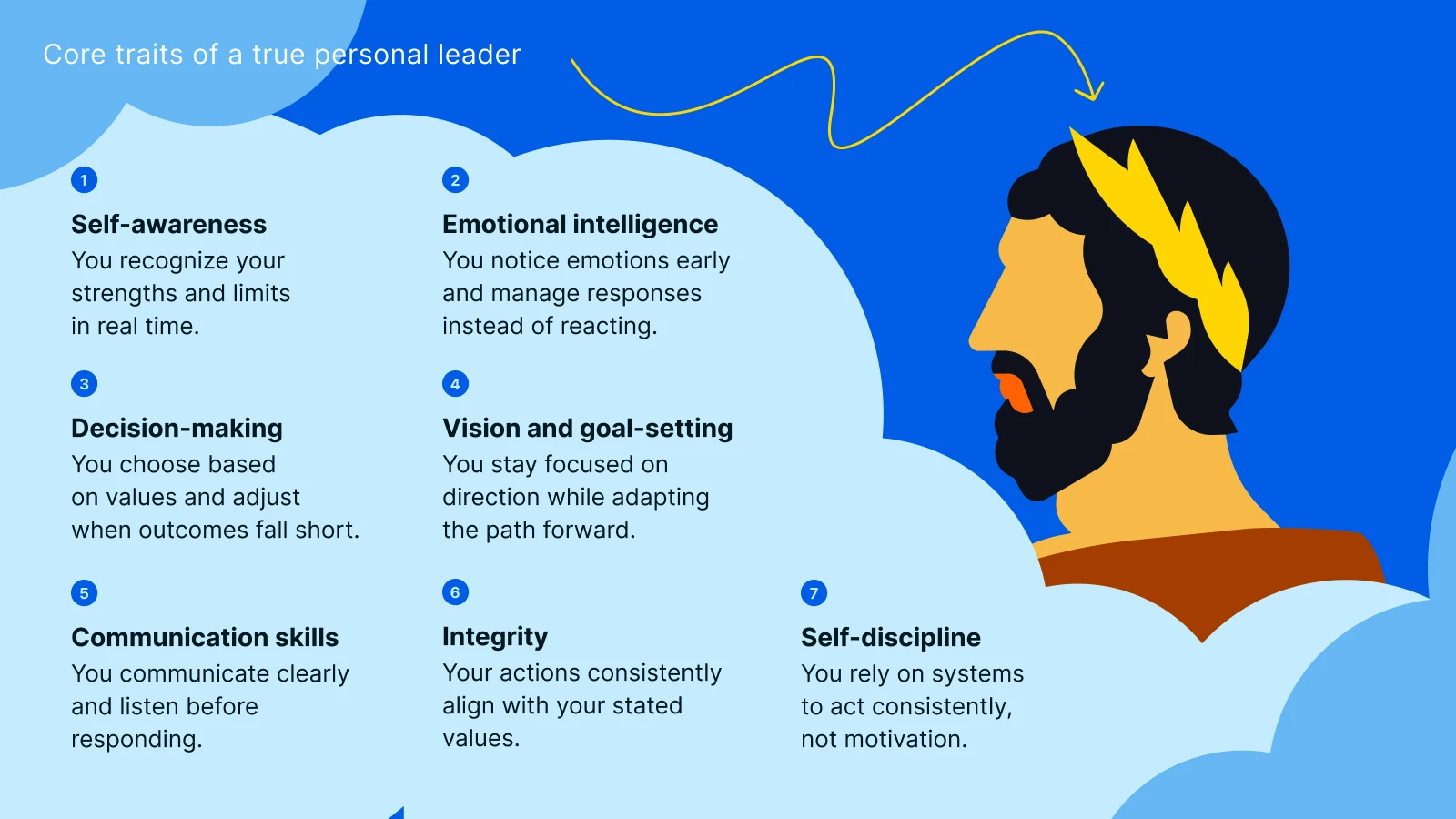
Let's break down what actually makes someone a strong personal leader. These aren't abstract qualities; they're practical traits you can spot in your own life (or lack thereof).
1. Self-awareness
You are aware of your good points as well as your shortcomings, and you know what tends to make you angry. When something goes wrong, you quickly recognize it and take responsibility rather than blaming bad traffic or your coworker's bad mood.
Simon Sinek talks about this in 'Leaders Eat Last.' The best leaders know themselves well enough to manage their reactions. They don't snap at people when stressed. They pause, breathe, and choose a response.
2. Emotional intelligence
This is your ability to read the room and manage your feelings. You notice when someone's upset before they say anything. You don't send that angry email at 11 pm because you know you'll regret it by morning.
Emotional intelligence is what separates effective leaders from poor ones. It's the difference between demanding "I need this now" and saying "Let's aim for Friday if possible."
3. Decision-making
As a personal leader, you aren't basing your decisions solely on ease or following trends; rather, you are basing them on your core values. When you make a bad decision, you own that decision and adjust accordingly.
In the book "The Art of War," Sun Tzu said, "In the midst of chaos, there is also opportunity." This means that, as a personal leader, you view your decisions as opportunities to exercise your judgment, not as threats to you.
4. Self-discipline
You do the thing even when you don't feel like it. That's it. That's the whole trait. Self-discipline is about building systems that make the right choice the easy choice.
5. Communication skills
You say what you mean. You listen more than you talk. You ask questions instead of assuming you know the answer.
Dale Carnegie's 'How to Win Friends & Influence People in the Digital Age' is still relevant. Even in Slack and Zoom, clear communication builds trust. Speaking with confidence isn't about being the loudest. It's about being clear and authentic.
6. Integrity
You do as you say. For instance, if you value spending time with your family, you should not take your phone and check your email during dinner. If you value being honest with people, then your feedback given should not be watered down to avoid conflict.
7. Vision and goal-setting
You have an idea of where you want to be, but perhaps not a detailed roadmap and timeline of goals (since those rarely survive the onslaught of reality). However, you do know what direction you're headed in, you've set yourself long-term goals and broken them down into smaller, manageable steps over time.
Vision-driven leaders understand this. As Machiavelli observed, the person who adapts their approach to changing circumstances succeeds. Personal leadership means having a vision while staying flexible.
Why personal leadership matters
For your personal life and well-being
When you lead yourself well, you make time for what matters. You don't just talk about self-care; you schedule it. You notice when you're burning out and pump the brakes.
Research from the University of Scranton shows that only 8% of people achieve their New Year's resolutions. The other 92% lacked the personal leadership skills to follow through.
For your work and career growth
Nobody's managing your career for you. Your boss has their own problems. If you want to reach your full potential, you've got to take charge.
Jim Collins writes in 'Good to Great': "Greatness is not a function of circumstance. Greatness, it turns out, is largely a matter of conscious choice." That choice starts with personal leadership development.
When you demonstrate strong leadership abilities, people notice. You get tapped for bigger projects. Your leadership position might not change overnight, but your influence does. Being a great leader at work starts with leading yourself first.
For your relationships and influence
Personal leadership changes how you show up. You stop waiting for the other person to apologize first. You set boundaries without guilt. You communicate needs instead of expecting mind-reading.
By successfully leading yourself, you will build trust with people. They will observe you being true to your commitments, which gives you influence that can't be purchased by any means. If you eventually move into managing others, this foundation makes all the difference.
How to build personal leadership skills
Start with self-awareness routines
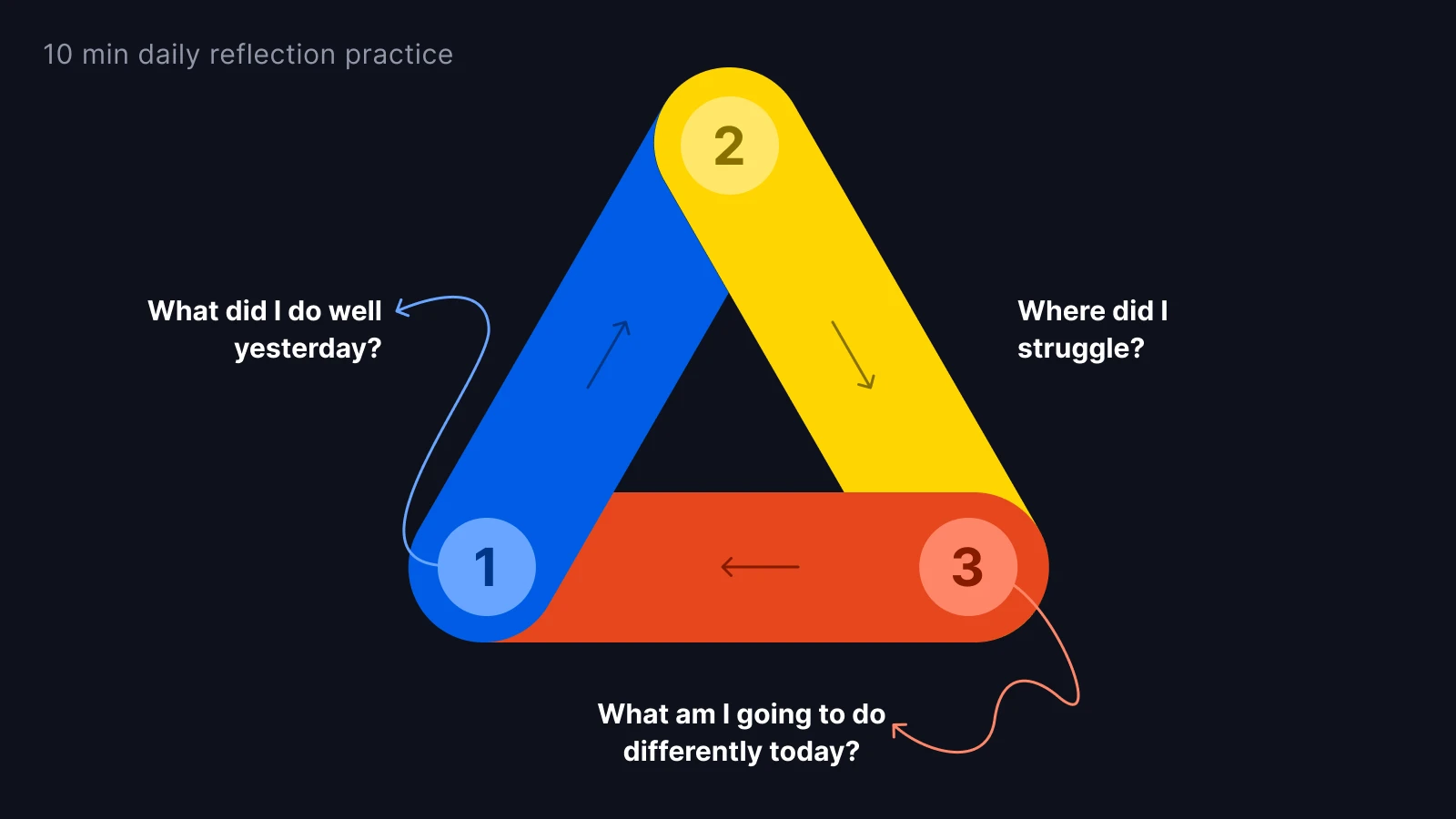
Take 10 minutes for daily reflective practices in the morning, and ask yourself:
What did I do well yesterday?
Where did I struggle?
What am I going to do differently today?
Don't spend too much time stressing about it; the point is to develop the habit of checking in on yourself.
There is also the opportunity to do a weekly assessment every Sunday, rating how you feel about your productivity in four key areas: productivity, relationships, physical health and mental health, and growth. Take note if you see any patterns in your answers.
Align your actions with your core values
Write down your top three values. Now look at last week's calendar. Are you a person who has their actions match their words?
Personal leadership means closing that gap. Say no to projects that don't align with your long-term direction. Choose difficult conversations over conflict avoidance whenever you have the opportunity.
Set and track personal goals
Break long-term goals into quarterly targets, monthly milestones, and then weekly tasks. Make it so small that even on your worst day, you can progress.
Apps like Headway help here. Complete one book summary weekly on leadership. That's 52 books worth of insights yearly, without reading 400-page tomes.
Build daily decision-making habits
Every decision is practice. What you eat, whether you check Instagram before getting up, and if you speak up in meetings — it all counts.
Create decision rules to assist with decision fatigue and self-discipline, such as "no emails before 9 am" or "ask one question per meeting."
Learn through microlearning
You don't need expensive online courses. You need consistent, bite-sized input you can use.
Headway gives daily challenges tied to your continuous learning. Read 'Atomic Habits'? Here's a challenge to apply one tiny habit today. It's active practice, not passive consumption.
Find mentors through podcasts, LinkedIn, or YouTube. Study what they do. How do they handle failure? How do they communicate?
Personal leadership habits to practice daily
Morning reflection (5 minutes): Ask yourself, "What's the one thing that would make today great?" Write it down.
Decision checkpoint (twice daily): Set alarms at noon and 5 pm. Ask: "Am I spending time on what matters?" Adjust if not.
Evening review (5 minutes): Write three wins from the day. "Made it to the gym" counts. "Didn't lose my cool when the project derailed" definitely counts.
Weekly self-assessment: Every Sunday, rate yourself 1–10 on self-awareness, emotional intelligence, decision-making, self-discipline, effective communication, integrity, and vision. Track trends.
Accountability check-ins: Share goals with one person monthly. Tell them what you're working on and where you're stuck.
Microlearning habit: One Headway summary per week. Fifteen minutes. Pick summaries on leadership traits you want to strengthen.
Your life, your leadership: Start today with Headway
Personal leadership isn't about being perfect. It's about being intentional. It's choosing to lead your own life instead of letting circumstances, other people, or your worst habits make the calls.
You don't need a leadership position to practice this. You don't need permission. Start with one decision, one habit, one moment of self-awareness.
And you're not doing this alone. Apps like Headway give you access to wisdom from successful leaders, distilled into 15-minute summaries you can use. Whether you're building trust with yourself, setting better personal goals, or figuring out your next move, the tools are there.
Want to get started?
Download Headway and explore summaries on personal leadership.
Your own life is the only one you get. Lead it well.
Frequently asked questions about personal leadership
What is personal leadership vs self-leadership?
They're basically the same thing. Both mean taking charge of your own growth, decisions, and actions. Some use "personal leadership" for developing leadership qualities, while "self-leadership" emphasizes internal work. Either way, you're steering the ship.
Is personal leadership only for managers?
Nope. You don't need a title to practice personal leadership. Students, freelancers, parents, entry-level employees — everyone benefits from knowing their core values and making aligned decisions. Developing these skills before you're in a leadership position makes you a better candidate when opportunities come.
Can personal leadership improve relationships?
Absolutely. When you lead yourself well, you communicate more clearly, set healthy boundaries, and own your mistakes. People trust you because you're consistent. Plus, emotional intelligence helps you navigate conflict without drama.
How long does it take to develop personal leadership skills?
You can see positive change in weeks with consistent daily habits. Real mastery takes months and years. But you don't need to wait for mastery to see benefits. Small improvements in self-awareness create noticeable shifts quickly.
What's the biggest mistake people make with personal leadership?
Waiting for the "right time" to start. People think they need everything figured out first. Truth is, the best time is now. Pick one habit, one area to improve, and go.