Self-growth
 Apps & Digital Tools
 Business & Career
 Success
 Growth Tools
 Psychology
 Communication
 Relationships

Around 15–20% of people score extremely high on conscientiousness — the very trait that defines a Type C personality. They're the ones who triple-check every email, stay late to fix someone else's mistake, and apologize before asking for a favor. Being detail-oriented and conflict-averse sounds harmless enough. But when those tendencies go unchecked, they quietly drain your energy, your confidence, and your sense of self.
That's exactly what a Type C personality is — and why it matters. If you tend to put everyone else's comfort ahead of your own feelings, keep reading. This guide breaks down the psychology behind Type C behavior, the real costs it carries, and — most importantly — what you can actually do about it. The Headway app has an entire library of books that speak directly to these patterns, so you can start making changes in just 15 minutes a day.
➡️ What exactly is Headway, and how does it benefit me?
The hidden cost of being a people pleaser
Top psychologists have mapped out exactly why you put others first—and how to stop.
See the solutionQuick answer: What are Type C personality traits?
Type C individuals are defined by their commitment to accuracy, harmony, and detail. Here's a snapshot of what that looks like in practice:
Conflict avoidance: You'd rather stay quiet than start an argument — even when you're right.
Detail-oriented: You catch the errors everyone else misses, and you can't help it.
Perfectionist tendencies: Your standards for your own work are almost impossibly high.
Emotional suppression: You push down negative feelings to keep things calm.
People-pleasing: Other people's needs consistently take precedence over your own.
What is a Type C personality in psychology?
Type C isn't as talked about as the competitive Type A or the laid-back Type B, but it's just as significant. In behavioral science, a Type C personality is characterized by industriousness, caution, and emotional restraint. These individuals tend to be introverted and prefer to work behind the scenes. They're the backbone of many successful teams.
Psychologists often map this type to the Big Five personality traits. Type C people typically score very high on conscientiousness — they're organized, dependable, and driven by a need to do things correctly. But their habit of suppressing emotion can create serious internal pressure over time.
📘 Start reading about emotional patterns today — download Headway.
What are Type A, B, C, and D personalities?
Understanding Type C is easier when you see the full picture. The A-B-C-D model focuses on how people respond to stress and social pressure, unlike tools like the Myers-Briggs test, which cover broader personality dimensions.
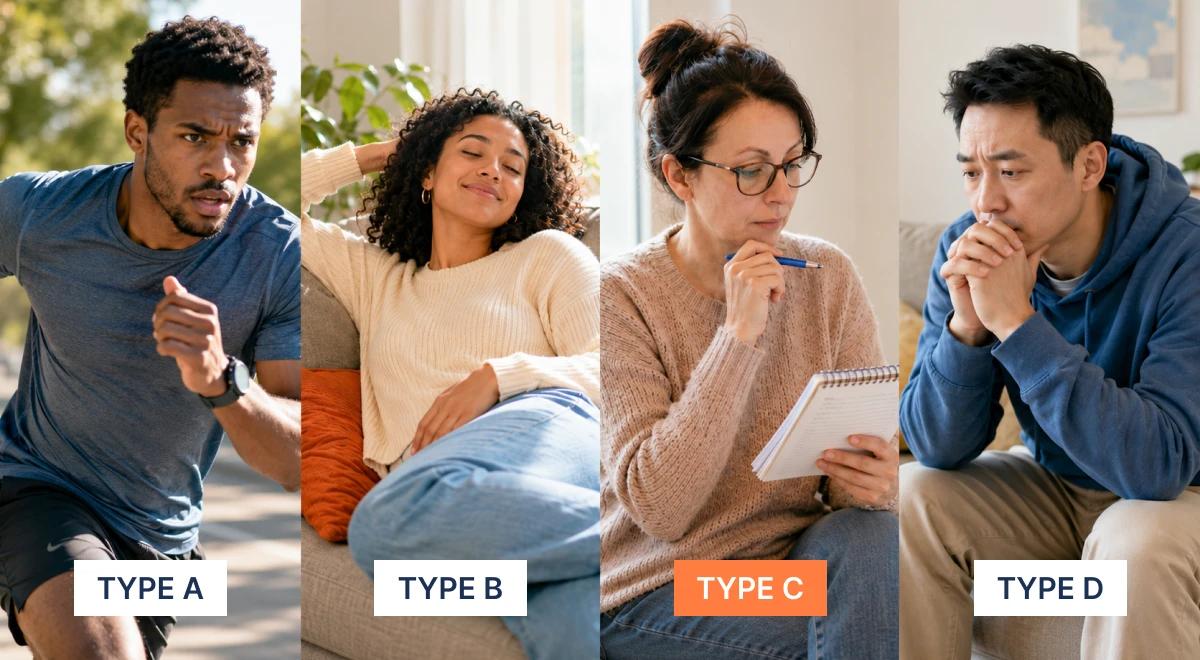
Here's a quick breakdown:
Type A: Driven, competitive, and urgency-oriented. They want to win and move fast.
Type B: Relaxed and easygoing. Change doesn't rattle them.
Type C: Detail-focused, cautious, and conflict-averse. They analyze change to the point of death to avoid mistakes.
Type D: Prone to worry, negative thinking, and social inhibition.
If you find yourself replaying conversations at 2 a.m. because you're worried you said something wrong, you're probably closer to Type C or D. The key difference? Type C is motivated by accuracy. Type D is driven by fear of the future.
Key Type C personality traits you should know
These traits aren't flaws — but they become problems when they run on autopilot. The more self-aware you are, the more control you have.
Conflict avoidance: You might agree with a decision you hate just to avoid tension. Over time, that creates hidden resentment that's hard to shake.
Perfectionism: You're not just detail-oriented — you're your own harshest critic. A single typo in an email can ruin your whole morning.
Logic over feelings: In stressful moments, you go cold and analytical. That looks composed from the outside, but internally, you're ignoring real emotional needs.
Compliance: You follow the rules precisely. It makes you reliable — but it can also stop you from taking the risks that lead to real growth.
Difficulty delegating: Handing off work feels risky because no one else will do it "right." So you end up carrying everything yourself.
📘 Break the perfectionism cycle — explore Headway's self-growth library.
Type C personality vs. Type A: The battle of the high-achievers
Both types work hard. That's where the similarity ends. Type A is driven by urgency and competition — they want to be first, visible, and in charge. Type C is driven by the need to be correct and avoid criticism. They don't want to lead the parade; they want to make sure every float is flawlessly organized.
In a work setting, this creates a familiar dynamic: the Type A takes the credit, and the Type C does the heavy lifting. Without assertiveness, Type C individuals often feel exploited — but they won't say a word about it.
The good news? Type C's strengths — precision, reliability, depth — are genuinely valuable. The work is learning to advocate for yourself while keeping those qualities intact.
The Type C mom: Navigating the "supermom" trap
Motherhood has a way of intensifying Type C tendencies. A Type C mom feels she must be perfect across every category — nutrition, education, emotional support, discipline — all at once. She's managing an enormous mental load and rarely asks for help because she doesn't want to seem like a burden.
The result is a slow-burning cycle of burnout that affects the whole family. Mental health isn't a luxury; it's a requirement. Learning to ask for help isn't a weakness — it's how the household actually stays afloat.
If this sounds familiar, Headway's "Happiness" and "Emotional Intelligence" categories are a good place to start. Fifteen minutes a day on the right book can shift a pattern you've been carrying for years.
The health risks of chronic emotional suppression
The primary health risk for Type C personalities isn't dramatic — it's quiet. Internalizing stress keeps your nervous system in a low-grade fight-or-flight state. Over months and years, elevated cortisol can disrupt sleep, suppress immunity, and contribute to anxiety and burnout.
Research into personality types and health outcomes does suggest a link between chronic emotional suppression and physical well-being — though it's important to note that no personality type causes illness. What it does cause is sustained stress, and that's real enough to take seriously.
The pattern to watch: you hold everything in, your body pays the price, and nobody around you even knows anything's wrong.
📘 Take your mental health seriously — find the right books on Headway.



How to thrive as a Type C individual
The goal isn't to become a different person. Your attention to detail and reliability are genuine strengths — especially in fields such as data analysis, editing, research, and project management. The work is adjusting the behaviors that aren't serving you.

Practice assertiveness in small doses: You don't have to start with the big confrontations. Next time someone takes credit for your idea in a meeting, say something brief and factual. That's enough.
Define "good enough" deliberately: Not every task deserves 100% of your energy. Decide in advance which things need perfection — and let the rest be finished, not flawless.
Challenge analysis paralysis: Type C people can get stuck gathering more information when a decision is already possible. Give yourself a deadline: once you have the key facts, make the call and move forward.
Find an outlet for your emotions: Journaling, therapy, or even a blunt conversation with a trusted friend can prevent the bottled-up pressure from building into something bigger.
Books on Headway that speak directly to Type C patterns
If you've recognized yourself in this article, these titles from the Headway library are worth your attention. Each one offers practical, grounded tools — not just motivation.
'Stop Overthinking' by Nick Trenton offers 23 techniques to interrupt negative thought loops and reduce the mental noise that Type C individuals accumulate. If you spend hours second-guessing decisions you've already made, this one's for you.
'How to Be an Imperfectionist' by Stephen Guise reframes perfectionism not as a strength to protect, but as a fear-based pattern to gradually dismantle. It's practical and honest — exactly what a Type C brain needs.
'The Dance of Anger' by Harriet Lerner is especially relevant for people who suppress negative emotions to keep the peace. It explores how unprocessed anger shapes relationships and offers concrete strategies for expressing it in ways that actually improve connection rather than damage it.
Each of these is available as a quick summary on Headway. You can listen during a commute, on a lunch break, or while doing something that doesn't need your full attention.
📘 Read the books that were written for exactly what you're dealing with — try Headway.
Exercises for self-awareness and emotional health
Building new habits takes repetition, not willpower. These exercises are small enough to fit into a busy day — and specific enough to actually work.
The emotion check-in: Three times a day, pause and ask yourself, "What am I feeling right now?" Don't evaluate it. Just name it. Over time, this reconnects you to emotions you've learned to ignore.
The "no" challenge: Say no to one small request each week. A social invite you don't want. An extra task you don't have the capacity for. Start small and build from there.
Reality testing: When perfectionism kicks in, ask yourself: "What actually happens if this is 90% done instead of 100%?" Most of the time, the honest answer is: nothing serious.
The brain dump: Before bed, write down everything that's circling in your head. Getting it onto paper interrupts the loop and gives your brain permission to rest.
Headway: Built for the kind of growth Type C actually needs
Self-improvement content tends to be loud, motivational, and vague — which doesn't land well with Type C readers. What works is specific, evidence-based, and actionable. That's what the Headway library is designed to deliver.
With over 2,500 book summaries across categories like Emotional Intelligence, Communication, and Happiness, you can build a reading list that addresses your exact patterns — not generic "be your best self" content. Each summary takes about 15 minutes and gives you the core insights without the filler.
You don't have to stop being the reliable one. You just have to start being reliable for yourself, too. Headway is where that shift begins.
📘 Download Headway and start with the books that were made for you.
FAQs on what you need to know about Type C personality
What is a C-type personality?
A Type C personality is a behavioral pattern built around emotional restraint, detail orientation, and conflict avoidance. People with this personality style suppress their emotional expression to keep things smooth — often at the cost of their own well-being. That internal pressure builds quietly, even when everything looks fine from the outside.
What is a Type C personality in psychology?
In psychology, a Type C personality maps to high conscientiousness within the Big Five framework. People with type C personalities tend to score low on neuroticism in terms of outward reactivity — but they internalize stress heavily. They're cautious, rule-following, and emotionally controlled, which makes them dependable but prone to quiet burnout.
What are Type C personality traits?
The core type C personality traits are conflict avoidance, perfectionism, and a drive for accuracy. People with this pattern hold themselves to high standards, struggle in stressful situations that demand quick decisions, and suppress frustration rather than voice it. Hard work is a genuine strength here — until it becomes a substitute for speaking up.
What is Type A, B, C, D personality — and what is my personality type A, B, C, D?
Type A is competitive and urgent. Type B personalities are laid-back and easygoing. Type C is detail-focused and conflict-averse. Type D is prone to worry. To find yours, observe your response to unwanted change — a personality test across these types of personality is the clearest starting point.
What is a Type C personality vs. a Type A? What are Type A, B, and C personalities?
What are types A, B, and C personality behavior, really? Type A personalities chase achievement and move fast. Type C chases accuracy and avoids mistakes. Type B is the most relaxed of the three — adaptable, whereas Type C overanalyzes. The simplest distinction between Type B and C: one rolls with change, the other picks it apart.
What does a Type C personality mean for your work environment?
In a work environment, Type C individuals are the team members whom team members count on to catch errors and meet every deadline. The challenge is adaptability and decision-making under pressure — they can stall when things get ambiguous. Building assertiveness and trusting their own judgment is what moves them from dependable background player to their full potential.
What is a Type C mom personality?
A Type C mom personality means holding yourself to near-impossible standards across every part of parenting — and rarely admitting you're struggling. The perfectionist tendencies that make her thorough also make burnout almost inevitable. Mental health has to be part of the picture, not an afterthought. Asking for help isn't failure — it's what keeps everything running.
What is a C-type personality — and what is a C personality type's greatest strength?
What is a C personality type actually good at? Problem-solving and follow-through. Type C individuals catch the details others miss and see difficult tasks through. When that reliability combines with self-awareness and a willingness to speak up, people with this personality style become exceptionally effective — professionally and personally.
What are Type A, Type B, and Type C personality health-wise?
Type A is associated with cardiovascular strain from chronic urgency. Type B tends to fare better — stress doesn't pile up the same way. For Type C, the long-term risk is the suppression of negative emotions; it affects sleep, immunity, and overall well-being. Early research drew a link to illness, including breast cancer, but modern evidence doesn't support a direct causal connection.
What is my personality type if I lean introverted — Type C or D?
Introversion and introversion-adjacent traits overlap with both types. If you're quieter because you value focus and accuracy, that points to Type C behavioral patterns. If it's driven by anxiety and negative thinking, you may have a Type D personality. Honest self-reflection on what actually motivates your behavior will tell you more than any personality test.