Self-growth
 Business & Career
 Success
 Communication
 Healing
 Relationships
 Psychology
 Happiness
If you're Googling "what is trauma bonding," you're probably stuck in the worst kind of relationship math: it hurts, you know that it hurts, but leaving feels impossible.As a somatic, trauma-informed practitioner, I don't think a trauma bond is "just a psychological phenomenon." It's based on a survival adaptation in the nervous system, which is why leaving can feel physically unbearable even when your mind is sure.
A trauma bond is a strong emotional attachment that forms in an unhealthy relationship — especially when harmful behavior gets mixed with occasional affection, remorse, or relief. The abused person often feels responsible for managing the abuser's actions, even while being harmed. Those "good" phases don't prove the relationship is healthy. They're usually what keeps the cycle running, according to Psychology Today.
In this guide, you'll get a quick "yes or no" quiz, clear signs of trauma bonding to look for, and practical, trauma-informed steps to start breaking the loop. And if you want bite-sized tools without reading five full books while your nervous system is already on fire, Headway's summaries can help you learn in minutes.
Disclaimer: This is educational, not medical or legal advice. If you're in danger or facing abuse, prioritize safety and reach out to qualified support.
Download Headway to explore quick summaries and exercises that support healing and healthy boundaries, even when you're overwhelmed.
Quick summary
Trauma bond: An attachment strengthened by a harm → relief → hope loop (intermittent reinforcement).
Common signs: You rationalize harm, crave the "good version" of the person, feel smaller and more isolated, blame yourself, and feel panicky at the thought of leaving.
What helps: Naming the pattern for what it is. The obvious but not simple step — reducing contact that pulls you back in. Choosing one boundary you can actually enforce — often with the help of a therapist.
Somatic angle: the tricky part is this: your body can confuse a drop in danger for love. Steady basics and small, repeatable practices reacquaint your system with what proper safety feels like.
Somatic angle: The tricky part is that your body can confuse a drop in danger for love. Steady basics and small, repeatable practices help your system learn what real safety feels like.
Healing: It goes smoother when you work with both the story in your head and what's happening in your body. If you want a starting point, pull the practical bits from summaries like 'The Body Keeps the Score' and 'The Myth of Normal.'
What is a trauma bond?
A trauma bond is an unhealthy attachment that forms in an abusive relationship, where periods of mistreatment get interspersed with kindness, closeness, or "repair."
People often hear "trauma bond" and think that it means bonding over shared hardship — but that's a different thing. A trauma bond is when harm and tenderness get braided together until your system confuses relief with safety. Experts (from Psychology Today) call this intermittent reinforcement. It's the same psychological trick that keeps people hooked on slot machines. Because the affection is so unpredictable, it becomes addictive.
You aren't staying because you love the pain; you're staying because your nervous system has been trained to chase the "relief" of the next good moment. Maybe you catch yourself thinking: "But when it's good, it's so good"... Well, that's the positive reinforcement talking. The emotional connection you feel isn't based on safety. Unfortunately, the connection is based on unpredictability and the other person's behavior, creating a cycle of harm and relief.
Understand why you stay: The nervous system logic behind trauma bonding
From a trauma-informed, somatic perspective, trauma bonding isn't just a mindset issue. Your body is involved too, and it affects both your physical health and overall well-being.
Living inside unpredictability with an abusive partner means that your system toggles between threat and relief. The relief feels like love. Your body learns, "When they're calm, I'm safe," and that sense of safety becomes intensely rewarding.
Your sense of self gets tied to managing their emotions. In your body, it can show up as:
Craving the "good" phase
Withdrawal when you pull back (restlessness, panic, and insomnia)
Mental replay of conversations, something you can't just shut off
Self-blame because control feels safer than helplessness: "If it's my fault, I can fix it."
This pattern isn't romantic. It's conditioning. The victim of abuse experiences this cycle in their body, not just their mind.
Note: If you have alexithymia or low interoception (when you find it hard to read internal signals), practice tracking external data, such as sleep, appetite, jaw tension, doom-scrolling after fights, dread before replying, or replaying conversations for hours.



Spot the pattern: Seven signs you may be in a trauma-bonded relationship
These signs of trauma bonding are written for scan-readers because you have a life. And probably a nervous system that's had enough. Family members and loved ones might notice these changes in you before you can see them clearly yourself.
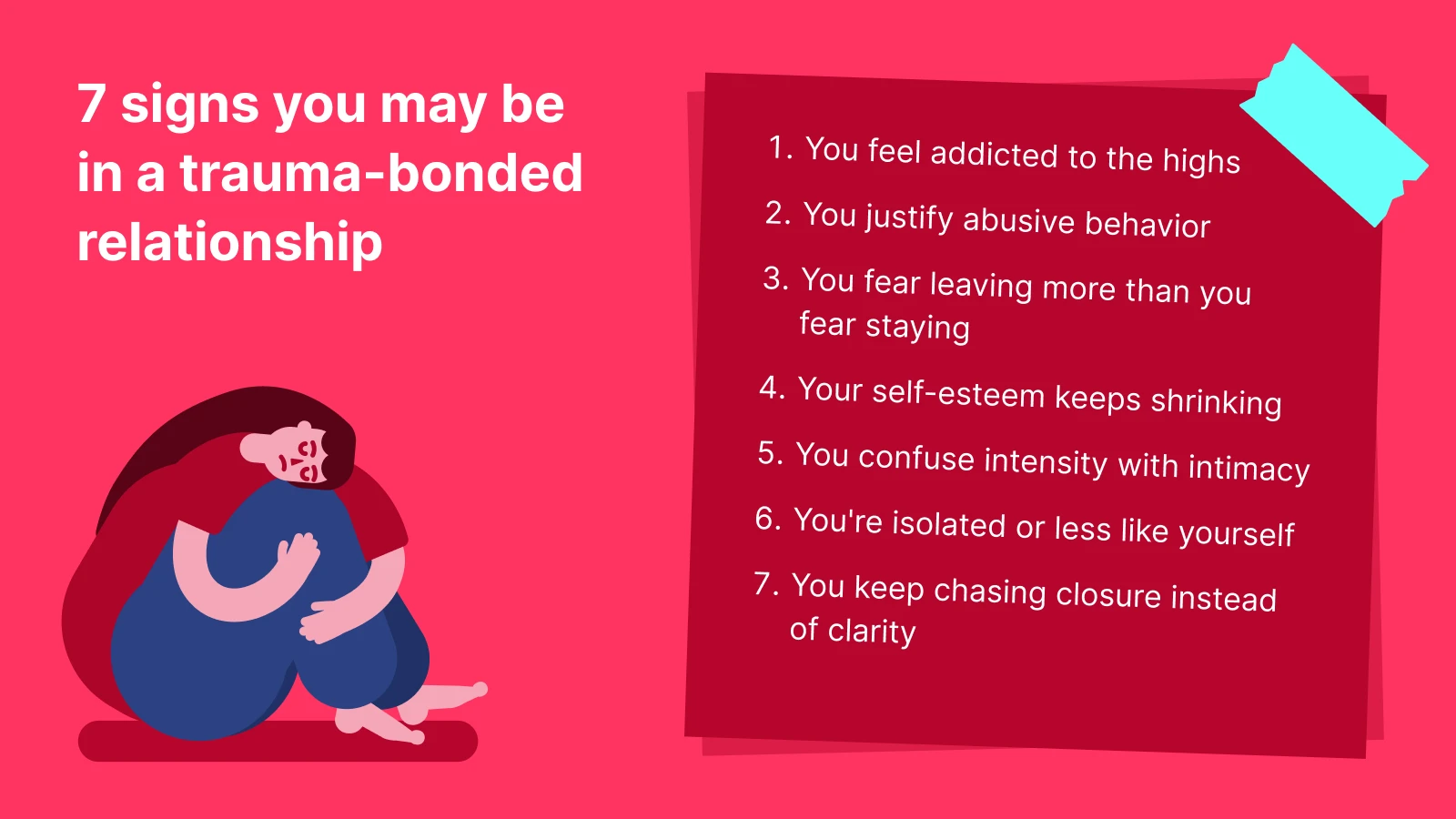
1. You feel addicted to the highs Those rare tender moments feel like oxygen. So the lows get reframed as "just stress."
2. You justify abusive behavior You become their PR team, covering for trauma history, bad days, and misunderstood intentions.
3. You fear leaving more than you fear staying You know that it's harmful. But the idea of separation feels unbearable.
4. Your self-esteem keeps shrinkingThis often happens when you second-guess everything, apologize constantly, and feel "too sensitive." You experience a loss of self as your identity becomes smaller.
5. You confuse intensity with intimacyThe relationship feels deep because it's dramatic, not safe. It creates emotional connection through crisis, not consistency.
6. You're isolated or less like yourself Sharing fewer details with family members and seeing friends less. Your world narrows.
7. You keep chasing closure instead of clarity You want the perfect conversation that finally makes them understand. Trauma bonds thrive on "almost."
If you want a broader scan of unhealthy patterns, Headway's guide on relationship red flags is a useful cross-check.
See the loop clearly: Stages of trauma bonding and the cycle of trauma
Trauma bonds commonly build through a repeating pattern often described as a cycle of abuse or a cycle of trauma. Understanding the stages of trauma bonding helps you recognize where you are in the pattern. The cycle can include tension, an incident of harm, a repair phase, and a calmer phase that resets hope, according to Sandstone Care.
The repair phase is the sticky part because it can feel like proof. It often includes:
Love bombing
Apologies and promises
Gifts and affection
Sudden "insight" or vulnerabilityYour body registers the drop in threat as a signal of connection, and the loop resets. Your brain remembers the relief and starts chasing it. The key here is intermittent reinforcement, a mix of negative experiences and occasional positive reinforcement that makes the bond much more challenging to break. According to Psychology Today, the abusive partner cycles between devaluation and idealization, creating a rollercoaster experience for the abused person.
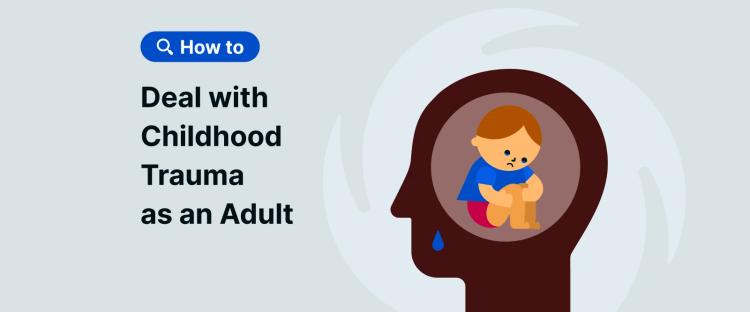
Why childhood trauma can make this feel familiar
It's important to discuss why your brain might be comfortable with that level of instability. If love wasn't consistent during your childhood, the "hot and cold" dynamic in your adult life might feel really familiar. Think back: Did you grow up needing to be hyper-aware of a parent's mood just to stay safe? Maybe you learned that affection was something you needed to earn. Or that it could be taken away in a second
When the person who is supposed to nurture you is also the one causing you stress, your body creates a "survival template." It's not your fault. Being wired this way was meant to help you adapt to an unpredictable environment; your nervous system simply memorized a formula where love equals unpredictability.
If that realization hits a little too close to home, don't panic. You aren't broken, you're just operating on an old blueprint. Headway's breakdown on childhood trauma is a great place to start untangling those wires. It helps you see the "why" behind your patterns without making you feel out of control.
Get clarity fast: Trauma bond vs Stockholm syndrome vs Codependency
People use these terms interchangeably. They're not the same.
| Concept | What it is | What drives it | Common contexts | What helps most |
|---|
Trauma bond or traumatic bonding | Unhealthy attachment to someone who harms you, strengthened by abuse plus intermittent reinforcement | Threat-relief conditioning | Romantic relationships, family, workplaces, high-control groups, and domestic abuse situations | Safety, boundaries, reducing reinforcement, and evidence-based trauma-informed support from qualified providers |
Stockholm syndrome | Survival attachment that can form under captivity and hostage conditions | Dependence under threat | Captivity-type situations | Safety, distance, and trauma processing |
Codependency | Over-focus on another's needs tied to self-worth or anxiety | Boundary collapse, rescuing patterns | Many types of relationships (not consistently abusive) | Boundaries, self-worth work, therapy, and support groups |
Overlap happens. But one thing to understand about trauma-bonded relationships is that they are typically anchored in harm and power imbalance.
Break the trauma bond safely: Practical steps that reduce the pull
Here are some practical steps to take in order to "unhook" yourself from a trauma bond.
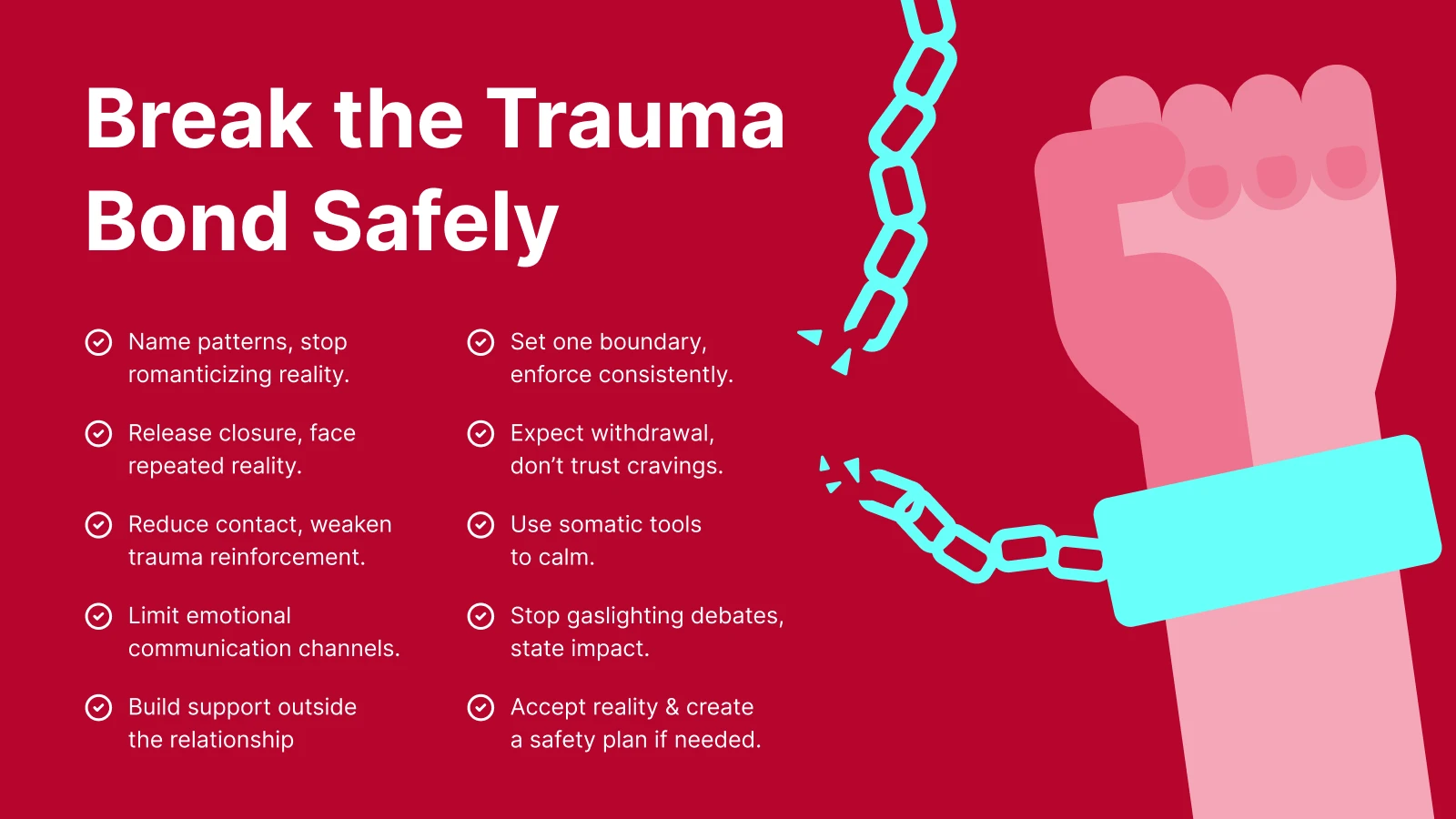
One: Start naming the patterns out loud
Trauma bonds only live in the fog. You'll notice that the moment you realize this, the connection starts to rot. Also, stop calling it a "rough patch" or a "complicated love story." It's intermittent reinforcement — a literal addiction to occasional breadcrumbs.
Watch their "repair" attempts — and watch closely. Because instead of a permanent change, this can just be a round of love-bombing to keep you from leaving, unfortunately. There is an actual tax you're paying. Think about all the lost sleep, wrecked focus, and drained dignity. Be pragmatic: when the relationship costs you your peace, you're overpaying.
Two: Forget "closure" — you need a reality check
We often stay because we're waiting for them to finally "get it." And spoiler alert, they won't. Your goal is simple — to learn to be your own anchor, and to look at their history instead of their potential.
Look at the repeats: What has happened three, five, or ten times already? That's reality.
Identify the fear: What are you afraid will happen if you walk away? Name that fear, and then you can get a better sense of it.
Three: Turn down the volume on reinforcement
Trauma bonds thrive on contact. Your brain gets a "relief" hit with every single interaction. So what do you do instead? Starve the cycle.
Shift the medium: If you have to talk, do it. But opt for an email or a text message. It's best to avoid the emotional weight of a phone call.
Stop the "Honeymoon" phase: Notice if they try to be extra affectionate after a blowout. And if they aren't being accountable, don't play along. Remember, it's just a distraction.
Structure over "No Contact": If blocking them feels too big, try a "one-time window." For instance, mute their messages and only check at 4 PM for five minutes. Then you're done.
Four: Build your "Truth Team" before you leave
Abusive dynamics only really work when you're cut off from everyone else. The best way to break that spell is to surround yourself with people who aren't under the abuser's influence — they're the ones who can help you remember what is true and what is not.
Start by picking one "no-nonsense" friend, someone who knows the whole story and won't let you sugarcoat things...yes, you might do that when you're feeling weak. Beyond that, find a therapist, ideally, a trauma-informed one. It's also worth looking into support groups; there is nothing like the relief of hearing someone else tell your exact story. It gives you validation that you aren't "crazy," and you never were.
Five: Pick just one boundary (and stick to it)
Don't try to change your whole life on a Monday morning. Pick one tiny line in the sand.
"I am hanging up if you start yelling."
"I won't reply to texts after 9 PM."
Commit to one: It's better to succeed at one small boundary than to fail at ten big ones.
Six: Expect the "Withdrawal" symptoms
When you finally choose to step away, your body will react. You will likely feel that you made a huge mistake. Keep this in mind — it's your chemistry adjusting, and it will take some time.
The Cravings: You will want to check their Instagram "just to see."
The Nostalgia: Your brain will suddenly play a highlight reel of only the good times. It is a trap.
The Shame: You'll feel bad for staying so long. Let it pass.
Seven: Try a two-minute somatic reset
When you feel the urge to call them, here is what you can try instead (because the easiest way out of the mental chatter is through the body!): one hand on your heart, one hand on your belly. Breathe in for four, out for six. Long exhales tell your nervous system to stand down. Say it: "I am safe right now." If words feel fake, skip them.
Instead, try this: press your feet into the floor for 10 seconds. Look to your left and right slowly (orienting). Then exhale longer than you inhale. Then decide what you'll do in the next two minutes, not forever.
Eight: Stop negotiating with gaslighting
When reality keeps getting rewritten, stop arguing the facts. Return to impact:
"That doesn't work for me."
"I'm not debating my experience."
"I'm done with this conversation."
Nine: Grieve the fantasy on purpose
A trauma bond often includes a powerful attachment to who they could be. Grieving the loss of that fantasy is painful, but it's also freeing.
Write three blunt lines:
"I wanted…" (the real want, not the polite one)
"I deserved…" (say it like you mean it for ten seconds)
"I kept hoping…" (name the fantasy version of them)
Then end with:
"What's real is…"

Heal Your Grief
Find actionable tips to overcome your traumatic experience.
Ten: Prioritize self-care and your physical health
When you're trying to untangle yourself from a trauma bond, "self-care" is not some fancy routine, but just stabilization. Pure and simple. Think about it: the relationship has basically trained your nervous system to run on a constant loop of adrenaline and cortisol. You're always waiting for the other shoe to drop. Eventually, your body reaches a limit.
You have to start with the "boring" stuff to remind your brain that you're safe now.
First off, sleep and actual food. It sounds basic, but you can't think your way out of a trauma bond if you're running on three hours of sleep and caffeine. Then there's movement. Not "punishment" workouts to change how you look, but just moving your body in a way that feels okay. Safe.
You also need to identify your "anchors," the one or two people who actually get it. People who won't tell you to "just get over it" or minimize what you've been through. And honestly? Find something — anything — that has nothing to do with the relationship. It can be a hobby you dropped some time ago. Maybe it's a playlist they hated. Or a walk they never went on. It's imperative to remember who you were before this bond started taking up all the oxygen in the room.
If the relationship installed a loud inner critic, answer it with one clean line of self-talk:
"My feelings make sense."
"I deserved better."
"I'm allowed to choose healthy relationships."
Eleven: Make a safety plan if there's violence involved
If there's domestic violence, stalking, threats, or you feel unsafe, before anything else, you should make a safety plan. And if you're in immediate danger, contact emergency services.
US resources that can help:
National Domestic Violence Hotline: 1-800-799-SAFE (7233)
RAINN National Sexual Assault Hotline: 800-656-HOPE (4673)
988 Suicide & Crisis Lifeline: call or text 988
Try these five Headway exercises to start healing today
When you're trauma-bonded, your mind wants a ten-hour explanation. Your body wants small, repeatable reps. These evidence-based exercises help you rebuild emotional connection with yourself, one boring little win at a time.
Inspired by Headway's summaries of the books below.
| Exercise | Why it matters | Pair it with the Headway summary |
|---|
Mind-body grounding | Reduces panic and urge-driven texting by anchoring you in the present; supports physical health | 'The Body Keeps the Score' by Bessel van der Kolk |
Reframe the belief that keeps you stuck | Trauma bonds often run on beliefs like "I'm hard to love"; it rebuilds a sense of self | 'The Myth of Normal' by Gabor Maté, MD |
Family pattern journal | Helps you see inherited relationship templates from caregivers without blaming yourself | 'It Didn't Start with You' by Mark Wolynn |
Thought-challenging for rumination | Interrupts spirals like "maybe it was my fault"; supports self-compassion | 'Get Out of Your Head' by Jennie Allen |
Self-worth affirmation practice | Rebuilds identity and sense of self after loss of self in the relationship | 'You Can Heal Your Life' by Louise L. Hay |
If you want additional reading on this topic, Headway's piece on the mind-body impact of trauma is a good companion.
Can't stop going back to someone who hurts you? Break the loop with Headway.
Let's be real: if you keep going back to someone who mistreats you, it isn't because you "love the drama." It's actually much more scientific (and frustrating) than that. Your brain has essentially been hijacked by a reward schedule that is incredibly hard to quit. You finally feel a sense of calm, and then — ping — a sweet text arrives. Then, you hear their soft voice on the phone. Maybe there's a promise — something like "this time is different." Your whole body finally unclenches. That tiny hit of relief isn't love — it's the hook.
Instead of spiraling into another "why did they do this" analysis session, you need a strategy you can actually follow when your nervous system is in a high alert state.
📘 Download the Headway app to get instant access to actionable summaries that help you rewire your brain and reclaim your peace.
Frequently asked questions about what a trauma bond is
Is my trauma bond the same as abuse?
No. Abuse is the harmful behavior itself. Trauma bonding is the unhealthy attachment that forms when abuse mixes with intermittent warmth or repair. You might feel loyal or responsible even while being harmed. The pattern trained your nervous system — you didn't want it.
Can I have a trauma bond without physical violence?
Yes. Trauma bonds form through emotional abuse, manipulation, coercive control, or chronic instability — even without physical violence. If harm is followed by affection or promises, that push-pull creates a powerful attachment that's difficult to break without emotional support from qualified providers, according to Sandstone Care.
How do I know if I'm trauma-bonded or just in love?
Love feels safer over time. Trauma bonds, on the other hand, feel intense, anxious, and consuming. If you find yourself habitually rationalizing abusive behavior, are more afraid of leaving than of staying, and feel "high" from brief good periods, you're likely reacting to intermittent reinforcement — the opposite of secure intimacy. A healthy emotional connection strengthens your sense of self; traumatic bonding erodes it, according to Psychology Today.
How long does it take to break a trauma bond?
There is no universal timeline. Many factors determine it. Such as: the basic safety level, the level of contact, the loved ones and providers who support you, and the extent to which the cycle has entrenched itself. Most people notice the strongest "withdrawal" in the early weeks after reducing reinforcement. Consistent boundaries, self-care, and evidence-based trauma-informed care usually speed recovery, suggests Psychology Today.
Can my trauma bond affect my mental health long-term?
Yes. Living in chronic relational stress may contribute to anxiety, depression, lowered self-esteem, sleep problems, and body-based hypervigilance. Trauma bonding affects your physical and mental health. Stress responses can still fire even after the relationship ends. Healing requires working with both the mind and the body.
What happens after I break my trauma bond?
You'll likely feel grief, relief, anger, and cravings in waves. Your identity may feel shaky, especially if you experienced loss of self to survive. Over time, clarity increases and your nervous system settles. You rebuild self-trust through consistent boundaries, self-compassion, emotional support, and healthy relationships.
What is the difference between trauma bonding and traumatic bonding?
People use "trauma bonding" and "traumatic bonding" to mean the same thing: an unhealthy attachment that forms in abusive relationships when harm gets mixed with occasional closeness," repair" even.
The on-and-off reward pattern (intermittent reinforcement) really makes leaving feel hard. Yes, even when you know it's hurting your mental health. Some clinicians use a slightly different phrase — "traumatic bonding". Mainly because it makes the point even sharper of how the bond itself is harmful and not romantic at all, despite how much you might want to romanticize it. And, trauma bonding or traumatic bonding is not the same thing as "we bonded over shared trauma."
Can this type of relationship happen outside romantic partnerships?
Yes. It can form anywhere there's a power imbalance mixed with unpredictability: parents, bosses, teachers, religious leaders, coaches, high-control groups, or caregivers.
How do I practice self-compassion during recovery?
Self-compassion has little to do with "being nice to yourself" when it comes to trauma bonds. You should stop the inner interrogation long enough to stabilize. You can practise one of these (especially when shame spikes):
"This makes sense for what I lived through."
"My body learned a strategy. Now I'm learning a new one."
"I don't need to prove it was 'bad enough' to deserve support."
If you notice that you keep returning to the same loop, work with a trauma-informed therapist. This pattern is treatable, but it's hard to manage on your own.