Self-growth
 Business & Career
 Success
 Communication
 Healing
 Relationships
 Psychology
 Happiness
"I'm just going to check the news real quick."
That was ninety minutes ago. Since then, you've read about three disasters, scrolled past forty arguments, watched someone you'll never meet have a meltdown, and absorbed enough secondhand outrage to fuel a small power plant. Your neck hurts from the angle. Your brain feels like static. You're somehow more anxious than before you "relaxed."
You put your phone down. You pick it back up. You hate that you picked it back up. You keep scrolling anyway.
Sound familiar? If you're wondering what to do instead of doomscrolling, you're already ahead of most people. Recognizing the trap is step one. Now let's talk about escaping it. We've got 100 ideas to try!
📘 Ready to turn your screen time into something that actually helps? Download Headway and swap 15 minutes of doom for one book summary that sticks with you. Same phone, completely different feeling afterward.
➡️ What is the Headway app and how does it work?
Quick answer: What is doomscrolling?
Doomscrolling is the act of endlessly scrolling through negative news or social media feeds, even when it makes you feel worse. You get that compulsive urge to keep checking updates, reading bad news, and refreshing TikTok or X long past the point of enjoyment.
Signs you're doomscrolling:
Your heart beats faster while you scroll, but you can't stop.
You lose track of time and suddenly realize hours have vanished.
You feel drained or anxious after a session, rather than relaxed.
If these patterns sound familiar and they're affecting your wellbeing, you're already ahead.
➡️ Want to dig deeper into breaking the habit? Check out our guide on How to Stop Scrolling Addiction and Reclaim Your Time in 5 Easy Steps.
Why we doomscroll (and why it never satisfies)
Your brain is wired to seek two things: novelty and completion. Every new post triggers a tiny dopamine release — that's the novelty. But social media offers endless novelty with zero completion. There's always another scroll, another video, another headline. Your brain keeps chasing a finish line that doesn't exist.
Researchers call the pattern a dopamine loop. Small reward; want more? Scroll again. Unlike finishing a crossword puzzle or checking off your to-do list, scrolling never gives you that satisfying "done" feeling. That's why spending time on endless feeds leaves you feeling empty rather than fulfilled. Your mental health takes the hit because of it.
But there is good news. Once you understand the pattern, you can hack it. The 100 alternatives below give you both novelty and completion. The dopamine hit plus the satisfaction of actually finishing something.
➡️ Looking for apps that work with your brain instead of against it? We've rounded up 18 Apps Like TikTok That Won't Waste Your Time in 2025.
100 things to do instead of doomscrolling
Move your body (1–15)
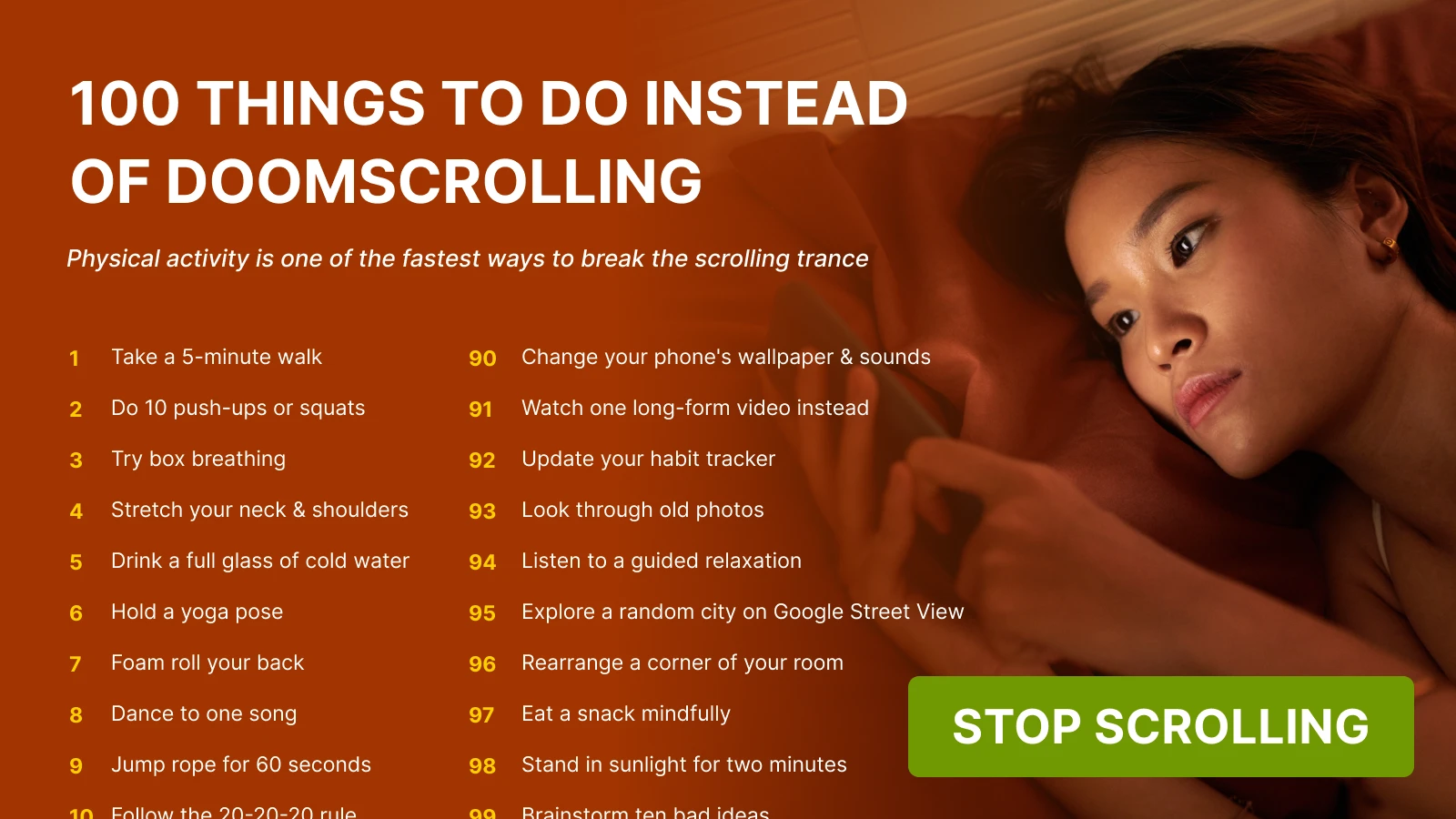
Physical activity is one of the fastest ways to break the scrolling trance. Even small movements reset your nervous system and pull you back into your body.
Take a 5-minute walk. Step outside for fresh air and change your environment. You don't need a destination. Just moving through space interrupts the scroll reflex.
Do 10 push-ups or squats. Bodyweight exercises require zero equipment. Physical effort redirects your restless energy toward something useful.
Try box breathing. Inhale for four counts, hold for four, exhale for four, and hold for four. It might sound too simple to work, but it interrupts anxiety faster than any amount of scrolling.
Stretch your neck and shoulders. Focus on relieving "tech neck," that forward head posture from staring at screens. Roll your shoulders back, tilt your head side to side, and feel the tension release.
5. Drink a full glass of cold water. Dehydration often mimics boredom. The cold temperature wakes up your system and breaks the autopilot loop.
6. Hold a yoga pose. Any pose will do, including child's pose, downward dog, or a simple forward fold. You don't need a full routine. Just one pose held for 30 seconds shifts your state.
7. Foam roll your back. If you have a roller, spend two minutes releasing the muscle tightness caused by sitting. Your physical health and mental health are connected.
8. Dance to one song. Put on something you love and move freely. No choreography required. Just let your body respond to the music.
9. Jump rope for 60 seconds. A high-intensity burst resets your heart rate and floods your brain with different chemicals than scrolling does.
10. Follow the 20–20–20 rule. Every 20 minutes, look at something 20 feet away for 20 seconds. This practice reduces digital eye strain and gives your brain a micro-break.
11. Go for a swim. If you have access to a pool, swimming provides a full-body, screen-free sensory experience that's impossible to replicate while scrolling.
12. Play a quick sport. Grab a ball and shoot hoops, kick it around the yard, or rally with a friend. Physical play engages your brain differently from passive consumption.
13. Ride your bike around the block. Even a short cycle changes your perspective. Leave your phone at home and just explore.
14. Do some gardening. Tending to plants provides a grounding, tactile experience. Digging in dirt is surprisingly therapeutic.
15. Practice balancing on one leg. It sounds silly, but single-leg balance improves focus and core strength. Try holding it for 30 seconds per side.
Calm your mind (16–30)
These activities focus on decompressing the mental clutter that doomscrolling often creates, or that drives you to scroll in the first place.
16. Do a 5-minute guided meditation. Apps offer sessions as short as three minutes. You don't need to become a guru — you just need a reset.
17. Write down three things you're grateful for. Gratitude practice sounds cheesy until you notice how it shifts your mood. Be specific: "the way sunlight hit my coffee this morning" beats "my food."
18. Visualize completing a goal. Spend two minutes imagining the successful end of something you're working toward. See the details. Feel the satisfaction.
19. Try the 5–4–3–2–1 grounding technique. Notice five things you can see, four you can touch, three you can hear, two you can smell, and one you can taste. This exercise pulls you into the present moment.
20. Journal for five minutes. Write whatever comes to mind. No structure needed. Just getting thoughts onto paper helps process emotions that might be driving the scroll urge.
21. Read a physical book. Paper books eliminate notifications, blue light, and the temptation to "just check one thing." Even ten pages count.
22. Listen to a podcast episode. Audio content lets your eyes rest while your mind stays engaged. Download a few episodes during your free time so they're ready when you need them.
23. Recite three affirmations. Write down or speak three positive statements about yourself. It feels awkward at first, but it works anyway.
24. Solve a Sudoku or crossword puzzle. These give your brain the novelty it craves, plus the completion that scrolling never provides.
25. Put on calming music. Enjoy music like lo-fi beats, classical piano, and ambient sounds. Essentially, anything without lyrics that lets your nervous system settle.
26. People-watch in a public place. Sit on a bench, observe the world, and notice how interesting real humans are compared to curated content.
27. Lie down and count to 500. It's boring on purpose. The boredom is the point. Your racing mind needs permission to slow down.
28. Color in an adult coloring book. The repetitive motion is calming, and finishing a section gives you that completion hit.
29. Practice 4–7–8 breathing. Inhale for four counts, hold for seven, and exhale for eight. Do that three times with your eyes closed.
30. Take a 20-minute power nap. Sometimes the urge to scroll is just exhaustion in disguise. A short nap beats an hour of mindless feeds.
If you want to build a consistent mindfulness practice, Headway offers summaries of books like 'The Power of Now' and 'Wherever You Go, There You Are' — insights you can absorb in 5–15 minutes instead of struggling through dense chapters.

Get something done (31–45)
Turning "dead time" into "productive time" provides an accomplishment that social media can never deliver. These tasks are small enough to start right now.
31. Tidy your desk or workspace. Just the immediate surface. Visible order creates mental clarity.
32. Review your calendar for the week. Knowing what's coming reduces the anxiety that often triggers scrolling.
33. Do a brain dump. Write down every task floating in your head. Getting it out of your mind and onto paper reduces overwhelm.
34. Complete one micro-task. Pick something that takes less than 10 minutes. Send that email. Make that call. Cross it off.
35. Plan tomorrow's meals. Meal planning removes daily decision fatigue. Plus, it saves money and improves your nutrition.
36. Declutter your phone's home screen. Move social media apps to the last page. Put Headway, your audiobook player, or a learning app where your thumb naturally lands.
37. Check your budget. Spend five minutes reviewing recent expenses. Financial awareness beats financial anxiety.
38. Water your plants. If you have them, tend to them. If you don't, this might be your sign to get one.
39. Read one article you bookmarked weeks ago. Clear out that "save for later" folder. Actually engage with the content you chose intentionally.
40. Clean out your wallet. Remove old receipts, expired cards, and random scraps. A lighter wallet feels surprisingly good.
41. Organize one drawer. Whether it's the junk drawer, the sock drawer, or whatever's closest. Declutter something small and feel the visible progress.
42. Pick five clothing items to donate. If you haven't worn it in a year, someone else could use it.
43. Sharpen your pencils or clean your tools. Maintenance tasks are meditative and leave you with functional supplies.
44. Sanitize your phone. Clean the screen, wipe the case. You touch this thing constantly — it deserves attention.
45. Unsubscribe from five promotional emails. Each one you eliminate is one less notification competing for your attention.
Learn something new (46–60)
Replacing mindless scrolling with intentional learning creates long-term satisfaction instead of short-term emptiness.
46. Spend 10 minutes learning a new skill. Watch a tutorial on something practical — a software shortcut, a cooking technique, or a repair skill.
47. Complete one language lesson. Apps like Duolingo offer 5-minute sessions. Those tiny practices add up to real progress over months.
48. Practice an instrument for 15 minutes. Even scales count. The point is engagement, not perfection.
49. Review your long-term goals. Where are you headed? What's the next step? Reconnecting with your vision beats disconnecting through feeds.
50. Write down questions for a mentor. If you have one, prepare for your next conversation. If you don't, think about who you'd want to learn from.
51. Read one chapter of a self-improvement book. Or better yet, read a Headway book summary and get the key insights in 5–15 minutes. Same learning, less time investment.
52. Play a strategy game. Chess, Go, or even a Rubik's Cube. Games that require thinking exercise different mental muscles than passive scrolling.
53. Watch one module of an online course. Platforms like Udemy, Coursera, or Skillshare break content into 10–15 minute segments. One module is better than zero.
54. Update your vision board. Digital or physical, spend time visualizing what you're working toward.
55. Find a new recipe to try this weekend. Researching food you'll actually make beats watching food content you'll never cook.
56. List your recent wins. Write down three things you've accomplished recently, no matter how small. Acknowledging progress builds momentum.
57. Watch a short documentary. A 20-minute historical piece teaches you something real about the world.
58. Sign up for a free webinar. Many experts offer free educational sessions. Put it on your calendar and show up.
59. Research something you've always wondered about. Follow your curiosity intentionally instead of letting algorithms decide what you learn.
60. Write something creative. You can write anything, like a short story, a poem, or a blog post. Creating content feels better than consuming it.
➡️ Speaking of learning, our article 15 Apps to Replace Social Media and Turn Your Screen Time Into Self-Growth has more ideas for turning your phone into a growth tool instead of a time sink.
Connect with humans (61–70)
Doomscrolling often feels isolating. These activities rebuild the emotional and social connections that screens can erode.
61. Text a genuine compliment to a loved one. Be specific about what you appreciate. "I love how you always ask follow-up questions" lands better than "you're great."
62. Do something kind for a neighbor. Bring in their trash can. Leave a note. Small gestures like these build community.
63. Spend dedicated time with a pet. Not scrolling while they sit nearby. Actually playing, grooming, or training. They notice the difference.
64. Call a family member. Not to ask for something. Just to check in and hear their voice.
65. Write a physical thank-you note. Handwritten cards are rare now. That's exactly why they mean so much.
66. Reach out to someone you haven't talked to in a year. Old friendships are worth maintaining. A simple "thinking of you" message can rekindle a connection.
67. Research local volunteer opportunities. Look up something happening this weekend. Helping others provides meaning that likes and shares never will.
68. Write a letter to your future self. Seal it with a date to open in 1, 5, or 10 years. It's a gift to the person you're becoming.
69. Plan a trip, even hypothetically. Research a dream destination and build an itinerary. Planning is its own form of enjoyment.
70. Schedule a coffee date or dinner with a friend. Put it on the calendar. Real-world connection beats digital interaction every time.
Make something with your hands (71–85)
Engaging your hands helps unplug your brain from the digital world. Fidgety fingers are one reason we reach for phones — give them a better job.
71. Learn basic bookbinding. Making your own journals is surprisingly accessible with tutorials online.
72. Set up a bullet journal spread. Design a custom layout for tracking your habits, goals, or weekly tasks.
73. Practice calligraphy or hand lettering. All you need is paper and a pen. The focus required leaves no room for scroll urges.
74. Make a handmade card. Design something for an upcoming birthday or holiday. Homemade beats store-bought.
75. Work on a jigsaw puzzle. Keep one going on a table. Even placing five pieces scratches the completion itch better than scrolling for an hour.
76. Doodle without judgment. Fill a page with shapes, patterns, whatever comes to mind. This isn't about art — it's about keeping your hands occupied.
77. Start a simple crochet or knitting project. It can be a scarf or a dishcloth, just make something achievable. Tutorials make it beginner-friendly.
78. Upcycle something in your home. Repaint an old frame, recover a cushion, or turn a jar into a planter. DIY projects provide tangible results.
79. Create a scrapbook page. Organize physical photos into a memory book. Handling real pictures feels different than swiping through a camera roll.
80. Build a model or LEGO set. Assembly projects require focus and reward you with something real at the end.
81. Organize your photos into albums. If you have boxes of prints, sort them. If everything's digital, create folders that actually make sense.
82. Learn a card trick. One simple trick you can practice and eventually show friends. It's a conversation starter that doesn't involve screens.
83. Try origami. Paper folding requires precision and patience. Start with a crane and work up from there.
84. Repair something you've been putting off. Sew a button, fix a loose handle, patch a small hole. Fixing feels better than replacing.
85. Press flowers or leaves. Collect something from outside and preserve it. It's meditative and creates something beautiful.
Use your phone differently (86–95)
If you must be on a device, these alternatives are less addictive and more enriching than social media doom spirals.
86. Read a book on an e-reader app. Set it to scroll mode, turn off notifications, and treat it like a paper book.
87. Train your brain with puzzles. Apps like Nibble or Skillsta offer cognitive exercises and skill-building that actually benefit you.
88. Browse museum collections online. The Smithsonian, Met, and countless other institutions have digitized their archives. Explore art and history intentionally.
89. Curate your music playlists. Organize your library into mood-based collections. It's productive, and you'll thank yourself later.
90. Change your phone's wallpaper and sounds. A small refresh makes your device feel new without buying anything.
91. Watch one long-form video instead of thirty short ones. A 30-minute video essay teaches you more than 30 minutes of shorts.
92. Update your habit tracker. If you use one, check in on your progress. If you don't, today's a good day to start.
93. Look through old photos. Revisit happy memories instead of consuming strangers' highlight reels.
94. Listen to a guided relaxation or sleep track. ASMR, body scans, nature sounds — content designed to calm rather than agitate.
95. Explore a random city on Google Street View. Virtual travel satisfies curiosity without the anxiety of news feeds.
For a phone experience that actually improves your life, try Headway. Our microlearning sessions start at just 3 minutes and are tailored to your personal growth goals — perfect for those moments when you want content but don't want to spiral.
Try something unexpected (96–100)
These ideas break routine and inject novelty into your day — the good kind of novelty that leaves you energized instead of drained.
96. Rearrange a corner of your room. Move furniture, swap decorations, or create a fresh environment. Change your space to change your mood.
97. Eat a snack mindfully. No screens means no distractions. Focus entirely on the taste, texture, and experience of eating.
98. Stand in sunlight for two minutes. Natural light regulates your circadian rhythm and boosts your mood. Step outside or find a sunny window.
99. Brainstorm ten bad ideas. Pick a problem you're facing and list ten intentionally terrible solutions. Creativity often hides behind the obviously wrong answers.
100. Sit in complete silence for five minutes. No phone, no music, and no input at all. Just you and your thoughts. It's harder than it sounds — and surprisingly refreshing.
➡️ There's a growing movement around sitting with discomfort. Check out Rawdogging Boredom: Why Gen Z is Choosing to Do Absolutely Nothing if you're curious about what happens when you stop filling every quiet moment.
The 3-step routine to break the scroll
Having 100 options is great. Knowing when to use them is better. Here's a simple routine that interrupts automatic scrolling before you lose an hour.
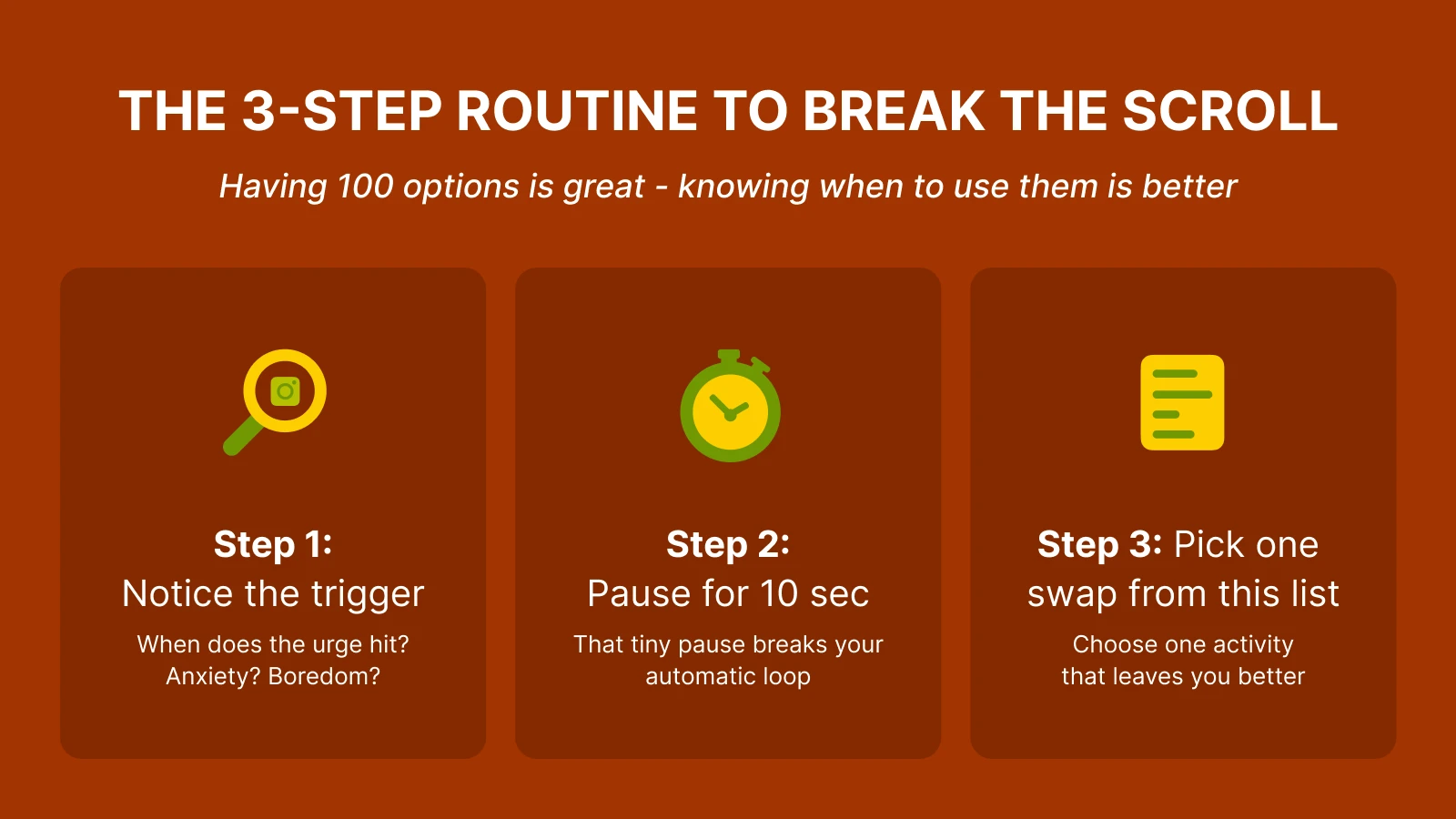
Step 1: Notice the trigger. When does the urge hit? Anxiety? Boredom? Overwhelm? Maybe you're dealing with ADHD and need stimulation. The trigger isn't the problem — it's information. Track your patterns for a week, and you'll start seeing what drives you to scroll.
Step 2: Pause for ten seconds. When you catch yourself reaching for your phone, put it face down. Count to ten. That tiny pause breaks the automatic loop and gives your brain a chance to choose instead of react.
Step 3: Pick one swap from this list. Instead of opening TikTok or checking negative news, choose one activity that leaves you better than you started. Match the activity to your energy level. Exhausted? Try #30 (power nap) or #25 (calming music). Restless? Try #8 (dance) or #2 (squats). Lonely? Try #64 (call someone) or #61 (text a compliment).
The goal isn't perfect willpower. It's having better options ready when the urge hits.
You don't need to quit your phone. Use your phone smartly with Headway
You don't need to throw your phone in a river or delete every app. You don't need superhuman self-control or a complete digital detox. What you need are better alternatives ready for when the scroll urge hits — and the awareness to choose them.
The urge to doomscroll comes from real needs: rest, novelty, connection, escape. Those needs are valid. True self-care isn't about punishment or restriction — it's about meeting those needs in ways that support your wellness instead of draining it.
Think about it: every lot of time spent on negative news or endless feeds is time you could spend learning a new language, calling a friend, finishing a puzzle, or simply resting without the anxiety spiral. The swap doesn't have to be dramatic. It just has to be intentional.
Set a time limit on the apps that drain you. Reorganize your home screen. Remove notifications from anything that doesn't truly need your attention. Design your environment so the path of least resistance leads somewhere good.
➡️ If procrastination is part of your picture, we've got you covered there, too. Check out How to Overcome Procrastination and Get Things Done in 2026.
📘 Your next scroll can be different. Download Headway and turn minutes of doomscrolling into steps toward your best self. One quick read or listen at a time — that's how real change adds up.
Frequently asked questions on what to do instead of doomscrolling
What is a healthy alternative to doomscrolling?
The healthiest alternatives give you what scrolling promises but never delivers: novelty plus completion. Reading a book, solving a puzzle, or learning something new all scratch the same itch without the anxiety hangover. The key is choosing activities that leave you feeling better afterward, not drained. Swap the endless feed for something with an actual finish line.
How to relax instead of doomscrolling?
Try activities that calm your nervous system rather than spike it. Guided meditation, gentle stretching, calming music without lyrics, or reading a physical book all work. The 4–7–8 breathing technique is surprisingly effective — inhale for four counts, hold for seven, and exhale for eight. Your body can't stay anxious when you're breathing slowly and deliberately.
Is Gen Z really addicted to doomscrolling?
Research shows Gen Z spends more time on social media than other generations, but "addiction" oversimplifies it. Many young people use scrolling to cope with genuine anxiety about climate change, economic uncertainty, and global events. The urge to stay informed is understandable — the problem is that doomscrolling increases anxiety instead of reducing it.
What to do instead of doomscrolling before bed?
Screens before sleep wreck your circadian rhythm, so switch to analog activities. Read a paper book, journal about your day, do gentle stretches, or listen to a sleep meditation. If you must use your phone, try a Headway summary with night mode — you'll learn something useful, and the defined endpoint helps your brain wind down instead of spiraling.
What to do instead of doomscrolling when tired?
When you're exhausted, scrolling feels like rest, but actually drains you more. Try actual rest instead: a 20-minute power nap, lying down with calming music, or simply closing your eyes and breathing deeply. If you need stimulation, listen to a podcast, audiobook, or book summary — your eyes get a break while your mind stays gently engaged.
What to do instead of doomscrolling at work?
Take a genuine micro-break that recharges you. Stand up and stretch, walk to get water, or step outside for two minutes of fresh air. If you need mental stimulation, read one Headway summary or tackle a small task you've been avoiding. Completing something tiny gives you momentum, while scrolling just makes the afternoon drag longer.
Is doomscrolling an ADHD thing?
People with ADHD are more prone to doomscrolling because their brains crave stimulation and struggle with impulse control. The endless novelty of social media feeds hits the ADHD brain's reward system hard. But this also means ADHD brains respond well to engaging alternatives — puzzles, creative projects, or learning apps that provide stimulation without the negativity spiral.