Self-growth
 Apps & Digital Tools
 Business & Career
 Success
 Growth Tools
 Psychology
 Communication
 Relationships

Have you ever left a conversation and, somewhere on the drive home, realized you talked too much?
You filled the silences, gave advice nobody asked for, and missed something the other person was trying to say. The phrase "talk less, listen more" is one of the oldest pieces of social wisdom — and one of the hardest, actually, to pull off.
This isn't another lecture on active listening. It's a practical guide to how to talk less and listen more in the conversations that matter — and why the gap between intention and behavior is bigger than you think.
The books that teach this — Kate Murphy's 'You're Not Listening', Celeste Headlee's 'We Need to Talk', Dale Carnegie's classic — are condensed into 15-minute reads and audios await you.
📘 If you've replayed a conversation tonight and wished you'd said less — get the Headway app and try to change it today!
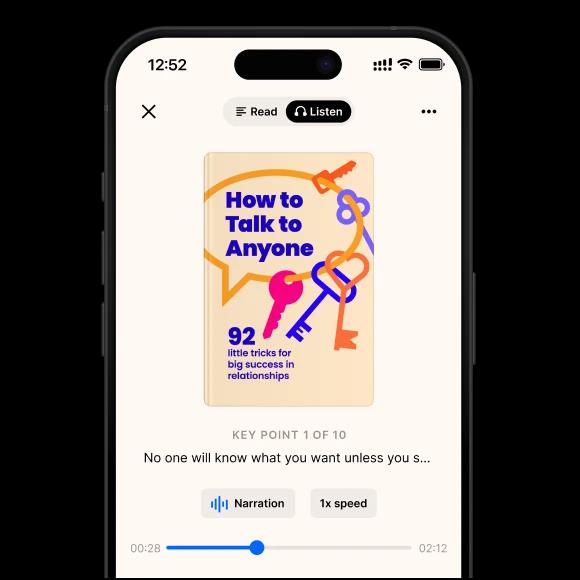
Ready to finally become a better listener?
Bestselling authors map out how to build deeper connections.
Build better conversationsTalk less, listen more: The short version (TL;DR)
Talk less, listen more isn't about silence — it's about replacing reactive speech with attention that actually picks up what the other person is saying.
The brain processes speech about four times faster than people talk, creating a gap we fill with anticipating, judging, and preparing a reply. That gap is where the move to listen more, talk less actually starts.
The biggest barrier isn't ego. It's discomfort with silence and the urge to fix or advise when someone mostly wants to be heard.
The skill is built through practice: pause before responding, ask deeper questions, summarize what you heard, and watch your body language for the signs you're about to interrupt.
Why is talking less and listening more actually important
The brain processes speech about four times faster than the average person speaks, and thinks about nine times faster than it speaks. That gap — between what someone is saying and what your brain is ready to do next — is where most listening collapses.
We use that space to anticipate, judge, prepare a comeback, or quietly check out. The power of listening lives in what you do with it.
You learn more. Most conversations contain information you don't have. The only way to get it is to let the other person talk long enough to share it.
You build trust faster. Being heard is one of the most underrated forms of being valued. People remember who let them finish — if you want to be more likable, this matters more than charm or wit.
You make better decisions. Talking commits you to a position. Listening keeps your options open. The most strategic people — whether they speak like a CEO, talk business at the top of an industry, or talk sense at the dinner table — tend to be the quietest.
Why you talk more than you mean to
There could be a list of reasons why you talk more than you mean to, some of them include:
You're uncomfortable with silence. A two-second pause feels longer than it actually is. Most people fill it with words. The fix: count three seconds of silence before responding. Mindfulness helps here — being able to sit with discomfort without acting on it is the underlying skill.
You think being helpful means giving advice. When a friend tells you they're struggling, your brain reaches for a solution. Most of the time, that person isn't asking for one — they're asking to be heard. Advice-giving is often just a way to escape someone else's emotions. Overtalking in these moments is rarely about ego — it's about avoidance.
You talk more when you're nervous. Many talkaholics aren't full of themselves — they're filling the air to manage nerves. The fix isn't ego work. It's nervous-system work. Slow breathing, grounding, and tolerating quiet all help.
How to actually talk less and listen more: Five strategies to try
This 5-step guide is actionable and gives you the exact understanding of what to do:
1. Pause before you respond
This is the single most useful change anyone trying to learn how to talk less and listen more can make. When the other person stops talking, count three seconds before you speak. It feels strange at first, then it doesn't, and you get more out of every conversation. The pause gives them room to keep going — and often, they do.
2. Notice what kind of conversation you're in
Not every conversation calls for the same response. If your friend is venting, they want to be listened to. If your colleague is brainstorming, they want engagement. If your partner is making a decision, they want input.
Knowing how to talk to anyone means reading the room before defaulting to your usual mode. If you're not sure, ask: "Do you want help thinking this through, or do you want me to just listen?"
3. Ask questions that pull out what wasn't said
Better listening isn't silent listening. It's curious listening. Ask questions that pull out what hasn't been said yet — "what part of that surprised you?" or "what do you wish you'd done differently?" — instead of fact-finding ones. This is where listening skills meet real curiosity.
4. Summarize what you heard before responding
Before you reply, reflect on what you understood: "so what I'm hearing is..." It feels formal until you've done it a few times, then it becomes second nature. It catches the misunderstandings that derail most conversations and helps you communicate effectively without raising the stakes.
5. Watch the body for the urge to interrupt
The temptation to jump in lives in the body — a forward lean, a tightened jaw, a pull in the chest. Eye contact that suddenly intensifies is a sign, too. Next time you notice these nonverbal cues in yourself, register them without acting on them. Most of the time, what you were about to say wasn't necessary.
📘 Want to actually use this on Monday? Pick one Headway summary tonight.


A note on pop culture and the listening theme
"Talk less, listen more" shows up everywhere — leadership books like 'Speak Like a CEO,' speak like a girlboss guides, rock songs, pop hits.
The Fray's 'How to Save a Life' is a song about failing to listen at a critical moment. Shania Twain's Juno Award–era catalog kept circling the same theme.
Tracks like 'Run Away to Mars,' 'Afraid of the Dark,' 'A Little Bit Happy,' 'Time Machine,' and 'Lord of the Flies & Birds & Bees' return to one truth: most of us would rather ramble than sit with what someone else is trying to say.
Become the person people want to talk to with Headway!
Most of what makes someone a great listener has already been written about.
Kate Murphy's 'You're Not Listening' is the modern foundational text on learning to talk less and listen more.
Dale Carnegie's 'How to Win Friends and Influence People' still has the clearest writing on why feeling heard matters.
Headway condenses these into 15-minute reads, so the work to become a well-spoken person who actually listens moves from intention to practice faster than on your own.
Whether you've been trying to figure out how to listen more and talk less, improve communication skills, or get out of overtalking patterns, the right reading speeds it up.
📘 The strongest people in any meeting or conversation are usually the quietest. Becoming one of them is closer than you think — do that with the Headway app!
FAQs about listening more and talking less
What does it mean to talk less and listen more?
Basically, it means not planning what you're going to say while the other person is still talking. That's the whole thing. Most of us don't actually listen — we wait for our turn. Talking less and listening more is the habit of dropping that, paying attention to what's being said, and reacting to it instead of to your own pre-written script.
What is the 43-57 rule?
It came out of sales research — somebody analyzed a bunch of sales calls and noticed the ones that closed had reps talking about 43% of the time and listening 57%. Not a hard rule, more of a benchmark. You don't have to track it. The point is just that you're probably talking more than you realize, especially when you want something from the conversation.
How to listen more, talk less?
Wait three seconds after the other person finishes before you say anything. That's it, that's the move. It feels weird the first few times. Then you notice the person keeps going, or you catch something you would have missed. The other one — watch for the physical urge to interrupt and just let it pass. Doesn't always need to be acted on.
What are good listening techniques?
A few that work: count three seconds before responding. Ask follow-up questions instead of jumping in with your own story. Sometimes just say back what you heard before answering — sounds weird, but it catches a lot of misunderstandings. And figure out what the person actually wants from the conversation. Venting? Brainstorming? Advice? They're different jobs.
Do people with ADHD find it hard to listen?
Yeah, often, but not always the way you'd think. A lot of ADHD interrupting isn't from not listening — it's from being scared of forgetting the thing they want to say. Working memory stuff. The pause technique still works, but takes more reps. Writing the thought down instead of blurting it helps a lot of people more than you'd expect.