Self-growth
 Apps & Digital Tools
 Business & Career
 Success
 Growth Tools
 Psychology
 Communication
 Relationships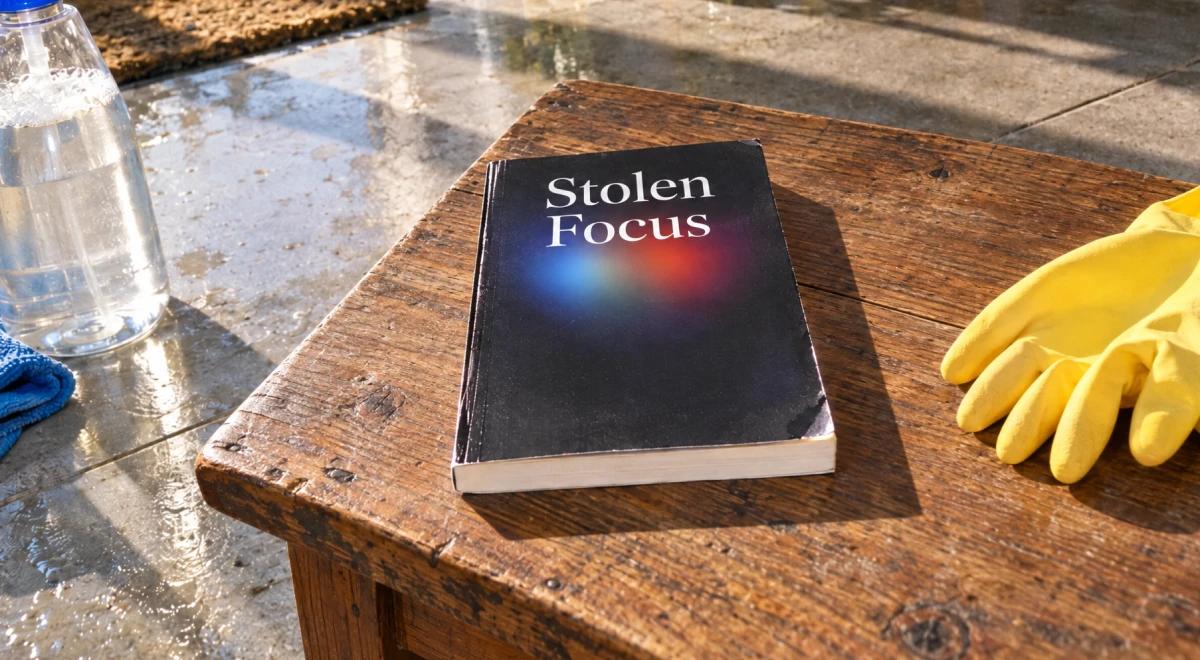

In 2004, a UC Irvine researcher measured how long office workers stayed on one screen before switching. Back then, it was 2.5 minutes. Her most recent measurements put that number at 47 seconds.
'Stolen Focus' is the term Johann Hari uses to describe exactly what's happening to all of us. His 2022 book argues that losing your ability to pay attention isn't a personal failing.
This 'Stolen Focus' review breaks down what the book argues, where it holds up, and where four other titles (including Cal Newport's 'Deep Work' and Susan Cain's 'Quiet') can round out the picture.
If you want the short version before committing to a book that runs a little over 350 pages, Headway's 'Stolen Focus' summary turns Hari's research into a 15-minute read or listen.
Get started with the Headway app and see how it fits into your day!
Quick summary: What 'Stolen Focus' argues
This review covers the 'Stolen Focus' main ideas below, plus the 'Stolen Focus' key takeaways worth remembering before we get into the full breakdown.
'Stolen Focus' argues attention loss comes from external forces, not weak willpower.
Johann Hari identifies twelve separate causes, from screen design to sleep deprivation.
Office workers' screen attention has dropped from two and a half minutes to under a minute.
The book pairs interviews with tech insiders with Hari's own three-month digital detox.
Headway's summary, plus four related titles like 'Deep Work' and 'Flow', turn these ideas into daily habits.
Keep reading for the full breakdown, the science behind it, and five practical exercises you can try today.
What 'Stolen Focus' is about
'Stolen Focus: Why You Can't Pay Attention—and How to Think Deeply Again' is Johann Hari's 2022 book, and it opens with an admission: Hari couldn't concentrate anymore, even on things he loved.
So he did what any obsessive journalist would do. He booked three months in Provincetown, Cape Cod, with no phone and no internet, just to see what his own brain would do without constant interruption.
That digital detox is the launchpad for the rest of the book. Hari traveled on to interview neuroscientists, former Silicon Valley insiders, and people affected by pollution, poor sleep, and overwork.
He's written this way before. His earlier books, 'Chasing the Scream' and 'Lost Connections', follow the same formula: take a subject everyone thinks they understand, like addiction or depression, and rebuild it from the ground up through reporting instead of guesswork.
The central reframe of 'Stolen Focus' is simple to state but hard to accept: your attention is not weak. It's being taken. As Hari writes elsewhere in the book, "You don't get what you don't fight for," and that line reframes twelve chapters' worth of evidence about social media, big tech, and the modern attention economy.
📘 Test which attention hacks actually work with Headway!

The 12 causes behind the attention crisis, according to Hari
Hari doesn't blame any single culprit. Instead, he lays out twelve overlapping causes that add up to what he calls the attention crisis, and these 'Stolen Focus' 12 causes are the backbone of the entire book.
The increase in speed, switching, and filtering, which trains your brain to expect novelty every few seconds.
The crippling of flow state, since deep focus needs long, uninterrupted stretches that rarely happen anymore.
The rise of physical and mental exhaustion, including sleep deprivation, which leaves little energy left for sustained reading.
The collapse of sustained reading, replaced by skimming headlines and short posts.
The disruption of mind-wandering, the daydreaming your brain uses to solve problems in the background.
The rise of technology that can track and manipulate you, built around engagement and the dopamine and attention span connection baked into every notification. Hari gives this addictive technology two full chapters.
Cruel optimism, a phrase Hari borrows to describe how burnout culture promises rest while demanding more.
A surge in stress that keeps your brain on constant alert, since a nervous system stuck in vigilance mode struggles to settle into anything.
Deteriorating diets, heavy in processed food and light on the nutrients attention actually needs.
Rising pollution, which Hari links to measurable drops in children's cognitive performance.
The rise of ADHD diagnoses, a chapter Hari has said was the hardest one in the book to write.
The confinement of children indoors, cutting off the free, unstructured play that helps build a lasting ability to focus.
Reading through this list, you start to see why fixing your own habits alone rarely works. Multitasking, TikTok, and phone addiction are symptoms of a system built for fragmentation, not proof that you lack self-control, and the link between social media and attention span shows up in nearly every one of these twelve causes.
How bad has our attention span gotten
You've probably heard the claim that human attention span has dropped significantly over the past decade.
What's actually happening is more specific. Your ability to sustain single-tasked focus keeps getting interrupted by phone addiction, social media, and workplace pressure to multitask. But screen time alone doesn't tell the whole story either.
A teenager scrolling TikTok for two hours and a parent checking work email every ten minutes are both losing focus, just through different digital distraction patterns. The research on multitasking and focus backs this up: switching tasks costs more time than it saves, no matter how efficient it feels in the moment.
Rising ADHD diagnoses over the last two decades add another layer, and it's one of the twelve causes Hari takes on directly, in what he's said was the hardest chapter of the book to write. He doesn't claim modern life causes ADHD, but he does argue that an environment built to fragment attention makes it harder for anyone, diagnosed or not, to concentrate.
📘 Get science-backed focus tips from real books on Headway!
'Stolen Focus' vs 'Deep Work' vs 'Digital Minimalism': How the arguments compare
If you're trying to pick one book on attention, here's how the three most-recommended titles actually differ in what they argue and who they're for.
Book | Core argument | Best for |
'Stolen Focus' | Attention loss is a systemic, designed problem | Readers who want the reasons behind distraction |
'Deep Work' | Individual practice can rebuild the capacity to concentrate | Readers who want a personal method |
'Digital Minimalism' | Deliberate, selective technology use restores time and attention | Readers who want a step-by-step detox plan |
The 'Stolen Focus' vs 'Deep Work' comparison comes up constantly because the two books answer different questions. Hari explains why your focus keeps getting stolen.
Cal Newport explains what to do about it once you accept the reasons. Reading both isn't overkill. It's actually the most complete approach if you want the full picture.
Is 'Stolen Focus' worth reading?
With 'Stolen Focus' explained across all 12 chapters, here's the answer to the question everyone lands on: is 'Stolen Focus' worth reading? Below is a fair read on what works and what doesn't, based on the book itself and the wider conversation around it.
Reasons it's worth reading:
The reporting style is accessible, without the dry, academic tone some books in this space fall into.
Hari's own three-month digital detox gives the book a personal stake most attention-crisis books skip.
It connects dots (sleep, pollution, diet) that most focus books never mention in the same chapter.
It reads more like investigative journalism than a self-help checklist, which keeps you engaged.
Fair criticism to know about:
Psychologist Stuart Ritchie has argued that several of the studies Hari leans on are thinner than the book makes them sound.
Some reviewers note the twelve causes aren't fully distinct chapters. Cause Six gets split across two chapters, and diet and pollution are grouped together, which makes the list feel a bit padded.
His proposed fixes, like restricting surveillance capitalism, raise real questions about how that would work in practice.
Anyone hunting for stolen focus quotes to share tends to land on the same line from early in the book, the one about attention being taken rather than lost.
If fiction is more your speed, Gabrielle Zevin's 'Tomorrow, and Tomorrow, and Tomorrow' explores a similar tension between craft, attention, and technology through a story about video game designers. It pairs surprisingly well with Hari's nonfiction argument.



Practical ways to reclaim your focus, based on 'Stolen Focus' and four related reads
Reading about the attention crisis won't fix it by itself. Headway's book summaries turn these stolen focus solutions into small, repeatable exercises you can actually use this week, whatever your goal looks like: deep focus techniques for work, or simply a way to stop getting distracted every ten minutes.
If you want to know how to get your focus back without overhauling your whole life, start with just one of the five below. And if you're searching for books like Stolen Focus, the four we'd recommend are 'Deep Work', 'Flow', 'Quiet', and 'Think Again'.
Protect one block of undistracted time, based on 'Stolen Focus'
Hari points to Perpetual Guardian, a New Zealand company that trialed a four-day week for full pay and saw employees report less distraction, along with similar experiments at places like Kellogg's and Microsoft.
Block one 90-minute window this week with your phone in another room, then compare how the work feels against a normal, interrupted session.
Build a ritual before entering focused work, based on 'Deep Work' by Cal Newport
Cal Newport frames deep work as a trained capacity, not a fixed trait you either have or don't. Pick one consistent cue, the same chair, the same drink, a five-minute warm-up, and use it before every focus block for a week straight.
Design tasks that stretch your skill just enough, based on 'Flow' by Mihaly Csikszentmihalyi
Flow states show up when a task's difficulty closely matches your current skill level, neither bored nor overwhelmed. Before you start a task, rate its difficulty against your ability on a scale from one to five, then adjust the scope until it lands close to a four.
Give your mind permission to slow down, based on 'Quiet' by Susan Cain
Cain's research on introversion points out how constant stimulation drains the reserves that clear thinking requires. Schedule 15 minutes of total quiet, no input of any kind, right before a task that needs your sharpest thinking.
Question your own first reaction to distraction, based on 'Think Again' by Adam Grant
Adam Grant's work on rethinking suggests our habits, like reaching for a phone, often go unexamined simply because they're automatic. Every time you reach for a screen out of habit, pause and name the trigger out loud before deciding if you'll act on it.
If habit-stacking small routines like these sounds familiar, it's worth checking out our review of 'Atomic Habits' by James Clear, which breaks down the mechanics behind why tiny, repeated actions stick better than big overhauls.
📘 Turn these five books into daily habits with Headway!
A simple weekly routine to rebuild sustained attention
If how to stop getting distracted is the actual question behind all of this, pulling the five tips above into one routine makes them easier to keep up with than trying to remember them separately.
Morning: Pick one 90-minute focus block and keep your phone in another room, based on Hari's undistracted-time exercise.
Midday: Rate your next task's difficulty against your skill level, then adjust it toward Csikszentmihalyi's flow zone.
Evening: Take 15 minutes of total quiet before your hardest remaining task of the day, drawing on Cain's research.
Weekly: Pick one habit you reach for out of pure automatic reflex and name the trigger every time it happens, per Grant's advice, then close the week with one Headway summary to keep the ideas fresh.
This kind of structured routine matters more than most people expect. Constant screen fragmentation and rising rates of phone addiction have real effects on kids too. Our review of 'The Anxious Generation' covers how the same forces Hari describes for adults are showing up even earlier in children's development, which is worth knowing if you're raising kids in the middle of all this.
It's also worth naming what Hari pushes for beyond personal routines. He spends real time on the idea of a collective attention rebellion, framing it as part of a much larger war on distraction that individual fixes alone can't win against companies whose entire business model depends on holding your attention.
Some of that same persuasion machinery, the funnels and hooks built to keep people clicking, gets a much more direct, practical treatment in our breakdown of 'DotCom Secrets'. It's worth a look if you want to see the attention economy from the marketer's side of the screen.
Why Headway works for building focus back into your day
Reading 'Stolen Focus' cover to cover is one option. Fitting its ideas into a life that's already full is a different problem, and it's the one Headway is actually built to solve.
Every summary comes in both audio and text, so you can read on a break or listen while you're doing dishes or walking the dog. Your personalized growth plan surfaces the right summaries based on what you're working on right now, be it focus, sleep, or something else entirely.
Spaced repetition and highlights bring key ideas from 'Stolen Focus' back around after you finish, instead of letting them fade the way most books do.
Offline mode means a summary is ready even without signal, and CarPlay and Android Auto support turns a commute into a chance to hear Newport, Cain, Csikszentmihalyi, or Grant instead of the radio. Daily streaks keep the whole thing consistent without feeling like one more chore on your list.
📘 Try a 15-minute summary and feel the fix with Headway!

Put 'Stolen Focus' into practice with Headway
Johann Hari's case is a hard one to argue with once you've read through all twelve causes. Attention loss isn't a character flaw you need to fix through sheer willpower. It's the predictable result of phones, algorithms, and workplaces all built to compete for the same limited resource, your focus.
Every exercise in this piece answers the same underlying question in a different way: how to concentrate better without white-knuckling it through willpower alone, and how to reclaim our focus one small routine at a time.
That's where Headway fits into the picture. Fifteen-minute summaries in audio or text, personalized recommendations based on your goals, spaced repetition to keep ideas from fading, and daily streaks that build the same kind of consistency Hari argues we've all lost. It's built for exactly the kind of fragmented day the book describes.
Download the Headway app and start with the summary of 'Stolen Focus' today. Fifteen minutes is enough to see if the ideas click.
FAQs about 'Stolen Focus'
What is 'Stolen Focus' by Johann Hari about?
This stolen focus Johann Hari overview covers a 2022 book arguing that attention loss comes from twelve external forces, not personal weakness. Hari combines his own three-month digital detox with interviews across neuroscience, tech, and public health. The stolen focus why we can't pay attention argument boils down to one idea: your attention is being taken, not lost, through a designed, systemic problem rather than a willpower failure.
Is there a 'Stolen Focus' PDF or audiobook available, and what about a chapter summary?
Yes, the Stolen Focus PDF and ebook editions are available through major retailers and libraries, and the Stolen Focus audiobook is narrated by Johann Hari himself, which fits well with the book's own argument about reclaiming time for sustained reading and listening. For a stolen focus chapter summary that's faster than either, Headway's own summary condenses all twelve chapters into a 15-minute read or listen.
What does Johann Hari recommend beyond personal habit changes?
Hari argues individual fixes only go so far against companies whose business model depends on holding your attention. He calls for a broader attention rebellion, including regulation of surveillance capitalism, restrictions on tracking children, and structural changes like shorter workweeks. The stolen focus how to improve focus advice in the book still covers personal habits, but Hari is clear that willpower alone can't outmatch designed systems.
What is the main stolen focus criticism from scientists?
Psychologist Stuart Ritchie has argued that several studies Hari cites are weaker than the book suggests, especially ones tied to smartphone use and distraction. Other reviewers point out the twelve causes aren't twelve fully separate chapters. One is split into two parts, and two others share a single chapter. Most critics still credit the reporting on tech design and its effects on focus.
How many pages is 'Stolen Focus' and how long does it take to read?
The print edition runs a little over 350 pages across twelve chapters plus a conclusion, which typically takes six to eight hours to read at a normal pace. The audiobook, narrated by Hari himself, runs a bit over 10 hours. If your schedule doesn't have room for either, Headway's summary covers the main arguments in about 15 minutes.
Is 'Stolen Focus' based on science or personal opinion?
It's a mix of investigative journalism and interviews with actual researchers, not a peer-reviewed study itself. Hari cites studies throughout but also draws heavily on personal experience and expert interviews to build his argument. Readers looking for a purely academic treatment may want to pair it with more research-heavy books like 'Deep Work.'
What is the "attention rebellion" Johann Hari talks about?
The attention rebellion is Hari's term for collective pushback against systems designed to fragment focus, rather than individual discipline alone. He argues real change requires regulation of tech companies, protection for children's unstructured play, and workplace reform, alongside personal habits like protecting undistracted time and improving sleep. It's less a single action and more a shift in how we treat attention as something worth defending.
Is 'Stolen Focus' worth reading in 2026?
Yes, if you want the reasoning behind why focus feels harder than it used to. The core arguments about social media, sleep, and tech design haven't gone stale. Pair it with 'Deep Work' if you also want a practical method, since Hari's book explains the problem in more depth than it prescribes solutions.